How to Architect AI: What the ThinkAI Symposium Revealed About the Future of Work, Trust, and Visibility
By Barbara Rozgonyi, keynote speaker, AI + PR visibility strategist, and founder of WiredPRWorks and Brighter Presence
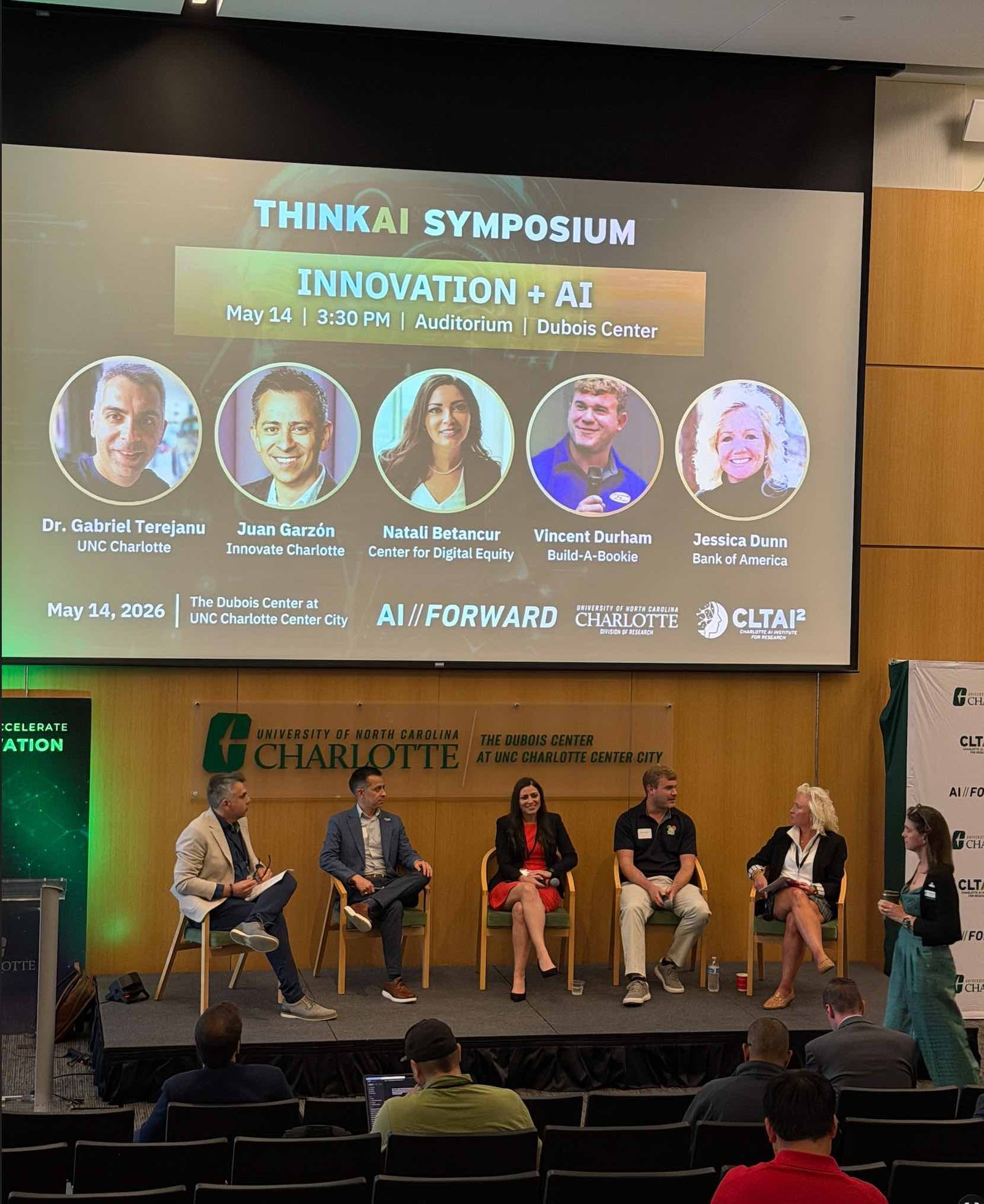
ThinkAI Research & Innovation Symposium | May 14, 2026 | The Dubois Center at UNC Charlotte Center City
Presented by UNC Charlotte’s Charlotte AI Institute for Research and AIFORWARD
Walking into the ThinkAI Research & Innovation Symposium in Charlotte, one thing became clear fast: this was not a room full of people wondering whether AI matters anymore. It was a room full of leaders trying to figure out how fast to move, what to trust, and where humans still create real differentiation.
That matters because Charlotte’s AI scene is no longer theoretical. It is becoming operational, regional, and increasingly relevant to business leaders, communicators, and anyone whose work depends on trust.
I went as a strategic observer, a translator, and a visibility strategist looking at the human side of the AI equation: trust, leadership, creativity, communication, adoption, and reputation. From that lens, the biggest story of the day was not just about AI tools. It was about what happens when technology accelerates faster than culture, governance, and communication can keep up.
One of the strongest takeaways came from Sakib Kadak, Creator and Director of AIFORWARD and Founder and CEO of Axiom Path. He offered a four-step way to think about AI maturity:
- Tool User.
- Workflow Integrator.
- Orchestrator.
- AI Systems Architect.
That framework is useful because it shows why so many leaders feel busy with AI but not yet better because of it. Plenty of people are still at the tool stage while assuming they are transforming the business. They are prompting, testing, and experimenting, but they have not yet made the deeper shift into orchestration, judgment, governance, and systems thinking.
Another signal came from the rooms themselves. The cybersecurity session was one of the most crowded, which tells you a lot about where organizational anxiety is rising. When the room that feels most urgent is the one about risk, security, and exposure, that is not just a technical trend. It is a reputation trend.
That is one reason public relations matters even more now. In a world flooded with synthetic content, competent content is no longer the differentiator; clarity, credibility, and recognizable human perspective are. When everyone can generate something decent, the people who stand out are the ones who bring discernment, voice, and trust.
The creative industries panel reinforced that point. Instead of treating AI like a magic creativity machine, the conversation centered on the tension between efficiency and originality. That matters for every leader and communicator trying to stay distinctive in a crowded market.
The closing innovation session added another grounded reminder: not every growth strategy has to be flashy to be effective. One example that stood out was Vincent Durham, who talked about walking the Rail Trail, meeting local businesses, and showing them how a website, app, or SEO solution could support revenue. That is a reminder that real-world adoption still starts with human conversation, relevance, and trust.
For me, that’s where visibility and AI intersect most clearly. Visibility isn’t about being louder. It is about being legible. It’s about helping people understand what you do, why it matters, and why they should trust you to guide them through complexity.
ThinkAI is presented by AIFORWARD and UNC Charlotte / Charlotte AI Institute (CLTAI2)
ThinkAI Speakers and sessions
Welcome
Opening Keynote
Driving AI Forward
AI in Retail + Health
AI + Cybersecurity
AI Workforce Readiness
AI in Creative Industries
The State of AI Agents
Unlocking Insights With Amazon Quick & Rapid Prototyping
Building in the Age of AI: Efficiency & Agentic Workflows
Sports Analytics + AI
- Dr. Michael Schuckers — Professor, Sports Analytics and Data Science, UNC Charlotte
- Eric Eager, Ph.D. — VP, Football Analytics, Carolina Panthers
- Eddie Mitchell, Ph.D. — VP, Artificial Intelligence, Joe Gibbs Human Performance Institute
- Udit Ranasaria — Director, Deep Learning Research, SūmerSports
AI in Human Capital Development
- Dr. George Banks — Co-Director, Center for Leadership Science + Charlotte AI Institute, UNC Charlotte
- Dr. Paul Gaggl — Associate Professor, Economics + Director, MS Economics Program, UNC Charlotte
- Andy Loignon, Ph.D. — Senior Research Scientist, Center for Creative Leadership
- Cheryl Flink, Ph.D. — SVP, Director of Research, Truist Leadership Institute
- Curtis Pollard, Ph.D. — Partner, Honeywell
Ethics in AI: From the Workplace to the Classroom
Innovation + AI
AI in Advanced Manufacturing
- Dr. Jose Outeiro — Professor, Advanced and Sustainable Manufacturing, UNC Charlotte
- Dr. Alejandro Astudillo — VP, Product Research, Trener Robotics
- Dr. Michael Gomez — Director, Manufacturing Research + Technology, MSC Industrial Supply Co.
- Dr. Sudhir Rajagopalan — Senior Research + Development Project Manager, Siemens
- Dr. Noel Greis — Research Professor, Digital Engineering and Advanced Manufacturing, UNC Charlotte
- Dr. Mahmoud Dinar — Assistant Professor, AI/ML in Manufacturing, UNC Charlotte
AI in Biomedical
- Dr. Daniel Janies — Distinguished Professor, Bioinformatics and Genomics, UNC Charlotte
- Colby Ford, Ph.D. — Owner + Principal Consultant, Tuple, The Cloud Genomics Company
- Rick Chakra, Ph.D. — Founder + CEO, Armada IQ
- Dr. Denis Jacob Machado — Assistant Professor, Bioinformatics and Genomics, UNC Charlotte
- Dr. Andrew McWilliams — Clinical AI Product Development, Advocate Health
IRL takeaways
- Audit where your team really sits: Tool User, Workflow Integrator, Orchestrator, or AI Systems Architect.
- Treat AI adoption as a leadership and communication challenge, not only a technology rollout.
- Build governance before scale.
- Sharpen human differentiation now.
- Focus on usefulness over hype.
One more note, because disclosure matters: I attended on a complimentary pass from the organizers, and I used AI to help organize and polish my event notes into this article while keeping the observations, interpretations, and editorial direction my own. In the AI era, trust grows when we show our work.
I left ThinkAI thinking the biggest opportunity ahead doesn’t belong only to the people building the tools. It also belongs to the people who can explain what those tools mean for humans, leadership, trust, and visibility. The technical experts will keep showing us what AI can do. The rest of us have important work to do, making sure people can still see clearly, choose wisely, lead well, and stay human.
FAQ
What is ThinkAI?
ThinkAI Research & Innovation Symposium is an AI-focused event in Charlotte that brings together researchers, business leaders, and practitioners to discuss AI trends, applications, and responsible adoption.
Why does AI trust matter so much now?
Because AI is making it easier to create content, automate tasks, and scale output. That makes credibility, transparency, and human judgment even more important for leaders and brands.
What was the biggest takeaway from the event?
The biggest takeaway was that AI adoption is no longer just a technology issue. It is a leadership, communication, and trust issue.
About Barbara Rozgonyi
Barbara Rozgonyi is a keynote speaker, AI + PR visibility strategist, founder of WiredPRWorks and Brighter Presence, and a longtime advocate for human-centered visibility in a digital-first world. She helps leaders turn visibility into velocity through strategic messaging, authority-building, and trust-centered thought leadership. Book Barbara Rozgonyi when you need an AI Keynote Speaker.