AI Personalization in customer experience is now the baseline for how modern brands engage customers. Today’s users expect relevance in every interaction, and AI enables this at scale using behavioral and contextual data in real time. The impact is clear. By 2026, Gartner predicts that 40% of enterprise applications will embed AI agents. This signals how deeply AI is becoming integrated into customer experience systems.
But adoption has outpaced accountability. Many CX teams invest in AI without clearly tying it to business outcomes. Measuring ROI is complex because AI influences both hard metrics, such as revenue and efficiency, and softer outcomes, such as satisfaction and loyalty.
This makes ROI measurement critical. In this guide, we break down frameworks, key metrics, challenges, and best practices, along with real-world examples, including how platforms like Insider One connect personalization to measurable growth.
What is AI Personalization in Customer Experience?
AI personalization in customer experience refers to the use of machine learning and real-time data to tailor every interaction based on an individual customer’s behavior, intent, and context. Instead of relying only on past actions, AI systems analyze browsing patterns, purchase history, and live signals to predict what a customer is likely to need next and deliver it instantly.
This is a clear shift from traditional personalization. Earlier behavioral segmentation approaches were rule-based and static. Marketers defined segments manually and pushed the same experience to everyone within that group. AI changes this by enabling dynamic, continuously evolving personalization. It creates micro-segments in real time and adapts content, offers, and journeys as customer behavior changes.
At a practical level, this shows up in three ways.
- Predictive recommendations anticipate what a customer is likely to buy or engage with next.
- Real-time segmentation groups users dynamically based on their live behavior rather than fixed attributes.
- Dynamic messaging adjusts content, timing, and channel automatically to maximize relevance and response.
For example, a retail brand using Insider One can surface product recommendations based on in-session behavior. A telecom brand can identify early churn signals and trigger predictive re-engagement campaigns before the customer drops off. Instead of reacting to customer actions, AI personalization enables brands to act ahead of them, turning every interaction into a high-probability conversion opportunity.
Why Measuring ROI Matters
AI personalization promises better engagement, higher conversions, and stronger retention. But without clear ROI measurement, these benefits remain assumptions. For CX leaders managing budgets and growth targets, that’s risky. If you can’t quantify impact, AI personalization stays an experimental investment instead of a proven growth driver.
Here’s what effective ROI measurement actually helps you unlock:
- Conversion uplift: AI-driven recommendations and real-time experiences increase the likelihood of purchase by aligning offers with immediate intent.
- Customer lifetime value (CLV) growth: Personalized journeys drive repeat purchases and deeper engagement, extending long-term revenue per customer.
- Retention and churn reduction: Predictive models identify at-risk users early, enabling timely interventions that improve retention rates.
- Operational efficiency: Automation reduces manual segmentation, campaign setup time, and optimization effort, lowering overall marketing costs.
- End-to-end visibility: Measurement connects individual campaign performance to broader business outcomes like revenue and profitability.
Measuring ROI turns AI personalization from a nice-to-have into a predictable growth lever. It helps teams double down on what works, eliminate waste, and confidently scale strategies that drive real business impact.
Real-World Case Study Examples
AI personalization delivers measurable impact only when it’s tied to real customer journeys. Across industries, brands are using it to drive revenue, retention, and efficiency at scale.
Retail and E-commerce
AI personalization is most visible in product discovery and conversion moments. Brands use predictive recommendations and cart abandonment journeys to recover lost revenue and increase basket size.
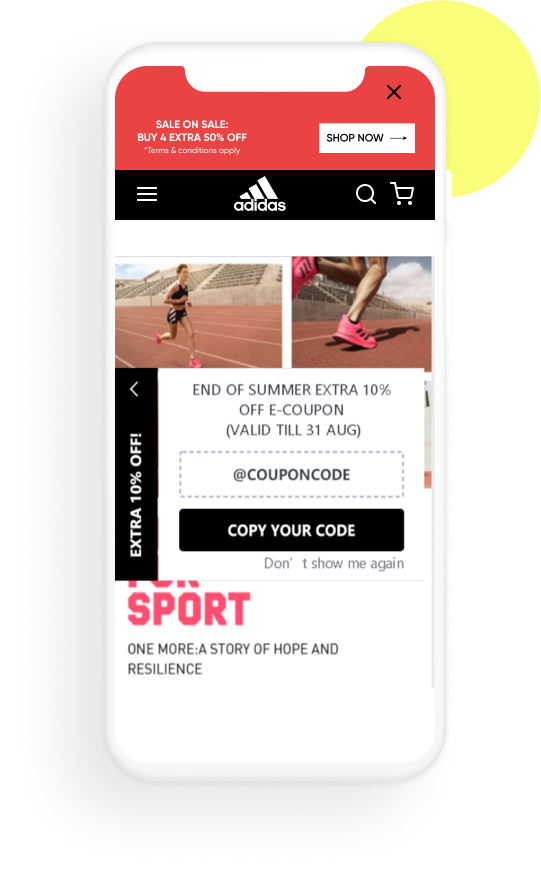
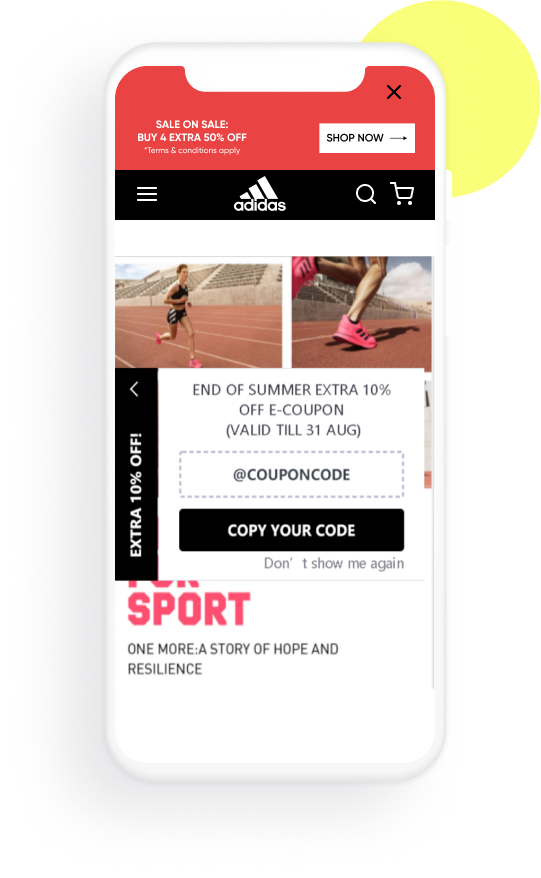
For example, Adidas implemented Insider One’s AI-powered recommendation engine to deliver real-time product suggestions across the web and app. The result was a 259% increase in average order value and a significant lift in conversion rates.
Travel and Hospitality
In travel, personalization is driven by intent signals like search behavior, location, and trip context. AI enables brands to deliver tailored itineraries, pricing, and offers in real time.
Travel brands using Insider One apply predictive segmentation to trigger personalized offers when users show booking intent. This leads to double-digit improvements in booking conversions and engagement, especially when campaigns are timed to high-intent moments.
Finance and Banking
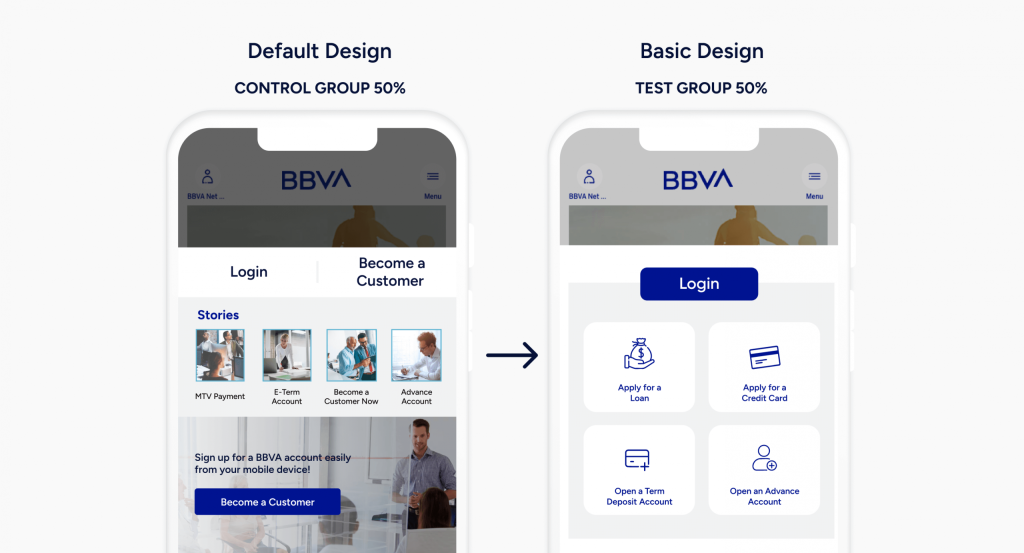
Financial institutions use AI personalization to recommend products, improve onboarding, and drive engagement while maintaining compliance. For instance, BBVA used Insider One’s advanced segmentation and personalization capabilities to drive a 192% boost in mobile credit card sign-ups and a 502% increase in loan applications.
Telecom and Media
Media and telecom platforms focus on engagement, content relevance, and retention. Euronews used Insider One to deliver personalized content recommendations and real-time audience journeys across web and app. By triggering contextual push notifications at high-intent moments, the brand achieved a 12% increase in app push opt-ins within two months, alongside large-scale personalization across millions of users.
Across industries, the pattern is consistent. AI personalization drives measurable gains when it’s applied to high-intent moments across the customer journey. The brands that win are the ones that connect these interventions to clear business outcomes like revenue, retention, and efficiency.
Challenges in Measuring AI Personalization ROI
AI personalization promises measurable impact, but most teams struggle to prove it. The challenge usually lies in connecting personalization efforts to clear, defensible business outcomes. Here’s where things typically break:
- Fragmented data across channels: Customer data lives in silos, across web analytics, CRM, app events, email platforms, and offline systems. This makes it difficult to build a unified view of the customer journey. Without that, personalization signals stay incomplete, and ROI attribution becomes guesswork.
- Attribution complexity across touchpoints: AI personalization works across multiple interactions, including recommendations, push notifications, emails, and in-app messages. A single conversion may be influenced by several of these touchpoints. Most teams rely on last-click or channel-level attribution, which undervalues personalization’s cumulative impact.
- Compliance and privacy constraints: With evolving regulations like GDPR and stricter consent frameworks, access to customer data is more controlled. This limits tracking, reduces signal availability, and makes it harder to measure long-term impact without violating privacy standards.
This is where platforms like Insider One change the equation, without adding more complexity. By unifying customer data into a single view, they enable consistent personalization across channels while preserving data integrity. Their approach to journey orchestration helps map how different touchpoints contribute to outcomes, improving attribution clarity. At the same time, built-in compliance frameworks ensure that personalization and measurement operate within evolving privacy standards. The result is a more reliable measurement. Teams move from fragmented insights to a clearer understanding of what actually drives growth.
Key Metrics to Measure ROI
AI personalization should be measured based on incremental impact, not just overall performance. The goal is to isolate what AI actually contributes to revenue, retention, and efficiency, typically through A/B testing or controlled experiments.

Here are the core KPIs CX and growth teams should track:
- Conversion rate uplift measures the incremental impact of personalization on conversions.
Formula: Conversion Uplift (%) = ((Variant Conversion Rate − Control Conversion Rate) ÷ Control Conversion Rate) × 100
Example: Control = 2%, Variant = 2.6%, Uplift = 30%
- Average order value (AOV) tracks whether personalization increases basket size.
Formula: AOV = Total Revenue/Number of Orders
Example: $5,00,000/1,000 orders = $500. AOV of $600 means 20% lift.
- Customer lifetime value (CLV) captures long-term revenue impact from improved retention and repeat purchases.
Formula: CLV = Average Order Value × Purchase Frequency × Gross Margin × Customer Lifespan
Example: $1,000 × 5 × 40% × 3 years = $6,000 CLV
- Retention rate measures how well personalization keeps existing customers over a defined period.
Formula: Retention Rate (%) = ((Customers at End − New Customers)/Customers at Start) × 100
Example: Start = 1,000, End = 900, New = 200, Retention = 70%
- Churn reduction tracks how personalization reduces customer drop-off.
Formula: Churn Rate (%) = (Customers Lost/Total Customers) × 100
Example: Churn drops from 20% to 15%, which means a relative deduction of 25%.
- Engagement measures interaction with personalized content.
Formula: CTR (%) = (Clicks/Impressions) × 100
Example: 5,000 ÷ 1,00,000 = 5% CTR
- Operational cost savings capture efficiency gains from automation and reduced manual effort.
Formula: Cost Savings = (Previous Cost − New Cost) + Value of Time Saved
Example: $2,00,000 − $1,40,000 + $20,000 (time saved) = $80,000 total savings
These metrics work best when used together. Conversion and AOV show immediate gains. CLV and retention show long-term value. Cost savings show efficiency. When measured through controlled experiments, they give you a clear, defensible view of ROI from AI personalization.
Step-by-Step Framework for Measuring ROI
Measuring ROI from AI personalization gets easier when you treat it like a disciplined growth program. The most reliable approach is simple: define the business outcome, lock in a baseline, run controlled campaigns, measure incremental lift, and then optimize what actually moves revenue, retention, or efficiency.
Step 1: Define the Business Goal
Start with one commercial outcome instead of a vague objective like ‘improve experience.’ For most CX teams, that means increasing conversion rate, average order value, repeat purchase rate, retention, or reducing churn. This matters because personalization works across many touchpoints, so your measurement needs one primary KPI and a few supporting metrics.
Step 2: Establish a Clean Baseline
Before launching anything, document the current performance for the KPI you chose. Use a fixed lookback window and segment the audience clearly. Then create a control group. This is one of the most important parts of the process because you can’t isolate incremental impact without a pre-personalization baseline and a non-personalized comparison group.
Step 3: Deploy Campaigns with a Tight Experiment Design
Launch one or more AI-personalized journeys tied to a specific moment in the customer lifecycle, such as product discovery, cart recovery, onboarding, or churn prevention. Keep the audience, timing, and offer logic clean enough that you can tell what changed in performance. A good rule is to test one major personalization lever at a time, such as recommendations, dynamic content, or channel selection, instead of changing everything at once.
Step 4: Measure Lift Across Revenue, Retention, and Engagement
Now compare the personalized variant against the control. Look at immediate impact, such as conversion rate or AOV, and downstream impact, such as retention, repeat purchases, and revenue by channel.
Insider One’s reporting guidance is useful here because it emphasizes combining metrics instead of reading them in isolation. Its analytics stack includes real-time dashboards, funnel and flow analysis, retention cohorts, and reports covering conversions, revenue by channel, and incremental gains.
Step 5: Calculate ROI and Optimize Continuously
Once you have incremental lift, connect it to financial outcomes. Calculate incremental revenue, subtract the cost of the personalization initiative, and track efficiency gains such as lower campaign execution time or reduced tool sprawl. Then feed the findings back into your next test cycle. This is where unified systems help: Insider One’s omnichannel CDP brings data unification, activation, and analytics together, which reduces operational overhead and makes ongoing optimization and reporting much easier.
A practical way to implement this is to start small. Pick one high-intent use case, one KPI, and one control group. Prove lift there first. Then expand to more channels and lifecycle stages once the measurement model is stable. This is also where a platform like Insider One becomes useful without needing to become the story itself. Because it centralizes customer data and reporting, teams can monitor personalization performance in real time, compare channels in one place, and build unified reporting around conversions, retention, and incremental gains instead of stitching together dashboards by hand.
Best Practices to Maximize ROI
AI personalization drives results only when it’s operationalized across data, channels, and teams. Here are some best practices you can adopt.

- Unify customer data before scaling personalization: Ensure all behavioral, transactional, and channel data flows into a single customer view. Fragmented data leads to inconsistent experiences and weak attribution. Start with high-impact sources (web, app, CRM) and expand gradually.
- Orchestrate personalization across channels: Customers move between email, push, web, SMS, and ads. Your personalization should follow them. Align messaging and timing across channels to avoid duplication and maximize cumulative impact. Platforms like Insider One enable this through multi-channel journey orchestration.
- Run continuous experiments: Treat personalization as an ongoing testing program. Always have control vs. variant experiments running. Test one major variable at a time, like recommendations, timing, or messaging, to isolate what drives lift.
- Align teams on shared KPIs: Marketing, CRM, product, and data teams often track different metrics. Align on a common set, including conversion, CLV, retention, and ROI, to avoid fragmented reporting and conflicting decisions.
- Automate where possible, but validate outcomes: Use AI to automate segmentation, messaging, and optimization, but regularly audit performance. Automation without oversight can scale inefficiencies just as fast as it scales wins.
- Prioritize high-intent use cases first: Focus on moments that directly impact revenue, such as product discovery, cart abandonment, onboarding, and churn prevention. These deliver faster ROI and clearer measurement.
Now, let’s look at how platforms like Insider One help you measure the ROI of AI personalization in customer experience.
Measuring ROI with Insider One
In 2026, measuring ROI isn’t just about looking at a rearview mirror of data; it’s about leveraging a self-optimizing ecosystem. Insider One’s architecture (built on a single-platform DNA) removes the “integration tax” that plagues legacy stacks, allowing our Agentic AI to move from insight to incremental revenue autonomously.
1. Agentic ROI: From Analytics to Autonomy
While traditional platforms require marketers to manually analyze reports and adjust journeys, Insider One’s Sirius AI™ agents act on your behalf.
- Self-Optimizing Yield: Our agents don’t just report on Churn or AOV; they proactively re-allocate budget and message frequency in real-time to the channels with the highest predicted ROI.
- Autonomous A/B Testing: Sirius AI™ identifies underperforming variants and automatically promotes winning experiences, ensuring you never leave money on the table during a manual review cycle.
2. Future-Proof Connectivity via MCP Server
The Insider One MCP (Model Context Protocol) Server is Insider One’s most significant differentiator. It allows your ROI data to live wherever your strategy does.
- LLM Native Insights: By exposing our unified data layer via MCP, your internal AI agents or executive LLMs (like Gemini or GPT-4) can query Insider One directly. You can ask, “What was the incremental lift of our VIP segment across WhatsApp and Web last week?” and receive a verified, data-backed ROI analysis instantly.
- Contextual Interoperability: MCP ensures that the high-intent signals captured by Insider One are available to your entire AI stack, ensuring consistent personalization and measurement across even the most complex enterprise ecosystems.
3. The Power of “One”: Radical TCO Reduction
The biggest hidden driver of ROI is the elimination of “tool sprawl.” Insider One is a single, unified platform for data (CDP), orchestration, and delivery.
- Eliminate Data Latency: Because your CDP and delivery channels (WhatsApp, RCS, Web, App) are the same platform, there is zero latency. You capture ROI on “in-the-moment” behaviors that fragmented stacks miss.
- Unified Attribution Intelligence: Stop guessing which tool gets the credit. With one platform, you get a “Single Source of Truth” attribution model that tracks a customer from an anonymous web visit to a loyal, multi-channel advocate.
The Result: Metrics That Move
Brands leveraging the full Insider One 2026 suite are seeing a shift in their ROI profiles:
- 30% Reduction in Operational Costs: AI agents handle the manual labor of segmentation and journey building.
- 20% Incremental Revenue Lift: Driven by Agentic AI that identifies and captures “micro-moments” of intent across the MCP-connected ecosystem.
- Instant Time-to-Value: Go from integration to AI-driven ROI in days, not months, thanks to our native, one-platform approach.
FAQs
AI personalization in customer experience refers to using machine learning and real-time data to tailor interactions based on individual behavior, intent, and context. Unlike rule-based personalization, it continuously adapts experiences across channels to deliver more relevant messaging, recommendations, and journeys.
ROI is calculated by measuring the incremental revenue generated from personalized experiences compared to a control group, then subtracting the cost of implementation. The standard formula is = ((Incremental Revenue − Cost of Personalization)/Cost of Personalization) × 100.
The most important metrics include conversion rate uplift, average order value, customer lifetime value, retention rate, churn reduction, and engagement metrics like CTR. Together, these provide a complete view of both short-term revenue impact and long-term customer value.
Insider One helps prove ROI by unifying customer data, campaign execution, and analytics in one platform, making it easier to track performance across channels. Its dashboards, real-time reporting, and cross-channel attribution allow teams to connect personalization efforts directly to revenue, retention, and efficiency outcomes.