Conversion results in Ads Manager attributed to a click have historically included more layers than most advertisers understood. It led to confusion about what results meant. Thankfully, Meta is making an important change.
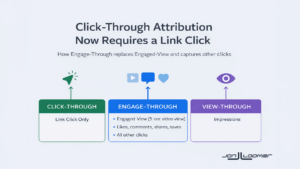
Click attribution will finally require a click on a link — no other clicks will be included. In addition to announcing this change today, “engaged-view” will be updated in name and substance to “engage-through.”
Here’s what you need to know…
The Change to Click-Through Attribution
Click-through attribution is how Meta gives credit for a conversion when someone converts after clicking an ad. While that may seem straight-forward, it’s not — and certainly wasn’t.
In fact, I misunderstood the underlying meaning for a decade. It wasn’t until I ran a test more than a year ago that I was able to confirm the truth behind click-through attribution: Meta counted a conversion when it happened following any click on your ad.
It didn’t need to be a click on a link. It could have been a like, share, comment, or other click. If someone clicked your ad and then converted within seven days, Meta counted it under click-through attribution.
I found this to be unnecessarily confusing, if not misleading. It was easy to assume that a link click would have been required. But part of the reason that this was easy to miss was that Meta’s old definition was vague.
Eventually, Meta updated the definition of click attribution to accurately reflect any click. But now, Meta is changing the definition of click attribution again.
“Going forward, we are changing the definition of click-through attribution for website and in-store conversions to exclusively include link clicks.”
This is good news. It should help align conversion results with expectations based on traffic driven from ads.
The New Engage-Through Attribution
Meta isn’t done making changes to attribution.
Conversions that resulted from reactions, comments, shares, saves, or other non-link click actions will be included in engaged-view attribution. To account for this change, Meta is renaming it “engage-through attribution.”
If you’re not familiar with the formerly named “engaged-view” attribution, it is part of the default attribution setting (7-day click, 1-day engaged-view, and 1-day view).
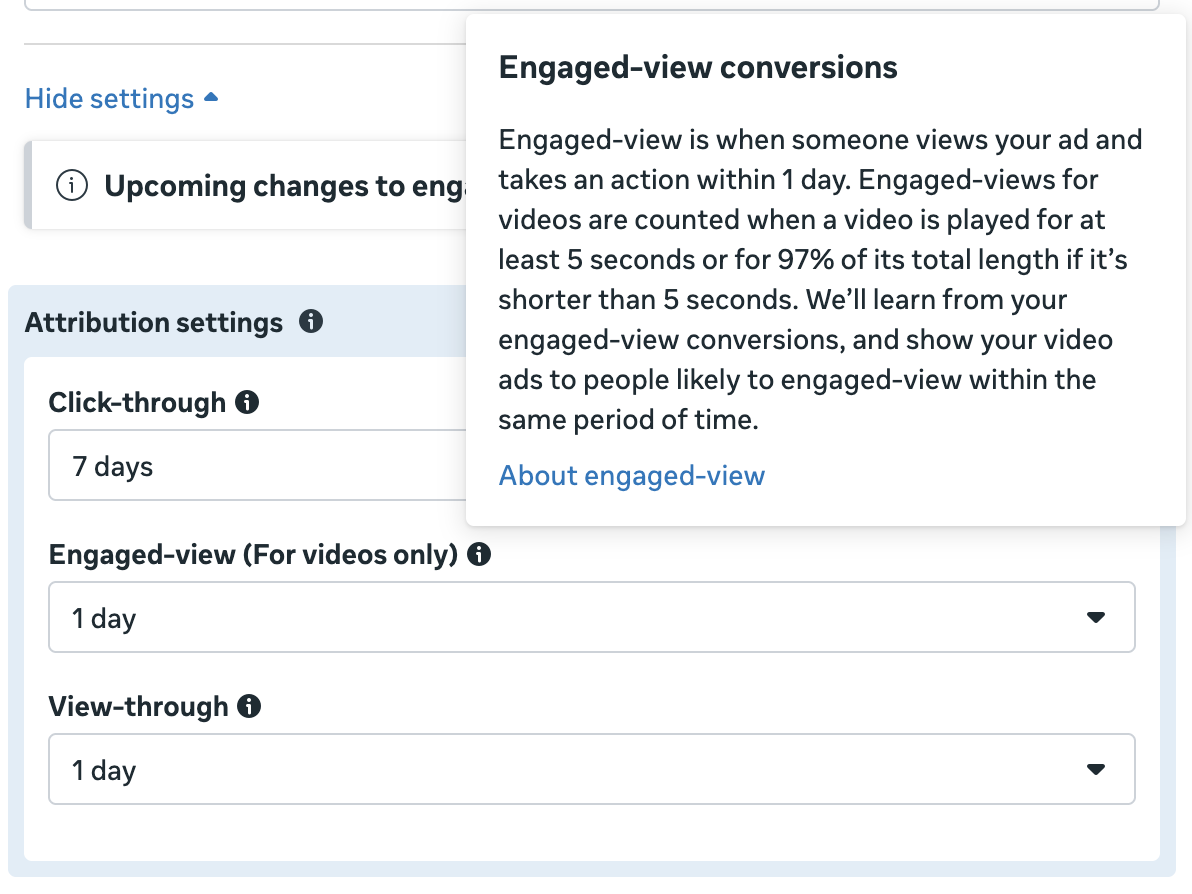
An engaged-view is counted when someone views your video for at least five seconds (formerly 10) and converts within a day. If the video is less than 5 seconds long, at least 97% of it needs to be watched.
So the new engage-through attribution will include the former engaged-view conversions, but also all conversions that resulted from clicks that weren’t link clicks. And unlike engaged-view, which applied only to videos, the new engage-through will apply to all formats.
What Are Link Clicks?
Some further clarification is required here about link clicks because it’s not quite as obvious as you may think.
Meta’s definition of link clicks includes clicks on links to websites. But it also includes several other clicks.
- Websites
- App stores or app deep links
- Click to call
- Click to message
- Maps/directions
- Shops
- Lead forms
- Marketplace
- Link clicks to Instagram profiles for ads promoting Instagram profile views
- Playable experiences
- Videos that launch the watch & browse experience
- Videos hosted by another website (including videos embedded in Feed ads but hosted on a video platform such as YouTube or Vimeo)
While this may seem like a long list of potential loopholes, these “other” link clicks should be exceedingly rare when using the Website conversion location and the performance goals to maximize the number or value of conversions. And that’s when limiting link clicks to those to an external website will be most important.
Still, it would have been better if Meta had gone all the way on this. Why not change the definition of click-through attribution to require a click to an outbound link?
Summary of Changes
Let’s simplify what happened…
1. Click-through attribution now requires a click on a link prior to a conversion.
2. Engage-through attribution replaces engaged-view.
3. Engage-through includes engaged-view and all other clicks that aren’t clicks on links.
Attribution is messy, so this remains somewhat complicated. But it’s a positive change.
Impact of Changes
In order to project the impact of changes, we’d first need to be able to isolate the conversions that were previously reported as click-through that would no longer qualify. Unfortunately, there’s no way to reliably do that.
But it may help to summarize what this behavior looks like. Someone would have clicked on your ad, but without clicking the CTA button or thumbnail if a static image link ad. The most likely types of clicks would have been a like, reaction, comment, share, save, or media expansion.
Of course, just clicking those things without clicking the link wouldn’t have been enough. They also would have needed to go to your website (via another method or later on) and convert within seven days. This behavior is similar to that of a view-through conversion, which is when it would be most common. And especially if you reach someone via a remarketing audience (intentionally or algorithmically) and they are driven to the conversion from another channel.
Will it happen? Yes. But how often is tough to say, and it is likely to happen more often when restricting your audience to remarketing. Especially since the default click-through attribution window is 7 days.
Something to remember is that some of these conversions will move to engage-through, but not all. If someone performed a click that now qualifies as engage-through and converts within 2-7 days, it will no longer be counted. Engage-through, like view-through, only has a 1-day window. You may lose some of those conversions.
My guess is that any impact on total results will be subtle, so most won’t notice it. You may be able to spot changes if you use the Compare Attribution Settings feature or Breakdown by Attribution to see how click-through and engage-through numbers evolve. But it may not be more than a loose correlation to these changes.
But it’s those who focus on remarketing strategies who are most likely to notice a difference. This is when view-through conversions often prop up results. This type of conversion that is moving to engage-through is very similar. And since you’ll lose the engage-through conversions that happened beyond the first day — which were previously reported under click-through — a drop is possible.
The other group of advertisers who may see an impact will be those who regularly turned off engaged-view, and now engage-through. They won’t have the safety net of some conversions moving from click-through to engage-through. They’ll just disappear entirely.
Your Turn
What do you think of this change?
Let me know in the comments below!
The post Click-Through Attribution Now Requires a Link Click appeared first on Jon Loomer Digital.