[ad_1]
Most eCommerce brands claim to personalize the customer experience, yet most still rely on static segments and rule-based campaigns.
That gap between what brands promise and what shoppers experience is where revenue slips away.
AI-powered personalization closes this gap by using live intent signals, behavioral patterns, and predictive intelligence to tailor every interaction in real time.
It anticipates the next action and clears friction before it shows up.
HP used Insider One’s personalization engine to deliver relevant product suggestions and targeted offers, even for anonymous visitors. This lift in real-time relevance helped the brand achieve an 11.64% conversion rate.
This guide breaks down how AI-driven personalization lifts conversions across key touchpoints, along with tools and best practices you must consider in 2025 and beyond.
What is AI personalization, and how does it work?
AI personalization uses artificial intelligence to tailor each user’s experience based on real-time behavior, intent signals, and contextual data. It moves beyond pre-set rules and treats every interaction as a fresh data point that can influence the next step in the journey.
AI-driven personalization does three things:
- Understands user behavior: AI interprets every micro-action (product views, scroll depth, dwell time, comparison activity, past purchases, and even hesitation at checkout) to understand what the shopper is likely trying to achieve.
- Predicts intent: Based on these signals, AI identifies the next best action the user is likely to take. This intent prediction becomes the engine behind every downstream decision.
- Personalizes the experience in real time: The AI agent then personalizes the user experience so that every touchpoint feels timely and relevant. It surfaces the next best product, message, offer, or support action, ensuring the entire journey stays context-aware.
For example, a shopper comparing two similar products might bounce between features, pricing, and reviews.
The AI agent interprets this as active evaluation and immediately adapts the experience by surfacing a comparison widget, highlighting a superior option, or presenting a relevant loyalty perk that supports the decision.
How AI personalization drives conversions
AI personalization increases conversions by making every step of the buying journey more timely, relevant, and easier to complete. It replaces guesswork with real-time evidence-based actions (strengthened by historical patterns) that push users toward the outcome they signal they want.
Here’s a deep dive:
- AI personalization shortens product discovery: The AI agent detects what a shopper is trying to find based on several factors, including recent product views, comparison loops, and filter behavior. It then personalizes the page layout in real time by prioritizing the most relevant categories, attributes, and product recommendations. This reduces unnecessary browsing and moves the shopper to a purchase-ready state much sooner.
- It increases engagement with high-intent content: When AI identifies a user who is researching deeply, it surfaces buying guides, size recommendations, price comparisons, or recently viewed items. These context-matched elements keep the shopper on-site longer, which results in more product views per session and a higher likelihood of adding items to the cart.
- It stabilizes the checkout journey: AI monitors friction signals like repeated clicks, long pauses, payment retries, or sudden backtracking. When these signals occur, it adapts instantly by offering guest checkout, alternative payment methods, or a reassurance message. These micro-interventions reduce drop-offs at the highest-value moment in the funnel.
- It increases the probability of conversion through targeted incentives: AI identifies which users respond to incentives and which do not. It triggers a personalised offer only when the customer’s behavior indicates that the purchase is at risk. This selective use of incentives lifts CVR without harming margin.
- It improves cart recovery outcomes: AI identifies why a customer abandoned a cart rather than just that they abandoned it. If price sensitivity caused the drop-off, the follow-up may include a limited-time discount. If stock uncertainty caused hesitation, the follow-up may include restock notifications or alternatives. This precision directly increases the recovery rate.
- It increases AOV through smarter product linking: AI identifies which products are most likely to be purchased together and introduces bundles, accessories, or upgrades at the correct moment.
- It optimizes campaign timing and channel selection automatically: Instead of sending the same message to everyone, AI identifies when each individual is most responsive across email, push, SMS, or WhatsApp. Messages land at the moment the user is most likely to act, which increases open rates, CTR, and on-site return visits.
Together, these mechanics translate AI personalization into measurable lifts in conversion rate, recovered revenue, AOV, and repeat purchase frequency.
The AI personalization landscape is crowded, but only a few platforms deliver real-time impact at scale.
These are the platforms worth considering if you want measurable lifts in conversions.
1. Insider One’s Agent One™
Agent One™ brings together three purpose-built AI experts that read customer behavior as it unfolds and shape the experience in the moment:
- Shopping Agent™: Anticipates intent and delivers context-aware product guidance that moves shoppers toward confident purchase decisions.
- Support Agent™: Resolves questions and friction points in real time with human-like empathy and autonomous actions.
- Insights Agent™: Monitors performance signals continuously and adjusts journeys to keep engagement and conversions on track.
Where Agent One™ stands apart is its ability to coordinate these agents around a single outcome.
For example:
- If a shopper hesitates at checkout, Shopping Agent™ steps in with clarity-building details based on real-time behavior and historical data like delivery times or return policies.
- If that hesitation turns into a question typed into chat, Support Agent™ takes over instantly and aims to resolve the concern.
- Meanwhile, Insights Agent™ captures the entire interaction, feeding the signals back into the journey so the next touchpoint (whether email, push, or onsite) is automatically optimized to recover the conversion.
This orchestration gives brands the ability to personalize every step at scale.
2. Braze
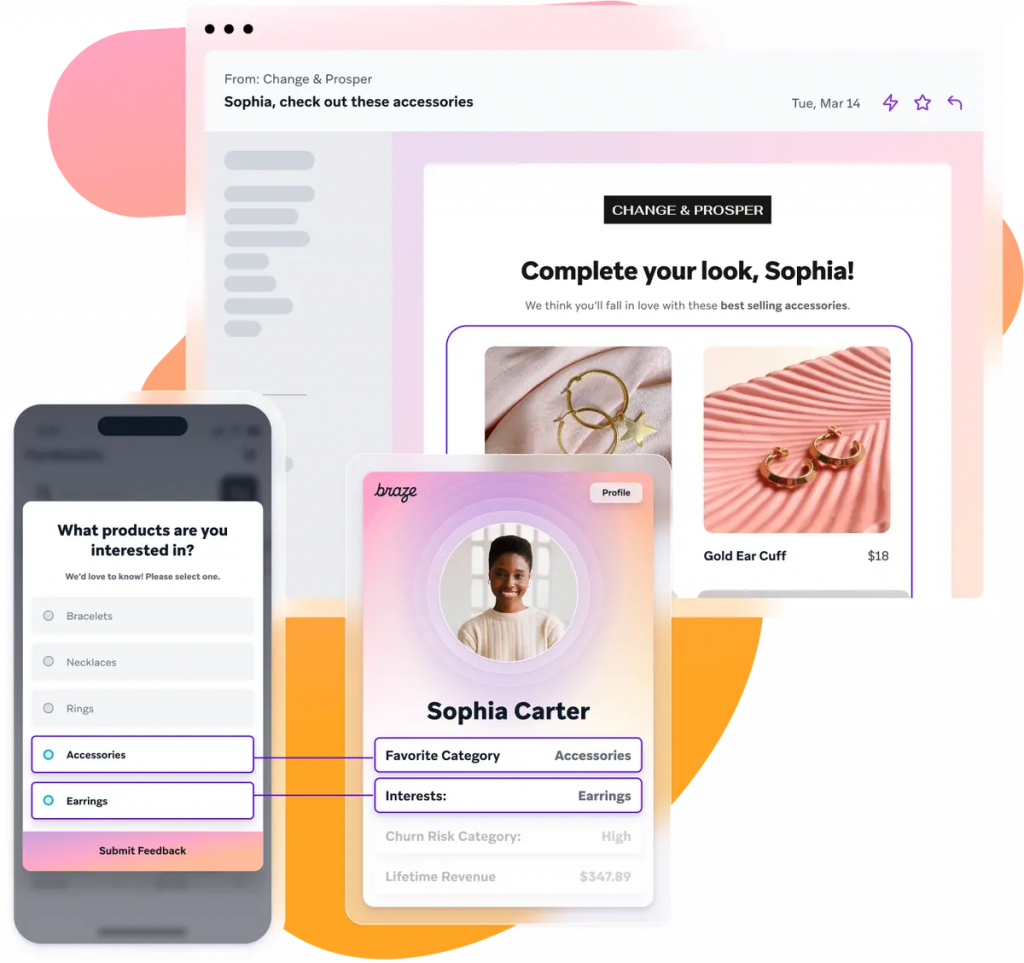
Braze is another great customer engagement platform built to personalize customer experience across several touchpoints, including email, mobile, web, and app using real-time data.
BrazeAI™ brings three standout capabilities:
- AI Item Recommendations that blend behavioral, transactional, and contextual data to surface genuinely relevant products or content.
- Personalized Paths that automatically adjust the channel, message, or offer for each individual based on predicted engagement.
- Intelligent Timing that sends every message at the moment each user is most likely to interact
On top of that, Braze Canvas gives teams a visual way to build and optimize journeys without writing code. You can layer predictions, dynamic content, and cross-channel logic in one workflow instead of managing fragmented automations across tools.
3. Salesforce Einstein
Salesforce Einstein brings in predictive, generative, and agentic AI directly into CRM workflows to personalize every touchpoint.
It sits inside the Customer 360 platform, where all your sales, service, marketing, and commerce data already lives. That gives its personalization engine full context: history, intent, channels, service cases, and purchase behavior.
Einstein’s AI stack includes three core layers:
- Einstein Prediction & Scoring: Identifies purchase likelihood, churn risk, and next-best actions grounded in real CRM data.
- Einstein Generative Content: Auto-writes emails, product messages, support replies, and campaign content enriched with customer and account details.
- Agentforce: A buildable AI copilot that handles tasks, reads CRM records, executes workflows, and powers conversational experiences for customers and employees.
It’s a personalization engine that wants AI woven into daily operations instead of running as a standalone marketing tool.
Best practices to drive more conversions with AI personalization
AI personalization delivers results only when the underlying execution is disciplined and grounded in real customer behavior.
Follow these best practices to make sure the AI agent works at its full potential:
- Connect the agent to your core systems: Integrate CDP, CRM, order management, inventory, pricing engines, and support platforms. When the agent has full visibility into stock, delivery timelines, and customer history, it can personalize with precision instead of guesswork.
- Define strict business guardrails: Set limits for discounting, frequency caps, product exclusions, margin protection, and brand guidelines. Guardrails ensure every intervention supports revenue and brand consistency rather than creating random “optimization wins.”
- Use next-best-action models for every decision point: Every touchpoint should be evaluated as: “What action increases the probability of conversion right now?” AI should decide whether to show social proof, an alternative product, a lower-risk variant, a reassurance message, or no intervention at all.
- Let the agent make micro-decisions: You control the journey architecture and commercial priorities. The agent handles real-time actions like when to recommend, when to reassure, and when to intervene. This keeps strategy human-led and execution machine-led.
- Train the agent with high-quality historical signals: Feed it past conversions, failed checkouts, return patterns, and purchase sequences. High-quality historical data helps the model understand what success looks like before it begins personalizing in the wild.
- Deploy personalization across channels: Let the AI agent view the entire customer journey across multiple channels. Web, app, email, WhatsApp, push, and support should all feed into one decisioning engine so users experience a unified story.
- Start with high-impact flows before expanding: Focus the agent on recovery, product discovery, and post-purchase support first. These areas produce the fastest revenue gains and give the model rich data for more advanced personalization later.
- Review agent decisions weekly using outcome-based reports: Instead of inspecting rules, evaluate outcomes: uplift in conversion rate, reduction in hesitation, lower abandonment, improved AOV. These insights show where the model is strong and where it needs adjustments.
For a deeper look at ecommerce personalization strategies → eCommerce Personalization Strategy: 2025 Guide.
Turn your customer journey into a revenue engine
The modern customer journey is too fragmented, too fast-changing, and too intent-driven for static rules and fixed segments to keep up.
Shoppers expect brands to understand what they need without forcing them through unnecessary steps, and they reward experiences that adapt in real time.
At Insider One, we’ve seen this firsthand.
Brands come to us with strong products, loyal customers, and solid traffic but their journeys struggle to keep up with how people actually shop today.
Once they shift to real-time intent signals and adaptive experiences, the change is immediate.
AI gives you a way to do that at scale, without adding pressure on your team. It turns the journey into a customer experience that keeps improving with every interaction.
[ad_2]
Source_link