For communicators writing bylines, op-eds, and executive thought leadership.
Kate Kucherenko is senior content manager at DataArt.
Open any business publication today, and you will find the same article written a hundred different ways, with a different topic and a different byline, but the same opening paragraph.
Generative AI has made it very easy to produce a particular kind of thought leadership prose that is structurally correct, confident in tone and completely empty. The patterns show up within the first sentence:
- “In today’s fast-changing world, leadership looks very different.”
- “As artificial intelligence becomes increasingly prevalent, organizations are facing new challenges.”
- “Change is inevitable. The question is whether your organization is ready for it.”
Each of these says something without making a claim. A reader who finishes any one of those sentences knows nothing they didn’t know before, and has no good reason to read the next one.
The publications where executives want bylines, including Harvard Business Review, MIT Technology Review and Fast Company, get hundreds of submissions built on these patterns every month. Their editors have seen them so many times that the decision to stop reading happens before the second sentence.
What a strong lead has to do
A strong op-ed lead answers three questions at once. Why does this topic deserve attention? Why does it deserve attention right now, today, in this publication? And why is this particular person, with this specific background, the right one to write it?
“I have 20 years of experience in this field,” answers none of those questions. A specific observation does. An unexpected data point does. A moment when something the author witnessed changed how they understood a problem.
Most op-ed leads skip all of this and go straight to the conclusion. The best ones earn the conclusion first.
Below are five leads from Harvard Business Review, MIT Technology Review and Fast Company, published between 2024 and 2026, each using a different approach and each worth understanding on its own terms.
1. Use a historical parallel where the reader already knows the ending
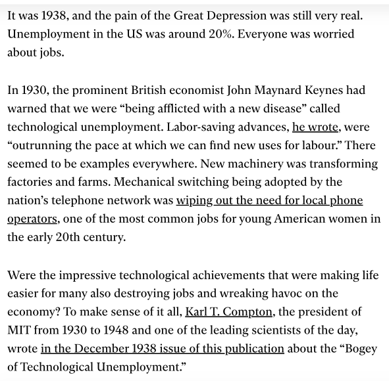
David Rotman | MIT Technology Review | January 2024
Source: MIT Technology Review
Rotman opens in 1938. US unemployment sits around 20%. Keynes coined the phrase “technological unemployment” to describe how machines are displacing workers. Rotman poses the question from that vantage point, asking whether the era’s technological advances were destroying jobs even as they made life easier, and leaves it open. The reader already knows how 1938 ended, which is precisely the point.
- He puts you inside 1938 rather than summarizing it; you feel the anxiety before being told it mirrors the present.
- The reader’s prior knowledge does the argumentative work — Rotman doesn’t draw the parallel to today; the reader does.
- “Technological unemployment” as a phrase maps exactly onto current anxieties without the author having to say so.
- Noting that this publication covered the same story in 1938 is a quiet, confident move that signals this conversation has history, and this writer knows it.
The technique: When today’s debate has a historical precedent in which the outcome is already known, open it there. The reader’s own knowledge becomes part of the argument, which is more persuasive than any point the writer could make directly.
2. Stack credentials, then turn them against yourself
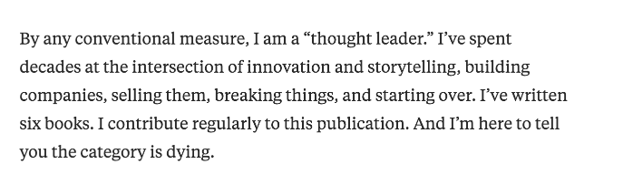
John Winsor | Harvard Business Review | March 2026
Source: Harvard Business Review
Winsor spends four short sentences establishing his credentials: decades in innovation, six books and a regular column in this publication. The fifth sentence announces that the entire category he represents is dying. He puts scare quotes around “thought leader” in line one — a quiet signal that careful readers pick up as foreshadowing; everyone else gets the reversal cold.
- Four sentences of authority make the fifth sentence land harder; the setup earns the subversion.
- The scare quotes do quite work, signaling his distance from the identity before he invokes it.
- There’s something almost funny about where this is published: a thought leader announcing the death of thought leadership, in a thought-leadership publication.
- Short sentences throughout; the plainness makes the reversal feel more honest.
The technique: Earn the authority first, then use it against the expected conclusion. The reversal only works if the setup has done its job.
3. Let the examples make the argument so you don’t have to
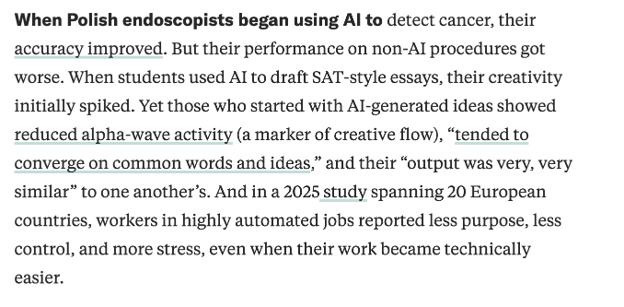
Rebecca Hinds and Robert I. Sutton | Harvard Business Review | December 2025
Source: Harvard Business Review
The lead covers three domains in quick succession. Polish endoscopists improved with AI assistance and got worse without it. Students seeded with AI-generated essay ideas showed early creative gains, then measurable drops in alpha-wave activity. Workers in highly automated jobs across 20 European countries reported less purpose and more stress, even as their tasks became technically easier. None of this is summarized or explained; the examples are placed side by side and left to speak for themselves.
- Each example follows the same pattern (benefit, then hidden cost), so by the third one, you’ve already worked out the argument yourself.
- Three different fields show the same thing happening without the authors having to claim it’s universal.
- The details are very specific (Polish endoscopists, alpha-wave activity, 20 countries), which tells you they read the actual studies rather than the headlines.
- When readers conclude on their own, they hold it more firmly than when it’s handed to them.
The technique: Show the same counterintuitive pattern across different contexts and let the reader draw their own conclusions. An argument readers arrive at themselves is harder to dismiss.
4. Name the thing that doesn’t have a name yet
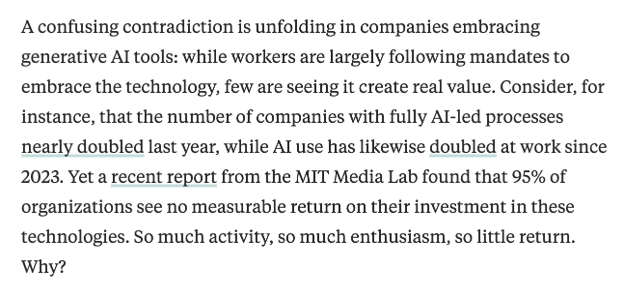
Kate Niederhoffer et al. | Harvard Business Review | September 2025
Source: Harvard Business Review
The article is titled ‘The Rise of Workslop,’ Niederhoffer’s term for AI-generated output that looks productive and delivers nothing. The lead earns the word before using it. AI adoption nearly doubled. Workplace AI use likewise doubled. An MIT Media Lab report found that 95% of organizations report no measurable return on those investments. Then three beats: “So much activity, so much enthusiasm, so little return.” Then one word: “Why?”
- ‘Workslop’ names something readers recognize before they have a word for it, and that moment of recognition creates investment in the piece before it has even started.
- 95% is a large enough number that you don’t quite believe it, which pulls you forward
- The three-beat sentence sums up the whole argument in one line.
- Ending with “Why?” is simple and works; it’s one word that makes you turn the page.
The technique: When there’s a phenomenon the industry is experiencing but hasn’t named, put the name in the headline and explain it in the first paragraph. Recognition is one of the strongest hooks available, and it feels personal in a way that surprises rarely does.
5 questions to ask before you write the lead
These leads use different techniques, but they all solve the same problem. Each one gives the reader a specific reason to keep going within the first three sentences, and each one signals that the author went somewhere, found something, and has a particular reason to be writing this piece rather than anyone else.
Before writing a lead, these questions are worth sitting with:
| Question | What to do with it |
| When did something stop making sense? | Write that moment down in one sentence, without the explanation. If it sounds strange without context, you have an opening. |
| Do you have a word for what you’ve been watching happen? | If the word or phrase doesn’t exist in the industry yet, put it in the headline and spend the first paragraph showing the reader why it fits. |
| Which industry phrase doesn’t hold up anymore? | Write down the line everyone repeats. Then write down the specific situation where you watched it fail. Start the piece there. |
| What’s the most specific detail you have? | Use it in the first paragraph, before you’ve explained anything. A date, a place, a number that surprises people. Don’t save it for later as supporting evidence. |
Generative AI has made it easy to produce writing that sounds like thought leadership without being thought leadership. The distance between that and a lead that earns the reader’s attention has nothing to do with polish. It comes down to having something specific to say and saying it from the first sentence.
The post How your opening paragraph decides whether anyone reads the rest appeared first on PR Daily.