
[ad_1]
Key takeaways:
- Most enterprise RAG failures originate in retrieval pipelines rather than in the large language model itself.
- Weak grounding, fragmented context, and poor retrieval precision directly increase the risk of hallucinations in production AI systems.
- Vector-only RAG architectures struggle with enterprise-scale reasoning, governance, multimodal retrieval, and contextual accuracy requirements.
- Production-grade RAG systems require observability, layered validation, hybrid retrieval, and governance-aware orchestration pipelines.
- Enterprises investing in retrieval intelligence and validation infrastructure achieve more reliable, scalable, and trustworthy AI deployments.
Retrieval-Augmented Generation, or RAG, has become a core part of modern enterprise AI systems. Yet understanding why RAG systems fail remains critical as deployments scale. The global RAG market is projected to reach over $40 billion by 2035 as enterprises increase investments in grounded AI infrastructure.
Banks use it for policy search. Healthcare firms use it to retrieve clinical knowledge. Manufacturers use it to surface operational data from fragmented systems. Yet many production deployments still fail after successful pilots.
The RAG system challenges rarely start with the large language model itself. Most failures begin earlier in the pipeline. Poor chunking breaks document context. Weak retrieval logic returns irrelevant records. Stale embeddings surface outdated information. Inconsistent reranking injects noisy context into prompts. The result is an AI system that sounds confident but produces inaccurate answers.
These retrieval-augmented generation issues create real business risk. A single hallucinated response can corrupt decision-support workflows, expose sensitive records, or undermine trust in enterprise AI programs. In regulated sectors, retrieval errors can expose compliance to GDPR, HIPAA, and internal governance policies.
This article examines the technical root causes behind RAG system failures. It explains why retrieval pipelines collapse at scale, where grounding mechanisms fail, and what enterprises must change to build reliable production-grade RAG architectures.
73% of Enterprises Already Deploy RAG
Weak retrieval pipelines quietly increase the risk of hallucinations, expose compliance risks, and destabilize enterprise AI at production scale.
What RAG Failure Actually Means in Enterprise AI
Many enterprises define RAG system challenges as hallucinations alone. That definition is incomplete. In production systems, failures start much earlier and spread across the retrieval pipeline.
A RAG platform can fail even when the generated response sounds fluent and technically correct.
Beyond Hallucinations: Defining Failure in Production RAG
Here is a quick overview table that explains what happens to different types of failures in production.
| Failure Type | What Happens in Production |
|---|---|
| Retrieval irrelevance | The retriever surfaces semantically similar but contextually incorrect documents |
| Incomplete grounding | Critical supporting records never reach the prompt context |
| Stale responses | Old embeddings retrieve outdated policies, procedures, or knowledge |
| Citation mismatch | The generated answer cites sources that do not support the response |
| Inconsistent outputs | Identical queries return different answers across sessions |
| Access control failures | Restricted enterprise records appear in unauthorized responses |
These problems often remain hidden during pilot deployments. Understanding how RAG applications in AI evolve from pilots to production is critical, as deployment challenges surface quickly under real-world conditions.
Enterprise data changes daily. Permissions shift constantly. Knowledge repositories remain fragmented across ERP systems, SharePoint environments, ticketing platforms, and internal databases.
Why “Grounding Failure” Is the Real Problem
A grounded generation system depends on retrieval precision and the completeness of context. If the retriever misses relevant records, the model probabilistically fills information gaps. This creates low answer faithfulness even when the language appears accurate.
The relationship is direct:
- Weak semantic retrieval lowers contextual relevance
- Poor contextual relevance weakens grounding quality
- Weak grounding increases hallucination risk
- Hallucinated outputs reduce enterprise trust
Understanding RAG challenges & solutions starts here. In most enterprise RAG systems, the retrieval layer determines answer reliability long before generation begins.
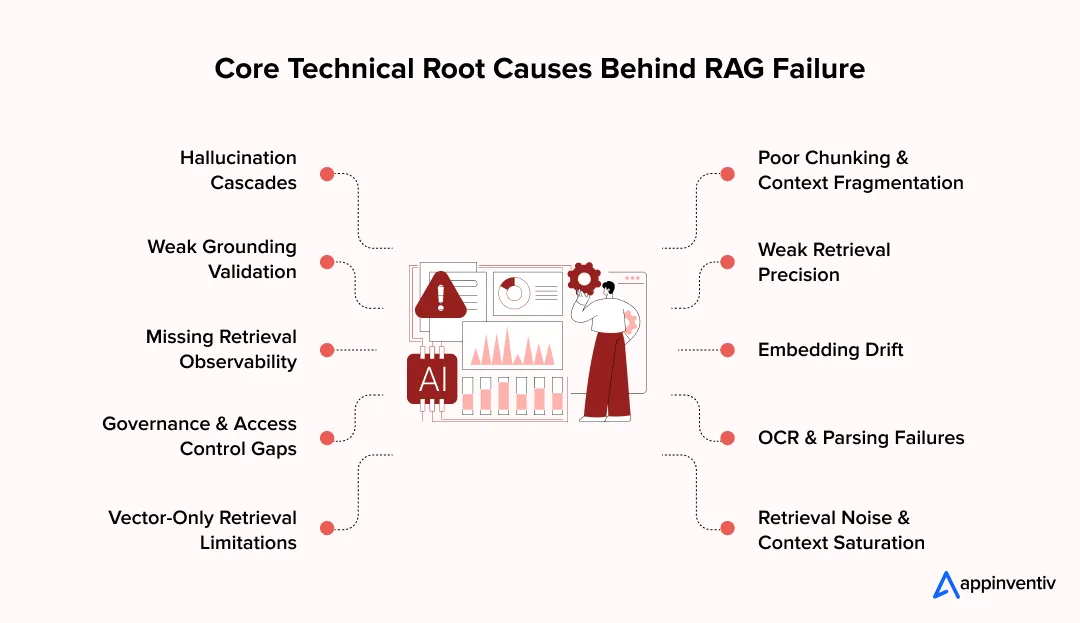
Core Technical Root Causes Behind RAG Failure
Most retrieval-augmented generation issues trace back to a small set of recurring technical weaknesses. These issues appear across retrieval pipelines, embedding systems, orchestration layers, and context assembly workflows. The sections below examine the most common failure points that reduce grounding quality, retrieval precision, and production reliability.
Poor Chunking and Context Fragmentation
Chunking is one of the most underestimated failure points and one of the most common RAG implementation mistakes. Many deployments still rely on fixed-size chunking strategies.
Chunking is one of the most underestimated failure points in enterprise RAG systems. Many deployments still rely on fixed-size chunking strategies that split documents after a predefined token limit. This works poorly for enterprise knowledge repositories.
A legal contract, clinical report, or ERP workflow rarely follows clean token boundaries. Fixed chunking often separates related clauses, tables, citations, and operational instructions into disconnected fragments. The retriever then surfaces an incomplete context during semantic search.
This creates semantic boundary loss. The model receives only partial information rather than complete meaning.
The impact becomes severe in enterprise environments:
- Healthcare records lose patient context across sections
- SOPs separate procedures from compliance instructions
- ERP documents split transactional dependencies
- Contracts disconnect obligations from governing clauses
Large chunks create another issue. They overload the context window with irrelevant text, thereby reducing token efficiency. Small chunks create retrieval fragmentation and weaken contextual relevance.
Modern RAG systems address this using more advanced chunking methods.
| Chunking Method | Purpose |
|---|---|
| Semantic chunking | Preserves meaning across related text blocks |
| Hierarchical chunking | Maintains parent-child document structure |
| Recursive chunk splitting | Breaks content dynamically based on semantic density |
| Metadata-aware chunking | Uses document type, headings, and labels during segmentation |
Production-grade retrieval pipelines depend heavily on chunk quality. Weak chunking reduces retrieval precision long before the generation stage begins.
Weak Retrieval Precision and Embedding Drift
Many corporate systems pull the wrong files. This precision problem explains why RAG systems fail. The software fetches similar documents but misses the true meaning.
A finance question about exposure limits might bring up cybersecurity files instead of credit policies. Hospital software can mix up medical terms. Factory systems trip over machine codes. General models lack deep industry knowledge.
Changing data creates more retrieval-augmented generation issues. Company facts change through rule updates and new products. Older data maps slowly lose accuracy over time.
Balancing file volume and precision is tough at scale. Gathering too many files brings in clutter. Narrowing your search means you miss vital context. These limits reveal critical RAG challenges & solutions for teams.
To fix these errors, platforms deploy specific data maps and scoring tools. Without semantic search optimization for RAG, your search network stays unreliable. Teams weighing RAG vs. fine-tuning discover that neither option works without high search precision.
Poor Document Parsing and Multimodal Ingestion Failures
Enterprise knowledge rarely exists as clean, structured text. Most organizations store critical information across scanned PDFs, spreadsheets, emails, invoices, slide decks, ERP exports, and handwritten records. Traditional RAG pipelines struggle to process this data accurately.
OCR failures remain one of the biggest ingestion problems. Poor character recognition corrupts extracted text and breaks downstream embeddings. A single parsing error in a compliance document or medical record can distort retrieval quality throughout the pipeline.
Table extraction creates another failure point. Many parsers flatten rows and columns into disconnected text blocks. Financial reports, operational dashboards, and supply chain records lose relational structure during ingestion.
PDF parsing inconsistencies also affect retrieval precision:
- Missing headers
- Broken section hierarchy
- Fragmented paragraphs
- Lost metadata
- Duplicated text blocks
These problems weaken contextual relevance before vector indexing even begins.
Modern enterprise systems now rely on more advanced ingestion pipelines built on intelligent document processing to handle OCR failures, broken tables, and multimodal content accurately.
| Ingestion Technique | Purpose |
|---|---|
| Layout-aware parsing | Preserves document structure and reading order |
| Metadata enrichment | Adds labels, timestamps, and contextual attributes |
| Document normalization | Standardizes formatting across repositories |
| Multimodal RAG | Processes tables, charts, images, and text together |
Production-grade retrieval systems depend heavily on the quality of ingestion. Weak parsing pipelines create noisy embeddings, low retrieval accuracy, and unstable grounded generation.
Context Window Saturation and Retrieval Noise
Packing too much text into an AI prompt to improve accuracy usually backfires. This clutter weakens answer quality. Large context windows do not guarantee smart reasoning. Instead, they flood the system with repetitive files, old notes, and low-priority fragments.
This crowding creates clear operational issues:
- Unrelated words dilute vital facts.
- Heavy text volume weakens contextual focus.
- Repetitive files waste system memory.
- Low-priority text fragments push out core evidence.
AI systems also suffer from the lost-in-the-middle problem. Language models often ignore facts buried deep inside long text blocks. Core records become invisible even when the system successfully finds them.
To counter this, modern systems deploy RAG performance optimization techniques to clean data before answers are generated.
Context Cleanup Methods
| Method | Purpose |
|---|---|
| Text compression | Removes low-value content |
| Priority sorting | Surfaces trusted files first |
| Context pruning | Clears out repetitive text fragments |
| Reranking files | Reorders results based on user goals |
The target is no longer a raw file volume. The target is high informational density. Extra text only helps when search precision stays high. Weak pipelines simply amplify noise on a larger scale.
Hallucination Cascades and Weak Grounding
RAG models in generative AI do not automatically eliminate hallucinations. They reduce the risk only when retrieval quality remains accurate, complete, and contextually relevant.
Many enterprise failures begin with partial retrieval. The retriever surfaces incomplete evidence, outdated records, or loosely related chunks. The language model then attempts unsupported synthesis across a fragmented context. This produces answers that sound credible but lack factual grounding.
Several failure patterns appear repeatedly in production systems:
- fabricated citations linked to unrelated documents
- unsupported claims generated from partial context
- missing regulatory or operational constraints
- confidence inflation during uncertain retrieval states
These are commonly called retrieval-induced hallucinations. The model does not randomly invent information. It extrapolates from weak or incomplete retrieval evidence.
A healthcare assistant, for example, can retrieve partial treatment guidance but omit contraindications. A financial RAG system can surface outdated compliance language during policy interpretation. In both cases, the response appears authoritative despite being only partially grounded.
Modern enterprise architectures now introduce validation layers specifically for AI hallucination reduction in RAG systems before final generation.
| Validation Mechanism | Purpose |
|---|---|
| Attribution validation | Confirms claims match retrieved sources |
| Groundedness scoring | Measures factual alignment with the retrieved context |
| Faithfulness evaluation | Detects unsupported synthesis in generated responses |
| Citation verification | Validates source-reference consistency |
These controls improve answer reliability and reduce the propagation of hallucinations. Without grounding validation, even advanced language models remain vulnerable to factual instability under enterprise-scale retrieval workloads.
Lack of Retrieval Validation and Observability
Operating without observability is among the most common RAG implementation mistakes. Many enterprise RAG systems function as black boxes. Teams manually measure response quality, but they lack visibility into retrieval behavior, grounding accuracy, and failure propagation across the pipeline.
This creates a serious operational gap.
Most deployments still have:
- No retrieval diagnostics
- No answer traceability
- Weak evaluation pipelines
- Limited monitoring systems
- No grounding verification layer
As a result, organizations cannot determine why inaccurate outputs occur. The system returns a flawed answer, but engineering teams cannot isolate whether the problem originated in chunking, retrieval, reranking, context assembly, or generation.
Retrieval observability addresses this challenge by exposing pipeline-level behavior in real time.
Modern production systems increasingly rely on telemetry pipelines that track:
- Retrieval quality
- Source attribution
- Ranking consistency
- Prompt composition
- Hallucination frequency
- Retrieval latency
This data supports faster debugging and continuous model evaluation.
| Evaluation Metric | What It Measures |
|---|---|
| recall@k | Ability to retrieve relevant records |
| MRR | Ranking quality of retrieved results |
| Groundedness | Alignment between output and source context |
| Citation accuracy | Correctness of referenced documents |
| Retrieval latency | Speed of retrieval orchestration |
Human-in-the-loop evaluation remains critical in regulated industries. Automated scoring systems cannot fully detect contextual ambiguity, policy conflicts, or operational nuance, which is why AI guardrails for enterprises have become a foundational layer in regulated RAG deployments.
Enterprise RAG systems require continuous observability throughout the retrieval lifecycle. Without validation infrastructure, hallucinations become difficult to trace, reproduce, and prevent at scale in production.
Hallucinations Are Usually a Retrieval Problem, Not a Model Problem
We help enterprises uncover grounding gaps, retrieval failures, and observability blind spots that quietly undermine production AI performance.
Security, Governance, and Enterprise Data Fragmentation
Effective knowledge retrieval AI solutions must handle disconnected repositories spread across cloud platforms, internal databases, SharePoint environments, ERP systems, and third-party applications. This fragmentation creates serious governance and security risks.
A retriever can accidentally surface restricted records if access-control logic is not enforced during retrieval orchestration. This is especially critical when deploying a RAG chatbot in enterprise environments where sensitive HR files, financial reports, or patient records can appear inside generated responses even when users lack authorization.
Prompt injection attacks create another growing concern. Malicious instructions embedded inside indexed documents can manipulate downstream model behavior and distort retrieval outcomes.
Stale knowledge exposure also affects enterprise reliability. Outdated compliance documents or deprecated operational policies often remain indexed long after revisions occur.
Modern enterprise AI systems increasingly adopt stronger governance controls.
| Governance Mechanism | Purpose |
|---|---|
| RBAC-aware retrieval | Applies role-based permissions during retrieval |
| Federated retrieval | Searches across distributed repositories securely |
| Policy-aware orchestration | Enforces governance logic across workflows |
| Zero-trust AI architecture | Validates every retrieval request continuously |
Compliance pressure is also increasing across GDPR, HIPAA, and SOC 2 environments. Enterprises now require retrieval systems that support auditability, traceability, and controlled access to knowledge across the full AI pipeline.
Why Most RAG Systems Fail Before Generation Begins
Most enterprises focus heavily on the language model, but why RAG systems fail usually traces back to the retrieval pipeline rather than the model itself. In production RAG systems, retrieval quality determines whether the model receives accurate context or noisy fragments.
Retrieval Is the Real Intelligence Layer
Many teams assume semantic similarity equals relevance. That assumption breaks quickly in enterprise environments.
A vector database retrieves embeddings that are mathematically similar. It does not understand business context, document hierarchy, or operational intent. Two chunks can appear similar in vector space yet carry completely different meanings inside a legal contract, clinical workflow, or financial report.
This creates a major gap between:
- Semantic retrieval
- Contextual relevance
- Downstream answer quality
That gap widens at scale.
Breakdown of the Enterprise Retrieval Pipeline
A production RAG system depends on multiple interconnected layers.
| Pipeline Layer | Common Failure Point |
|---|---|
| Ingestion | Incomplete document synchronization |
| Parsing | Broken tables, OCR errors, metadata loss |
| Chunking | Context fragmentation and semantic boundary loss |
| Embeddings | Domain vocabulary mismatch |
| Vector Indexing | Low retrieval recall and indexing drift |
| Retrieval | Irrelevant or incomplete context retrieval |
| Reranking | Incorrect prioritization of retrieved chunks |
| Context Assembly | Noisy prompt construction |
A small issue in one layer spreads rapidly across the pipeline.
For example:
- Poor parsing corrupts chunk quality
- Weak chunks reduce embedding accuracy
- Low-quality embeddings hurt recall@k performance
- Weak retrieval injects irrelevant context
- Noisy context destabilizes generation
Failure Propagation Across the Pipeline
Most hallucinations originate from retrieval failures, not generation failures.
A low recall retriever misses critical records. The model then attempts to complete from a partial context probabilistically. This weakens answer faithfulness and increases factual inconsistency.
Weak context assembly creates another problem. Many systems retrieve large amounts of loosely related text. This overloads the context window and dilutes high-value information. Reranking systems often fail to prioritize the most authoritative records.
Production-grade RAG systems require retrieval orchestration, validation logic, and continuous monitoring. Without those controls, the pipeline becomes statistically unreliable long before generation starts.
Why Traditional Vector-Only RAG Architectures Are Breaking at Scale
Early RAG systems relied heavily on vector similarity search, but retrieval-augmented generation issues emerged quickly as enterprise deployments scaled beyond narrow datasets and simple question-answer workflows. Enterprise deployments exposed their limitations quickly.
The Limitations of Naive Vector Search
Vector retrieval identifies mathematically similar embeddings, not true contextual meaning. This creates semantic ambiguity during enterprise retrieval.
A query about “risk exposure” can return cybersecurity content rather than financial risk controls. Similar phrasing produces overlapping embeddings even when operational intent differs completely.
Vector-only retrieval also struggles with:
- Weak multi-hop reasoning
- Fragmented entity relationships
- Poor relational understanding across documents
- Disconnected business context
Enterprise queries rarely depend on a single chunk of information. A compliance workflow may require:
- Policy interpretation
- Historical amendments
- Regional exceptions
- Approval hierarchy hierarchy
- Linked operation rather than use
Traditional vector search cannot reason across these dependencies effectively.
Why Modern Enterprise AI Requires Hybrid Retrieval
Hybrid search for RAG systems combines multiple retrieval methods instead of relying solely on dense vector search.
| Retrieval Model | Primary Function |
|---|---|
| Hybrid search | Combines keyword and semantic retrieval |
| Graph RAG | Maps relate, thereby reducing the distance between entities and documents |
| Agentic retrieval | Dynamically selects retrieval strategies |
| Adaptive retrieval pipelines | Adjust retrieval logic based on query complexity |
| Query decomposition | Breaks complex prompts into smaller retrieval tasks |
These systems improve contextual relevance and retrieval precision under large-scale enterprise workloads. Agentic RAG implementation takes this further by enabling dynamic retrieval strategy selection based on query type and context.
Retrieval orchestration is becoming the new control layer in production AI systems. Modern architectures now prioritize:
- Retrieval planning
- Reranking logic
- Contextual filtering
- Validation pipelines
- Dynamic context assembly
The future of enterprise RAG depends less on larger context windows and more on intelligent orchestration of retrieval across distributed knowledge systems.
Also Read: Autonomous Agents in Business: Driving Efficiency and Innovation
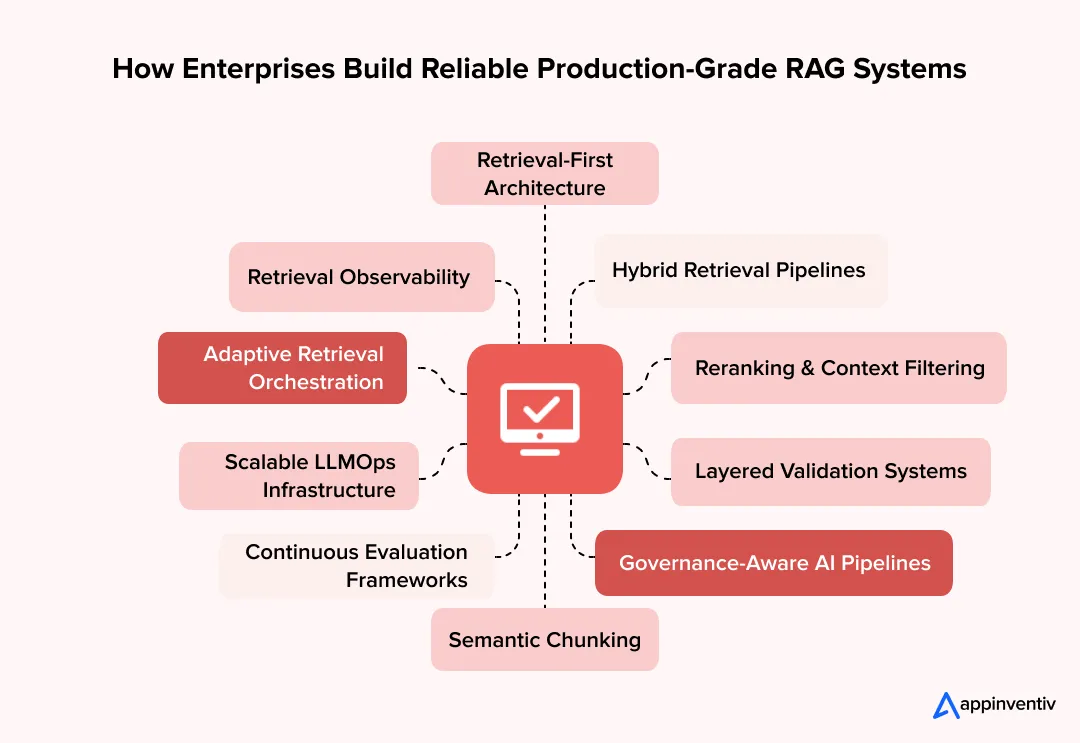
How Enterprises Build Reliable Production-Grade RAG Systems
Enterprise RAG deployment challenges demand far more than vector databases and prompt engineering. Large enterprises already account for over 73% of current RAG implementation activity, yet many deployments still struggle with retrieval reliability and grounding accuracy.
Reliable systems depend on retrieval quality, validation infrastructure, observability, and governance controls operating together across the full pipeline.
Architectural Principles of Enterprise-Ready RAG
Modern enterprise systems increasingly follow a retrieval-first architecture. The primary goal is not to generate faster. The goal is to retrieve accurate context before generation begins.
Several architectural principles now define production-grade RAG systems:
- Layered validation across the retrieval and generation stages
- Observability-by-default for pipeline monitoring
- Modular orchestration for flexible retrieval workflows
- Governance-aware pipelines with access-control enforcement
- Retrieval prioritization based on contextual relevance
This changes how enterprises approach generative AI implementation, with many now turning to specialized AI consulting services to architect retrieval-first systems, with generation as the final step within a larger orchestration layer.
Recommended Enterprise RAG Stack
A scalable RAG system architecture separates retrieval pipelines into multiple operational layers.
| Architecture Layer | Core Responsibility |
|---|---|
| Ingestion Layer | Connects enterprise repositories and data sources |
| Preprocessing Layer | Cleans, normalizes, and segments documents |
| Embedding Layer | Generates vector representations |
| Hybrid retrieval Layer | Combines semantic and keyword retrieval |
| Reranking Engine | Prioritizes high-relevance results |
| Orchestration Layer | Coordinates retrieval workflows and query routing |
| Validation Layer | Detects hallucinations and grounding failures |
| Monitoring Layer | Tracks retrieval quality and system performance |
This layered design improves scalability, debugging, and governance management across distributed enterprise environments and integrates closely with LLMOps infrastructure that governs model versioning, evaluation, and continuous deployment.
RAG Evaluation Framework for Enterprise Deployments
Most RAG failures remain invisible without continuous evaluation. Enterprises now require structured testing frameworks that measure retrieval quality under real production conditions.
Modern evaluation pipelines often include:
- Offline evaluation using benchmark datasets
- Online evaluation against live user traffic
- Adversarial testing for prompt injection resistance
- Synthetic benchmarks for retrieval stress testing
- Continuous feedback loops from user interactions
A proper RAG evaluation framework uses several operational metrics to measure production reliability.
| Evaluation Metric | What It Measures |
|---|---|
| Groundedness | Alignment between responses and source records |
| Hallucination Rate | Frequency of unsupported generation |
| Retrieval Precision | Accuracy of retrieved context |
| Response Consistency | Stability across repeated queries |
| Latency | Retrieval and generation response time |
Human review still plays a major role in regulated sectors such as healthcare, BFSI, and legal operations. Automated evaluation systems cannot fully detect contextual nuance, policy conflicts, or procedural ambiguity.
Reliable enterprise RAG systems emerge from disciplined retrieval engineering, continuous validation, and strong operational governance. Understanding the full scope of RAG integration for business applications helps teams plan this governance from day one.
Retrieval Augmented Generation Best Practices for Building Reliable Enterprise RAG Systems
Addressing RAG system challenges requires more than model tuning. Reliable systems depend heavily on retrieval quality, validation logic, and governance controls. Enterprises that focus solely on model performance often struggle with unstable outputs and weak grounding.
These retrieval-augmented generation best practices consistently improve production reliability.
| Best Practice | Business Impact |
|---|---|
| Hybrid retrieval | Improves contextual accuracy across enterprise datasets |
| Semantic chunking | Preserves meaning during document segmentation |
| Domain-tuned embeddings | Improves retrieval for industry-specific terminology |
| Reranking pipelines | Prioritizes high-authority records before generation |
| Retrieval observability | Detects grounding failures and retrieval drift |
| RBAC-aware retrieval | Prevents unauthorized document exposure |
Enterprises should prioritize retrieval precision over retrieval volume. Large prompts filled with loosely related records weaken contextual relevance and increase retrieval noise. Dynamic context pruning and reranking systems produce more stable outputs during production workloads.
Evaluation pipelines also require continuous monitoring.
Key metrics include:
- Groundedness
- Citation accuracy
- Retrieval precision
- Hallucination rate
- Response consistency
- Retrieval latency
Version-aware indexing is equally important. Enterprise knowledge changes constantly through policy updates, operational revisions, and regulatory changes. Without continuous synchronization, stale embeddings quickly reduce retrieval accuracy.
The most reliable enterprise RAG deployments apply proven RAG performance optimization techniques, combining retrieval orchestration, layered validation, observability, and governance controls. Teams planning RAG application development should treat these controls as foundational, not optional.
How to Improve RAG Accuracy in Production
Improving your network accuracy requires more than picking a larger language model. In corporate setups, retrieval quality dictates your answer’s reliability. Weak retrieval, broken text chunks, and old data maps cause mistakes long before the model speaks.
The most effective setups improve precision across multiple layers:
| Strategy | Enterprise Impact |
|---|---|
| Semantic chunking | Saves core context and stops text breaking |
| Hybrid retrieval | Raises accuracy across complex files |
| Domain-tuned embeddings | Sharpens search for industry language |
| Reranking models | Places top records at the front |
| Groundedness validation | Cuts out unverified text outputs |
| Continuous re-indexing | Stops software from fetching dead facts |
Reliable corporate frameworks treat search tuning as a non-stop task. They constantly polish text quality, search precision, and factual anchoring before the system writes an answer.
RAG Evaluation Metrics That Matter
Many system bugs hide behind clean prose. An answer can look correct while relying on partial files, weak notes, or bad logic. Tracking your search and mapping quality is vital for live setups.
| Metric | What It Measures |
|---|---|
| Recall@K | Success in finding matching records |
| Precision@K | Exact relevance of the pulled files |
| MRR | Order quality of the fetched text |
| Groundedness | Match between the answer and source files |
| Citation Accuracy | Correctness of your source notes |
| Hallucination Rate | How often does the tool invent fake facts |
| Response Consistency | Output stability over repeating queries |
| Retrieval Latency | Search and reply delivery speeds |
Many corporations deploy tools like RAGAS, DeepEval, TruLens, LangSmith, and Arize Phoenix. These tools track search quality, check fact matching, and block hallucination risks inside live production networks.
Scaling RAG Requires More Than Better Models
We help enterprises design retrieval-first architectures that improve accuracy, governance, and performance as AI adoption grows.
Where Enterprise RAG Architectures Are Headed
As RAG system challenges evolve, enterprise RAG systems are shifting away from static retrieval pipelines. Modern deployments now rely on adaptive retrieval systems that can reason across distributed knowledge sources, user intent, governance policies, and contextual dependencies.
Traditional vector-only retrieval struggles under large-scale enterprise workloads. New architectures increasingly introduce orchestration and validation layers between retrieval and generation.
Recent retrieval orchestration techniques have reduced large-scale retrieval latency by as much as over 51%, highlighting how orchestration quality now directly affects production performance.
Several architectural patterns are gaining traction across production AI systems.
| Emerging Architecture Pattern | Primary Goal |
|---|---|
| Agentic retrieval | Dynamically selects retrieval strategies per query |
| Graph-enhanced RAG | Maps relationships across entities and documents |
| Adaptive reranking | Reorders context based on intent and retrieval confidence |
| Multimodal retrieval | Processes text, tables, images, and diagrams together |
| Policy-aware orchestration | Applies governance controls during retrieval workflows |
Enterprises are also investing in retrieval validation systems that can:
- Detect hallucination risk before generation
- Identify low-confidence retrieval states
- Verify citation alignment
- Measure groundedness continuously
And AI agents in enterprise workflows increasingly take on the role of orchestrating these checks.
Memory-aware orchestration is becoming another major focus area. These systems maintain contextual continuity across long enterprise workflows rather than treating every query in isolation.
The next generation of scalable RAG system architecture will depend less on larger context windows and more on retrieval intelligence, orchestration accuracy, and governance-aware AI infrastructure.
Also Read: Agentic RAG in eCommerce: Enterprise Use Cases
How Appinventiv Helps Enterprises Engineer Reliable RAG Systems
Building a reliable RAG system means overcoming real enterprise RAG deployment challenges. Most failures originate from weak retrieval pipelines, fragmented knowledge systems, poor grounding logic, and missing observability layers. Appinventiv helps enterprises navigate RAG challenges & solutions at the architectural level.
As a trusted enterprise RAG development company, our teams design custom enterprise RAG systems built around:
- Hybrid retrieval pipelines
- Semantic and metadata-aware chunking
- Reranking systems
- Retrieval validation layers
- Multimodal AI ingestion pipelines
- Governance-aware orchestration
- AI observability and monitoring frameworks
We help enterprises reduce:
- Retrieval irrelevance
- Hallucination risk
- Stale knowledge exposure
- Context fragmentation
- Retrieval latency bottlenecks
- Access-control leakage
Our engineers also build scalable LLMOps infrastructure that supports:
- Vector databases
- Adaptive retrieval workflows
- Secure enterprise AI systems
- Retrieval evaluation pipelines
- Continuous indexing and synchronization
Our knowledge retrieval AI solutions and enterprise AI delivery experience include:
| Enterprise AI Capability | Scale |
|---|---|
| AI-powered solutions delivered | 300+ |
| Data scientists and AI engineers | 200+ |
| Custom AI models deployed | 150+ |
| Enterprise AI integrations completed | 75+ |
| Bespoke LLMs fine-tuned | 50+ |
| Industries served | 35+ |
These deployments have helped enterprises achieve:
- 75% faster decision-making
- 98% AI prediction accuracy
- Up to 10x faster time-to-market
Appinventiv partners with enterprises to understand exactly why RAG systems fail and to build reliable, scalable, and governance-ready RAG ecosystems. For teams looking to hire RAG architects with the right enterprise experience, this is where that process starts.
Let’s connect and build enterprise RAG systems that deliver accurate, grounded, and reliable outputs.
Frequently Asked Questions
Q. What Are the Most Common Reasons RAG Systems Fail in Production?
A. Understanding why RAG systems fail starts with the retrieval pipeline, not the language model itself. Common issues include poor chunking, low retrieval precision, embedding drift, noisy context assembly, and missing validation layers. Enterprise systems also struggle with fragmented knowledge repositories, stale embeddings, limited observability, and governance gaps that reduce grounding quality and increase the risk of hallucinations at scale.
Q. What Are the Biggest Scalability Challenges in Enterprise RAG Systems?
A. Enterprise RAG systems often struggle with retrieval latency, distributed knowledge retrieval, noisy context injection, and inconsistent reranking across large datasets. Scalability becomes difficult when pipelines process multimodal documents, fragmented repositories, and continuously changing enterprise data. Many organizations also lack retrieval orchestration, observability infrastructure, and version-aware indexing systems required to maintain contextual accuracy under production-scale workloads.
Q. What Is the Difference Between Semantic Search Failure and LLM Failure in RAG?
A. Inadequate semantic search optimization for RAG causes retrieval failures when the retriever returns irrelevant, incomplete, or low-context records. LLM failure happens during response generation after context retrieval is complete. In most enterprise RAG systems, retrieval issues create downstream generation instability. Weak semantic retrieval lowers grounding quality, increases the risk of hallucinations, and reduces response faithfulness long before the language model generates the final response.
Q. How Can Hybrid Search Improve RAG System Performance?
A. Hybrid search for RAG systems improves performance by combining semantic retrieval with keyword-based search. This improves contextual relevance, retrieval precision, and domain-specific query handling across enterprise datasets. Hybrid retrieval also reduces semantic ambiguity and retrieval noise during complex workflows. Appinventiv helps enterprises implement hybrid retrieval architectures, reranking systems, and governance-aware AI pipelines that improve grounding accuracy, scalability, and production reliability across enterprise AI ecosystems.
Q. Why Should Enterprises Choose AppInventiv for Production-Grade RAG System Development?
A. Appinventiv helps enterprises engineer reliable RAG ecosystems built for real production workloads, not isolated AI pilots. Our teams design hybrid retrieval pipelines, retrieval observability frameworks, governance-aware AI systems, and scalable LLMOps infrastructure that reduce hallucination risk and improve grounding accuracy. With 300+ AI solutions delivered and 50+ bespoke LLMs fine-tuned, we help enterprises build secure, scalable, and high-performance RAG architectures that operate reliably at enterprise scale.
[ad_2]
Source_link