[ad_1]
Artificial intelligence is no longer just a tool that waits for your command. It has started to think, plan, and act on its own. That shift is exactly what agentic AI is about. If you have been hearing this term everywhere lately and wondering what it actually means, you are in the right place.
This guide breaks down what is agentic AI, how it works, why it matters for businesses, and what sets it apart from the AI you already know. Whether you are a business owner, a decision-maker, or someone just getting started with AI, this guide gives you a clear and honest picture of where things stand in 2026.
What is Agentic AI?
Agentic AI refers to artificial intelligence systems that can pursue goals independently by taking real actions in the world, rather than simply generating a response for a human to act on. You give it an objective, and it figures out how to complete it.
Think of it this way. A traditional AI chatbot answers your question. An agentic AI system takes your question, researches it, creates a plan, executes the steps, checks the results, and delivers the finished outcome. The difference is not just about capability. It is about autonomy.
The term “agentic” comes from the word agency, meaning the capacity to act independently. When applied to AI, it signals that the system does not just talk. It acts.
The Core Idea Behind Agentic AI
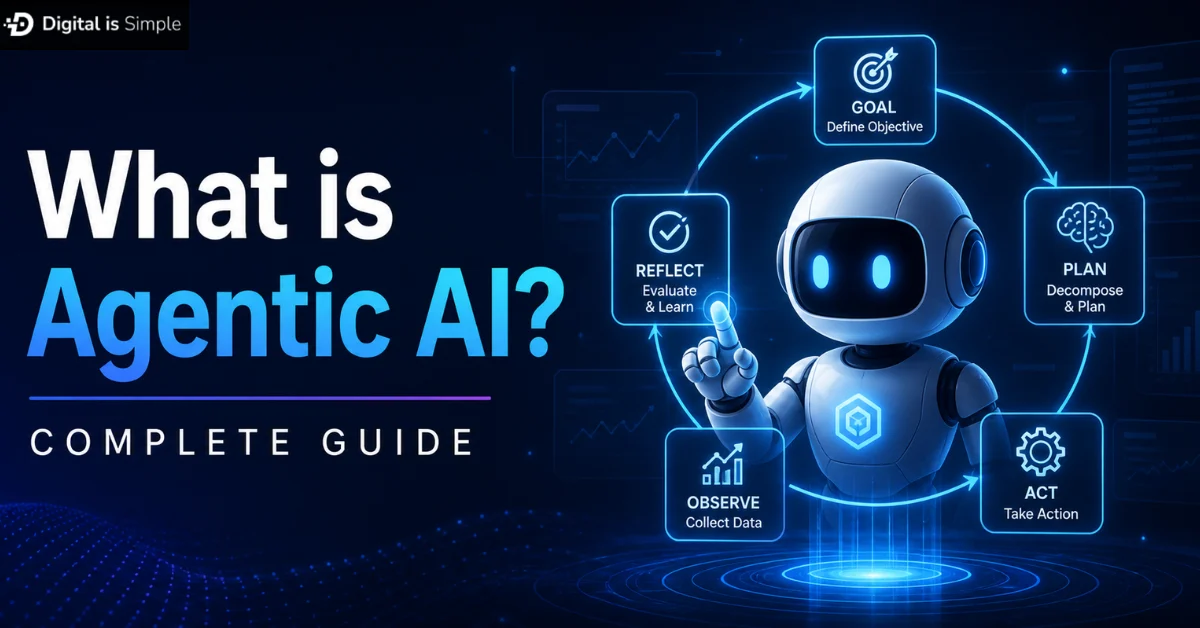
At its heart, agentic AI operates in a continuous loop:
- Perceive the environment or receive a goal
- Plan what steps are needed to reach that goal
- Act by using tools, APIs, code, browsers, or databases
- Observe the results of those actions
- Adapt and keep going until the task is done
This loop is what separates agentic systems from traditional software. It is not a one-and-done generation. It is an ongoing process of reasoning and doing.
How Agentic AI Works
Before diving deeper, it helps to understand the mechanics. Many people assume agentic AI is just a smarter chatbot. It is fundamentally different in architecture.
A standard large language model (LLM) like GPT or Claude takes a prompt and returns a response. That is a single step. If you want to get the full picture of how actually Agentic AI works, the answer lies in what happens around that model, not just inside it.
The Perception Layer
An agentic AI system first needs to understand its environment. This includes reading documents, browsing web pages, analyzing images, pulling data from APIs, or checking the current state of a database. Without this perception layer, the agent cannot make informed decisions.
The Planning and Reasoning Engine
Once the agent has context, it breaks the larger goal into smaller, actionable subtasks. This is where reasoning models shine. The agent essentially writes its own to-do list and determines which tools or resources it needs to complete each step.
Tool Use and Execution
This is where agentic AI diverges most sharply from conventional AI. The agent calls real tools. It might write and execute code, send an API request, update a file, browse a website, fill out a form, or even interact with a desktop interface. These are not simulated actions. They happen in the real world.
Memory and Context Management
Agents need to remember what they have done and what they have learned. Short-term memory keeps context within a single task. Long-term memory, often powered by vector databases, allows agents to recall past interactions and build knowledge over time.
The Feedback Loop
After taking an action, the agent observes the result. Did it work? Did it fail? Does it need to try a different approach? This feedback loop is what makes agentic systems adaptive rather than rigid.
Difference Between Agentic AI & Generative AI
This is one of the most common points of confusion. Both use large language models, but they serve fundamentally different purposes. For a full breakdown, the comparison of Agentic AI vs Generative AI goes into granular detail.
Here is a quick comparison:
| Feature | Generative AI | Agentic AI |
|---|---|---|
| Primary Function | Generates text, images, code | Takes multi-step actions to complete goals |
| Interaction Style | Single prompt, single response | Continuous loop of planning and acting |
| Tool Use | Limited or none | Deep integration with APIs, browsers, databases |
| Autonomy | Low, human-driven | High, goal-driven |
| Memory | Limited to conversation window | Short-term and long-term memory systems |
| Output | Content or code | Completed tasks and outcomes |
| Best For | Writing, summarizing, creating | Automating workflows, research, operations |
Generative AI answers. Agentic AI acts. Most agentic systems are actually built on top of generative models, but they add the planning, tool use, and feedback loops that transform text generation into real-world action.
Key Components of an Agentic AI System
Understanding what is agentic AI also means understanding what it is made of. Each component plays a role in enabling autonomous behavior.
Here is a breakdown of the essential building blocks:
1. The Orchestrator
The orchestrator is the brain. It receives the goal, breaks it into subtasks, decides the order of execution, and coordinates all other components. In multi-agent systems, the orchestrator may manage several specialized sub-agents.
2. The Tools Layer
Tools are what make agents powerful. Common tools include:
- Web browsers for real-time information retrieval
- Code interpreters for running scripts
- File systems for reading and writing documents
- APIs for connecting to external services
- Search engines for finding relevant data
- Databases for structured information retrieval
3. The Memory System
| Memory Type | Description | Example Use |
|---|---|---|
| In-Context Memory | Active working memory during a task | Remembering steps already completed |
| External Memory | Vector databases and document stores | Recalling past decisions |
| Procedural Memory | Stored instructions and workflows | Repeating successful task patterns |
4. The Execution Environment
The environment is where the agent operates. This could be a cloud-based sandbox, a local machine, or a browser session. The environment determines what tools the agent can access and what constraints it operates under.
Agentic AI Examples in the Real World
Nothing makes a concept clearer than seeing it in action. Agentic AI examples today span across industries, and the applications are growing faster than most people realize.
1. Customer Support Automation
An agentic AI system can handle an entire customer support ticket independently. It reads the complaint, looks up the order history, checks the inventory system, drafts a resolution, sends the response, and logs the interaction. No human involvement needed for routine cases.
2. Software Development
Coding agents like GitHub Copilot Workspace and Devin can receive a feature request, plan the implementation, write the code, run tests, fix errors, and open a pull request. The developer reviews the final output rather than writing every line.
3. Research and Analysis
A research agent can take a topic, search dozens of sources, extract key findings, cross-reference data, identify gaps, and deliver a structured report. What used to take days now takes minutes.
4. Sales and Marketing
Agentic systems can manage outbound sales campaigns end to end. They identify prospects, personalize outreach, schedule follow-ups, track engagement, and update the CRM, all without manual input.
5. Finance and Operations
In financial services, agents monitor portfolios, detect anomalies, flag risks, generate reports, and even rebalance investment positions within defined parameters. The speed and consistency are transformative.
6. Healthcare Administration
Agents are being used to schedule appointments, process insurance claims, follow up with patients, and extract data from medical records. This frees clinical staff to focus on patient care.
Agentic AI Frameworks: The Infrastructure Behind Agents
Building an agentic AI system from scratch is complex. That is where agentic AI frameworks come in. A framework provides the scaffolding: memory management, tool integration, orchestration, and workflow coordination.
The leading agentic AI frameworks in 2026 include:
| Framework | Best For | Key Strength |
|---|---|---|
| LangChain | General-purpose agents | Broad tool ecosystem and community support |
| LangGraph | Stateful multi-agent workflows | Fine-grained control over agent state |
| CrewAI | Team-based agent workflows | Business-friendly abstractions |
| AutoGen | Multi-agent collaboration | Microsoft-backed, enterprise-ready |
| LlamaIndex | Knowledge-intensive agents | Exceptional data retrieval and RAG integration |
| Semantic Kernel | Enterprise .NET and Python | Strong integration with Microsoft Azure |
Choosing the right framework depends on your use case, team skills, and the complexity of the tasks you want to automate. Businesses exploring Agentic AI development services should evaluate frameworks based on their existing technology stack.
Multi-Agent Systems: When One Agent Is Not Enough
One of the most significant trends in 2026 is the shift from single agents to coordinated multi-agent systems. Instead of one agent doing everything, specialized agents handle different parts of a workflow and pass results to each other.
Think of it like a team at work. A research agent gathers data. An analysis agent interprets it. A writing agent drafts the output. A review agent checks accuracy. Each agent is optimized for its specific role.
This architecture mirrors how high-performing organizations operate, which is why enterprises are adopting it rapidly. Gartner reported a 1,445% surge in multi-agent system inquiries between early 2024 and mid-2025, signaling a fundamental shift in how AI systems are being designed.
The Benefits of Agentic AI for Businesses
Why should business owners and decision-makers care about this technology? The benefits of Agentic AI extend across nearly every function of a modern organization.
1. Speed at Scale
Agents do not sleep, take breaks, or get tired. They complete tasks around the clock at a consistency no human team can match.
2. Cost Efficiency
Automating repetitive, high-volume workflows with agentic systems reduces operational costs significantly. McKinsey research shows AI-powered workflows can cut time spent on low-value tasks by 25 to 40 percent.
3. Reduced Error Rates
Human errors in repetitive tasks accumulate over time. Agents follow defined processes with precision, reducing mistakes in data entry, reporting, and routine decision-making.
4. Faster Decision-Making
When an agent can research, analyze, and summarize in minutes, decisions that used to take days can now be made with confidence in hours.
5. Scalability Without Headcount Growth
Growing your operations no longer has to mean growing your team at the same rate. Agents scale with demand, handling peak periods without the need for additional hiring.
Agentic AI Use Cases by Industry
The Agentic AI use cases are expanding rapidly. Here is a snapshot of how different sectors are applying this technology today:
| Industry | Use Case | Impact |
|---|---|---|
| E-commerce | Inventory management, customer support, personalized recommendations | Higher conversion, lower support costs |
| Healthcare | Patient scheduling, claims processing, record extraction | Faster admin, reduced staff burden |
| Legal | Contract review, research, due diligence | Faster turnaround, lower billable hours on routine work |
| Finance | Portfolio monitoring, compliance checks, fraud detection | Faster alerts, reduced risk exposure |
| HR | Resume screening, onboarding automation, policy Q&A | Faster hiring cycles, better candidate experience |
| Software | Code generation, bug fixing, testing, deployment | Reduced developer time on routine tasks |
| Marketing | Campaign automation, content strategy, lead nurturing | Higher output, better targeting |
The Spectrum of Agentic AI: From Reactive to Strategic
Not all agentic systems are equal. Agenticness is better understood as a spectrum rather than a binary. At one end, you have a simple tool that responds to prompts. At the other, you have a fully autonomous system making long-horizon decisions.
Here is how that spectrum generally looks:
- Reactive Tool – Responds to a single prompt with no memory or planning
- Enhanced Assistant – Uses tools within a session but does not retain state
- Task Agent – Completes a defined multi-step task with some tool use
- Autonomous Agent – Breaks down goals independently, uses multiple tools, retains memory
- Collaborative Agent – Works alongside or coordinates with other agents
- Strategic Agent – Makes long-horizon decisions with minimal human input, adapts to new information dynamically
Most production systems in 2026 sit in the middle of this spectrum. Fully autonomous strategic agents exist in specialized contexts but are not yet mainstream.
Challenges and Limitations of Agentic AI
A fair guide would not ignore the obstacles. Agentic AI is powerful, but it comes with real challenges that organizations must plan for.
1. Hallucination and Reliability
Agents built on language models can still produce incorrect outputs. In a multi-step workflow, one wrong decision can compound into a bigger problem downstream. Human oversight checkpoints remain critical for high-stakes tasks.
2. Security and Access Control
When an agent can access files, databases, APIs, and browsers, the attack surface grows. Organizations need to implement strict permission models, audit trails, and sandboxed execution environments.
3. Governance and Compliance
Agents make runtime decisions that may have legal or regulatory implications. Building governance frameworks, escalation paths, and audit logs is not optional. It is essential.
4. Scaling to Production
While many organizations experiment with agents, fewer than one in four has successfully scaled them to production, according to industry research. The gap between prototype and production is significant and often underestimated.
5. Cost Management
Agents that run long workflows with many tool calls can consume significant compute resources. Token costs and API fees need to be factored into any ROI calculation.
Is Agentic AI Right for Your Business?
The answer depends on your specific situation. But here are some signals that your organization is ready to explore this technology:
- You have high-volume, repetitive workflows that consume significant employee time
- Your operations require coordination across multiple systems or data sources
- Speed and consistency matter more than creative judgment in a key process
- You have IT resources to integrate and monitor agentic systems
- You are open to redesigning workflows rather than just layering AI on top of existing ones
Businesses that are ready to take the next step often start by working with an experienced AI development company to map their highest-value automation opportunities before building.
How to Get Started With Agentic AI
Starting does not mean deploying a fully autonomous system on day one. It means identifying the right opportunity and building deliberately.
Step 1: Identify a High-Value Process
Look for tasks that are repetitive, rule-based, and time-consuming. These are the easiest wins for early agentic deployments.
Step 2: Define Clear Boundaries
Decide what decisions the agent can make independently and what decisions require human review. Starting with bounded autonomy reduces risk.
Step 3: Choose the Right Framework and Model
Match your agentic AI framework to your use case, team skills, and infrastructure. Do not default to the most complex option.
Step 4: Build, Test, and Iterate
Start with a narrow pilot. Measure performance against defined metrics. Fix issues before expanding scope.
Step 5: Invest in Governance
Set up audit trails, access controls, and escalation paths from the beginning. Adding governance retroactively is much harder than building it in.
Businesses that want to move faster often explore Generative AI development services to accelerate the build process with specialists who have already navigated these challenges.
Where Agentic AI Is Headed
The trajectory is clear. Gartner predicts that 40 percent of enterprise applications will embed agentic AI by the end of 2026, up from less than 5 percent in 2025. The market is projected to grow from roughly $7.8 billion today to over $52 billion by 2030.
The most significant near-term shifts include:
- Model Context Protocol (MCP) becoming a standard for connecting agents to tools and data sources
- Multi-agent collaboration becoming the default architecture for complex workflows
- Voice-driven agents handling real-time customer interactions across channels
- Regulated industries catching up with governance frameworks that enable safe deployment
- Agent marketplaces emerging where businesses can deploy pre-built specialized agents
The organizations that move now, thoughtfully and with clear strategy, will have a meaningful head start over those that wait.
Frequently Asked Questions
1. What is agentic AI in simple terms?
Agentic AI is an AI system that can take actions to achieve a goal, rather than just generating a response. You give it a task, and it plans the steps, uses tools, and completes the work with minimal human involvement.
2. How is agentic AI different from a chatbot?
A chatbot responds to your messages with text. Agentic AI goes further by using tools, taking actions, and completing multi-step workflows. The difference is that an agent does things in the real world, while a chatbot only produces text.
3. What are some real agentic AI examples in business today?
Common examples include automated customer support systems that resolve tickets end to end, coding agents that write and test software, research agents that gather and synthesize information, and sales automation tools that manage outreach campaigns without manual input.
4. What is an agentic AI framework?
An agentic AI framework is a software platform that provides the building blocks for creating autonomous AI agents. It handles orchestration, memory, tool integration, and workflow coordination so developers do not have to build these systems from scratch.
5. Is agentic AI safe to use in business?
Agentic AI can be used safely when proper guardrails are in place. This includes defining clear boundaries for agent autonomy, building audit trails, implementing access controls, and establishing human review checkpoints for high-stakes decisions. The technology is powerful, but governance is essential.
[ad_2]
Source_link