[ad_1]
Plus: Denver Airport responds to pedestrian fatality; more companies are hiring AI CEOs.
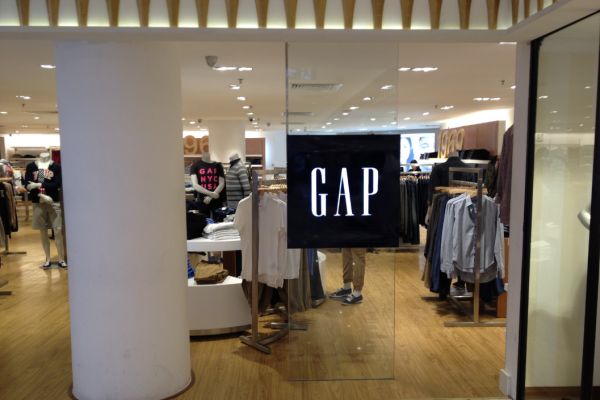
Gap CEO Richard Dickson says the company’s turnaround strategy is more significant than a retail recovery.
In an interview with The New York Times tied to the company’s recent performance, Dickson argued that Gap has moved from fixing operational problems to rebuilding cultural relevance.
He said Gap wants to stop acting like a legacy retailer trying to survive and start acting more holistically, connecting to audiences in ways that resonate with them. To start, Dickson brought in designer Zac Posen as creative director and got attention by dressing Kendall Jenner in a Gap gown at the Met Gala. The brand is also running more entertainment-style ads with talent like Katseye and Parker Posey, he said.
He’s even expanding into entertainment itself, hiring a “chief entertainment officer” to lead content, partnerships and Hollywood deals.
He described the company as being at a “pivotal point” in its transformation and said Gap is “firmly back in the cultural conversation.”
“Why do you exist? What is our purpose? What’s our point of difference? Those simple questions have very complicated answers when you’re in a turnaround. If you can’t answer it in a sentence or two, or one or two words, you’ve got a problem,” he said.
Dickson said that Gap’s recent collaborations, pop culture moments and multigenerational appeal are signs the brand is reconnecting with consumers.
Throughout the interview, Dickson is very plain and clear about the direction of the company, tying his ideas back to tangible business outcomes.
Why it matters: Gap spent several years being seen as stale, inconsistent and culturally irrelevant. Dickson’s strategy shows how companies can make a comeback by reinforcing a small number of concrete ideas instead of trying to sound like they’re changing in every direction all at once.
His messaging returns to execution and how they’re making changes, which is important because audiences are increasingly skeptical of overly optimistic promises without visible proof.
Dickson refers to Gap as a “pop culture brand,” rather than a retailer. This is because brands increasingly compete on identity, relevance and emotional familiarity as much as products themselves. PR teams are now expected to help brands stay part of cultural conversations without looking desperate or performative.
Dickson’s tone throughout is optimistic, but he consistently backs it with specifics. This helps him feel credible and steady without being seen as too aspirational. In a period when many CEOs sound cautious, defensive or use a lot of jargon, simple and confident language stands out.
Editor’s Top Reads:
- A Frontier Airlines flight headed from Denver to Los Angeles was forced to abort takeoff Friday night after the plane struck and killed a person who had entered the runway at Denver International Airport. CNN reports authorities said the person had jumped a perimeter fence and crossed onto the active runway just minutes before the collision. The aircraft, an Airbus A321 carrying 224 passengers and seven crew members, was accelerating for takeoff when the impact happened. No one on the plane was seriously hurt. Denver Airport said in a statement across social media: “At approximately 11:19 p.m., Frontier Flight 4345 reported striking a pedestrian during takeoff at DEN. Emergency crews responded to the scene. Passengers were bussed to the terminal and the majority have since departed DEN on a new Frontier flight. DEN can confirm the pedestrian jumped the perimeter fence and was hit just two minutes later while crossing the runway. The pedestrian is deceased, and is not believed to be an employee of the airport nor have they been identified. The airport has examined the fenceline and found it to be intact.” They added that 12 passengers on the flight reported minor injuries and condolences to those involved. This was a confusing situation with plenty of unknowns and a possible safety crisis. The airport did a good job of saying what happened chronologically in clear language, so it’s easily understood. DEN’ s media team included time stamps to help people understand what they knew when. They also avoided speculation, relying on facts, which helps keep the message focused. Later, the airport provided updates. As confusing as this kind of incident can be, the airport did well by getting information out there without adding more fuel to the fire.
- According to CNBC, a new report from IBM shows AI is changing how leadership teams operate. About 76% of more than 2,000 organizations surveyed now have a chief AI officer, which is a big jump from 26% in 2025. “AI is driving what may be the largest organizational shift since the industrial and digital revolutions,” Vivek Lath, partner at McKinsey & Company, told the outlet. Companies are restructuring around AI because leaders increasingly see it as a productivity and competitive advantage issue. McKinsey estimates generative AI could add $4.4 trillion in productivity growth across corporate use cases. Employees are already moving faster than leadership expected too. McKinsey found workers are using AI tools at roughly three times the rate executives assumed. This is an interesting time. AI is quickly becoming tied to reputation, workforce strategy and customer expectations. Investors want to hear how companies are using AI. Employees want training and clarity around how it affects jobs. Customers increasingly expect faster, more personalized experiences. Organizations that are slow to integrate AI into their business strategy risk looking slow or disconnected, while companies rushing in without governance risk trust and credibility problems just as quickly. A chief executive AI officer may be a good solution for both.
- Retail media networks, the advertising businesses run by retailers like Amazon, Walmart and Target, are growing fast, but the industry is hitting an awkward middle stage. The Wall Street Journal reports that global retail media revenue has already surpassed traditional TV advertising revenue, and U.S. spending is projected to reach $72 billion this year. But most of that money still flows to a few dominant players, especially Amazon, which controls nearly 80% of the U.S. market. But now, retailers are trying to transition into full-scale media businesses. Companies including Albertsons, Home Depot and DoorDash are planning a retail media upfront event modeled after TV upfronts traditionally hosted by broadcasters. But instead of celebrity appearances and entertainment, the pitch is focused on measurable outcomes and first-party customer data. “We’re a gangly teenager of an industry,” Albertsons Media Collective SVP, Brian Monahan, told the outlet. “We have to be easier to do business with.” The bigger push is proving that retail media can do more than drive quick purchases. Networks are now trying to convince marketers they can also build long-term brand affinity. Retailers increasingly control audience data, attribution and proof of business impact. That means communicators will face growing pressure to connect campaigns to tangible outcomes, not just awareness or engagement.
Courtney Blackann is a communications reporter. Connect with her on LinkedIn or email her at courtneyb@ragan.com.
The post The Scoop: Gap CEO connects brand’s cultural relevance with concrete turnaround goals appeared first on PR Daily.
[ad_2]
Source_link