[ad_1]
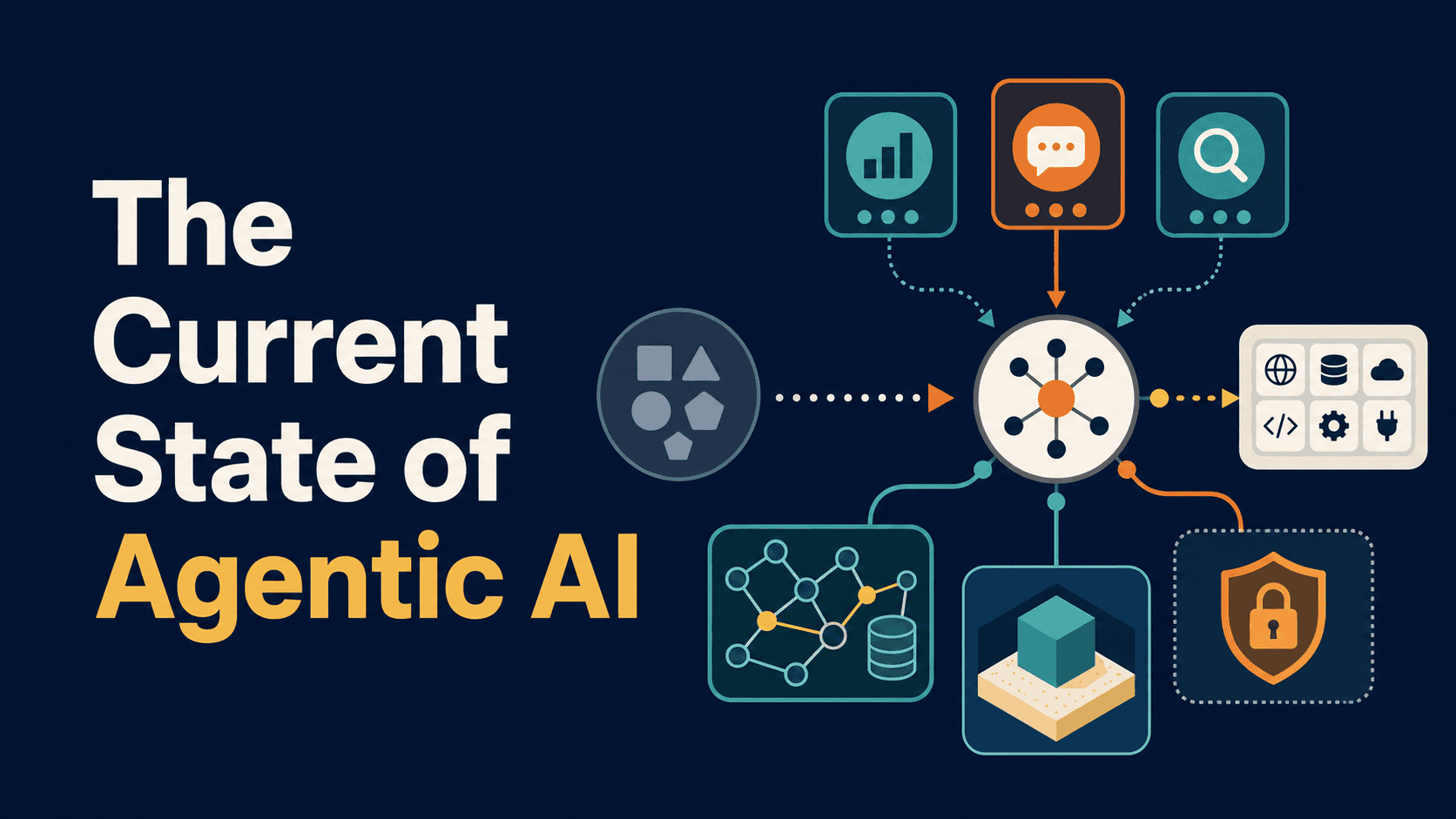
In this article, you will learn how agentic AI architecture has evolved by mid-2026, including the shift away from orchestrated reasoning loops, the rise of multi-agent swarms, and the standardization of tool protocols through MCP.
Topics we will cover include:
- Why native reasoning models have made complex external orchestration frameworks increasingly redundant.
- How to design a multi-agent swarm using stateless specialist agents connected through handoff tools.
- How the Model Context Protocol, persistent memory graphs, and emerging security patterns define the current production landscape.
Let’s not waste any more time.
Introduction
Look back at how we built AI agents just a year ago, and the dominant paradigm was brute-force orchestration. Engineers spent their time hand-crafting complex ReAct (Reasoning and Acting) loops, fighting with brittle prompt chains, and trying to force single, massive language models to juggle planning, tool execution, and context management all at once.
Today, in mid-2026, the ecosystem has fractured and specialized. The era of the monolithic, do-everything agent is fading.
We’re now working with native reasoning models, standardized tool protocols, and multi-agent architectures, often called “swarms.” As foundation models have integrated “System 2” thinking directly into their architectures, the role of the AI engineer has shifted from prompting agents to designing the infrastructure in which specialized agents communicate.
This tutorial breaks down the current state of agentic AI architecture, covers the three major shifts defining production systems today, and walks through how to design a modern agent swarm.
1. Transitioning Away from Orchestrated Loops
Let’s start at the layer that has changed most dramatically: how agents actually think.
Previously, in The Machine Learning Practitioner’s Guide to Agentic AI Systems, we explored patterns like Plan-and-Execute and Reflexion. These were external loops, where we used code to force a model to think step-by-step, critique its own output, and try again.
Today, foundation models handle test-time compute natively. Models now generate hidden reasoning tokens, explore multiple solution branches, and self-correct before outputting a single word to the user. The scaffolding we built to simulate reflection is becoming redundant.
What this means for your architecture: you no longer need to build complex orchestration frameworks just to get an agent to plan. If you’re still using LangChain or LlamaIndex to force a model to reflect on its own errors, you may be adding latency and token overhead for something the model now handles more naturally.
The orchestration layer should instead focus on routing, state management, and environment execution. The agent’s cognitive loop is handled by the model; your job is to build the sandbox it operates in.
With that cognitive overhead lifted, we can put engineering energy somewhere more valuable: decomposing work across multiple specialized agents.
2. Building Agent Swarms (Multi-Agent Microservices)
Now that models handle their own reasoning, the question becomes: what should a single agent actually be responsible for? The answer production teams have landed on is: as little as possible.
As argued in Beyond Giant Models: Why AI Orchestration Is the New Architecture, attaching 50 tools to a single large model creates a bottleneck. A growing number of production teams have moved toward agentic swarms — a collection of smaller, highly specialized agents that communicate via a standardized protocol.
Instead of one agent with 50 tools, you have:
- A Triage Agent that understands the user’s intent and routes requests.
- A SQL Agent that only knows your database schema and has one tool:
execute_query. - A Python Agent running in an isolated container that handles data transformations.
You might wonder whether splitting a monolithic agent into many smaller ones just moves the complexity around rather than reducing it. Here’s the key insight: the complexity doesn’t disappear, but it becomes manageable, testable, and replaceable in a way it never was before.
Building a Basic Swarm Pattern
The following is illustrative pseudo-code. It is not runnable as written. There is no swarm_framework package. For real implementations, see the OpenAI Agents SDK or LangGraph Swarm:
|
from swarm_framework import Agent, Swarm, TransferCommand
# Define the triage entry point triage_agent = Agent( name=“Triage”, system_prompt=“Route the request to the correct specialist agent.”, tools=[transfer_to_sql, transfer_to_analyst] ) |
|
# Define scoped specialist agents sql_agent = Agent( name=“Data Fetcher”, system_prompt=“You write and execute read-only PostgreSQL queries.”, tools=[execute_read_query] )
analysis_agent = Agent( name=“Data Analyst”, system_prompt=“You analyze datasets using Python pandas and generate insights.”, tools=[run_python_sandbox] ) |
|
# Define the handoff routing logic def transfer_to_analyst(context_variables): “”“Call this when raw data has been fetched and needs analysis.”“” return TransferCommand(target_agent=analysis_agent, context=context_variables)
sql_agent.add_tool(transfer_to_analyst)
# Initialize and run the swarm enterprise_swarm = Swarm( starting_agent=triage_agent, agents=[triage_agent, sql_agent, analysis_agent] ) response = enterprise_swarm.run( user_input=“How did our Q2 churn rate correlate with support ticket volume?” ) |
Notice the architecture: individual agents are stateless per call, and orchestration relies on handoff tools. When the SQL agent finishes fetching data, it calls a tool to transfer control and the data context to the Analyst agent. This keeps context windows lean and lets you use cheaper, faster models (like Qwen3 or current-generation small language models) for individual nodes, reserving larger models for routing and synthesis.
This pattern — stateless-per-agent but stateful-across-the-system — becomes even more important once you factor in how tools are connected. That’s where standardization has made a real difference.
3. The Standardization of Agency: Model Context Protocol
Building a swarm is one thing; connecting it to the real-world systems your users care about is another. Until recently, that integration work was one of the most tedious parts of the job.
As covered in Mastering LLM Tool Calling: The Complete Framework for Connecting Models to the Real World, integrating an API previously required writing custom schemas, handling HTTP requests, and dealing with arbitrary JSON parsing errors from the model. Each new integration meant reinventing the same wheel.
The current state of tool calling is increasingly defined by the Model Context Protocol (MCP). This open standard acts as a universal adapter between AI models and local or remote data sources.
| Old Paradigm (Pre-2025) | Current State (Mid-2026) |
|---|---|
| Hardcode API keys into the agent’s environment | Agent connects to an isolated MCP server |
| Engineer writes custom JSON schemas for every tool | MCP server automatically exposes available tools and resources |
| Agent directly executes API calls inline | Execution happens on the MCP server, separating concerns |
This standardization means you can plug a pre-built GitHub MCP server, a Slack MCP server, and a PostgreSQL MCP server into your swarm without writing the underlying API wrappers. Practical implementation still requires careful credential management on the server side, but the integration surface is much smaller.
4. Continuous Learning via Memory Graphs
One of the most significant promises from Agentic AI: A Self-Study Roadmap was agents that learn from their own execution history. That’s moving into production via memory graphs, and the mechanism is worth understanding clearly.
The distinction to draw is between per-call statelessness and system-level memory. Individual agents remain stateless per invocation, keeping context windows lean. The system, however, carries persistent memory through a graph database like Neo4j or managed alternatives injected directly into the agent’s context pipeline.
When a swarm executes a task, a specialized Memory Agent runs asynchronously in the background. Its only job is to evaluate the main swarm’s trajectory, extract persistent facts, and update the graph.
Here’s how it works in practice:
- User asks: “Deploy this code to staging.”
- Swarm fails: The deployment agent tries an outdated AWS CLI command. It searches internal docs, finds the new command, and succeeds.
- Memory Agent runs: It observes the failure, extracts the working command, and writes a node to the knowledge graph: [Staging Environment] -> [Requires] -> [Command X].
- Next execution: The Triage agent queries the graph, pulls the updated fact into its system prompt, and bypasses the failure entirely.
This moves us from prompt engineering to context engineering. The system improves over time without requiring fine-tuning of the underlying models.
5. Security: The Swarm Attack Surface
With multi-agent systems connected via universal protocols, the attack surface has expanded. In Facing the Threat of AIjacking, I warned about indirect prompt injections hijacking automated workflows. That threat is now among the primary concerns for enterprise adoption, and the swarm architecture makes it structurally more dangerous than it was in the monolithic model era.
Here’s why: when Agent A (which reads external emails) can transfer context and control to Agent B (which has database access), a malicious instruction embedded in an email can pivot through your swarm laterally, mirroring traditional network intrusion patterns. The same handoff mechanism that makes swarms useful makes them susceptible.
Three emerging defenses are converging on this problem:
- Cryptographic Tool Provenance: Tools are signed, and agents only execute tool calls if the request originated from a verified internal state, not external data.
- Semantic Firewalls: A lightweight, fast model sits between agents in the swarm, analyzing handoff payloads for malicious instructions before allowing the transfer.
- Ephemeral Sandboxes: Agents execute code in single-use WebAssembly (Wasm) containers or microVMs that are destroyed after each task completes.
These aren’t yet universally standardized, but they represent the active frontier of production agentic security. Any team moving swarms into production today should treat at least one of them as a baseline requirement.
The Path Forward
Agentic AI has moved from research curiosity to an engineering discipline with real constraints, real failure modes, and real design decisions at every layer.
The foundational primitives — tool calling, routing, and native reasoning — are maturing fast. The remaining leverage is in the systems layer: how you design the swarm topology, how you architect memory so the system compounds knowledge over time, and how you draw the security boundaries that let these systems operate safely at scale.
The teams building well today aren’t chasing smarter individual agents; they’re building more resilient, specialized swarms. If you’re starting from scratch, pick one of the patterns here, implement it at small scale, and instrument it carefully. The architectural intuitions you develop from a three-agent swarm transfer directly to a thirty-agent one.
[ad_2]
Source_link