Key takeaways:
- State regulations shape your cloud choices, security configurations, and system layouts long before code is written.
- Saudi laws demand built-in protections across mobile applications, cloud software, machine learning platforms, and corporate tools.
- Early design planning cuts code rewrites, network threats, buyer procurement delays, and long-term engineering budgets.
- Separate business sectors require distinct technical methods even though they share identical national regulatory baselines.
- Proactive engineering accelerates corporate buyer approvals and supports secure technology upgrades within the Kingdom.
Saudi Arabia drives massive public and private technology infrastructure investments under its Vision 2030 digital transformation compliance agenda, making platform development compliance in Saudi Arabia a priority for every builder. Commercial banks, large hospitals, retail firms, and government departments build new enterprise platforms.
They launch large online marketplaces, financial applications, and connected systems for local users. This momentum has helped Saudi Arabia rank first globally in the UN Online Services Index, reflecting the country’s rapid progress in digital government services.
Many corporate leadership teams treat government compliance rules like a final administrative hurdle. This dangerous mistake causes massive project delays, high engineering costs, and critical security gaps.
Today, compliance dictates every technical choice from the start. Software engineers must choose the correct cloud region for data residency. They must create safe login systems and protect sensitive user data.
Technical teams encrypt files and protect credit card payment transactions. They keep permanent, unalterable logs for future official government audits.
AI-powered platforms also require model governance, data lineage, human oversight, and security controls embedded into the software delivery pipeline.
This executive guide outlines specific Saudi compliance regulations for corporate directors. It details practical engineering choices for your corporate systems before active software development begins.
Prevent SAR 5M Compliance Risks
Design secure platforms that satisfy Saudi regulations before development locks in expensive architectural decisions.

Many companies treat regulatory rules as a final legal check. Ignoring app compliance requirements in Saudi Arabia (KSA) creates problems early in the software development cycle.
Compliance shapes major architecture choices during initial planning sessions. It dictates data storage locations, user authentication, and API data exchanges. Systems built without these rules require expensive redesigns to enter the Saudi Arabian market.
Compliance Safeguards Commercial Success
Procurement teams and government agencies evaluate data security before signing contracts. Strong regulatory standards help corporate growth in several ways:
- Earn trust from enterprise buyers.
- Shorten security reviews.
- Qualify for government contracts.
- Raise investor confidence.
- Avoid expensive software redevelopment.
Verifiable trust creates a clear competitive advantage for custom mobile app development services in Saudi Arabia. Corporate buyers and state agencies demand strict data privacy controls before signing procurement contracts. Ignoring these rules causes severe financial damage.
IBM’s Cost of a Data Breach Report 2025 estimates that the global average cost of a data breach is now US$4.44 million, making preventive compliance far less expensive than remediation.
Violations of the Personal Data Protection Law trigger direct fines of up to SAR 5 million. Building compliance into early software production cuts regulatory risk. This proactive strategy builds deep customer confidence and corporate credibility from day one.
Compliance Guides Engineering Standards
Regulations shape daily software production methods. Technical teams track specific system requirements from day one:
- Local cloud regions for data residency.
- Multi-factor user authentication with role-based protections.
- Data encryption during storage and transit.
- Secure API gateways for service communications.
- Approved payment architecture for credit card transactions.
- Permanent audit logs for official government reports.
- Automated security testing pipelines.
Multiple state authorities govern software compliance in Saudi Arabia, with no single regulatory framework covering every operational sector. No single regulatory framework covers every operational sector. Each agency targets a specific field. These fields include privacy laws, data security, cloud storage, financial systems, artificial intelligence, and corporate taxes.
Corporate technology systems must comply with several overlapping rule sets simultaneously. Executives must identify relevant laws before system construction. This initial knowledge guides early hardware choices, data structures, and security configurations.
| Regulation | Main Rules | Covered Entities | Engineering Requirements |
|---|---|---|---|
| Personal Data Protection Law (PDPL) | Data collection, storage, and transfers. | All companies handling Saudi citizen data. | Data residency, cross-border data transfer controls, explicit user consent, encryption, user rights management, and breach notification capabilities. |
| NCA Essential Cybersecurity Controls (ECC) | Base-level national data protection rules. | Government agencies and public sector suppliers. | Divided networks, user identity checks, and automated security pipelines. |
| SAMA Cybersecurity Framework | Financial sector security systems. | Commercial banks, fintech firms, and insurers. | Fraud tracking systems, credential protection, and continuous network scans. |
| CST Cloud Computing Framework | Cloud provider rules and user rights. | Internet software firms and public cloud hosts. | Local database hosting, regional backups, and vendor risk management. |
| E-Commerce Law | Consumer protections and online trade rules. | Digital shops and digital marketplaces. | Plain store policies, clear refund structures, and permanent purchase records. |
| Electronic Transactions Law | Electronic contracts and digital signatures. | Firms using paperless contract workflows. | Encrypted signatures, document validation tools, and timestamp logs. |
| PCI DSS | Credit card data protection rules. | Any system processing card payments. | Payment token tools, gateway links, and isolated transaction systems. |
| ZATCA e-Invoicing Rules | Digital tax filing and invoices. | All companies pay value-added tax. | Automated invoice generation, API links, and long-term file storage. |
| SDAIA AI Governance Principles | Ethical artificial intelligence structures. | Machine learning tools and language models. | Model tracking records, human bias checks, and system audit trails. |
| Special Industry Rules | Dedicated market operational laws. | Medical firms, schools, and transport fleets. | Custom software integrations and mandatory government status updates. |
This proactive mapping guides engineers to build unified firewalls, host locations, and interfaces. Your technical group satisfies multiple state demands with a single effort. This strategy reduces development revisions and provides a stable foundation for regional business expansion.
Compliance Requirements vs. Compliance Certifications
Building compliant platforms requires both regulatory adherence and recognized security certifications, but they play fundamentally different roles throughout software development.
| Area | Regulatory Compliance | Industry Certification |
|---|---|---|
| Purpose | Meets mandatory legal and PDPL standards in Saudi Arabia. | Demonstrates adherence to recognized security and operational best practices. |
| Who Defines It | SDAIA, the National Cybersecurity Authority, SAMA, CST, and other Saudi regulatory authorities through laws and executive regulations. | Independent standards bodies such as PCI Security Standards Council and ISO. |
| Mandatory? | Yes, where applicable to your platform, industry, and personal data processing activities. | Usually voluntary unless required by customers, contracts, or specific sectors. |
| Development Impact | Influences architecture, data protection safeguards, cloud hosting, encryption, audit logging, and governance from day one. | Validates that technical and operational controls have been implemented effectively. |
| Business Outcome | Reduces regulatory exposure, supports market entry, and satisfies Saudi legal obligations. | Builds customer confidence, strengthens enterprise procurement, and simplifies security assessments. |
Key Takeaway
Compliance determines what your platform must do to satisfy Saudi regulations. Certifications demonstrate how well those controls have been implemented, but they do not replace legal obligations.
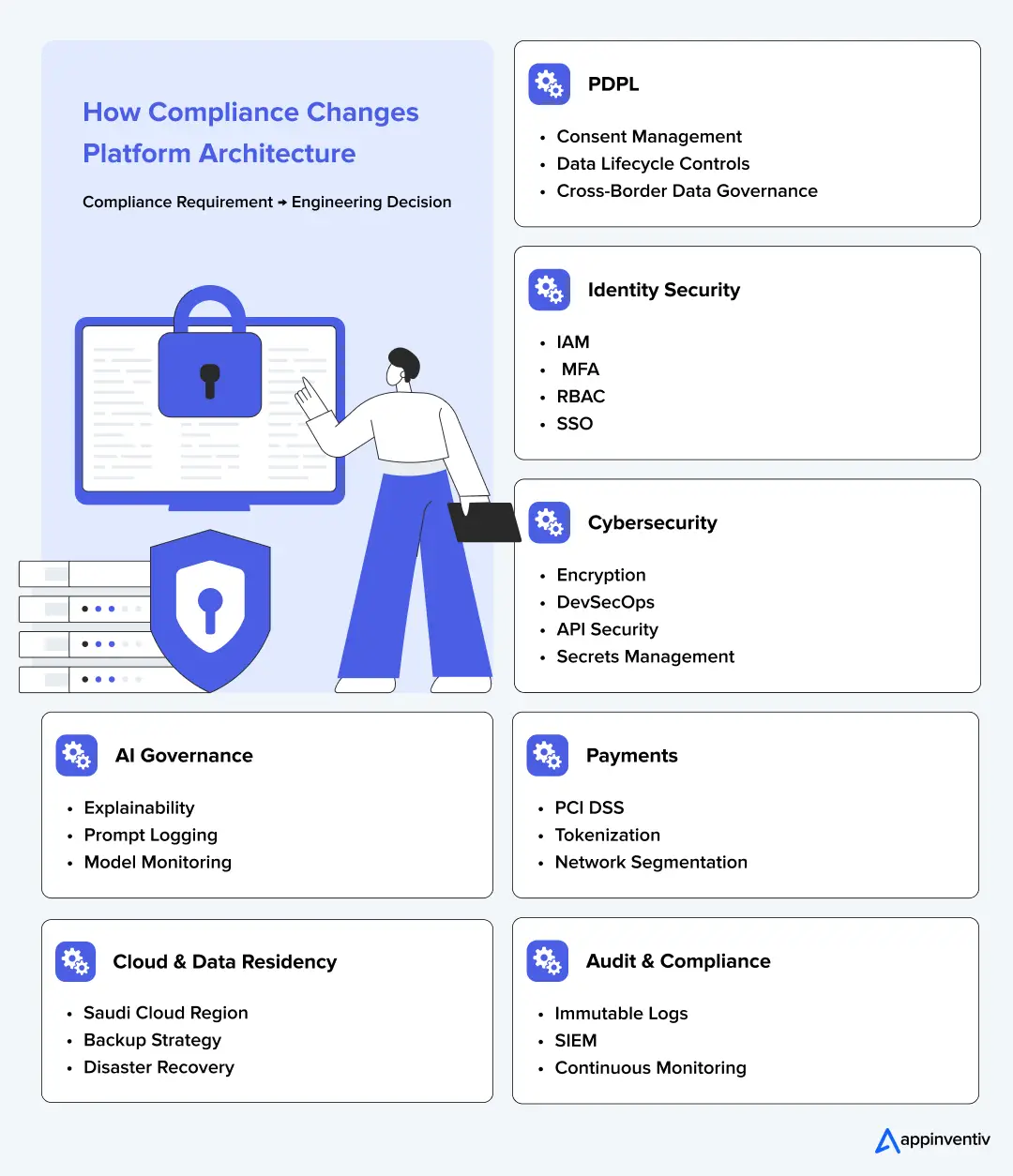
Regulatory requirements dictate modern software design choices, which is why platform development compliance in Saudi Arabia shapes every engineering layer instead of serving as a post-launch check. Systems must embed state protections directly into infrastructure, identity setups, code pipelines, and data stores.
This pattern holds true across software development in the Middle East more broadly, not just in Saudi Arabia.
1. Identity and Access Control
Every user, administrative account, and connected system must be validated before viewing database records. Production deployments use access control engines with multi-factor authentication and role protections. Engineers deploy single sign-on tools and short-lived tokens via OAuth 2.0 or OpenID Connect.
Verizon’s 2025 Data Breach Investigations Report identifies credential abuse as one of the leading causes of security breaches, reinforcing the need for strong identity controls.
2. Data Lifecycle and Privacy
Local regulations require detailed control over how systems process, store, and delete personal records. Technical teams must deploy explicit consent management services and automated data retention and secure destruction schedules.
Platforms should collect only the personal data required for a defined business purpose, following data minimization and purpose limitation principles throughout the data lifecycle.
Databases require text encryption during storage and active transit. Databases should apply encryption, data masking, pseudonymization, or anonymization based on the sensitivity of the personal data being processed.
3. Cross-Border Personal Data Transfers
Enterprise platforms rarely operate within a single country. Cloud backups, analytics platforms, external APIs, and third-party services often transfer personal data across borders. Under the PDPL and its Executive Regulations, organizations must assess personal data transfer regulations before moving data outside Saudi Arabia.
Development teams should establish a secure data transfer framework with appropriate safeguards, encryption, and contractual controls between data controllers and processors. These decisions influence cloud regions, disaster recovery, vendor selection, and backup locations, helping platforms meet Saudi compliance requirements without disrupting business operations.
4. Automated Cybersecurity Pipelines
State security regulators mandate continuous verification rather than annual system audits. Code deployment setups must run automated testing scripts before pushing updates to production. Teams embed static application security testing, software composition analysis, and container scan utilities into main deployment pipelines.
Engineering teams should also maintain incident response playbooks, automated alerting, and recovery procedures to support rapid containment, reporting, and compliance with applicable data breach notification requirements during security events.
Also Read: Cybersecurity Services, Consulting, and Implementation in UAE
5. Sovereign Cloud Infrastructure
Data residency rules dictate cloud provider choices. Engineering groups position core systems inside local cloud regions. They build separate virtual networks, deploy customer-managed encryption keys, and establish regional disaster recovery centers.
6. Segmented Payment Environments
Systems processing credit card transactions must isolate financial records. Applications forward payment details to certified external gateways using secure tokenization links and hosted checkout screens. Architecture designs isolate payment traffic via web application firewalls and strict rate limits.
7. Production AI Governance
Deploying machine learning models or predictive analytics introduces strict accountability rules. Production environments need model version tracking and complete prompt log histories. Systems must include human verification steps for high-risk automated actions and clear data lineage logs.
8. Centralized Auditability
Enterprise platforms connect with external accounting software, database systems, and state APIs. Every connection expands the system boundary. Compliant setups record all administrative changes and system calls inside unalterable log files. Centralized event monitoring applications track these data streams.
Industry-Specific Compliance Requirements in Saudi Arabia
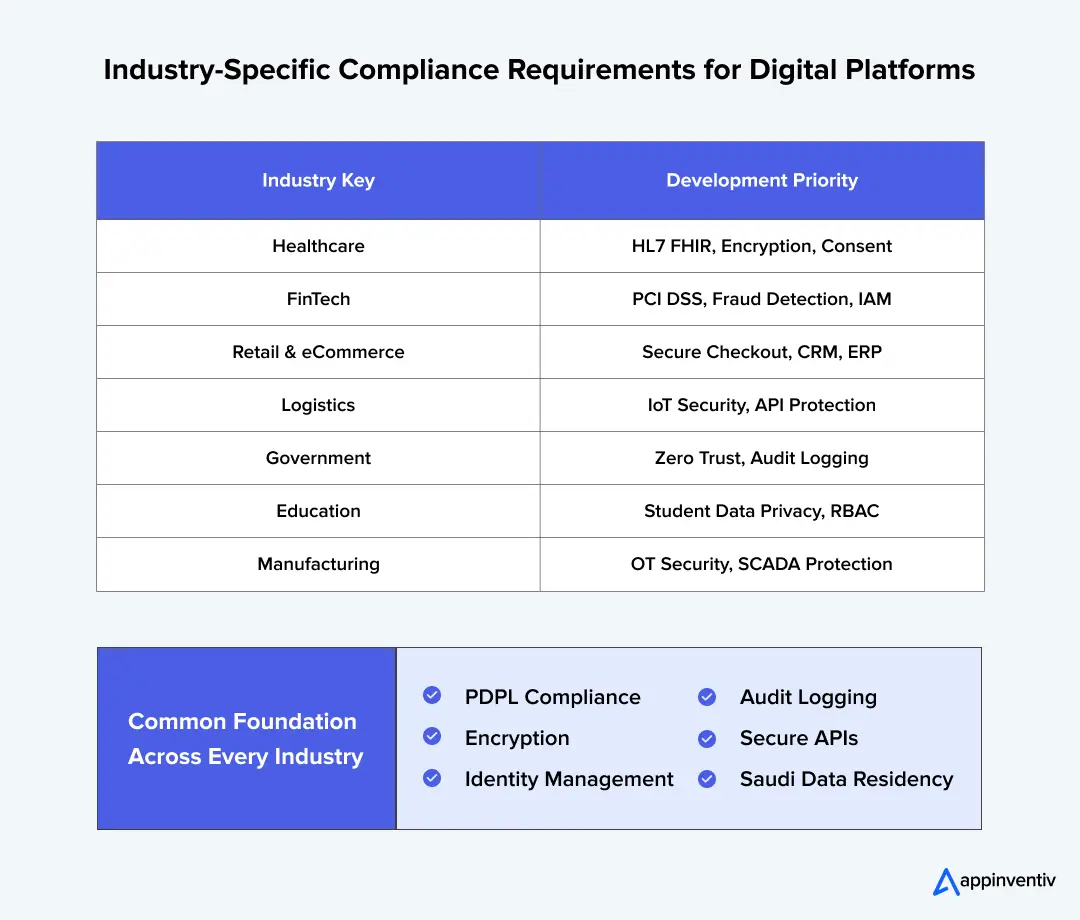
State regulatory baselines remain steady across separate commercial fields. Actual software execution changes based on your data types, target end-users, and connected tools. A medical application prioritizes clinical data privacy and hospital system connections.
A financial application concentrates on payment tracking and fraud blocks. Recognizing these differences allows your development group to build platforms that satisfy both operational metrics and legal rules from day one.
Healthcare
Why Compliance Matters
Medical platforms handle highly sensitive personal details in the Kingdom. Electronic health records, diagnostic scans, lab results, prescriptions, and medical hardware contain regulated information. This data demands strong defense throughout its entire operational lifecycle.
Key Development Priorities
Engineering groups must construct reliable identity verification systems and strict access permissions. They write code for encrypted database files, patient consent screens, and unalterable tracking logs. Your software must support secure communication standards like HL7 FHIR and DICOM. These tools facilitate the exchange of clinical data among hospitals, labs, pharmacies, and insurance carriers.
Architecture Focus
Medical infrastructure features encrypted databases, API gateways, and identity management services. It incorporates centralized event logging, secure cloud hosting, redundant backup servers, and continuous safety scans. Engineers isolate clinical APIs from public web channels to reduce entry threats.
Business Impact
Validated healthcare software prevents launch delays. It builds patient trust and accelerates sales cycles with hospitals, insurance companies, and state medical agencies.
Also Read: Healthcare Mobile App Development in Saudi Arabia
FinTech
Why Compliance Matters
Financial platforms process high-value money transfers, user identities, credit card data, and corporate account ledgers. This is especially true for institutions offering Shariah-compliant banking products, where compliance logic is at the core of the product. Safety failures cause direct capital losses, user fraud, and severe government penalties.
Key Development Priorities
Technical teams build secure payment workflows, automated transfer monitoring, and fraud detection engines. They install tokenized transaction tools, administrative access rules, and automated vulnerability checks. Risk-based logins and behavioral tracking scripts block account takeover attempts.
Architecture Focus
Financial system design incorporates PCI-approved payment gateways and hardware security modules. It relies on API gateways, fraud-checking software, SIEM platforms, and identity tools. Event-driven software tracks cash movements in real time.
For a deeper look at these architectural choices, see our guide to enterprise FinTech app development in the Middle East.
Business Impact
Safe financial architecture secures enterprise corporate partnerships. It accelerates technical supplier reviews and expands buyer confidence in your digital payment features.
Retail and E-Commerce
Why Compliance Matters
Retail applications collect buyer profiles, credit card entries, shipping addresses, loyalty points, and consumer habits across multiple web channels.
Key Development Priorities
Software development focuses on secure checkout structures, data consent tools, and user account shields. Engineers build encrypted payment links, fraud blocks, and connections to payment gateways. The platform integrates directly with ERP, warehouse management, and CRM systems.
Architecture Focus
Digital commerce setups merge microservices, API managers, and headless commerce patterns. They include content delivery networks, secure payment tools, and single identity registries to handle peak buyer traffic.
Business Impact
Embedding statutory protections into the retail code reduces transaction liabilities. It stabilizes consumer trust during the purchase cycle.
Logistics and Supply Chain
Why Compliance Matters
Freight platforms share operational records with shipping companies, deep warehouses, customs agencies, and fleet trackers. They connect with IoT hardware and corporate software. Every single bridge creates new data protection and oversight duties.
Key Development Priorities
Technical teams lock down API lines and defend cargo location metrics. They encrypt IoT sensor data and verify external software links. Engineers maintain complete operational history logs across all supply chain processes.
Architecture Focus
Standard setups unite API gateways, IoT software managers, and event streaming utilities. They run GPS positioning tools, warehouse applications, transit trackers, and unified monitoring screens.
Also Read: Inventory Management Software Development in Dubai
Business Impact
Compliant transit platforms clarify operational visibility. They support secure collaboration across your entire corporate partner network.
Government and Public Sector
Why Compliance Matters
State platforms process national citizen identities, official records, permits, tax filings, and federal web services. System uptime, strict data secrecy, and file accuracy hold equal weight.
Key Development Priorities
System construction prioritizes Zero Trust rules, identity federation, and role permissions. Teams configure encrypted chat channels, disaster recovery plans, continuous monitoring scripts, and total audit logs for every admin action.
Architecture Focus
Public systems hook into secure state networks and federal identity databases. They run file management applications, API layers, SIEM tools, and security operations centers for live threat tracking.
Also Read: How Custom Enterprise Apps Are Powering the Dubai 2040 Vision
Business Impact
High compliance execution simplifies technical security checks. It permits long-term operational clearance in the Saudi public-sector market.
Education
Why Compliance Matters
Academic schools manage private student records, test grades, virtual classrooms, and research libraries. Thousands of students and faculty members use these web learning tools daily.
Key Development Priorities
Platforms guard student identities and lock down learning management software. Developers encrypt academic files, manage family consent steps when necessary, and separate user access for students, teachers, admins, and external groups.
Architecture Focus
School systems integrate learning management platforms, identity verification tools, and group collaboration tools. They link file repositories, analytics services, and safe cloud vaults managed by central identity software.
Business Impact
Regulated academic software protects student data. It maintains secure online learning across regional schools and universities.
Manufacturing
Why Compliance Matters
Industrial platforms merge corporate IT systems with physical operational technology, industrial IoT hardware, assembly equipment, and vendor networks. This mix creates a larger threat area than basic office software.
Key Development Priorities
Code design insulates factory systems using network segmentation and secure industrial gateways. Engineers build encrypted machine communications, high-level access boundaries, and continuous tracking across both IT and operational networks.
Architecture Focus
Production architectures connect manufacturing execution systems with ERP software and SCADA frameworks. They link industrial IoT gateways, predictive repair software, digital twins, and centralized safety monitors.
Business Impact
A compliance-first infrastructure reinforces operational durability. It protects assembly-line continuity and supports the secure rollout of connected industrial projects in Saudi Arabia.
Building Compliant Mobile Apps, SaaS Platforms, and Enterprise Software
As a custom software development company in Saudi Arabia approaches, modern corporate platforms must operate together. A customer places an order on a phone app. This action triggers payments on software platforms and updates corporate accounting databases.
Each connection introduces state compliance rules. Technical teams must design safety, data oversight, and core architecture during early development cycles. Many businesses choose to hire mobile app developers in Saudi Arabia who already understand these compliance layers firsthand.
Mobile Applications: Protecting On-Device Data
Phone applications collect personal records, payment data, coordinates, and face recognition scans. Compliance requirements like these are also a major factor in mobile app development costs in Saudi Arabia, since security architecture requires substantial engineering effort.
Defending this asset starts at the user hardware level. Technical teams must prioritize specific design points:
- Permission controls: Request only the specific access needed for store operations. Explain the business needs clearly to users.
- Biometric logins: Combine fingerprint scans or face recognition with multi-factor authentication for sensitive financial actions.
- Protected storage: Place data tokens and security keys within native phone chips, such as Apple’s Secure Enclave or Android’s Keystore. Avoid basic storage.
- Offline encryption: Scramble stored phone files. Corporate records stay safe when devices lose cellular connections.
- App code defense: Apply certificate validation, runtime tracking tools, and root detection software. These blocks reduce external phone threats.
SaaS Platforms: Tenant Isolation and Data Governance
Cloud software serves multiple corporate clients from shared hardware. Total separation between user corporate profiles is a mandatory architecture rule. A compliant platform includes:
- Multi-tenant boundaries: Separate individual client databases through clear code partitions or separate server hardware.
- Identity management: Use role permissions and single sign-on tools. Deploy industry-standard protocols like SAML 2.0 or OpenID Connect.
- Regional data hosting: Select local cloud data centers that match Saudi data residency regulations.
- Backup recovery plans: Encrypt all secondary data files. Define target recovery times and save file version histories to preserve operations.
- Central tracking: Track account changes, system modifications, and threat incidents through continuous system logs.
Enterprise Software: Locking Down Integration Points
Dubai’s HRMS software development is a common example, since it touches personnel data, access permissions, and payroll systems all at once. Every link expands the system boundary. Core architecture priorities include:
- Corporate network bridges: Connect external resource databases and sales systems using verified, authenticated web interfaces.
- National platform integrations: Enterprise platforms often integrate with Saudi digital services such as Nafath for identity verification or SADAD for payment workflows. These integrations should be secured through authenticated APIs, encryption, and continuous monitoring.
- Interface gateways: Validate data requests, set transfer limits, check incoming file packages, and trace interface traffic across the network.
- Identity governance: Centralize user creation, log monitoring, and validation checks using institutional identity tools.
- Single sign-on setup: Give personnel one corporate identity across all connected tools to simplify team permissions.
- Unalterable audit histories: Record executive commands, account tasks, interface actions, and layout changes to back regulatory reviews.
Compliance Changes Every Architecture Decision
Align infrastructure, APIs, security, and cloud architecture with Saudi regulations before engineering begins.
Adding machine learning tools to a system demands new regulatory controls. Companies must show how algorithms make specific choices. They must document the origin of training data and track system actions after deployment.
Saudi Arabia’s national principles, managed by SDAIA, mandate responsible computing through transparency, accountability, and human control. Enterprise AI integration in the Middle East increasingly follows this same governance-first pattern.
Technical groups build these verification rules directly into the software lifecycle. They do not write them as final documentation after setup.
- Model transparency: Document model purpose, training datasets, version history, and intended use.
- Human oversight: Require manual reviews for high-impact choices in banking, medical, and state sectors.
- AI risk classification: Categorize workloads based on commercial impact and regulatory risk.
- LLM governance: Control access to foundation models, user prompts, and text outputs using explicit policy walls.
- Prompt and response logging: Keep secure records of interaction history to assist regulatory audits.
- Model monitoring: Trace model drift, performance drops, and strange outputs after launch.
- Bias and explainability: Test models for fairness and provide clear reasoning for automated choices. Getting this right often requires bringing in an AI ethics consultant early, before architecture decisions are locked in.
- Data provenance: Record the source, legal ownership, and operational lifecycle of training files.
- RAG governance: Restrict retrieval sources, apply document-level access rules, and block large language models from exposing corporate records.
These controls matter even more as AI agents for ME’s digital transformation take on greater autonomy across businesses in the Middle East.
Embedding Compliance Into the Software Production Cycle
Fix compliance parameters directly inside the software development cycle. Do not save legal reviews for a final pre-launch check. Blending security rules into daily engineering workflows helps tech groups catch risks early. It minimizes code rewrites. Teams ship corporate software with total confidence.
Establish Clear Rules Early
Software creation starts with a plain mapping of data sensitivity and legal rules. This concrete knowledge governs early technical setups before engineers write code. Many enterprises bring in an ME AI implementation consultant at this exact stage to validate architecture decisions before development begins. It dictates cloud selections, database encryption, access configurations, and external integrations.
Run Automated Security Inspections
Automated inspection scripts check every software release. Modern deployment workflows must run specific software tools automatically:
- Static and runtime application security testing (SAST and DAST).
- Software composition analysis (SCA).
- Cloud container and infrastructure-as-code scans.
- Data credential tracking and policy checks.
Maintain Constant System Tracking
Regulatory oversight continues long after the software goes live. Engineering teams must track system actions, network health, and user logons through permanent utilities:
- Centralized activity tracking logs.
- Constant policy compliance scanners.
- Live code threat detectors.
- Cloud environment security tools.
- Immediate security notification protocols.
Gather Audit Records Daily
Audit preparation remains a core part of regular company operations. It is not a frantic exercise before a state deadline. Tech teams keep unalterable logs, system layout records, penetration test summaries, and live data dashboards. This strategy accelerates government inspections. It drops corporate overhead costs.
Weaving defensive methods into the engineering cycle helps corporations deliver safe platforms. Your group minimizes software launch delays. You lower repair bills and build lasting operational strength.
Common Compliance Mistakes That Delay Product Launches
Technical choices made early in development cause most compliance roadblocks. Intricate state regulations rarely cause these project delays. Resolving these technical gaps during initial planning costs far less than fixing them after product deployment.
| Common Corporate Mistake | Direct Commercial Impact | How to Prevent It |
|---|---|---|
| Choosing a cloud host before confirming data residency rules. | Forced infrastructure changes, migration delays, and higher operating costs. | Map out your exact data location needs before signing cloud contracts. |
| Viewing the PDPL as a simple legal paperwork exercise. | Faulty data-gathering methods and illegal file-handling procedures. | Code data consent tools and user rights directly into the application layout. |
| Postponing security engineering until after core code writing finishes. | Costly system rewrites and late product launches. | Use automated deployment methods and insert safety checks during early architecture planning. |
| Operating without a unified system activity tracking registry. | Blind spots during state audits and security investigations. | Keep permanent, unalterable logs for user actions, interface calls, and admin choices. |
| Deploying weak system interface validation steps. | Greater danger of data leaks and criminal access. | Lock down system communication using OAuth 2.0, OpenID Connect, mTLS, and gateway tools. |
| Mixing live product data with testing environments on shared servers. | Expanded data exposure dangers across corporate workloads. | Isolate live production environments and apply strict entry blocks. |
| Neglecting technical risk reviews for external software suppliers. | Weak external software links that compromise your main platform. | Review cloud hosts, external tools, and software partners before system linkage. |
| Launching artificial intelligence tools without an oversight rule set. | Weak model control and high exposure to regulatory penalties. | Set up model tracking, prompt history logging, manual reviews, and live behavior monitoring. |
| Missing clear rules for data storage timelines. | Storing sensitive files for too long and violating state records retention acts. | Configure automated schedules to securely wipe regulated data files. |
| Overlooking special rules for your specific business sector. | Long holdups during client procurement and official state approvals. | Document special market duties during the initial system exploration phase. |
| Neglecting local software regulations before submitting your corporate application. | State legal penalties, late product launches, or total bans within the Saudi market. | Check statutory rules before publishing software. Run formal legal and data security reviews during regular release cycles. |
How Compliance Planning Affects Development Cost
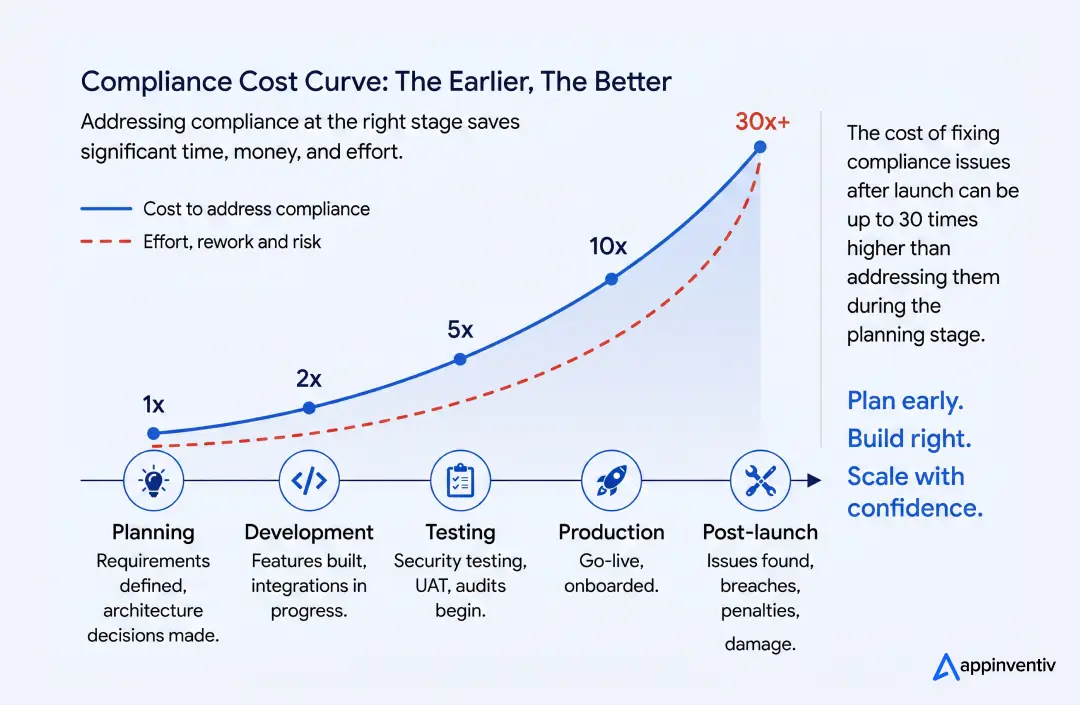
Regulatory rules do not inherently raise software engineering budgets. Late discovery of security gaps causes actual cost spikes. Catching these errors after deployment forces expensive work.
Building protections into your platform from day one reduces redesign work, minimizes code fixes, and shortens government approval timelines.
This is especially relevant for organizations pursuing legacy system modernization in Dubai and across greater Saudi Arabia, where legacy architectures and new compliance rules often collide.
| Project Phase | Without Compliance Planning | With Compliance by Design |
|---|---|---|
| System Architecture | Heavy code rewrites to patch security gaps. | Teams integrate state rules directly into the blueprint from day one. |
| Software Development | Engineers slap security tools onto completed code. | Teams write encryption, access tokens, and activity logs alongside business tools. |
| System Testing | Repeated rounds of vulnerability fixes and manual audits. | Automated scripts test security rules during daily code deployment. |
| Pre-Launch Operations | Long delays for penetration tests and missing data records. | Audit evidence and security reports sit ready for immediate state inspection. |
| Post-Launch Scaling | Steep maintenance bills, live system updates, and state fines. | Smaller operational dangers and fewer code alterations as the software grows. |
Enterprises evaluating ERP software for their operations should apply this same vendor-review discipline before integration.
The biggest compliance cost comes from redesign rather than implementation. Building security, IAM, encryption, monitoring, and audit controls early reduces technical debt and avoids expensive production changes.
Ship Faster With Compliance
Build secure platforms that satisfy Saudi regulatory expectations before launch, procurement, and enterprise security assessments.
A Practical Starting Checklist for Founders & CTOs
Verify these technical controls before deploying digital systems in the Kingdom.
- PDPL Data Readiness: Activate customer data consent tools, user deletion choices, and storage timelines.
- NCA Cybersecurity Safeguards: Merge national baseline protection codes directly into the core system.
- Data Encryption: Protect all private communication and database records during storage and active transfer.
- Local Data Residency: Route your production servers and storage nodes inside local Saudi cloud boundaries.
- User Identity Controls: Set up single sign-on access, multi-factor tokens, and explicit role permissions for all staff.
- Supplier Safety Audits: Finalize formal technical safety inspections for every connected external cloud vendor.
- Permanent Audit Logs: Capture database queries, administrator changes, and API actions inside unalterable tracking logs.
- System Penetration Testing: Run mock digital attacks to find and patch software flaws before launching.
- Responsible AI Rules: Build manual verification loops, prompt history tracking, and logic logs for machine learning tools.
- Disaster Recovery Controls: Test server failover speed, emergency backup files, and corporate continuity actions.
Build Compliant Digital Platforms in Saudi Arabia with Appinventiv
Building secure software in Saudi Arabia demands strong engineering skills. Teams must turn strict state rules into secure databases, cloud setups, and application code. Appinventiv constructs mobile applications, cloud software, and artificial intelligence programs. We weave corporate safety regulations into your system from the very first week of planning.
Our engineering groups insert data encryption, user access controls, and automated code testing into every software update.
This compliance-first approach also helps enterprises prepare for procurement reviews, vendor security assessments, architecture evaluations, and technical due diligence conducted by large organizations and public-sector entities across Saudi Arabia.
Our regional experience includes delivering digital products for organizations such as Petromin, Hakbah, and Watani, helping businesses build platforms aligned with evolving Saudi compliance requirements.
This process prevents deployment delays and shields your organization from regulatory penalties. We know the technical realities of the Saudi Arabian market. Our regional track record includes:
- 1,000+ completed technology projects across the Middle East.
- 35+ commercial industries served.
- 12+ state compliance programs completed.
- 10+ years of regional operating experience.
- 95% verified client satisfaction rate.
- 99.90% server uptime for critical corporate software.
- Up to 40% budget savings when modernizing older IT configurations.
Appinventiv operates as a dedicated mobile app development company in Saudi Arabia. We also serve as a trusted AI-powered development partner in Saudi Arabia.
Our teams build secure, dependable systems rooted in platform development compliance Saudi Arabia standards for your long-term corporate expansion.
Let’s connect and build AI platforms ready for Saudi compliance.
Frequently Asked Questions
Q. Does every app in Saudi Arabia require compliance?
A. Yes. Platform development compliance Saudi Arabia rules apply to any mobile application, cloud system, or enterprise platform that stores consumer data. Your specific obligations depend on your business model, payment tools, and artificial intelligence features. The state regulates all digital platforms that manage local citizen records.
Q. Do startups also need PDPL compliance in Saudi Arabia?
A. Yes. The Personal Data Protection Law applies to all businesses regardless of corporate size. As part of software compliance in Saudi Arabia, startups must build explicit user consent screens and data safety tools if they handle customer files or employee profiles. Ignoring these rules brings heavy state fines.
Q. Does AI create additional compliance requirements in Saudi Arabia?
A. Yes. Machine learning systems require deeper oversight than basic software tools. Technical groups must document the origins of model training and record all user prompt histories. They must also include mandatory human-review steps to comply with national computing rules.
Q. Which industries have the strictest compliance requirements?
A. Under app compliance requirements in Saudi Arabia (KSA), commercial banking, healthcare networks, telecom firms, and government departments face the tightest regulations. These sectors handle sensitive citizen records daily. They require advanced user identity checks, strong database encryption, and continuous network-tracking logs.
Q. Can compliance be added after development?
A. Yes, but this choice delays your product launch. Rewriting cloud infrastructure blueprints or modifying system interfaces late in the project requires heavy engineering hours. Building these protections from the start works much better and saves time.
Q. How much does compliance affect development cost?
A. Early planning balances your product budget. Spending hours on security architecture and access permissions early blocks expensive code rewrites during the final test phase. This proactive method drops your long-term maintenance bills and development debt.
Q. Do I need Saudi cloud hosting for my app?
A. Not always. Your hosting location depends on your market sector and target users. Review the exact national data residency laws for your industry before selecting a public cloud provider or a regional backup facility.
Q. Should compliance be discussed before starting development?
A. Yes. Address state regulations during the initial solution discovery phase. Early planning defines your hosting choices, user permissions, and interface security controls. This step removes critical project risk before your technical group writes code.
Q. What are the penalties for PDPL noncompliance in Saudi Arabia?
A. PDPL noncompliance can result in warning notices, regulatory investigations, and fines not exceeding SAR 5,000,000, depending on the nature of the violation. Organizations should use automated alert systems, real-time alerts, and continuous compliance monitoring to identify compliance issues early and reduce enforcement risks.
Q. How should platforms handle data subject rights under the PDPL?
A. Platforms should support data subject rights under the PDPL, including the right to know, the right to access personal data, correction, the right to destruction, and the ability to withdraw consent. Development teams should capture consent, automate data rights fulfillment, track recipients of personal data disclosures, and help data controllers and processors manage information throughout its lifecycle.
Q. What should organizations do after a data breach under the PDPL?
A. Organizations should activate incident response plans immediately after detecting unauthorized access to personal data. Under the PDPL and its Executive Regulations, data controllers should follow applicable data breach notification requirements, maintain data protection safeguards, document the incident, and notify the relevant regulatory authority where required.