
Key takeaways:
- Machine learning governance helps enterprises manage AI risk, ensure compliance, and maintain control throughout the ML lifecycle.
- Organizations with strong governance frameworks scale AI faster while reducing operational, regulatory, and financial risks.
- Effective ML governance requires model inventory, risk classification, clear ownership, continuous monitoring, and automated audit trails.
- Building governance into AI projects costs significantly less than fixing security breaches, compliance failures, or failed AI initiatives later.
- As agentic AI adoption grows, governance must evolve to address autonomous decision-making, identity management, and human oversight.
- Governance is no longer just a compliance requirement. It is a strategic capability that enables enterprises to deploy AI confidently at scale.
A model gets deployed on a Friday. By the following Wednesday, it is flagging a spike in false positives, nobody remembers who owns it, and the data science team that built it has moved on to the next sprint. This is not a hypothetical. It is the default state of machine learning inside most enterprises today, and it is exactly the gap that machine learning governance exists to close.
The numbers back this up. According to a market report, 88% of organizations now report regular AI use in at least one business function, but only 8% run a comprehensive governance framework, a figure that falls to 2% among smaller firms. That 80-point gap is not a footnote. It is where AI incidents, regulatory exposure, and wasted budget all originate.
AI-related incidents climbed 55% year over year through 2025. Meanwhile, 74% of all economic value created by AI is concentrated in just 20% of organizations- the ones disciplined enough to govern what they ship, not just build it.
So the real question facing CTOs, CIOs, and CFOs in 2026 is not whether machine learning governance is worth the investment. It is how to build it without grinding data science velocity to a halt or torching the budget on tooling nobody uses. Enterprises weighing this decision often start by evaluating an experienced machine learning development services partner rather than building governance capability from zero.
This guide walks through what machine learning governance actually is, why it matters at the enterprise level, how to implement it in practice, what it costs, where teams get stuck, and how to fix it.
Struggling with AI Risk You Can’t Yet See?
Get a clear governance roadmap built around your model portfolio, your regulatory footprint, and your existing AI stack, not a generic template.

What Does Machine Learning Governance Actually Mean?
Strip away the buzzwords and machine learning governance comes down to one thing: control over the full lifecycle of a model, from the data that trains it to the decision it eventually makes in production. That means lineage tracking, risk tiering, documentation, bias testing, access controls, and monitoring that doesn’t stop the day the model ships.
It gets confused with AI in data governance constantly, and the distinction matters more than it sounds. Data governance is about whether your inputs can be trusted: is the data clean, is it labeled correctly, who can touch it. Machine learning model governance picks up from there. It asks whether the system built on top of that data, the model, its outputs, and the humans accountable for both, can withstand an audit.
Put differently: data governance protects the fuel. ML governance protects the engine, and everyone standing near it when it runs.
Why Does Machine Learning Governance Matter for Enterprise AI?
Governance used to be the function that showed up after something broke. That has changed. Enterprises that treat ML as a portfolio of production systems, not a pile of side projects, are the ones actually converting AI spend into business value.
Three pressures are driving this shift:
- Operational risk. A model retrained without notice. A feature pipeline that changes silently upstream. An auditor asking how a specific credit decision was made, and no team able to reconstruct the answer. These aren’t edge cases, they’re what happens by default without governance.
- Regulatory exposure. Regulators no longer want a policy document describing good intentions. They want evidence: model registries, risk classifications, audit trails. Machine learning governance for regulated industries, banking, insurance, healthcare in particular, has shifted from “nice to have” documentation to the artifact you hand over during an exam.
- Value capture. ML platforms are now judged on whether they govern the full lifecycle, not on training speed alone. Governance, done right, compounds. It’s the reason some enterprises scale from ten production models to two hundred without the wheels coming off, and others stall at fifteen.
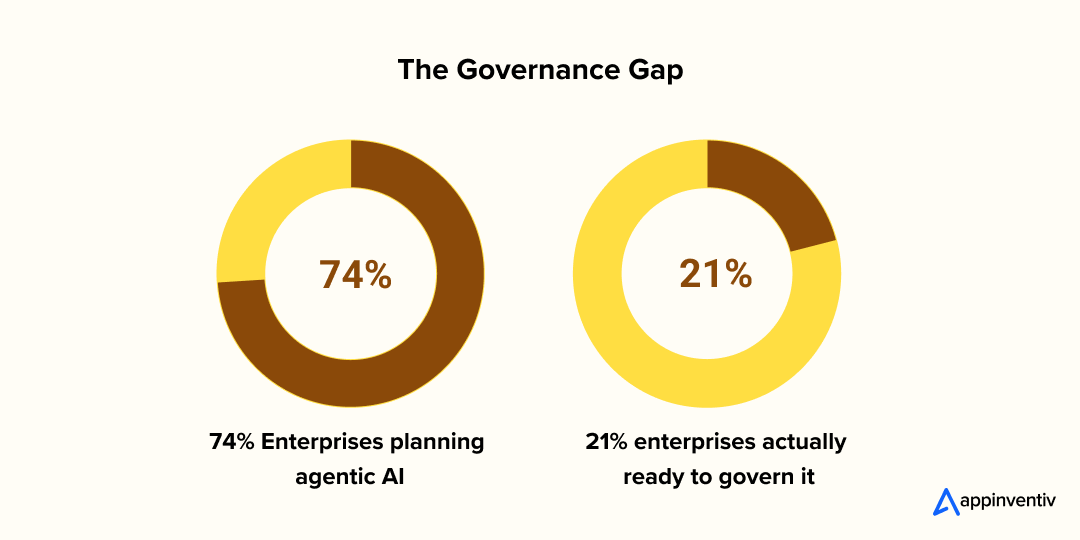
Agentic AI in enterprise raises the stakes further. 74% of organizations plan to deploy agentic AI within two years. Only 21% currently have a governance model mature enough to handle it. Multi-agent systems introduce problems static model governance was never built for: agent identity, autonomy boundaries, and knowing exactly when a human needs to step in before an agent executes an irreversible action.
How Do You Implement Machine Learning Governance, Step by Step?
Order matters here more than most teams expect. Enterprises that try to run these steps in parallel, or skip the boring ones to get to tooling faster, tend to be rebuilding their governance program from scratch within 18 months.
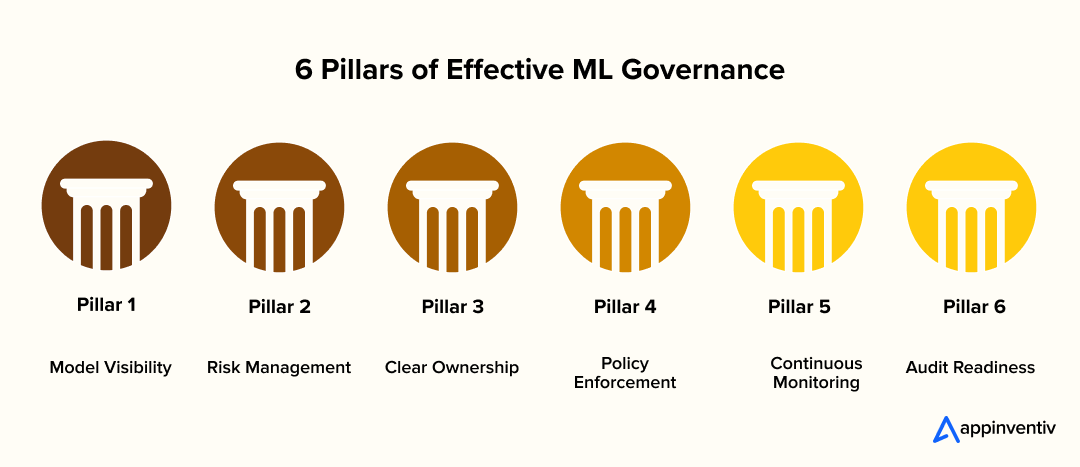
Step 1: Inventory everything first: Map every AI and ML system currently running, in production or otherwise, with its owner, data sources, and business purpose attached. Nothing after this step works if the inventory is incomplete.
Step 2: Classify risk before you build controls: Assign each model a risk tier based on potential impact, ideally against an established reference like NIST AI RMF’s Govern, Map, Measure, and Manage structure rather than inventing a taxonomy internally.
Step 3: Assign real ownership: Every model needs an accountable human, not a team distribution list. Governance that works spreads responsibility across data engineering, data science, legal, compliance, and security instead of parking it all with one overwhelmed team.
Step 4: Put technical controls in place: Lineage tracking, model documentation, access controls, bias testing. This is where machine learning governance tools and unified metadata platforms earn their keep, since manual tracking collapses somewhere around model number thirty.
Step 5: Wire in continuous monitoring: Connect drift detection and performance tracking directly into your MLOps pipelines with automated alerting, understanding how MLOps differs from DevOps when scaling AI. If governance issues only surface during quarterly reviews, they’ve already been live in production for months.
Step 6: Automate the audit trail: Generate model cards and decision logs as a byproduct of the pipeline, not as a scramble two weeks before an audit. Manual evidence-gathering is where governance programs quietly die.
Step 7: Revisit the roadmap regularly: The machine learning governance roadmap isn’t a document you file away. Regulations shift, agentic AI adds new risk categories, and risk classifications that made sense last year may not hold up this year.
Realistically, a foundational program takes four to six months end to end: four to six weeks for assessment, eight to ten weeks for policy work, six to eight weeks for technical controls, four to six weeks for training rollout.
Mapped the Steps. Need Hands to Execute Them?
Appinventiv builds the technical controls, monitoring, and audit trail so your governance roadmap turns into a running program, not a slide deck.

How Much Does Machine Learning Governance Cost?
Budgets vary depending on scale, regulatory footprint, and how many models are actually in production. Much like general AI development cost estimates, most enterprise machine learning governance programs land somewhere between $40,000 and $400,000 to implement.
| Scope | Typical Cost |
|---|---|
| Foundational governance program (single business unit, core policies plus basic tooling) | $40,000 – $150,000 |
| High-scale governance build (multiple business units, automated documentation, monitoring) | $150,000 – $400,000 |
| Annual maintenance | 25-50% of initial build cost |
The more useful number, though, is what happens when you skip governance altogether. Remediation after the fact runs 15 to 25 times higher than what it would have cost to build governance in from the start. The average data breach hit $4.44 million in 2026. Healthcare breaches averaged $7.42 million, financial services $5.56 million. Shadow AI, tools running without any governance oversight, can tack on another $600,000-plus to breach costs, mostly because security teams have zero visibility into what they’re even dealing with.
Forecasting is its own problem. More than half of enterprises miss their AI cost projections by 11-25%, and nearly a quarter miss by more than 50%. Building governance into the original AI budget, rather than bolting it on later, is one of the simplest ways to start scaling AI projects cost-effectively.
What Are the Core Components of ML Governance?
A governance program that actually functions rests on a handful of building blocks. Miss one, and the gap shows up later, usually during an audit or an incident, which is the worst possible time to discover it.
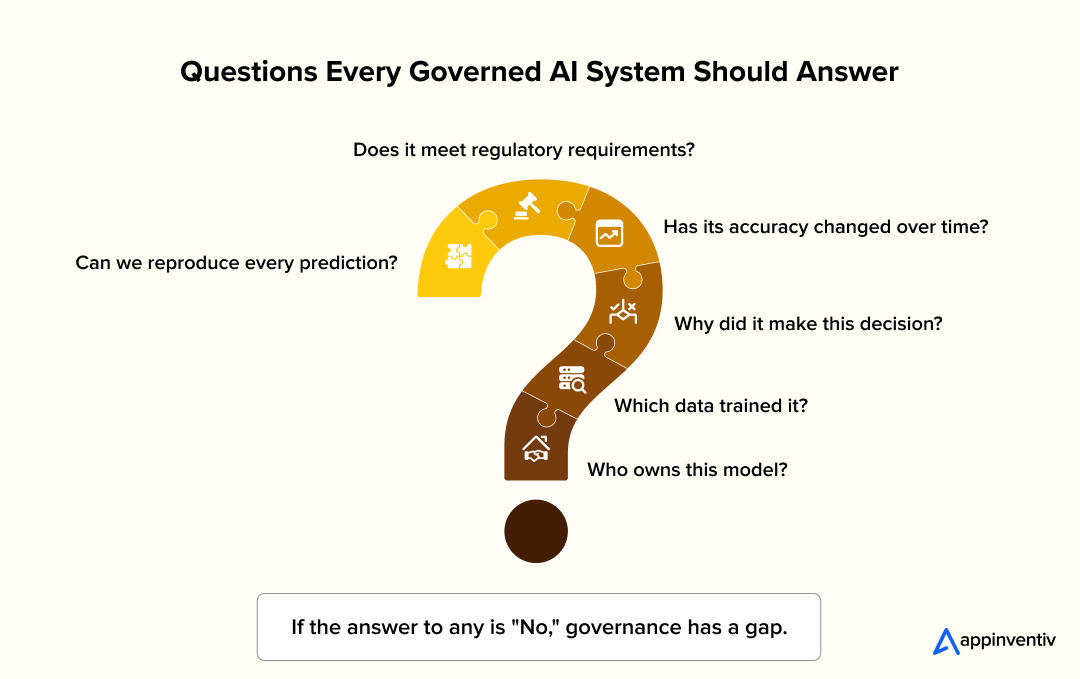
- Model inventory and asset registry – a single, current record of every model in production: owner, purpose, training data, risk tier. You cannot govern a model you don’t know exists, and shadow models are more common than most CIOs assume.
- Risk classification – a structured tiering system, borrowed from frameworks like NIST AI RMF or the EU AI Act’s minimal/limited/high/unacceptable scale. Part of a broader AI in risk management discipline: a recommendation engine and a lending model do not carry the same risk, and they should not carry the same controls.
- Model documentation (model cards) – training data sources, intended use, known limitations, bias testing results, version history. Treat this as the clinical trial paperwork of AI: when a regulator or customer asks for proof, this is the answer.
- Monitoring and drift detection – continuous tracking of performance decay, data drift, and emergent bias, wired into alerting, with AI model collapse prevention practices built in. A model that was accurate in January can be quietly producing biased outputs by June, and nobody notices without instrumentation watching for it.
- Governance structure and accountability – named executive ownership, cross-functional representation (data science, legal, compliance, security), and an escalation path that doesn’t dead-end in a Slack channel nobody checks. Many enterprises formalize this through an AI center of excellence.
- ML governance architecture – the technical layer connecting all of the above, typically bolted onto existing custom MLOps platforms rather than standing alone as a separate system nobody integrates with.
Where Is the ML Governance Market Headed in 2026?
The spending trajectory tells its own story. The global AI governance market sat at $308.3 million in 2025 and is on track to reach somewhere between $1.42 billion and $3.59 billion by the early 2030s depending on which analyst you ask, at a compound annual growth rate north of 35%.
Three shifts are worth watching closely:
- Generative and predictive ML are converging. Enterprises are learning, sometimes the hard way, that GenAI and predictive models need to sit on the same governance and monitoring infrastructure. Running them as separate, ungoverned stacks just doubles the blind spots.
- Regulation is spreading past the usual suspects. Governance pressure used to concentrate in government and defense. It’s now expanding hard into finance, life sciences, and healthcare, where bias and privacy failures carry direct legal consequences.
- Identity and access are becoming the new governance battleground. AI-related attacks jumped almost 490% year over year as enterprises expanded their AI footprint faster than their visibility into it. AI agent security, governing who and what can access a model, is turning out to matter as much as governing the model itself.
What Are the Biggest ML Governance Challenges Enterprises Face?
The same obstacles show up across nearly every enterprise governance rollout:
- Ownership gets fragmented: Spread governance across departments without a coordinating structure and compliance incidents run three times higher. Someone has to own the whole thing, not just a slice of it.
- Shadow AI keeps outpacing central review: Teams adopt tools faster than governance can catalog them, and the blind spots only surface after something goes wrong.
- Regulation won’t sit still: The EU AI Act regulation and compliance timeline has already shifted once in 2026, with high-risk obligations possibly pushed to December 2027 pending the Digital Omnibus package. US AI regulation and compliance, meanwhile, splits oversight across the OCC, SEC, CFTC, and FDA instead of one federal law. Governing across jurisdictions means governing a moving target.
- Agentic systems break static playbooks: Governance frameworks built for a model that predicts a number don’t map cleanly onto a system of agents making decisions and calling tools autonomously. This is why more enterprises are starting to build agentic AI governance frameworks from the ground up rather than retrofit existing ones. Identity, autonomy limits, and oversight triggers need rethinking, not retrofitting.
- Business alignment gets lost: Governance framed purely as a compliance exercise loses executive sponsorship fast. Many of the AI adoption challenges enterprises face trace back to this exact disconnect. The programs that survive budget cuts are the ones tied directly to risk reduction and provable ROI, not just checkbox compliance.
Hitting These Roadblocks Already?
Fragmented ownership, shadow AI, shifting regulation. Appinventiv helps enterprises fix the exact gaps slowing governance down, before they turn into incidents.

What Are the Best Machine Learning Governance Solutions?
The enterprises getting this right tend to share a handful of habits, not a single silver-bullet tool.
Start minimal, expand deliberately: Build the leanest governance layer that gives real transparency and risk control, then scale it as AI use grows. Overbuilding a comprehensive framework before you know which risks actually materialize wastes budget and slows everyone down for no measurable benefit.
Make governance code, not a checklist: Policy checks, deployment gates, and audit logging belong inside the MLOps pipeline itself, wired into tools like Jira or ServiceNow your teams already use. Governance that lives inside the workflow gets followed. Governance that exists as a separate review step gets quietly routed around.
Decide buy versus build early: Smaller model portfolios can usually extend an existing platform using a GRC implementation framework. Larger, higher-risk portfolios generally need dedicated ML governance workflow integration purpose-built for the job, a classic custom AI vs off-the-shelf AI tradeoff, not a spreadsheet with delusions of scale.
Anchor to a recognized framework: Custom machine learning governance solutions built entirely from scratch take longer to implement and are harder to defend to auditors than programs mapped to NIST AI RMF, ISO 42001, or the EU AI Act, even where compliance isn’t yet legally required.
Build the cross-functional structure on day one: IT, cybersecurity, compliance, legal, data science, and business leadership need a shared steering table from the start. Bolting this on after the fact is where most governance programs stall out.
Enterprises that need machine learning governance implementation support without building an entire program in-house typically get there faster by partnering with an experienced development provider.
How Appinventiv Helps
Appinventiv offers machine learning development services and implements governance programs designed to survive regulatory scrutiny without slowing down AI delivery. That includes model inventory and risk classification, technical controls like lineage tracking and drift monitoring, and operating models tailored to sector-specific rules across BFSI, healthcare, and other regulated industries.
For enterprises further along their AI maturity curve, looking to connect governance to broader AI risk strategy rather than treat it as a standalone project, Appinventiv’s AI governance consulting services provide the strategic layer that ties governance directly to business outcomes.
Whether the starting point is one high-risk model or a global AI portfolio spanning multiple business units, the goal stays the same: governance that lets enterprises scale AI with confidence, not governance that gets in the way of shipping.
Frequently Asked Questions
Q. How can enterprises maximize ROI from machine learning governance?
A. Tie governance metrics directly to business outcomes, not just compliance status. Track things like faster model approval cycles and reduced incident rates. That’s what keeps executive sponsorship alive and proves governance is paying for itself beyond avoiding fines.
Q. What are the must-have components of an enterprise machine learning governance operating model?
A. At a minimum: a complete model inventory, a risk classification system, named ownership with a real escalation path, model documentation, and continuous drift and bias monitoring. Skip any of these and the gap shows up later, usually at the worst time.
Q. Can machine learning governance be integrated into an existing AI ecosystem without disrupting operations?
A. Yes, if it’s built as code inside existing MLOps pipelines rather than bolted on as a separate manual review step. Start with inventory and risk classification, then layer in automated controls. That sequencing minimizes disruption to programs already in flight.
Q. How does Appinventiv help enterprises implement machine learning governance?
A. Appinventiv builds governance programs around an enterprise’s existing AI ecosystem and regulatory footprint, covering model risk classification, technical controls, and ongoing monitoring, so governance strengthens AI delivery instead of slowing it down.