Summary
| Predictive personalization uses AI to anticipate each customer’s next need based on behavioral signals rather than static segments or rules, shifting marketing from reactive triggers to proactively identifying intent before customers act. Success depends on a continuous loop of unified data, propensity scoring, and real-time orchestration, as batch segmentation can’t keep up with how customers actually behave across channels. |
Most marketing teams treat personalization as a reaction engine. A customer abandons a cart, so you send a discount. They browse a category, so you show related products. But by the time you react, the moment has already passed.
Predictive personalization flips that model. It uses AI to anticipate what each customer will do next and intervenes before they act. Instead of waiting for explicit signals like cart abandonment or a support ticket, you score intent in real time and deliver the right message, offer, or experience while the customer is still deciding.
This shift from reactive segmentation to proactive intervention changes how growth and retention teams operate. It protects margin by suppressing discounts for high-intent users, reduces churn by flagging disengagement before customers cancel, and optimizes lifetime value by balancing short-term conversion against long-term customer quality.
This guide explains how predictive personalization works, what infrastructure it requires, and where it creates the most leverage across the customer journey. You’ll learn the difference between propensity scoring and uplift modeling, how to unify data for real-time decisioning, and how to orchestrate predictions across channels without over-messaging customers.
We’ll also cover the operational safeguards that prevent model drift and the measurement rigour required to prove incremental lift.
What is predictive personalization?
Many teams confuse predictive personalization with advanced segmentation or product recommendations. They solve different problems.
Predictive personalization uses machine learning to anticipate individual customer behavior and deliver the right message, offer, or experience before the customer explicitly signals intent. Segmentation looks backward at what groups have done. Predictive personalization looks forward at what an individual will do.
Segmentation groups customers by shared traits, like “women who bought shoes recently.” Recommendation engines surface products based on similarity, showing “customers also bought” suggestions. Predictive personalization scores each individual’s likelihood to take a specific action and intervenes accordingly.
| Approach | What it does | When it acts | Example |
| Rules-based personalization | Applies fixed logic to segments | After trigger event | “Show discount banner to cart abandoners” |
| Recommendation engine | Surfaces similar or popular items | During browsing | “Customers also bought these sneakers” |
| Predictive personalization | Scores individual intent and selects next-best action | Before explicit signal | “Suppress discount for high-intent user; offer free shipping instead” |
Why predictive personalization matters for growth and retention.
Rules-based personalization becomes less effective when customer journeys fragment across channels. Manual segment maintenance can’t keep pace with behavioral shifts. Static rules fail to adapt to the non-linear way customers shop and engage.
Predictive personalization changes the operational model from volume-based targeting to precision-based intervention:
- Conversion lift: Predictions identify high-intent users who don’t need discounts, protecting margin while still converting
- Churn reduction: Models flag at-risk customers before they disengage, enabling preemptive intervention rather than reactive win-back campaigns
- Lifetime value (LTV) optimization: Next-best-action decisioning balances short-term conversion against long-term value, avoiding over-discounting that erodes customer quality
Predictive personalization requires sufficient historical event data to train models effectively. Teams with smaller user bases or limited behavioral instrumentation see diminishing returns until data maturity improves.
How predictive personalization works across channels.
Most predictive personalization initiatives stall because teams treat data unification, model scoring, and journey activation as separate projects. Different teams own each piece with misaligned timelines. Success requires a unified infrastructure where these elements feed into each other.
Think of it as a continuous loop: collect → predict → decide → deliver → measure → retrain. The loop must close for predictions to improve over time.
Unify customer data with an actionable CDP.
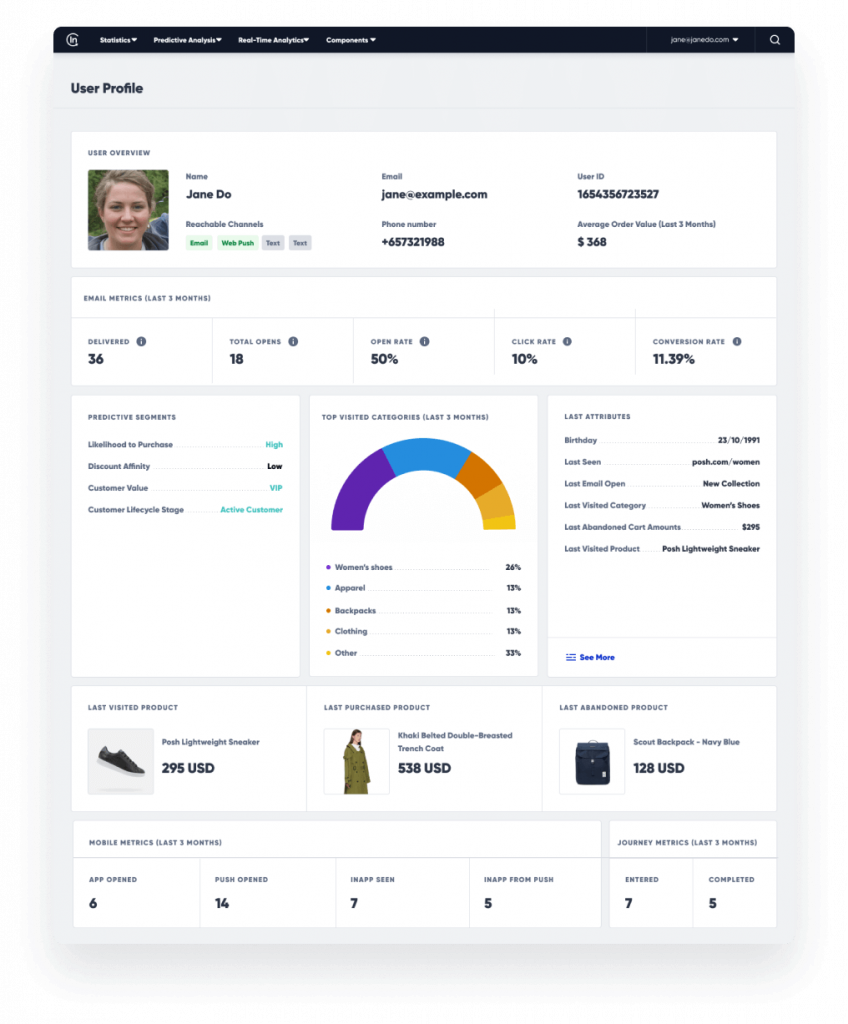
Teams often assume they have unified data because profiles exist in a customer data platform (CDP), yet few brands have the data needed to truly understand their customers. Predictions fail when identity resolution is inconsistent or event taxonomies vary across sources. A model can’t learn from a user’s web behavior if it can’t connect that data to their mobile app activity.
Minimum viable data for predictive personalization requires the following elements:
- Identity resolution: Deterministic matching (email, phone, user ID) across channels
- Event taxonomy: Standardized event names and parameters across web, app, and offline sources
- Recency: Behavioral data that isn’t recent contributes less to intent prediction
Before launching predictive models, assess your data readiness:
- Do you have a single identifier that stitches profiles across channels?
- Are event names and parameters consistent across web, app, email, and point-of-sale?
- Can you access recent behavioral data in real time?
If you want to see what “unified data you can actually activate” looks like in practice, request a demo, and we’ll walk through the full loop from identity to real-time decisions.
Score intent and next best action with AI.
Choosing the right model depends on the specific decision you need to make. Are you predicting who will convert, who needs help converting, or which content works best right now?
| Goal | Model type | When to use | Constraint |
| Identify high-intent users | Propensity model | When you want to prioritize outreach to likely converters | Doesn’t account for whether your action changes behavior |
| Measure incremental impact | Uplift model | When you want to target users who wouldn’t convert without intervention | Requires holdout testing infrastructure |
| Optimize in real time | Contextual bandits | When you have multiple treatments and want to learn which works best per user | Needs sufficient traffic volume to explore options |
New users present a data-scarcity challenge, often called a “cold start,” because they lack behavioral history. Hybrid approaches combine collaborative filtering (looking at similar users) with contextual signals like device type, referral source, and time of day until individual behavior accumulates.
Propensity models alone can waste budget on users who would convert anyway. If margin protection is a priority, combine propensity with uplift modeling to identify “persuadables,” users who will buy only if they receive an incentive.
To compare model approaches side-by-side and see where propensity stops and uplift starts, explore the product demo hub for real examples of intent scoring and next-best-action in motion.
Orchestrate journeys in real-time across channels.
Predictions lose value when journey orchestration can’t act fast enough. A churn score generated overnight is useless if the at-risk customer already received several promotional emails that same morning.
Latency requirements vary by channel:
- Web/app personalization: Near-instant decisioning required
- Email/short message service (SMS)/push: Minutes to hours acceptable
- Paid media: Daily or near-real-time sync to ad platforms
Without safeguards, predictive models can over-message users. Fatigue rules protect the customer experience:
- Frequency capping: Limit total touches per user per day/week across all channels
- Suppression rules: Exclude recent purchasers, support ticket openers, or users who opted out of specific categories
- Channel hierarchy: Define which channel takes priority when multiple triggers fire simultaneously
Tighter frequency caps protect experience but reduce reach. Teams with aggressive growth targets should test cap thresholds rather than defaulting to conservative limits.
If your bottleneck is activation speed (not model accuracy), request a demo to see how real-time orchestration keeps predictions from being delayed before activation.
Predictive personalization use cases across the customer journey.
Where in the customer journey do predictions create the most leverage? Usually where your current approach relies on static rules or manual triggers that fail to account for individual context.
Cart recovery with margin protection
Standard cart recovery treats every abandoned cart the same, despite an average cart abandonment rate of about 70%, often training customers to wait for a discount. Predictive personalization changes the offer based on the user’s likelihood to buy. Suppress discounts for high-intent users; offer free shipping or urgency messaging instead. Recovered carts without eroding margin on users who didn’t need incentives.
Churn prevention for subscription brands
Reactive win-back campaigns often reach customers after they’ve already mentally checked out. Predictive models identify subtle signals of disengagement weeks before cancellation happens. Trigger proactive outreach, like a value reminder, exclusive content, or human check-in, before the renewal window. Intervention reaches at-risk users while they’re still persuadable.
Cross-sell timing for ecommerce
Recommending a complementary product immediately after purchase can feel pushy or irrelevant. Predictive timing ensures the offer arrives when the customer is actually ready to buy again. Surface complementary products when the user is in-market, not immediately post-purchase. Higher cross-sell conversion because the offer aligns with intent, not just recency.
Send-time optimization for email
Batch-and-blast email scheduling ignores the fact that different users engage at different times. AI predicts the optimal engagement window for every individual on your list. Deliver campaigns at the predicted optimal window for each recipient. Higher engagement without increasing send volume or frequency.
For a fast look at these use cases, margin-safe recovery, churn prevention, and timing-based cross-sell, visit the product demo hub and pick the scenario closest to your roadmap.
Challenges and safeguards for predictive personalization.
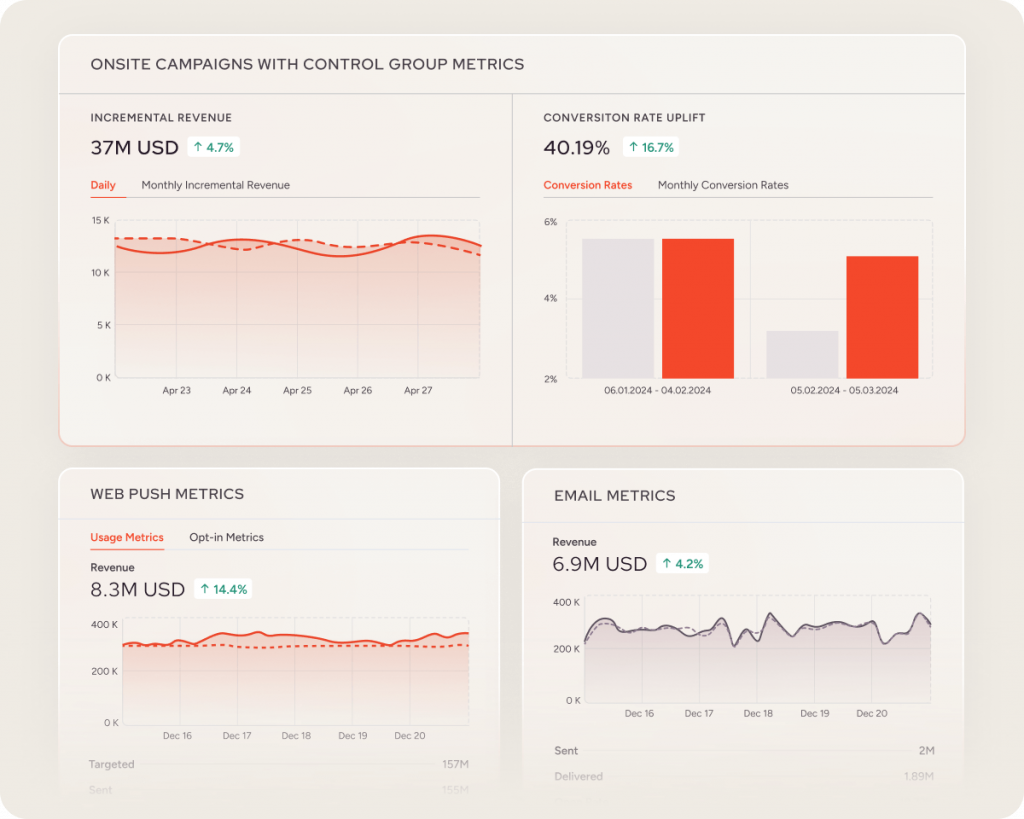
Teams launch predictive personalization without holdout groups, then can’t prove whether the model drove incremental lift or simply targeted users who would have converted anyway. Rigorous measurement is the only way to validate return on investment (ROI).
Measurement rigor
Always maintain a holdout group that receives the baseline experience. Without holdouts, you measure correlation, not causation. Define success metrics before launch: incremental conversion rate, incremental revenue per user, and margin impact. Vanity metrics like open rates and click rates don’t prove business value.
Privacy and compliance
Predictions based on behavioral data require clear opt-in under the General Data Protection Regulation (GDPR) and the California Consumer Privacy Act (CCPA). Ensure your CDP respects consent signals and suppresses users who haven’t opted in. Collect only the events and attributes your models actually use. Hoarding data “just in case” increases compliance risk without improving predictions.
Operational safeguards
Predictions degrade as customer behavior shifts. Set alerts for performance decay and retrain models on a regular cadence. Define thresholds that automatically pause a campaign if conversion rates drop below baseline or complaint rates spike. Review model outputs for unintended demographic skew, as predictions that systematically exclude or disadvantage certain groups create legal and reputational risk.
How Insider One powers predictive personalization.
Predictive personalization requires unified data, AI-powered scoring, and real-time orchestration working together. Insider One brings these capabilities into a single platform.
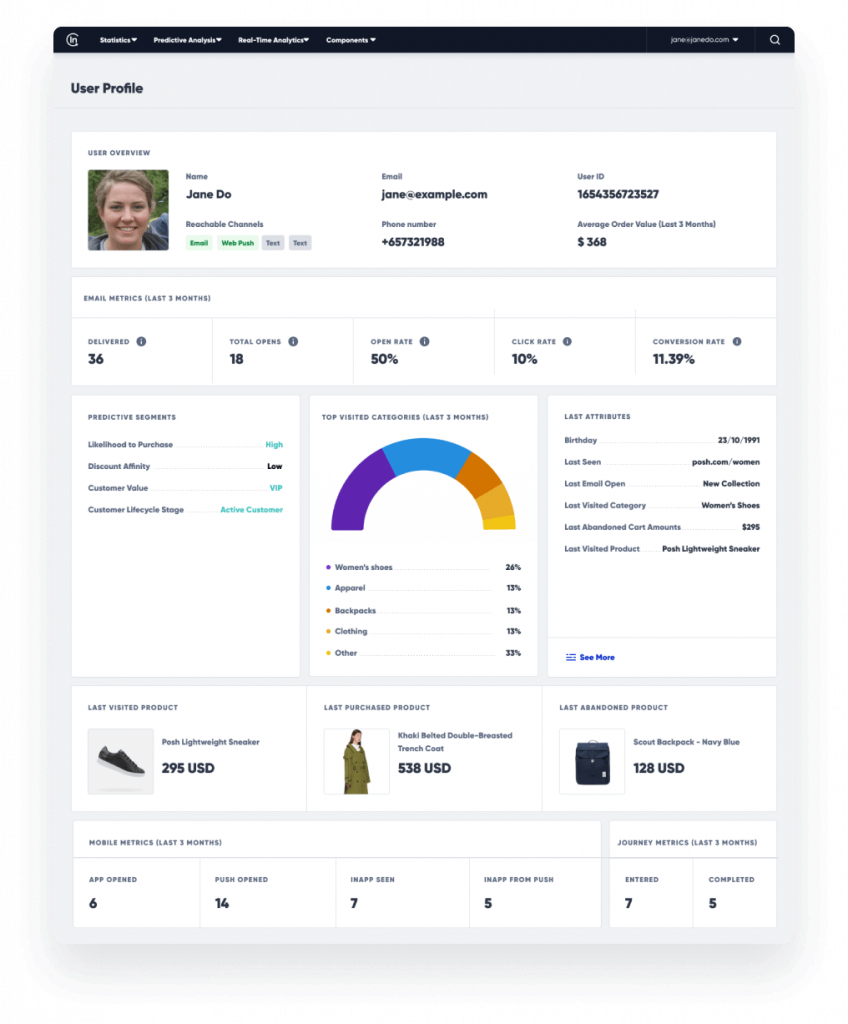
Insider One’s Customer Data Platform (CDP) unifies behavioral, transactional, and engagement data into complete profiles with real-time identity resolution. Deterministic matching across email, phone, and user ID ensures predictions train on complete customer histories, not fragmented signals.
Sirius AI™, Insider One’s extensive set of AI capabilities, includes Predictive Segments that score users for likelihood to purchase, churn risk, discount affinity, and lifetime value. These segments update continuously as new behavior streams in, so predictions reflect current intent, not stale snapshots.
Architect, Insider One’s customer journey orchestration solution, activates predictions across SMS, email, WhatsApp, web, app, and paid media from a single canvas. Next Best Channel selection, send-time optimization, and A/B Auto-Winner Selection automate decisions that would otherwise require manual analysis and intervention.
Teams launch quickly, supported by Migration Lab™ for zero-friction onboarding.
To see how unified data, Sirius AI™, and Architect work as one system (not three projects), explore the product demo hub before you invest more time in another disconnected stack.
FAQs
Segmentation groups customers by shared traits or past behavior; predictive personalization scores each individual’s likelihood to take a specific future action and intervenes accordingly.
You need unified customer profiles with consistent identity resolution, standardized event taxonomies across channels, and access to recent behavioral data.
Maintain a holdout group that receives the baseline experience, then compare incremental conversion rate, revenue per user, and margin impact between treatment and control.
Models require sufficient historical data to train. Teams with smaller customer bases see limited accuracy until data volume increases; hybrid approaches using collaborative filtering can help bridge the gap.
Ensure your CDP respects consent signals, collects only the behavioral data your models actually use, and maintains transparency about how predictions influence the experiences customers receive.