[ad_1]
The fastest way to make more money with fewer customers is to restructure your offers around your most profitable work, build in pricing that rewards loyalty, and stop designing packages that make it easy for the wrong customers to stay. This is not a price increase. It is an offer redesign — and the most successful version of this strategy filters your client base automatically, without a difficult conversation.
You’ve felt this strategy from the inside, even if you didn’t recognize it at the time. A software tool you’d been using for years — a social media scheduler, a project management platform, an email service — quietly changed how their pricing worked. The headline price stayed the same: $12.99 a month. But where the old plan included 8 social profiles, the new structure charged $12.99 per profile. Your bill didn’t go up if you only used one. But if you were getting real value from the platform and managing 6 or 8 profiles, your cost just tripled or quadrupled. Customers who barely used it dropped off. Customers who were deeply embedded stayed — and paid significantly more. The company made more money from fewer, more committed customers. That was the entire plan.
Why Trying to Make More Money with Fewer Customers Feels Wrong at First
The moment revenue slows, most small business owners do the same thing. They try to get more customers. Drop the price. Add a cheaper option. Run a sale. It seems like the obvious move — more customers should mean more money coming in.
The math rarely cooperates. A lower entry price brings in customers who are shopping on price — which means they’re also the first ones to leave the moment a competitor undercuts you. A discount promotion pulls in deal-seekers who never convert to full-price buyers. A stripped-down tier creates a price anchor that makes your real offer harder to sell. You end up with more customers, more support volume, more complexity — and the same or lower margins.
The businesses that actually grow revenue aren’t chasing volume. They make more money with fewer customers by engineering their offers so the right customers self-select in and the wrong ones self-select out. That’s not an accident. It’s a design decision.
Make more money with fewer customers. That’s the goal — and it requires a completely different approach than what most small businesses are doing.
⚠️ REALITY CHECK
Adding a lower-priced offer to attract more customers is one of the most common and costly pricing mistakes in small business. It pulls your brand positioning downmarket, anchors price expectations at a lower level, and attracts customers who will drain your support and delivery capacity while generating the least revenue. If your offer menu has a “lite” version you created to reduce friction, audit it carefully.
What Software Companies Know About Pricing That Most Small Businesses Don’t
Software companies have been restructuring their offer to weed out unprofitable customers for decades. Let’s go back to the example I talked about in the introduction. I’m going to focus on social media software in particular.
Here’s exactly how it works. A software company starts with a flat-rate plan — $X per month, everything included. That plan attracts a wide range of customers: power users who squeeze every feature, casual users who log in occasionally, and everyone in between. On paper, revenue looks healthy. In practice, the power users are getting an enormous amount of value at the same price as someone who barely shows up. The pricing isn’t tied to the value being delivered.
So the company restructures. Instead of one flat price, they move to usage-based pricing — per seat, per profile, per contact, per connection, per API call. The headline number often stays the same or even appears lower. But the total bill now scales with how much the customer actually uses the product.
What happens next is the important part. Casual users — the ones who weren’t getting much value anyway — see their bills change and cancel or drop to a minimal plan. Power users — the ones deeply embedded in the product, whose teams are trained on it, whose data lives in it — stay. And they pay significantly more than before, because their usage reflects their actual dependence on the tool. Switching would cost them more in time, disruption, and retraining than the price increase ever would.
The result: the software company ends up with fewer total customers, higher revenue per customer, and a client base that’s more committed, more profitable, and less likely to churn. They made more money with fewer customers — on purpose.
I call the underlying logic the Anchor Customer Framework. Every business has a core group of deeply embedded, high-value clients — customers who need what you do, trust how you do it, and would find leaving genuinely disruptive. When you build your offer structure around what those customers need and what they’re actually worth, you naturally attract more of them and price out the ones who were never a real fit. Software companies figured this out years ago. Most small businesses are still trying to attract everyone.
💡 STRATEGY ALERT
The most loyal customers are not always your longest-tenured ones. They’re the ones most embedded in your process, most dependent on your specific expertise, and most certain that switching would cost them more than staying at a higher price. Identify those customers before you redesign anything. They’re the anchor of your new pricing structure.
Before You Redesign Anything: Know What Everything Actually Costs
You cannot make more money with fewer customers unless you know what each customer and each offer is actually costing you. Not your invoice costs. Your total costs — including the one most small business owners consistently undercount: time.
Start by tracking time the way an accountant tracks cash. Every hour you spend on a client or a deliverable has a cost. Every hour an employee or contractor spends on anything connected to a product or service is a cost. Most small businesses run on the comfortable fiction that “my time is free” — and that fiction quietly subsidizes their least profitable customers at the expense of their most profitable ones.
Here is the tracking structure that works:
1. List every product and service you sell. Not categories — specifics. If you sell three different service packages, those are three separate line items. If you sell a product with two SKUs, those are two line items.
2. For each offer, estimate the total time required to deliver it. Include your time, your team’s time, and any overhead time (onboarding, reporting, admin, communication). Be honest. If a “two-hour project” typically runs four hours by the time you include back-and-forth emails and revisions, the number is four hours.
3. Assign a cost to that time. Use your desired hourly rate — what you want to earn, not just what you’re currently earning. This is the number that tells you whether an offer is actually profitable at its current price or whether it’s subsidized by your unpaid labor.
4. Add your hard costs. Software subscriptions tied to delivery, contractor fees, materials, platform fees. Any dollar that leaves your account to fulfill that offer.
5. Compare total cost to revenue per offer. The gap between those two numbers is your actual margin. For most small businesses running this exercise for the first time, at least one offer on the list is operating at a loss or near breakeven once time is properly costed. That offer is where your pricing restructure starts.
The service pricing math guide walks through the specific numbers on undercharging and what it costs a service business over 12 months when one offer is consistently underpriced. The figures are usually enough to motivate the conversation.
What the Cost Audit Reveals About Your Customers

Once you have real cost data per offer, the next step is mapping it to your actual customers. Not hypothetical customers — the ones currently paying you.
Pull your active client list. For each one, note which offer or package they’re on, how long they’ve been a customer, and whether their actual service delivery maps to what you quoted. Some clients are exactly what the contract says. Others have accumulated extra touches, custom requests, and additional communication that you’ve absorbed without billing for it.
Rate each client on three dimensions: profitability (what they pay versus what it actually costs to serve them), ease (scope creep, communication overhead, revision cycles), and strategic value (referrals, case studies, marquee logo effect on your positioning). A full breakdown of this client profitability audit is in the guide to raising prices on existing clients.
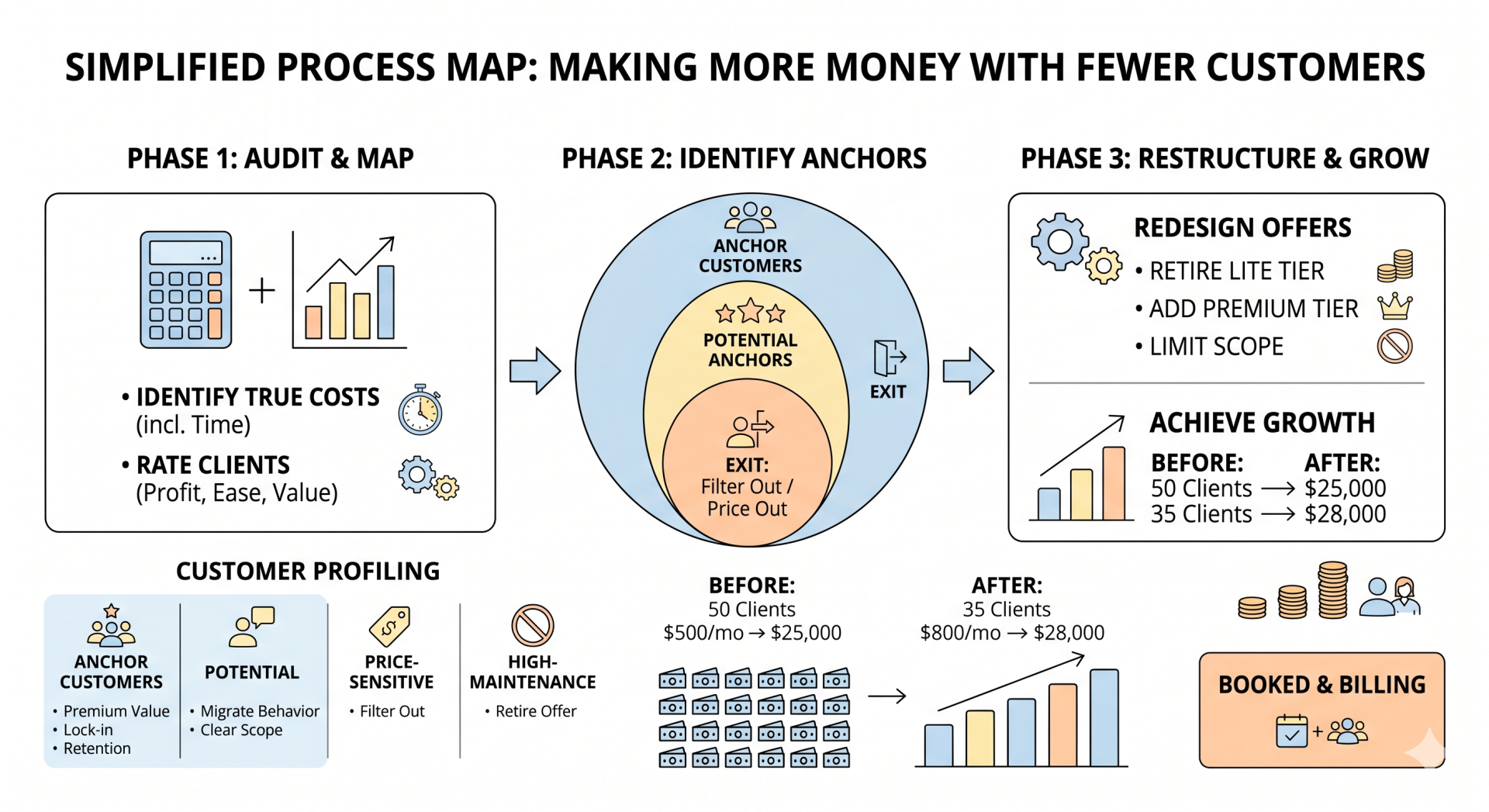
What you’re looking for: a segment of clients who rate high on all three dimensions — they’re profitable, they’re easy to serve, and they make you look good. Those are your anchor customers. Your offer redesign is built for them. Everyone else either migrates toward that profile or exits.
| Customer Type | What They Look Like | What Your Offer Should Do |
|---|---|---|
| Anchor Customers | High revenue, low friction, refer others, stay long-term | Lock in with premium value, reward longevity, price for retention |
| Potential Anchors | Good revenue but higher maintenance, newer relationship | Migrate toward anchor behavior with clearer scope and expectations |
| Price-Sensitive Buyers | Shop on price, first to negotiate, never quite satisfied | Let the offer redesign filter them out — don’t chase them |
| High-Maintenance Low-Revenue | Lowest price tier, most support requests, highest churn risk | Retire the offer tier they’re on or price it to reflect true cost |
How to Restructure Your Offers So Better Customers Self-Select In
The software company per-profile example works because it ties pricing to usage — and usage correlates with value delivered. Customers who get more value pay more. Customers who were barely using the product pay less or leave. The offer structure does the filtering automatically.
For a service business, the equivalent is restructuring around outcomes and depth of engagement rather than time or deliverables. A few practical approaches:
Eliminate your lowest-priced tier. The bottom of your offer stack is almost always your least profitable work and your most difficult client profile. Retiring it doesn’t mean those clients disappear — it means they either buy up to a better-margin offer or they self-select out. Either outcome improves your business. The packaging guide on DIYMarketers covers this reframe in depth — the same customers will buy, just differently structured.
Build scope limits into your remaining offers. Instead of a vague “monthly retainer,” define exactly what’s included. A defined scope does two things simultaneously: it stops the scope creep that makes your most affordable offer unprofitable, and it makes the premium tier feel clearly worth it by contrast. Customers who need more than the standard scope naturally buy up.
Add a premium tier that rewards your best customers. This is the direct equivalent of the software company’s usage-based pricing. Your premium tier offers more access, faster turnaround, or deeper involvement — and it’s priced to reflect what that’s actually worth. Most of your clients won’t choose it. But some will, and they’re typically your anchor customers who were already getting that level of access informally. Now they’re paying for it.
Price the inconvenience of being a new customer. Onboarding a new client costs you real time and energy. Consider an onboarding fee that reflects this, or a shorter-term entry contract at a slightly higher rate that converts to a lower annual rate. Clients who are committed enough to be real anchor customers will accept it. Clients who were planning to try you for one month and leave were never going to be profitable anyway.
🛑 DON’T COPY BLINDLY
The software per-unit model only works because the value delivered scales with usage. If you restructure your offers in a way that feels arbitrary or punitive — raising prices without changing what’s included or what the client receives — you’ll generate churn without the compensating loyalty effect. Offer redesign must be anchored in real value, not just in your cost structure. The customer has to feel the logic of the new pricing, even if they don’t love the number.
Make More Money with Fewer Customers — Here’s the Revenue Math
The simplest version: you have 50 clients at $500 a month. That’s $25,000. You redesign your offers, raise prices to reflect real costs, and 15 clients leave — the ones who were on your lowest tier or most price-sensitive. Your remaining 35 clients are now averaging $800 a month. That’s $28,000 — more revenue, 30% fewer clients, and significantly lower delivery overhead.
The less obvious win is the margin improvement. Your 35 remaining clients are your anchor customers. They’re easier to serve, generate fewer support requests, and produce a higher revenue-per-hour ratio. The $28,000 costs less to deliver than the $25,000 did. That’s what it means to make more money with fewer customers — the number on the invoice goes up and the cost to earn it goes down at the same time.
For a deeper look at why revenue growth and profit margin often move in opposite directions, the profit margin protection guide covers the full diagnostic. Revenue going up while margins shrink is almost always an offer structure problem, not a sales problem.
Frequently Asked Questions: How to Make More Money with Fewer Customers
How do I know which customers to let go of without damaging my business?
The safest way to make more money with fewer customers is to let your offer structure do the filtering — not a direct conversation about ending a relationship. Run a profitability audit first. Rate each client on revenue generated, ease of service delivery, and strategic value. The clients who score consistently low on profitability and ease — regardless of tenure — are the ones a redesigned offer will naturally price out.
Is it risky to raise prices and lose customers at the same time?
The risk depends entirely on which customers you’re losing. If you lose your lowest-margin, highest-maintenance clients and your revenue holds within 10–15%, the business is healthier after the transition. The price increase strategy guide walks through how to sequence the change to manage attrition risk, starting with new clients before moving to existing ones.
How do I track my true cost per customer if I don’t currently track time?
Start with a simple time log for two weeks. Use a spreadsheet with columns for date, task, client name, and hours — nothing complicated. At the end of two weeks you’ll have enough data to estimate the average hours per client type and per offer. Multiply those hours by the rate you want to earn, add your hard costs, and compare to revenue. That comparison tells you exactly where your offer redesign starts.
What if my most loyal customers are also my lowest-paying ones?
Loyal does not automatically mean profitable. A client who’s been with you for five years on your lowest tier may be loyal precisely because you’ve never raised their price. Loyalty built on underpricing is different from loyalty built on value. When you communicate a price increase to long-term clients with proper context, notice, and a transition window, the ones genuinely loyal to your work — not your old price — tend to stay.
How is the Anchor Customer Framework different from just raising prices?
A straight price increase applies the same rate to the same offer. The Anchor Customer Framework changes what’s in the offer, how it’s priced, and who it’s designed for — so any price change is a byproduct of a clearer value structure, not the whole point. Software companies don’t announce “we’re raising prices.” They announce “we’re introducing new plans.” The math produces the same result, but the customer experience of the change is completely different. That’s the distinction between a pricing strategy and an offer redesign.
Additional Reading
[ad_2]
Source_link