📌 THE GIST
- Most small business owners are doing too much marketing — but they don’t know how to think like a marketer. The hours pile up, the results stay flat, and AI just makes it faster to do the wrong things.
- A 2026 Talker Research survey of 1,000 small business owners found the average entrepreneur logs over 200 extra hours a year on creative and marketing tasks — yet only 1 in 5 felt prepared to handle those demands when they launched.
- This article introduces the 4-Question Monthly Check-In: a 30-minute thinking ritual that separates the entrepreneurs who get traction from the ones who stay perpetually busy.
To think like a marketer means making decisions based on what’s already working — not chasing every tactic that sounds good. It starts with one simple practice: once a month, before you create anything, post anything, or spend anything, you stop and answer four questions about what’s actually driving your business forward. That 30-minute check-in is more valuable than the next 200 hours of execution.
I spent three years giving small business owners the exact same advice: pick one strategy, stay consistent, measure what matters. They’d nod, take notes, go home — and two weeks later I’d see them posting six times a day on four platforms, testing a new email tool, signing up for a Pinterest course, and wondering why nothing was working. The problem wasn’t effort. It was that nobody had taught them how to think about marketing before doing it.
Why small business owners are logging 200 extra hours a year on marketing
New research from Talker Research, commissioned by Adobe Express, surveyed 1,000 American small business owners and found something that should stop you cold. The average entrepreneur simultaneously plays five roles: customer service rep (54%), marketer (44%), bookkeeper (43%), social media manager (41%), and creative director (35%). And most of them had no idea how demanding those roles would be.
The math adds up to over 200 extra hours annually — just on creative and marketing work. More than half (54%) say they spend more time on marketing tasks than they ever anticipated. And 56% report that marketing pulls them away from their core business operations at least once a week.
Here’s the part that stings: only 20% of these owners felt fully prepared to handle the creative and brand marketing demands of today’s marketplace when they started.
Four out of five entrepreneurs are winging it — working more hours on marketing than they planned, getting pulled away from the work they love, and doing it all without the foundation they need. That’s not a productivity problem. That’s a thinking problem.
Why AI helps you work faster — but won’t tell you what to work on
The Talker Research survey found that 50% of small business owners use AI tools regularly or occasionally. Among those who do, nearly three-quarters say AI has increased their confidence in handling tasks outside their expertise. Those are real, meaningful benefits.
But look closer at how they’re using AI. The top application is research (56%), followed by design and visual content creation (46%). Both of those are execution activities — getting things made faster, getting work done more efficiently.
AI is an excellent production partner. It helps you write the email faster, create the graphic without hiring a designer, repurpose the post across six platforms in ten minutes. That part of the value proposition is legitimate.
What AI cannot do is tell you whether the email should go out in the first place. It can’t evaluate whether social media is the right channel for your specific business at this specific moment. It won’t push back when you’re about to spend three hours building a funnel for an offer that hasn’t been validated.
When you don’t know how to think like a marketer, AI is just a faster way to do the wrong things. The most common AI marketing mistakes aren’t technical failures — they’re strategic ones. Business owners automate the wrong things, scale the wrong messages, and produce content at speed without stopping to ask whether that content is actually connected to revenue.
AI without marketing thinking is like having a professional kitchen without a recipe. You can cook faster. You might still make something inedible.
💡 STRATEGY ALERT
The 2026 marketing landscape has shifted from “what channels should I use?” to “what decisions am I trying to influence?” Google’s own 2026 marketing guidance is explicit: strategy starts at business outcomes and works backward to content and channels. For a small business owner, that means every marketing action traces back to a specific customer decision — and you need to know which decisions matter most before you start executing.
What does it mean to think like a marketer in 2026?
Learning how to think like a marketer is not about learning more tactics. It’s a set of mental habits that filter what you do — and what you skip.
Here’s how the difference between marketing strategy and tactics shows up in real life: a marketer who’s thinking well asks “is this connected to revenue?” before they start. Everyone else asks “did we post today?”
Based on the strongest 2025–2026 thinking on this topic — from Google’s own marketing guides to Duct Tape Marketing, Merkle, and a growing chorus of practitioners — the 2026 marketer mindset comes down to five shifts:
- From campaigns to systems. You stop thinking in launches and start thinking in loops. What’s the sequence that turns a stranger into a customer, and a customer into a referral source?
- From “what should I post?” to “what decision am I trying to influence?” Every piece of content is either moving someone closer to a decision or it’s noise.
- From activity to evidence. The 2026 marketer defaults to “show the receipts” — before/after, testimonials, data, real results. Not because it’s trendy, but because trust is the only marketing asset that doesn’t depreciate.
- From reach to retention. Acquisition is expensive. Retention compounds. A small business with 200 loyal customers who refer and repeat will outperform one with 2,000 one-time buyers every time.
- From “using AI” to “designing for an AI-mediated world.” AI agents are increasingly the first layer between your potential customer and their decision. If your business isn’t described clearly and consistently in your content, those agents can’t recommend you — even when you’re the right answer.
None of these shifts require a big budget. They require a change in how you think before you act. And the best way to build that thinking habit is a simple monthly practice.
The 4-question monthly check-in that teaches you to think like a marketer
This is the core framework I want you to take from this article. It takes 30 minutes. You can do it with a notebook and a cup of coffee. No software required.
Once a month — before you write content, schedule posts, or spend a dollar — sit down and answer these four questions about the past 30 days.
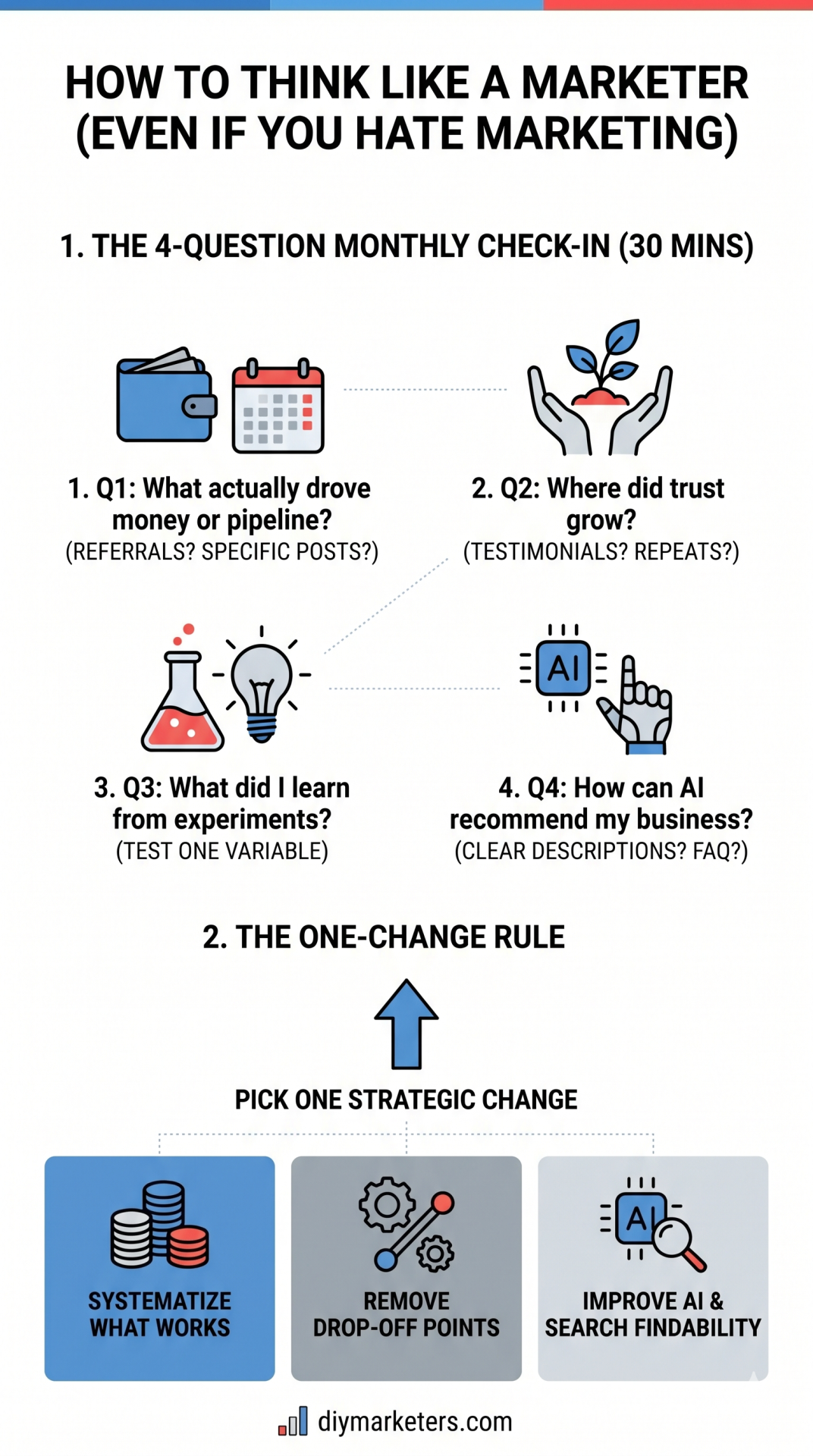
Question 1: What actually drove money or meaningful pipeline?
Look at your last 30 days and identify what clearly led to revenue, qualified leads, or booked calls. Be specific. “Two clients came from a referral at a BNI meeting. One came from a LinkedIn comment on a post I wrote six weeks ago. None came from the Facebook ads I ran.”
This is the question that immediately exposes where your time is misallocated. Most small business owners are spending the most time on the channels driving the least revenue. The marketing audit process starts here — with honest attribution, not assumptions.
Question 2: Where did trust grow?
List the concrete signals of trust from the past month: testimonials you received, referrals you were given, repeat purchases, unsolicited shout-outs, DMs from people saying your content helped them. These are not vanity metrics. They’re evidence that your marketing is building something durable.
The reason this question matters in 2026 specifically: trust is the primary competitive advantage that neither AI nor a bigger competitor can easily replicate. A client relationship, a community, a reputation — those compound in ways that ad spend never does.
Question 3: What did I learn from any experiment I ran?
Capture any test you ran — even tiny ones — and what you learned, not just whether it worked. “I tried sending the newsletter on Tuesday instead of Thursday. Open rates were 6% higher. I’m switching permanently.” That’s a $0 improvement based on evidence.
The smartest small business marketers in 2026 run a continuous experiment portfolio. Not dozens of tests at once — one or two small bets per month, with clear hypotheses and a simple record of results. Over 12 months, that’s 12–24 data points that eliminate guesswork from your decisions.
Question 4: How can AI and search agents better explain and recommend my business next month?
This is the question most small business owners haven’t started asking — and it’s becoming one of the most important questions in marketing. If someone’s AI assistant went shopping or researching on their behalf right now, what would it find when it looked for your business? Could it accurately describe what you do, who you serve, and why you’re different?
Ask yourself: Does your website have a clear, scannable answer to “who is this business for?” Do you have a FAQ that matches the questions your customers actually ask? Is your Google Business Profile complete and current? These are not optional checkboxes anymore. They are the infrastructure that determines whether you get found in an AI-mediated world.
⚠️ REALITY CHECK
The one-change rule that makes this framework work
After answering the four questions, there’s one constraint that separates people who use this framework from people who read it and move on: you are allowed to make only one strategic change for the next 30 days.
One. Not four. Not ten. One.
Look at your answers and pick whichever signal was loudest. Then choose exactly one of these moves:
- Double down. Something clearly drove money or trust. Systematize it. Do more of it intentionally, not accidentally.
- Fix friction. Something is causing people to drop off or disengage. Simplify, clarify, or remove that friction point.
- Improve AI visibility. Your business isn’t being described or found accurately. Add a Q&A page, update your profiles, rewrite your homepage headline in plain language your customer would actually use.
The reason for the one-change constraint is that the biggest enemy of marketing progress for small business owners isn’t laziness — it’s scattered execution. The Talker Research data shows owners are already doing too much and feeling unqualified for most of it. Adding more things to the list makes that worse. Doing one thing well — based on evidence — creates momentum.
| If your answer reveals… | It means… | Your one change is… |
|---|---|---|
| Referrals drove most of your revenue | Word-of-mouth is your real engine | Build a formal referral ask into every client interaction |
| Trust signals are thin — few testimonials, no referrals | Your relationship marketing needs work | Send a personal note to 10 past clients asking for a testimonial or check-in |
| You ran no experiments | You’re operating on assumptions, not data | Pick one variable to test this month: subject line, send day, CTA wording, pricing anchor |
| AI can’t describe your business clearly | You have an AI visibility gap | Rewrite your homepage intro and add a 5-question FAQ page this month |
| No single channel clearly drove revenue | You’re spread too thin | Stop two channels for 30 days and pick one strategy to go all in on |
How the 4-question check-in is different from a marketing plan
This framework is not a marketing plan. A marketing plan is a document you build once, present once, and mostly ignore. This is a thinking habit — a monthly 30-minute practice that keeps you connected to evidence.
The research from the “think like a marketer” landscape in 2026 is clear: the best small business marketers don’t have longer plans, they have shorter feedback loops. They don’t need a 30-slide deck to make a good decision. They need a clean answer to “what worked last month?”
If you’ve struggled with staying consistent with a marketing process, the answer isn’t more discipline — it’s a simpler process. Four questions, 30 minutes, one change. That’s the whole process.
And if you want to know how to stop throwing good hours at the wrong work, the first step is auditing what you’re already doing. The marketing audit framework walks you through that diagnostic — what to look at, what to measure, and how to decide what deserves your time.
Frequently asked questions about how to think like a marketer
What does it mean to think like a marketer as a small business owner?
Thinking like a marketer means making decisions about your marketing based on evidence — what’s actually driving revenue, where trust is growing, and what your customers are responding to — rather than chasing tactics because they seem popular. It’s a mental habit, not a skillset. You develop it by regularly asking “what’s working and why?” before you decide what to do next. Small business owners who think like marketers spend less time on marketing, not more, because they stop doing things that aren’t connected to results.
How much time should I spend thinking about marketing vs. doing marketing?
Most small business owners spend almost no time thinking about marketing and enormous amounts of time doing it — over 200 hours a year according to 2026 Talker Research data. A better ratio is one hour of strategic thinking (your monthly check-in) for every 10–15 hours of execution. That one hour of clear thinking prevents you from spending those 15 hours in the wrong direction. Block 30 minutes at the end of each month for the 4-question check-in and you’ll find that execution becomes faster and more focused.
Can AI teach me how to think like a marketer?
No — and this is a critical distinction. AI can execute marketing tasks faster: writing emails, creating graphics, repurposing content across channels. Among small business owners who use AI, 73% report increased confidence in handling marketing tasks (Talker Research, 2026). But AI cannot evaluate whether your marketing strategy is connected to your business goals, identify that you’re working in the wrong channel, or tell you that your time would be better spent calling five past clients than posting six times a week. Strategic thinking is a human skill. AI is a production tool.
What’s the single most important question to ask to start thinking like a marketer?
Start with this one: “What actually drove money or meaningful pipeline in the last 30 days?” Before you write a word of content, schedule a post, or sign up for a new tool, answer that question with specifics. Not “I think social media helps” — but “two clients booked from a referral, one from a podcast interview, none from my paid ads.” That answer tells you everything about where your time should go next. It’s the foundation of the 4-Question Monthly Check-In framework.
How is “thinking like a marketer” different from having a marketing strategy?
A marketing strategy is a plan — typically built once and rarely revisited. Thinking like a marketer is an ongoing practice of connecting your actions to outcomes. You can have a detailed marketing strategy and still not think like a marketer if you never stop to evaluate whether it’s working. The confusion between strategy and tactics is one of the most expensive mistakes small business owners make. Thinking like a marketer means using evidence to update your strategy continuously, not annually.