📌 THE GIST
- When clients enter cost-cutting mode, they protect the services that hurt most to lose — and most small business owners have never made that case for theirs.
- The Sandler FID framework — Frequency, Intensity, Duration — gives you a measurable way to quantify buyer pain and move your service into the three budget categories executives protect even in austerity: revenue, risk, and mandated obligations.
- By the end of this article, you’ll have a 30-minute exercise to rewrite every service you offer as a revenue-protection or risk-reduction asset — the language that actually survives budget meetings.
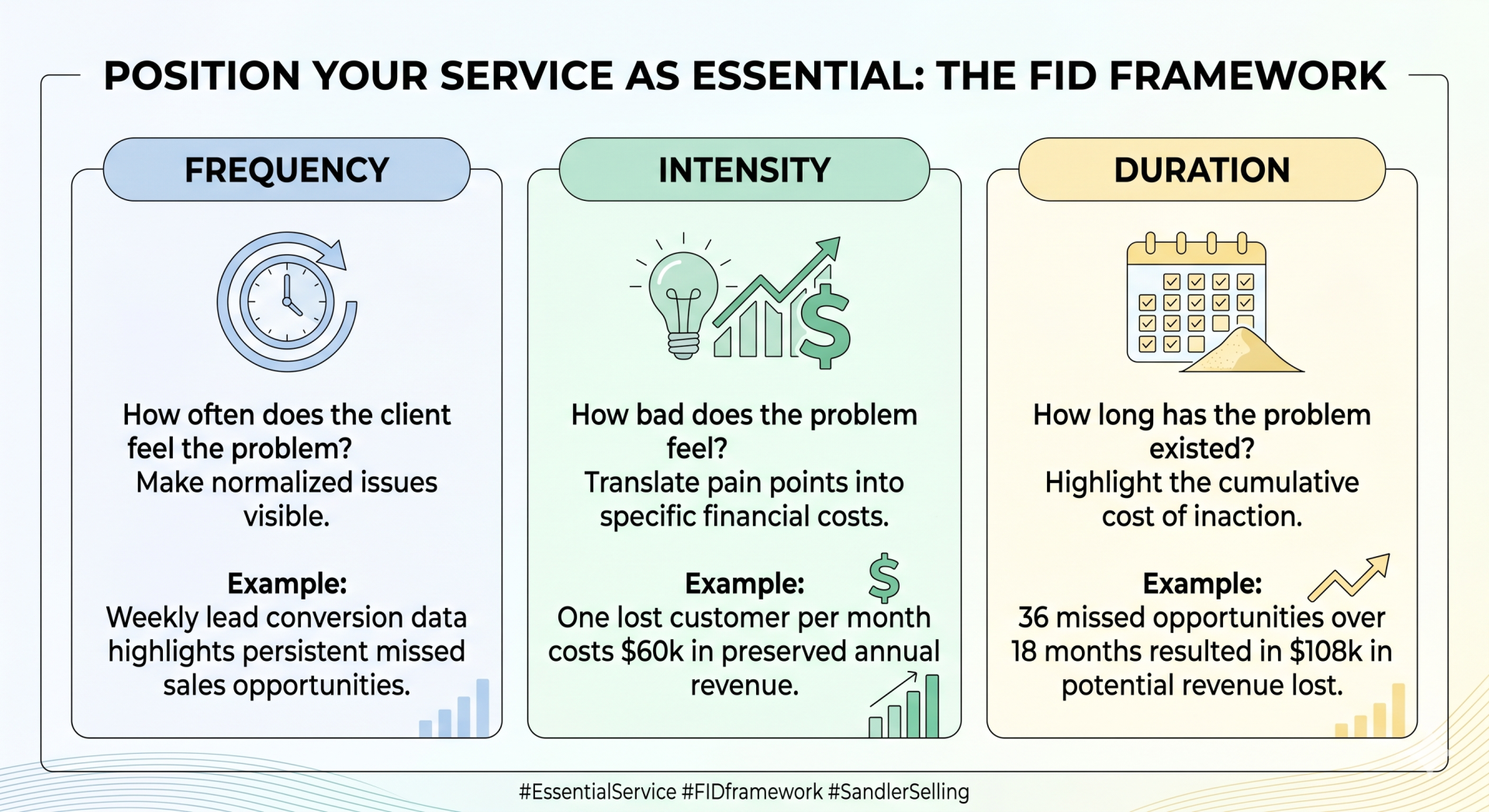
Knowing how to position your service as essential starts with one question: how viscerally does your client feel the cost of your absence? When buyers run mental triage during a budget cut, they protect spending tied to revenue, risk reduction, or contractual obligations. Everything else gets deferred. The Sandler FID framework — Frequency, Intensity, Duration — is the tool that moves your service from the deferral list to the protected column.
I have a confession: when I’m in cost-cutting mode, the first thing I drop is any subscription I barely open. The last thing I touch is my hair and nails. My $200 hair appointment keeps me camera-ready, sharp in client meetings, and confident enough to close deals. The $29/month tool I logged into twice last quarter disappears without a second thought.
Both decisions come from the same calculation: how much will I feel the absence? My hair and nails register immediately. The unused software barely registers at all. Your clients are running the same calculation about your service right now — and if you’ve never made them feel that absence, you’re the subscription that disappears.
Most service providers respond to budget pressure by discounting. The real issue is low perceived pain of absence. If your clients can’t feel what disappears when they stop working with you, they’re gone the moment their CFO opens a spreadsheet — regardless of what you charge.
What “essential” actually means when a client is under financial pressure
Economists define essential goods as necessities where demand holds steady regardless of income changes — food, utilities, housing. In the world of B2B services, essential is a perception your buyer holds based on one question: “What happens if I stop paying for this?”
When a client tightens their budget, they run mental triage. At the top of the keep list: spending tied to revenue protection, risk reduction, or mandated obligations. At the bottom: anything that feels like optimization, enhancement, or “eventually.”
Research on cost-cutting buyer behavior consistently shows that executives in austerity mode protect three categories of spending: what reliably protects revenue, what reduces the probability of a specific costly failure, and what fulfills a compliance, contractual, or investor obligation. Everything else is negotiable.
If your service sits in the “eventually” pile in your client’s mind — rather than one of those three protected buckets — it won’t survive a 15% budget reduction mandate. Ask yourself whether your client can feel what disappears when you’re gone. That question matters more than any ROI presentation you could build.
How to position your service as essential using the Sandler FID framework
David Sandler built his sales methodology around one foundational idea: people buy relief from pain. The way you measure how real that pain is comes down to three dimensions: Frequency, Intensity, and Duration. Sandler Training calls this the pain funnel — a structured way to help buyers hear themselves describe a problem clearly before any solution enters the conversation.
Frequency is how often the problem shows up. A client who loses a sale to a competitor once a year experiences that problem very differently than a client who watches qualified leads go cold every single week. Same problem, completely different urgency.
Intensity is how bad it feels when it happens. A slow website is an irritation. A slow website measured against a paid campaign driving $8,000 in traffic this month is an emergency. The facts are identical. The felt intensity depends entirely on context.
Duration is how long the problem has been sitting there. A pain that’s been chronic for two years gets normalized — it fades into the background of daily operations and stops triggering action. Surfacing duration helps the client calculate the cumulative cost of inaction, which is almost always larger than they’ve acknowledged.
Your client’s decision to keep paying you comes down to their FID score. When they feel the problem frequently, feel it intensely, and it’s been unresolved for months — they’ll find the money. When the frequency is low, the intensity is mild, and it feels like something they’ll “get to eventually,” you’re a discretionary expense. Raise their awareness of that FID score before the budget conversation happens.
💡 STRATEGY ALERT
The question worth asking before any renewal conversation: “Does my client feel the frequency, intensity, and duration of the problem I solve?” If the answer is no, your price will always feel high regardless of what you charge. Fix the perception first, then address the number.
How to make frequency visible to your clients
Most clients can’t see how often a problem is happening because they’ve normalized it — the symptom becomes background noise. Your job is to pull it into the foreground with data.
If you manage their email marketing, show them how many subscribers haven’t been contacted in 90 days alongside industry average open rates for engaged lists versus dormant ones. If you handle their content, show them how many times per week a competitor published while their site sat quiet. If you run their follow-up system, pull the number of leads who came in last month with no follow-up response.
Numbers create frequency awareness. “You have 847 subscribers who haven’t heard from you in four months” lands in a completely different place than “your email list needs some attention.”
For clients you already have, this is an ongoing conversation rather than a sales pitch. The clients who see frequency data regularly never question whether your service is worth keeping.
How to translate intensity into dollars your client can’t ignore
Vague pain is easy to defer. Dollars are harder to set aside. This is where most service providers leave retention on the table.
The ROI formula for any service is straightforward: (Financial gains – Cost of your service) / Cost of your service × 100. Walk your client through conservative math. One lost customer per month, multiplied by average lifetime value, over 12 months — then show them your fee. The math is almost always embarrassing in your favor. For a detailed walkthrough of this calculation, the value-based pricing framework here covers the exact process.
“This service protects $X in annual revenue” lands in a completely different place than “I manage your social media for $1,500 a month.” The felt intensity shifts when you change the unit of measure from service hours to business outcomes.
Transparent, conservative math beats a detailed proposal every time. “Roughly $60,000 in preserved revenue” is more persuasive than a 47-slide deck — and a budget decision-maker can defend that number internally without needing you in the room.
| If your client says this… | The real pain is… | Your intensity question is… |
|---|---|---|
| “We need to cut costs” | No visible ROI connecting your work to outcomes | “What does it cost when [the problem you solve] goes unaddressed for a quarter?” |
| “We’re pausing this for now” | Your service feels optional rather than urgent | “What was happening in the business last time this wasn’t in place?” |
| “We might need to scale back” | No connection between your work and a specific outcome | “Which of your revenue targets would be at risk without this in place?” |
| “I need to run this by my team” | No internal champion who feels the FID score | “Who on your team feels this problem most acutely day-to-day?” |
How to use duration to make chronic problems feel urgent again
Chronic pain is the enemy of essential positioning. When something has been wrong for two years, it gets filed under “that’s just how things are here.” The budget cut becomes the excuse to finally stop trying to fix it.
Pull duration back into the conversation as a cumulative cost calculation, not a complaint.
Ask your client: “How long have you been dealing with this?” Then follow with: “What has it cost you over that period to leave this unsolved?” Most clients do that math for the first time in that conversation, and the number lands larger than they anticipated.
A client who says “we’ve been losing about two leads a month for the past 18 months” has just told you they’ve absorbed 36 missed opportunities. At an average deal value of $3,000, that’s $108,000 in potential revenue that walked away while the problem sat unaddressed. That duration conversation changes what your fee looks like entirely.
For a clear look at what happens when clients pull back before you’ve had this conversation, this breakdown on why customers stop buying covers the patterns most service providers miss entirely.
⚠️ REALITY CHECK
Most service providers jump straight to the solution before the client has fully felt the problem. A client who hasn’t sat in the discomfort of their FID score will always treat your solution as optional. Slow down the problem conversation before you accelerate the solution pitch. The client who articulates their own pain score is the client who protects your invoice.
Three ways to reframe your offer around what clients never cut
Go back to the three categories executives protect even under pressure: revenue protection, risk reduction, and mandated obligations. Map your service to at least one of them — in language your client uses, not language your industry uses.
Revenue protection: “We help you hit pipeline targets with fewer resources” outperforms “We provide marketing services” in a budget conversation every time. Identify which specific leads, conversions, or retention numbers your work directly touches. The research on why retaining existing customers outperforms acquiring new ones quantifies this gap more clearly than most service providers realize.
Risk reduction: Name the specific bad thing that happens without you. “Your brand will suffer” is too vague to defend in a budget meeting. “Without this, you’re running three customer acquisition channels with no data on which one is working, and you’ll keep spending on all three regardless” has a specific failure mode attached. Specific risk has a price tag. Vague risk gets dismissed.
Mandated obligations: Does your service help your client deliver something they’ve already promised to a board, a lender, a key partner, or a major account? That connection gives your service iron-clad budget protection. Work that lives inside a commitment they’ve already made can’t be cut without breaking something more consequential than your invoice.
The offer structure matters too. When clients pull back, the packaging is often the real problem — a sharp, scoped, outcome-specific offer is harder to cut than a broad retainer. “90-day churn reduction sprint for your top customer segment” is easier to approve than “ongoing marketing support.”
How to position your service as essential in the next 30 days
Open your service list. For each service, answer these three questions:
- “What specific revenue, risk, or obligation does this directly touch?”
- “If a client canceled this tomorrow, what bad thing becomes more likely within 90 days?”
- “How do I express that bad thing in dollars or probability?”
Rewrite your service description using those answers. Drop “better brand awareness,” “improved engagement,” and “strategic support.” Replace them with concrete outcomes: “Reduces the probability of [specific failure] by [estimate]” or “Protects $X in [revenue/retention/acquisition] per quarter.”
Generic language gets cut in budget meetings. Specific outcomes get defended by the client internally, even when you’re not in the room. That’s the entire goal of learning how to position your service as essential — making your client the internal champion for keeping you, with language they can use to justify the decision upward.
For a model of how this plays out in pricing conversations, the margin protection framework here shows how to build the financial case without sounding like you’re justifying your existence.
A supporting resource worth bookmarking: Harvard Business Review’s coverage of cost-cutting strategy shows how the C-suite frames these decisions internally — and speaking that language in your positioning conversations makes a measurable difference.
🛑 DON’T COPY BLINDLY
Messaging alone won’t hold if the outcome doesn’t back it up. Positioning your service as essential works when the result justifies the language. One client who cancels and says “it didn’t deliver what was promised” costs you more referrals and reputation than a clean budget cut ever would. Make the case — then deliver on it.
Frequently asked questions about positioning your service as essential
What is the best way to position a service as essential when clients are cutting costs?
The most effective approach to positioning your service as essential in a cost-cutting environment is tying it directly to one of three outcomes clients protect regardless of budget pressure: revenue protection, risk reduction, or contractual and compliance obligations. Vague benefits like “brand building” or “strategic support” get cut because the math of their absence is invisible. Specific, measurable outcomes like “reduces customer churn by 3 percentage points, preserving $X in annual recurring revenue” get defended because anyone can follow that math. Use the Sandler FID framework — Frequency, Intensity, Duration — to help clients articulate how serious the problem is without your service, then connect your service directly to relieving that pain in financial terms. The client who puts words to their own pain score is the client who fights to keep your service when their CFO asks what can go.
How does the Sandler FID framework apply to service positioning?
The Sandler FID framework measures how serious a buyer’s pain is across three dimensions: how often the problem occurs (frequency), how bad it feels when it does (intensity), and how long it has been unresolved (duration). Applied to service positioning, you use FID to help clients articulate the problem clearly before your service enters the conversation. A client who acknowledges a problem happens weekly, costs them real dollars, and has been dragging on for 18 months sits in a very different budget conversation than a client who views the same issue as a minor occasional inconvenience. The higher the felt FID score, the more acutely clients feel the cost of canceling your service. You skip arguing for your value and instead help them calculate the cost of your absence, then let that math carry the conversation.
Should I lower my price when clients say they’re cutting costs?
Discounting should be your last move in a budget conversation, arrived at only after other options are exhausted. When a client says “we need to cut costs,” they’re describing a perception problem — the math in their head hasn’t yet connected your service to specific, visible outcomes. Run the FID exercise with the client before you touch your pricing. Help them articulate how often the problem occurs, what it costs in dollars when it does, and how long they’ve been carrying it unsolved. A client who has genuinely felt their FID score asks how to justify keeping you internally, rather than asking for a discount. Discounting before completing that conversation trains clients to open every renewal cycle with a price negotiation, regardless of the results you’ve delivered. This guide on navigating price conversations covers the full framework for holding your rate under pressure.
What spending do clients actually protect when cutting marketing budgets?
Clients in cost-cutting mode consistently protect spending that connects directly to near-term revenue, quantifiably reduces a specific risk, or fulfills a contract, compliance mandate, or investor expectation. They cut spending that is hard to measure, shows no visible short-term consequence when stopped, or is framed around long-term goals like awareness or brand equity. Marketing services positioned as brand-building investments get cut when pressure hits. Marketing services positioned as the system converting existing pipeline, or the process preventing churn in top accounts, are much harder to remove from a budget. According to research on small business marketing budget risk, the framing shift from “marketing service” to “revenue protection mechanism” is often the difference between being kept and being cut.
How do I quantify ROI for my service in a budget conversation?
Start with conservative math and make the formula visible rather than presenting a conclusion. Identify one specific metric your service directly affects — conversion rate, churn rate, lead volume, or cost per acquisition. Establish the client’s current baseline for that metric. Estimate a realistic improvement using actual results from comparable clients or conservative industry benchmarks. Multiply the improvement by the client’s volume, average transaction value, and 12 months to arrive at annual financial impact. Then compare that number to your annual fee and calculate the ROI percentage. A service costing $18,000 per year that preserves $120,000 in revenue produces a 567% ROI — and that specific number shifts the conversation from expense to investment. Transparent, followable math that a budget decision-maker can defend upward without your help is worth more than any proposal document you could produce.