Sometimes more smoke can help companies detect a fire.
From moments of pride to frustrations with the boss, younger employees are sharing their work experiences online for everyone to see.
This trend is giving consumers a raw look into how companies operate behind closed doors, altering their perceptions along the way.
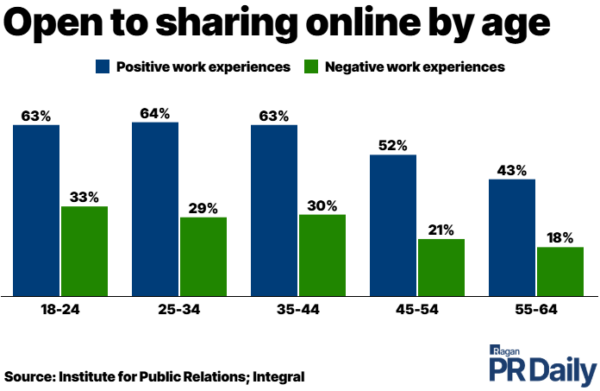
New research from the Institute for Public Relations and Integral, an employee experience agency, shows 63% of workers aged 18-24 are open to sharing positive work experiences on the web. Meanwhile, 33% show a willingness to post negative ones. In both cases, the inclination to either celebrate or criticize via the internet is stronger among younger employees than it is among older employees.
Overall, the situation presents companies with a new set of challenges and opportunities.
Navigating risk and reward
Negative reviews or embarrassing incidents can hurt a company’s image. Stories that make a private act of corporate kindness public, on the other hand, can do wonders to enhance it.
Stacey Zolt Hara, U.S. head of workplace and purpose at the global public relations and communications firm Burson, noted that because younger, digitally native employees may lack a deferential filter or be more casual in their language, it can feel risky to let that voice loose.
But, she continued, “While the risk may be higher with younger employees, so is the reward given their social reach.”
The benefits of employees acting as unofficial brand ambassadors are many. Positive posts coming directly from insiders have the potential to raise awareness of the company, boost its credibility, and both attract and retain talent.
“If you earn their advocacy, it is so powerful in lifting the company’s reputation,” said Zolt Hara.
Below are three ways communicators can make the most of young employees sharing their work experiences online.
- Manage through better communication
For people just entering the workforce, managers play a major role in shaping their impression of the organization.
“I don’t think you can overemphasize how important the relationship is with first-line managers,” said Ethan McCarty, CEO of Integral.
It’s therefore important for managers to possess quality leadership skills and convey a clear vision of where the company is going. Engaged employees aren’t likely to disparage their place of work.
“You have to invest in managers and how they communicate as if your reputation depends on it — because it does,” McCarty added. “As people say, ‘You don’t quit the job; you quit the manager.’”
- Avoid both extremes
Although it’s natural for companies to want their employees to share the positives while staying silent on the negatives, Zolt Hara warned it’s dangerous to push too hard for either outcome.
Asking workers to post on their social channels is fine. Apply too much pressure, however, and the option begins to feel like an obligation.
At the same time, restricting what employees can say on their own personal accounts just feels wrong. It certainly doesn’t demonstrate a sense of trust.
“Companies fall short when they go to the extreme of overly censoring employees or encouraging it so much that employees begin to feel like big brother is watching,” said Zolt Hara.
A happy medium, Zolt Hara added, consists of creating clear yet simple guidelines explaining how employees can be good stewards of the company at every turn.
- Treat every post as a signal
No employer wants to see an employee post something damaging about their job. As much as it might sting, however, companies should treat the situation as an opportunity to learn and improve.
While the post might be unfair or inaccurate, it might also uncover a real problem that requires urgent attention. It may be smoke that reveals a fire, giving companies a chance to put it out before it spreads.
“If employees are feeling bad enough to write a negative review, that’s a signal something’s happening upstream,” said McCarty. “They’re having a bad experience, and that’s worth looking at.”
The post How to make the most of young employees sharing work experiences online appeared first on PR Daily.