[ad_1]
If you’ve ever seen something like this in the search results…
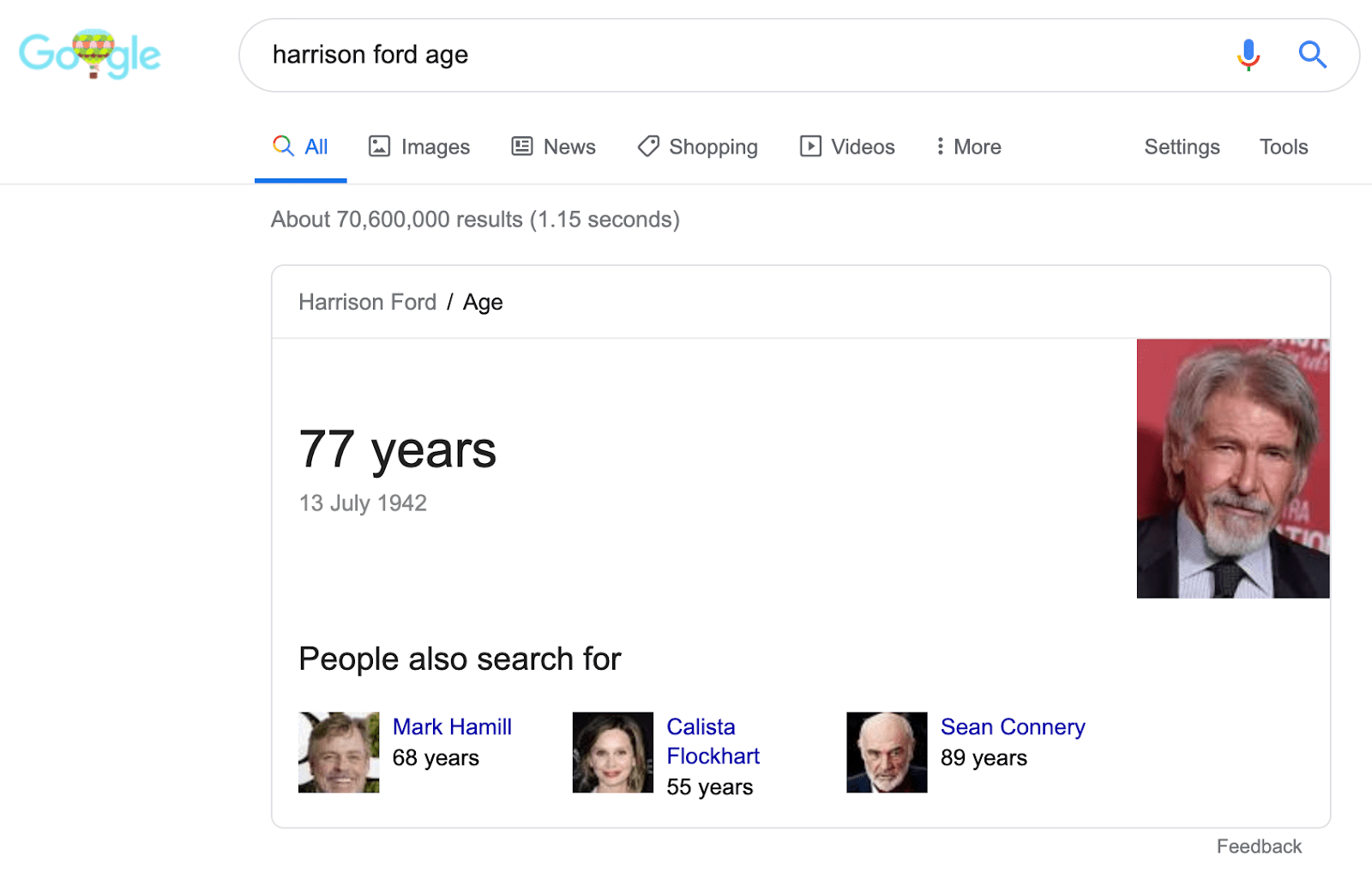
… then you’ve already experienced the benefits of Google’s Knowledge Graph.
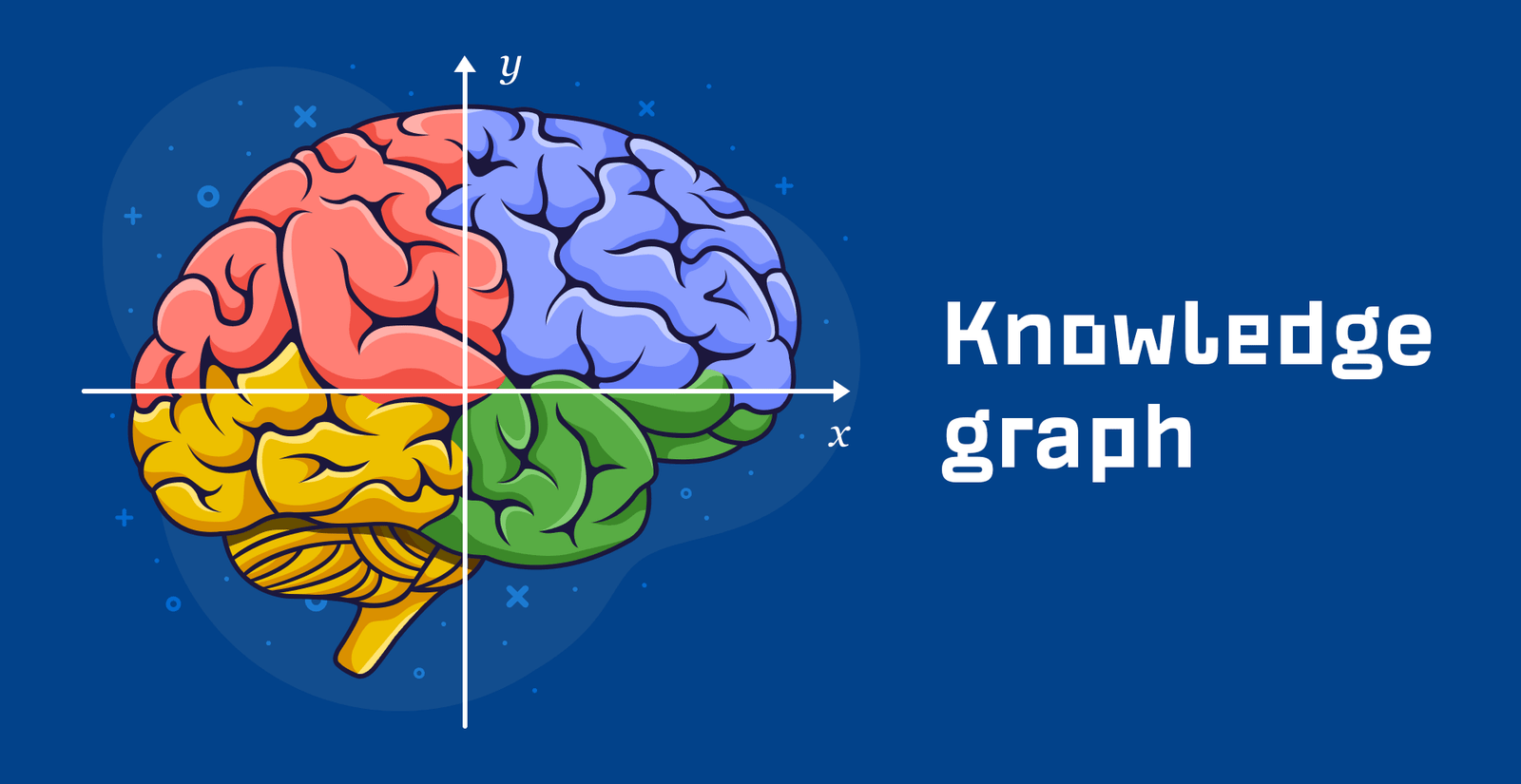
But what is a knowledge graph? How does it work? And how can you take advantage of it to increase brand visibility and improve SEO?
Google’s Knowledge Graph is a knowledge base of entities and the relationships between them. It contains over 1.6 trillion facts about 54 billion entities.
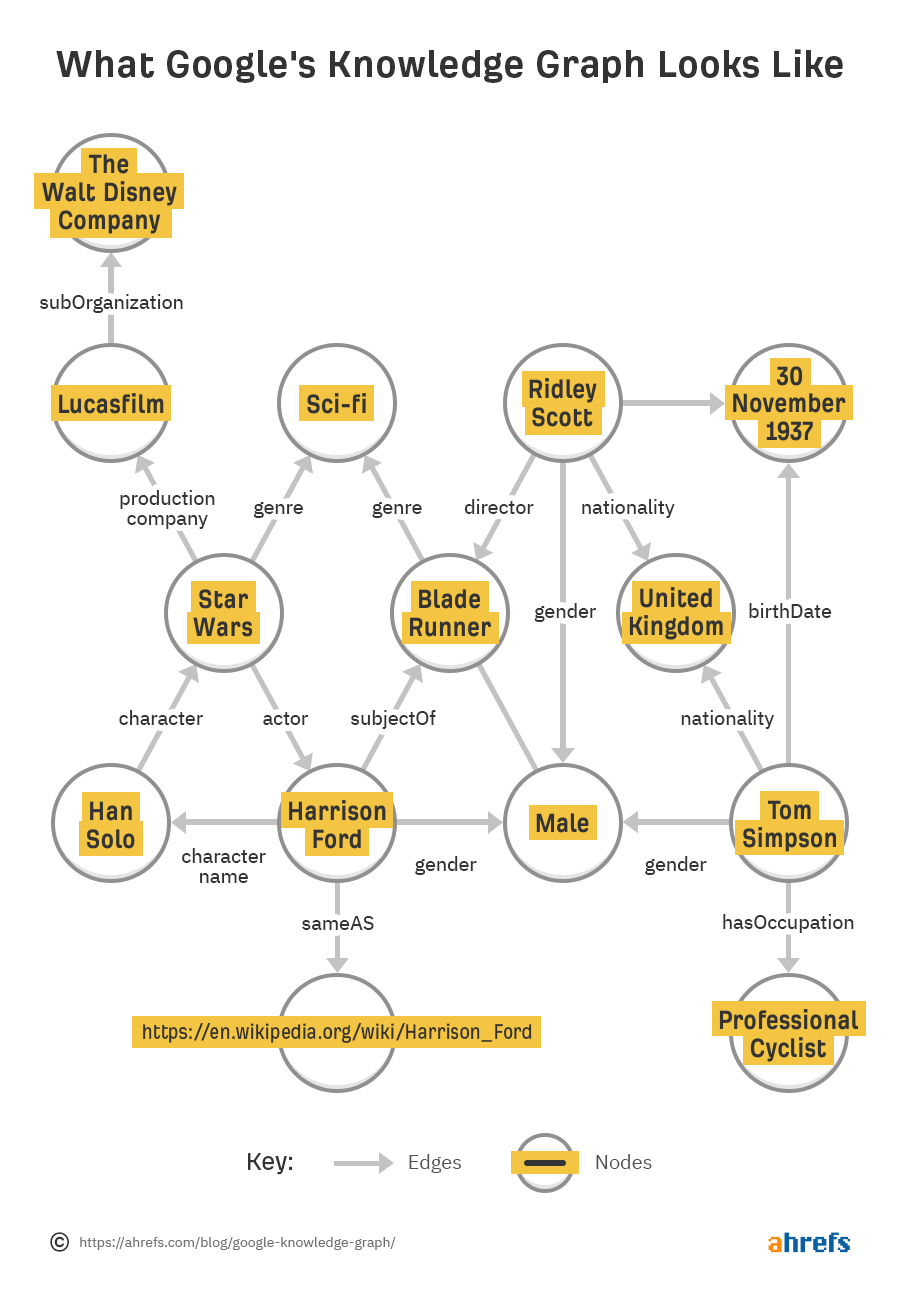
What is an entity? It’s any object or concept that can be distinctly identified. This includes tangible elements like people, places, and organizations, as well as intangible elements like colors, concepts, and feelings.
Entities are connected by edges that describe the relationships between them.
Storing real-world data like this helps Google understand the meaning behind search queries, which leads to more relevant results for searchers.
Generally speaking, the Knowledge Graph is beneficial for both users and SEO professionals. Users get more relevant search results, and SEOs get more visibility in search features that attract attention.
But there are also some downsides. Here are the main ways the Knowledge Graph influences search (both positively and negatively).
Google better understands search intent
Links are great for gauging a page’s quality, but not its relevance to the search query.
That’s fine as long as search queries match the content’s language. But people don’t always search that way. They describe things in different ways.
That’s where the Knowledge Graph comes in, as it allows Google to go beyond keyword matching and return more relevant results.
For example, take the query “small green guy with lightsaber”:
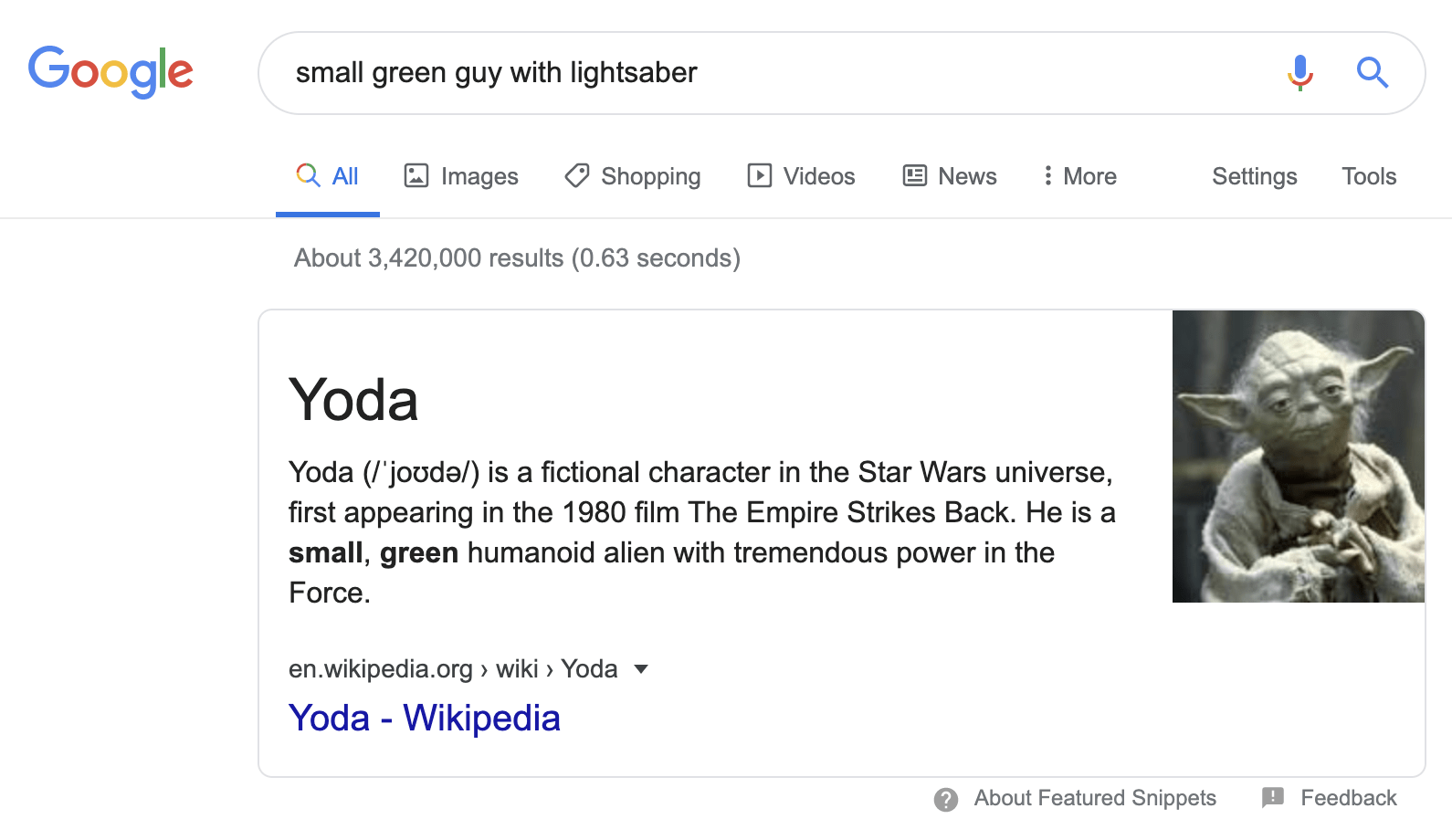
Despite not mentioning Star Wars, Google still understands what we’re looking for and gives us the answer. The same is true for the query “han solo actor other movies”:
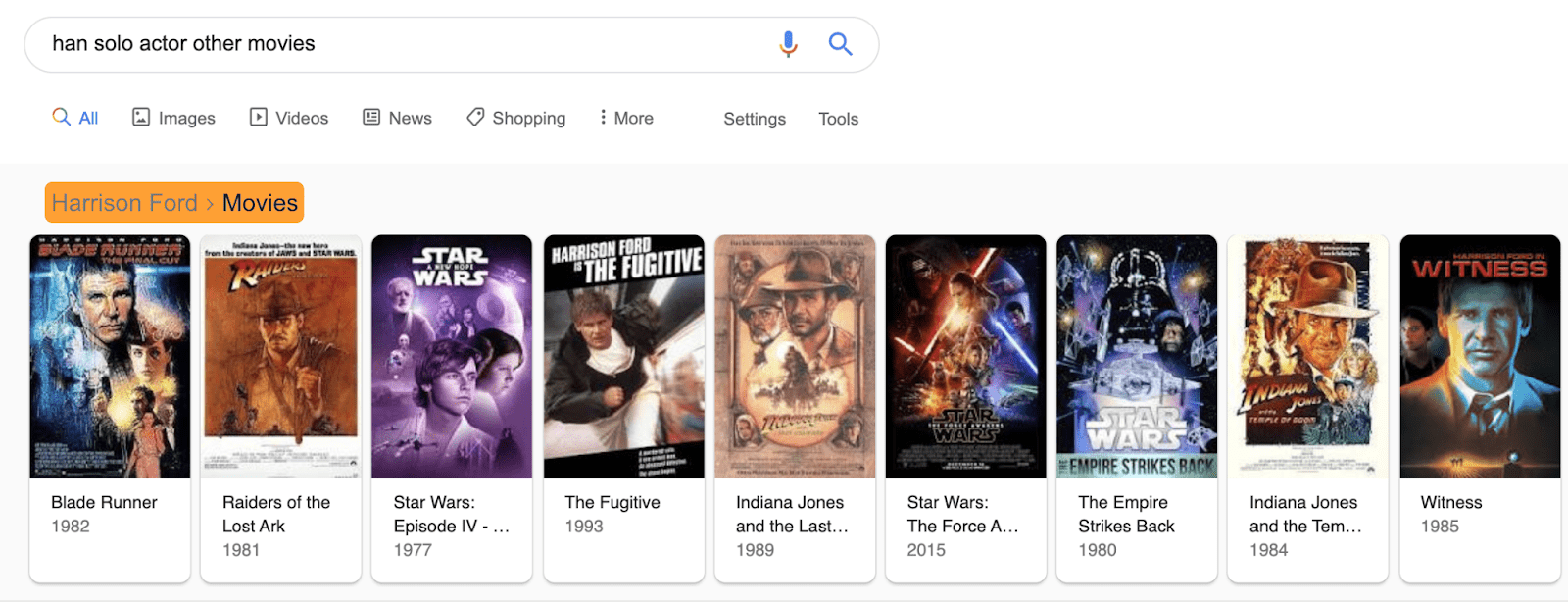
Here, not only are the results relevant, but Google also shows the connection in the Knowledge Graph and provides an entity carousel that satisfies the query.
More brand visibility and authority
Google displays Knowledge Graph data in SERP features such as Knowledge Panels and Knowledge Cards.
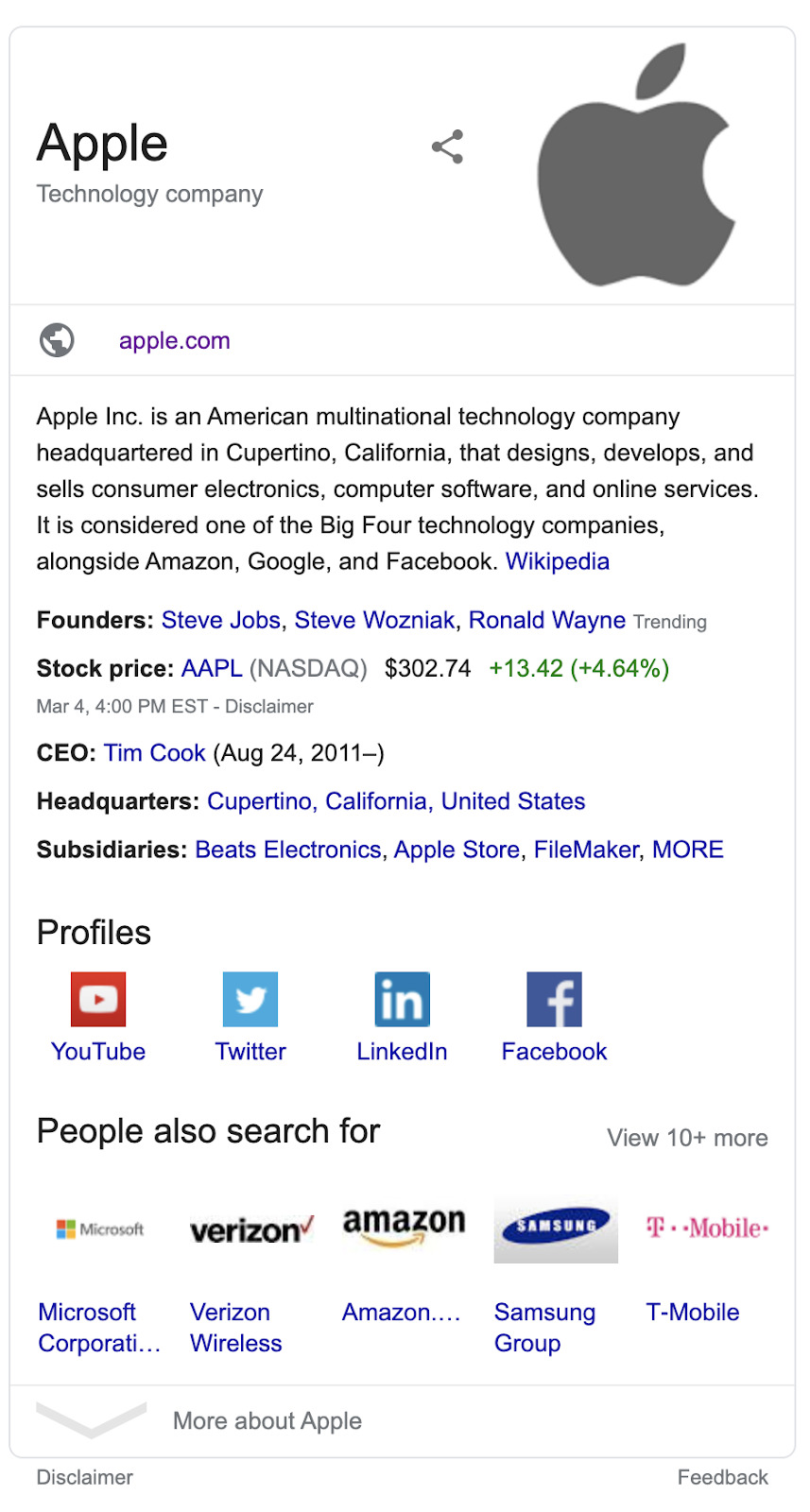
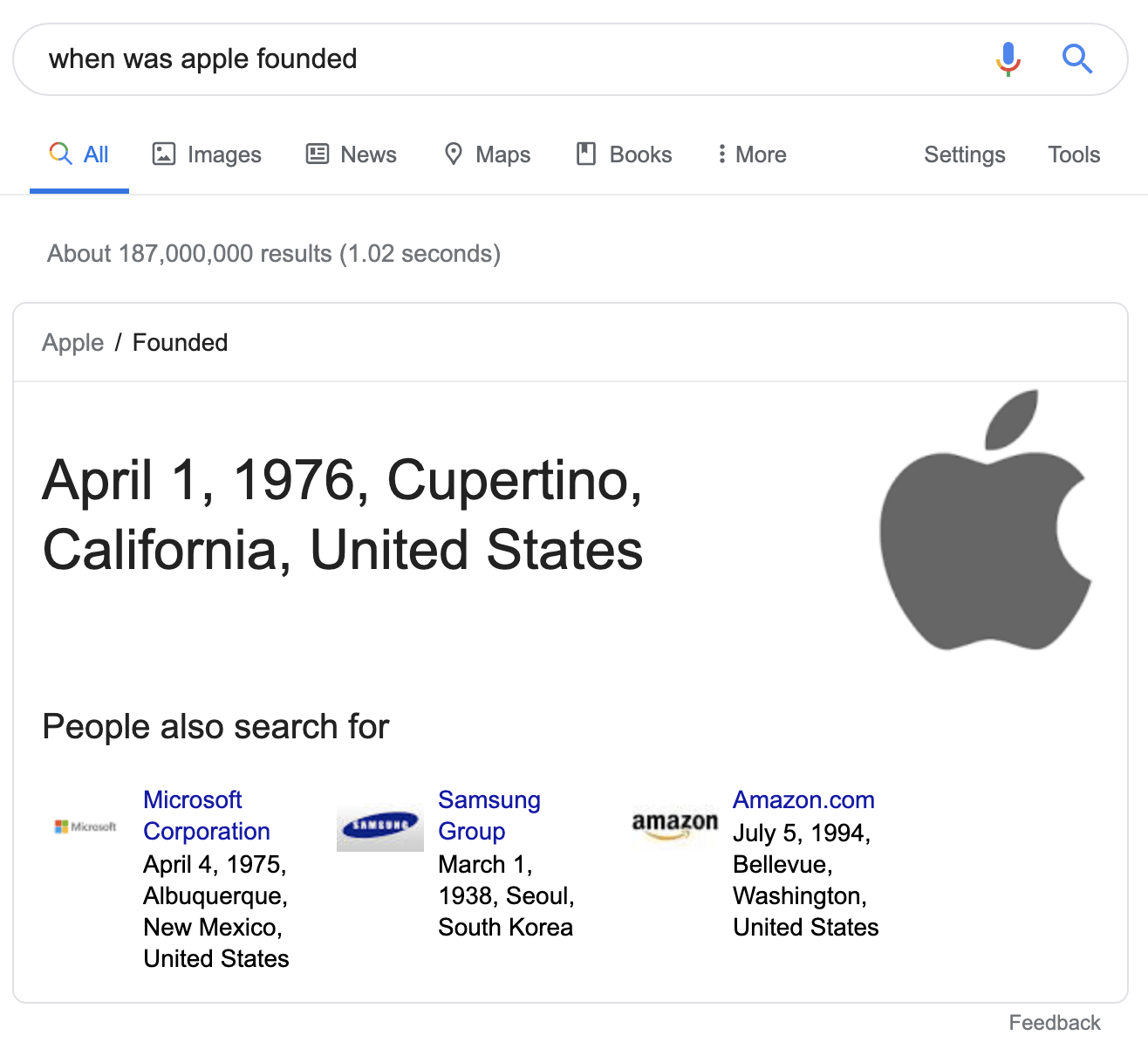
If you can get your brand into the Knowledge Graph, you’ll benefit from more SERP real estate, visibility, and authority in the eyes of searchers. Being in the Knowledge Graph now also influences your visibility beyond traditional search results, especially with emerging AI-generated answers.
Fewer clicks on search results
Sparktoro’s recent research revealed that about 60% of searches end without a click.
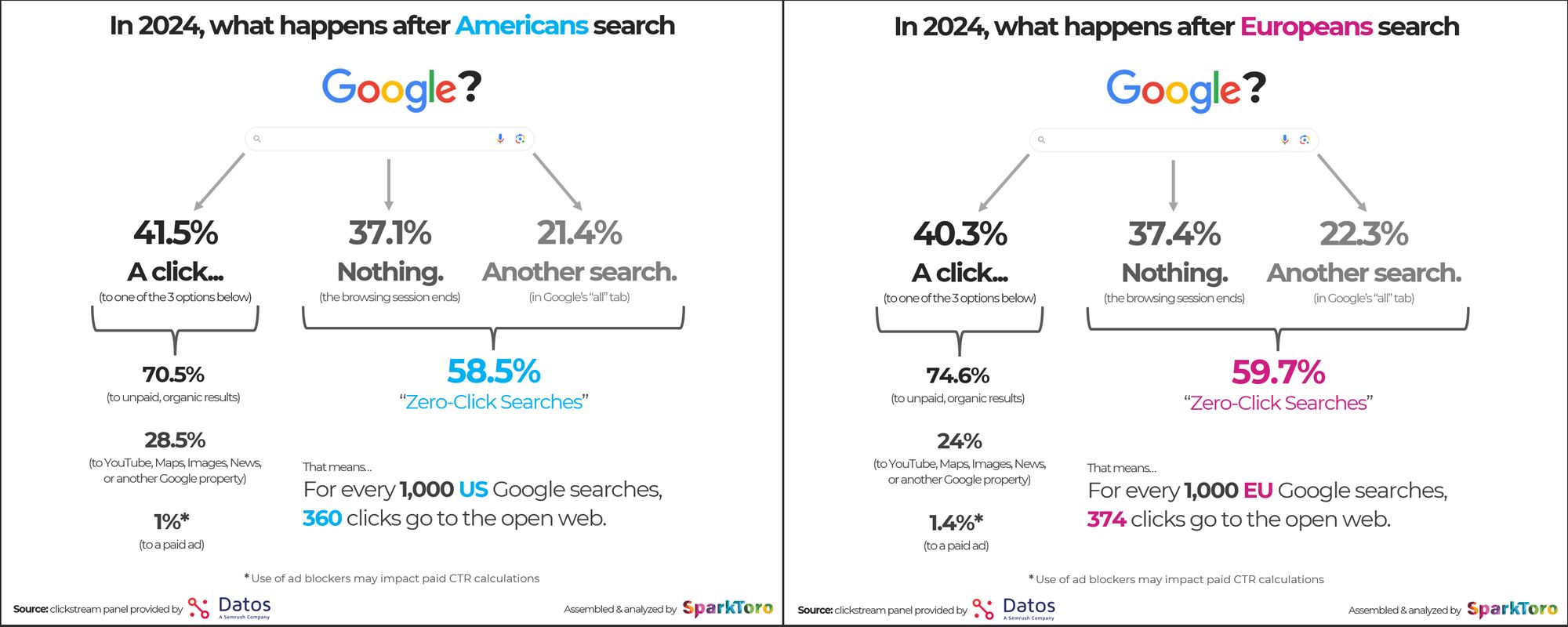
Part of the reason this happens is down to the Knowledge Graph, which helps Google answer more queries directly in the SERP through features like AI Overviews, Knowledge Panels, and People Also Ask.
Just look at a query like “what is seo”. You may see a Knowledge Panel like so: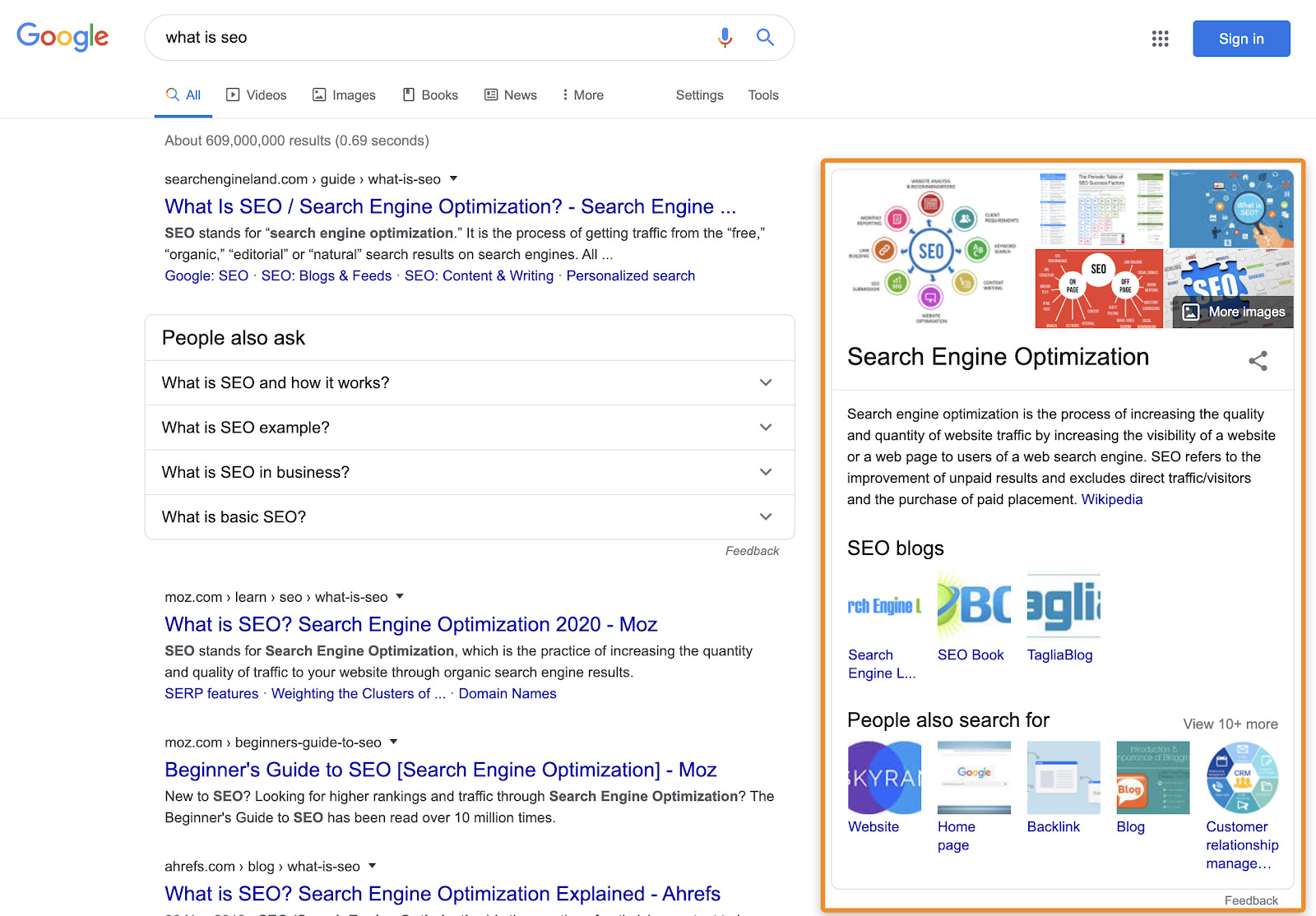
Or you may see an AI Overview providing a direct answer:
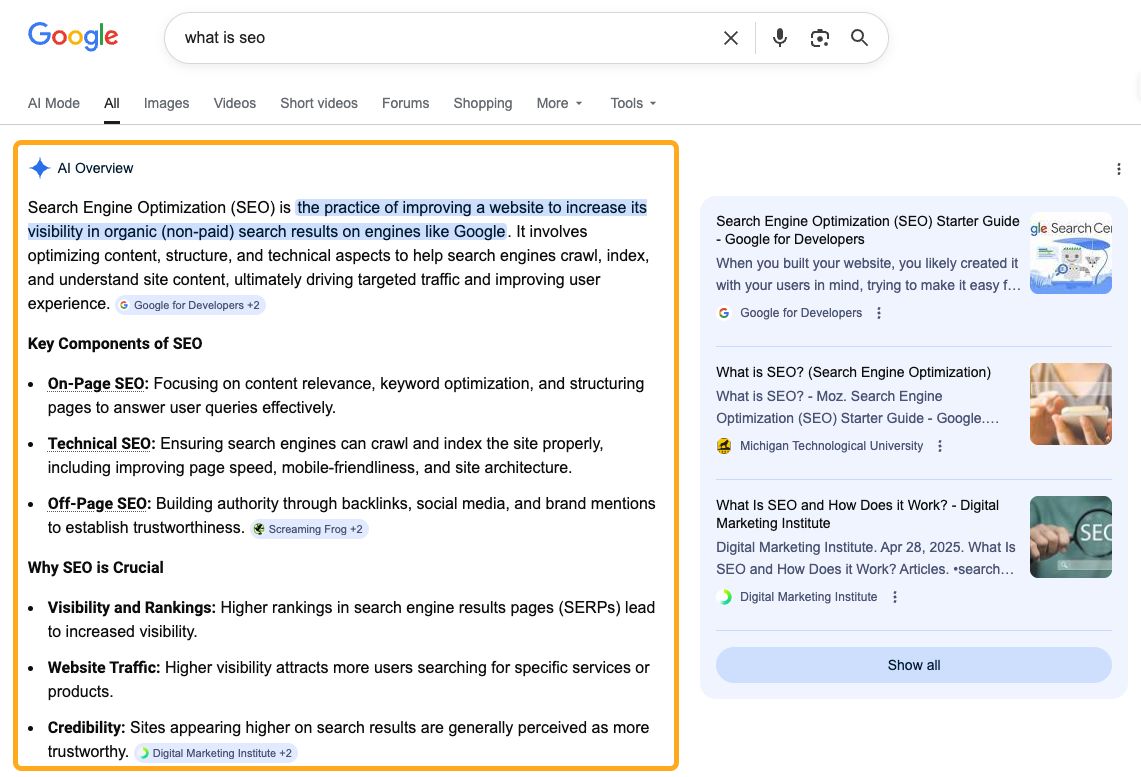
Google includes data from its Knowledge Graph in features like these.
For SEOs, this can be a problem. If people aren’t clicking search results, then you stand to get little or no organic traffic—even if you rank number one.
How do you solve this?
You can avoid targeting keywords with low organic click-through rates.
For example, 53% of searches for “what is seo” result in no clicks…
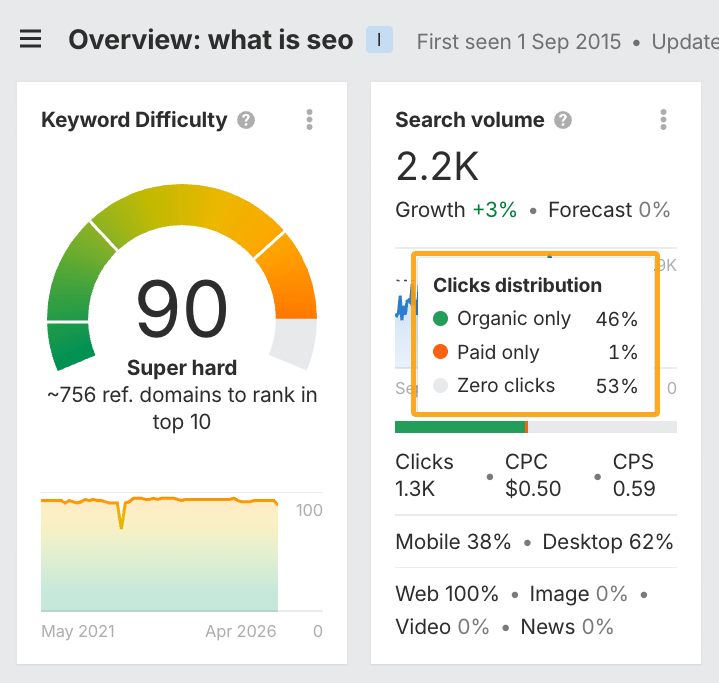
… so while the Knowledge Panel affects click-through rates, there is still some traffic potential for the sites ranking for it.
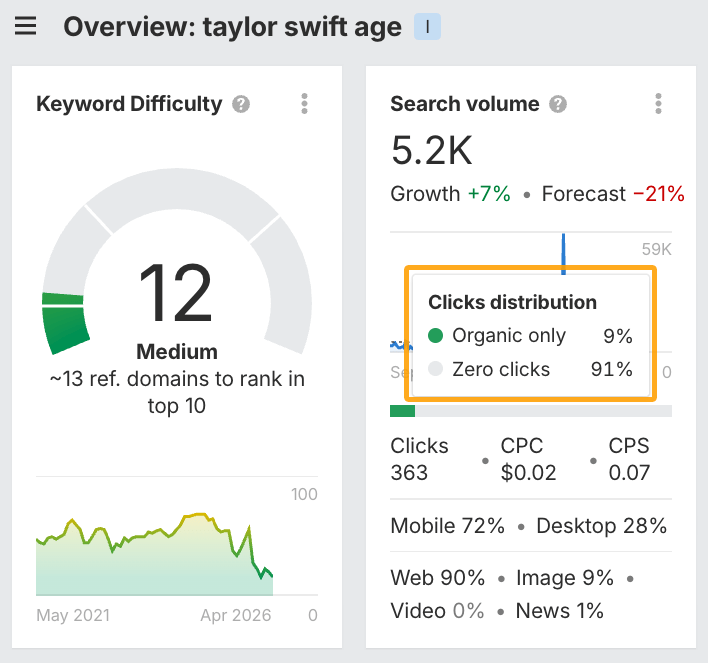
But the same isn’t true for a query like “Taylor Swift age,” where only 9% of searches end in clicks.
Google’s Knowledge Graph has always been the engine behind Knowledge Panels and Featured Snippets. But its role has expanded significantly.
It’s now also a foundational infrastructure for Google’s AI-powered products.
AI Overviews
When Google generates an AI Overview, it doesn’t just retrieve web pages. It can also use the Knowledge Graph to identify and verify the entities involved in a query.
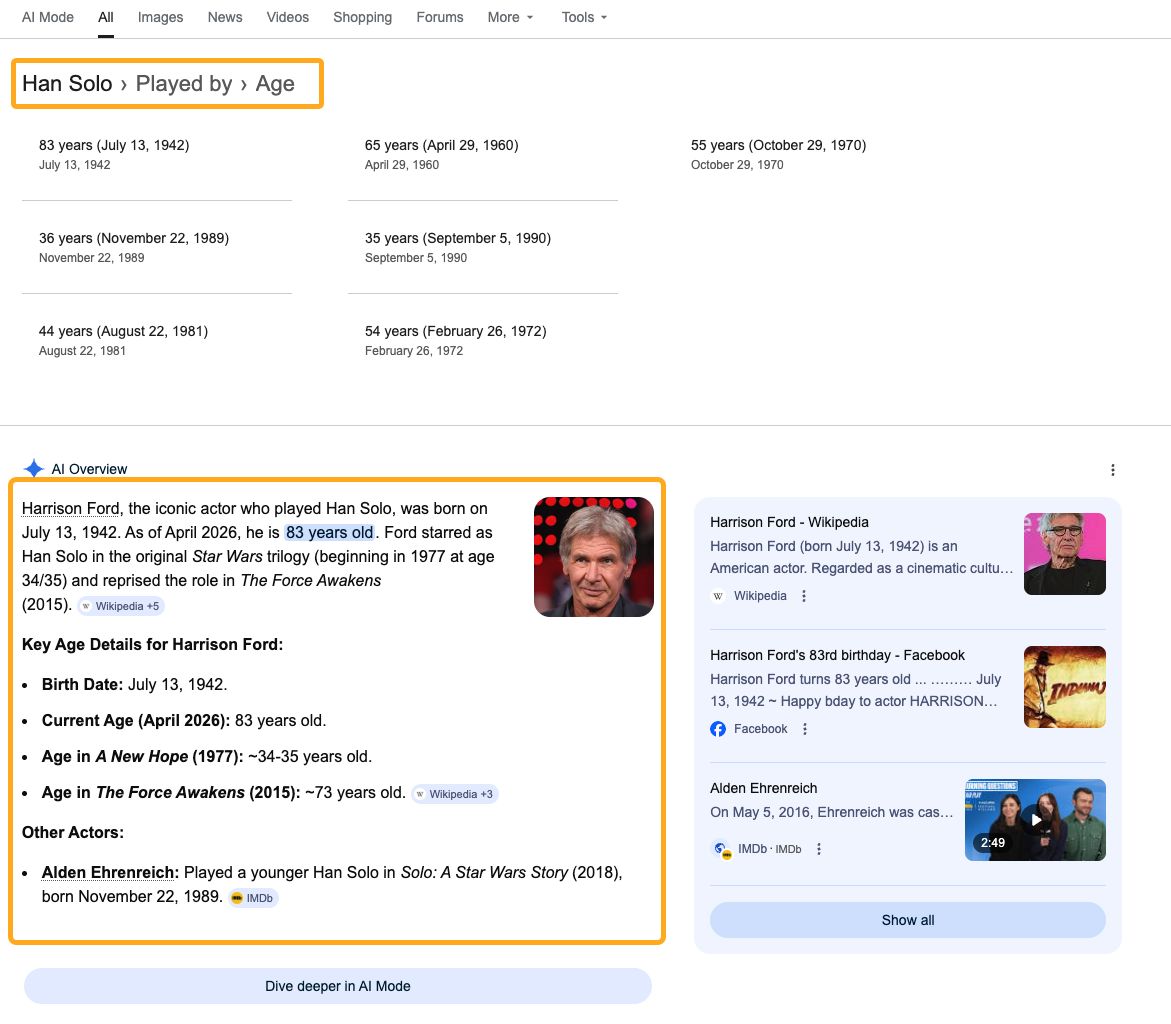
For instance, when searching “han solo actor age” Google displays information from the Knowledge Graph that is then given further context in the AI Overview:
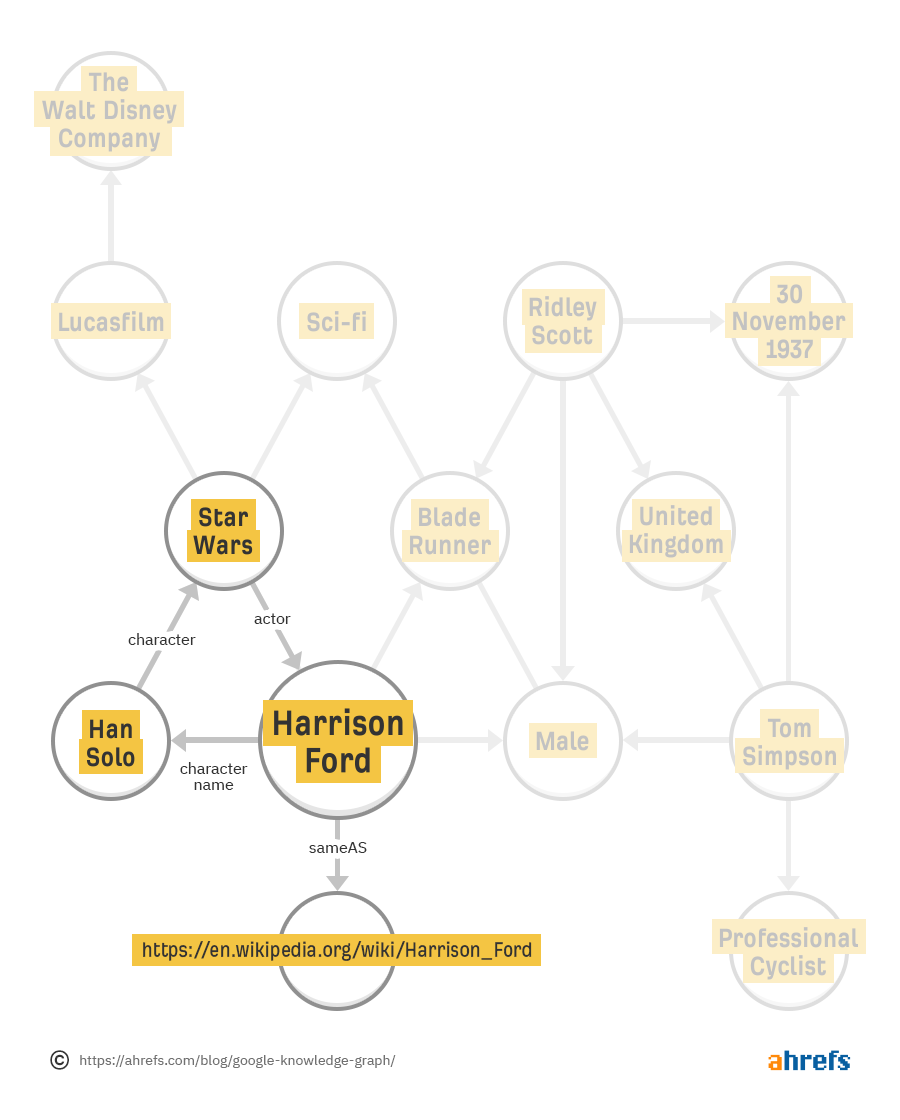
In the background, Google uses relationships in the Knowledge Graph to gather additional context and provide the answer a searcher is looking for. It recognizes Han Solo as a fictional character from Star Wars who was predominantly played by Harrison Ford:
This is one method for how Google grounds AI-generated answers in established facts, rather than relying solely on what it finds across crawled web pages.
It’s also how Google can provide answers to questions that may not be directly covered in content. It can infer entity relationships and context without relying on external content.
AI Mode
Google’s AI Mode (currently its most conversational search experience) explicitly draws on the Knowledge Graph alongside real-time web results.
For instance, when searching for “director of Inception other films,” the response in AI Mode underlines other connected entities in Google’s Knowledge Graph. When you click on any of these underlined entities, a panel opens up with more details from the Knowledge Graph:
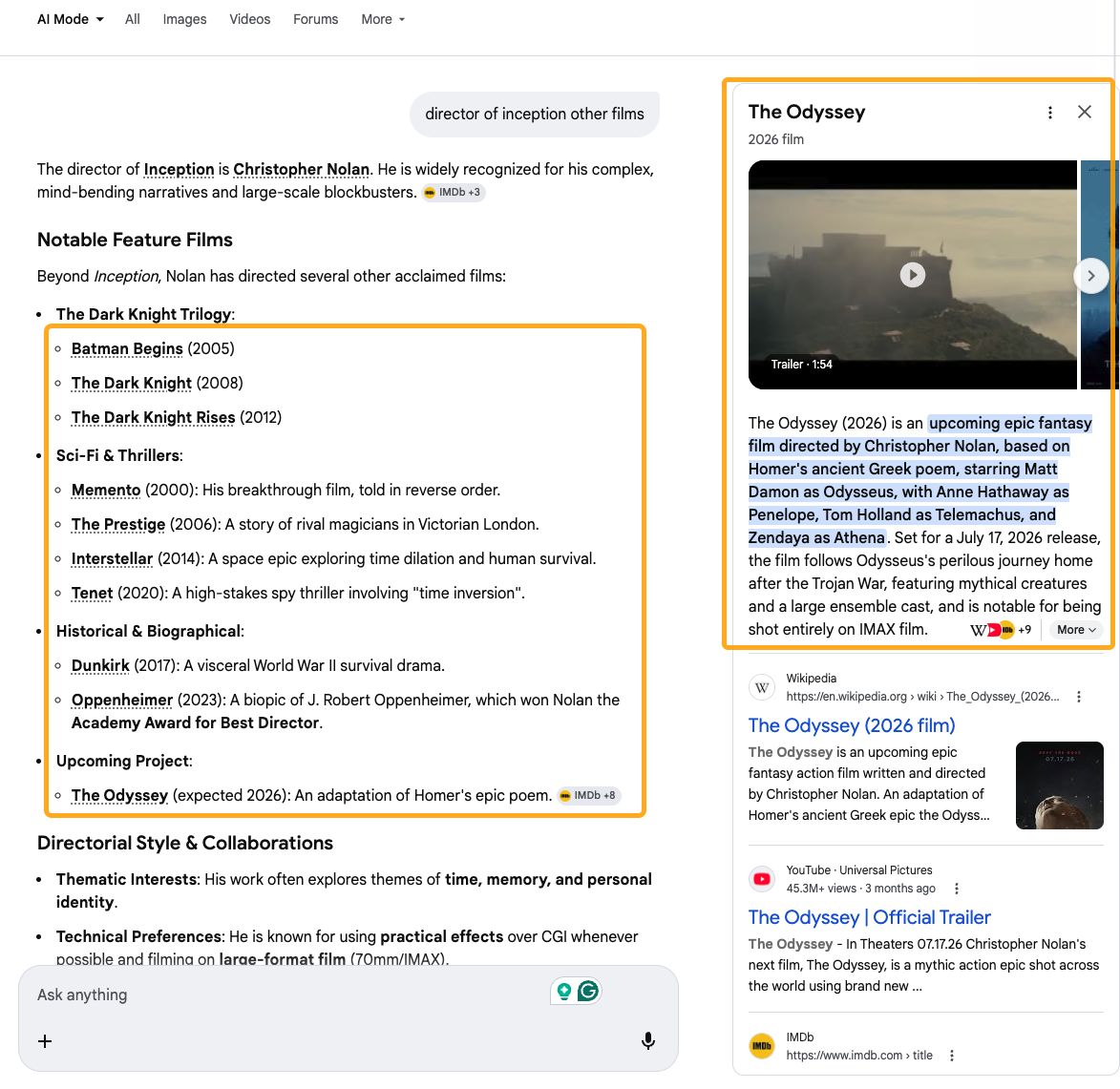
Google has confirmed that AI Mode pulls from the Knowledge Graph as part of its retrieval process, giving it access to structured, factual data about entities that pure web crawling can’t always cleanly provide.
Gemini
Google has documented the Knowledge Graph’s role in Gemini most explicitly in its enterprise product.
According to Google Cloud’s own documentation, the Knowledge Graph enhances Gemini by linking data across people, content, and interactions to improve entity recognition, relationship mapping, and intent understanding.
The same underlying infrastructure powers consumer-facing Gemini responses.
What this means for SEO and AI search
The practical implication is that the Knowledge Graph is no longer just a mechanism for winning a Knowledge Panel. It’s a core part of how Google decides which brands and entities to surface in AI-generated answers.
If your brand isn’t clearly established as a recognized entity (with consistent signals across your website, structured data, and authoritative third-party sources), you risk being invisible not just in traditional SERPs but also in AI Overviews and Gemini responses.
It’s also worth noting that in June 2025, Google significantly pruned its Knowledge Graph.
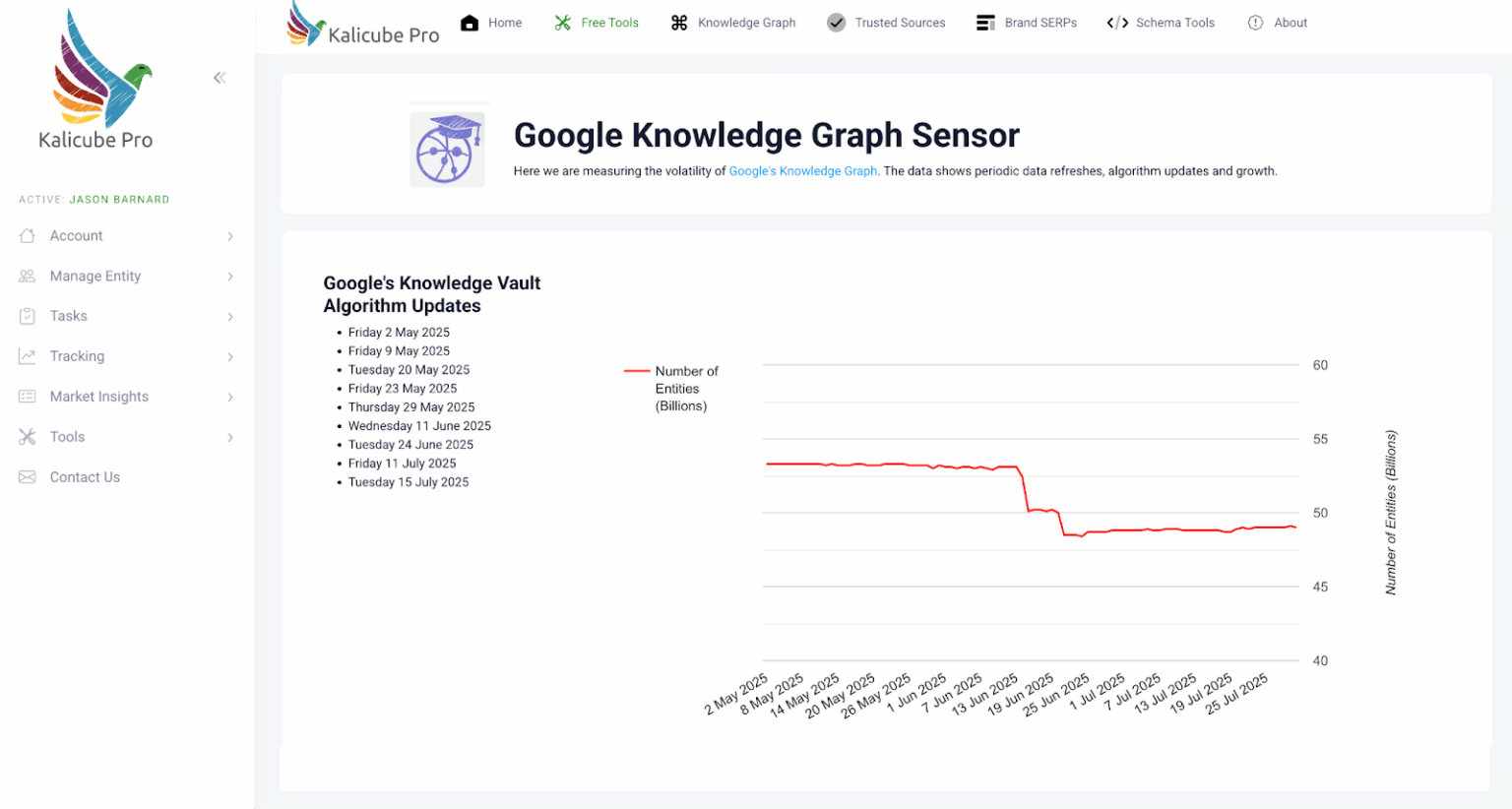
It removed over three billion entities in a single week. The move was widely interpreted as Google prioritizing a leaner, higher-quality dataset to power its AI features more reliably.
The takeaway for SEOs: quality and consistency of entity signals matter more than ever.
It should be clear by now that the positives of being in the Knowledge Graph outweigh the negatives, but how do you get in?
While there’s no definitive process, there are a few things you can do to improve your chances.
1. Check whether you’re already in the Knowledge Graph
Before spending time building new entity signals, it’s worth checking whether Google already recognizes your brand as an entity.
You can do this using the Knowledge Graph API or Carl Hendy’s free Knowledge Graph checker. Search for your brand name and see if an entity result comes back, what entity type Google has assigned it, and what attributes it has.
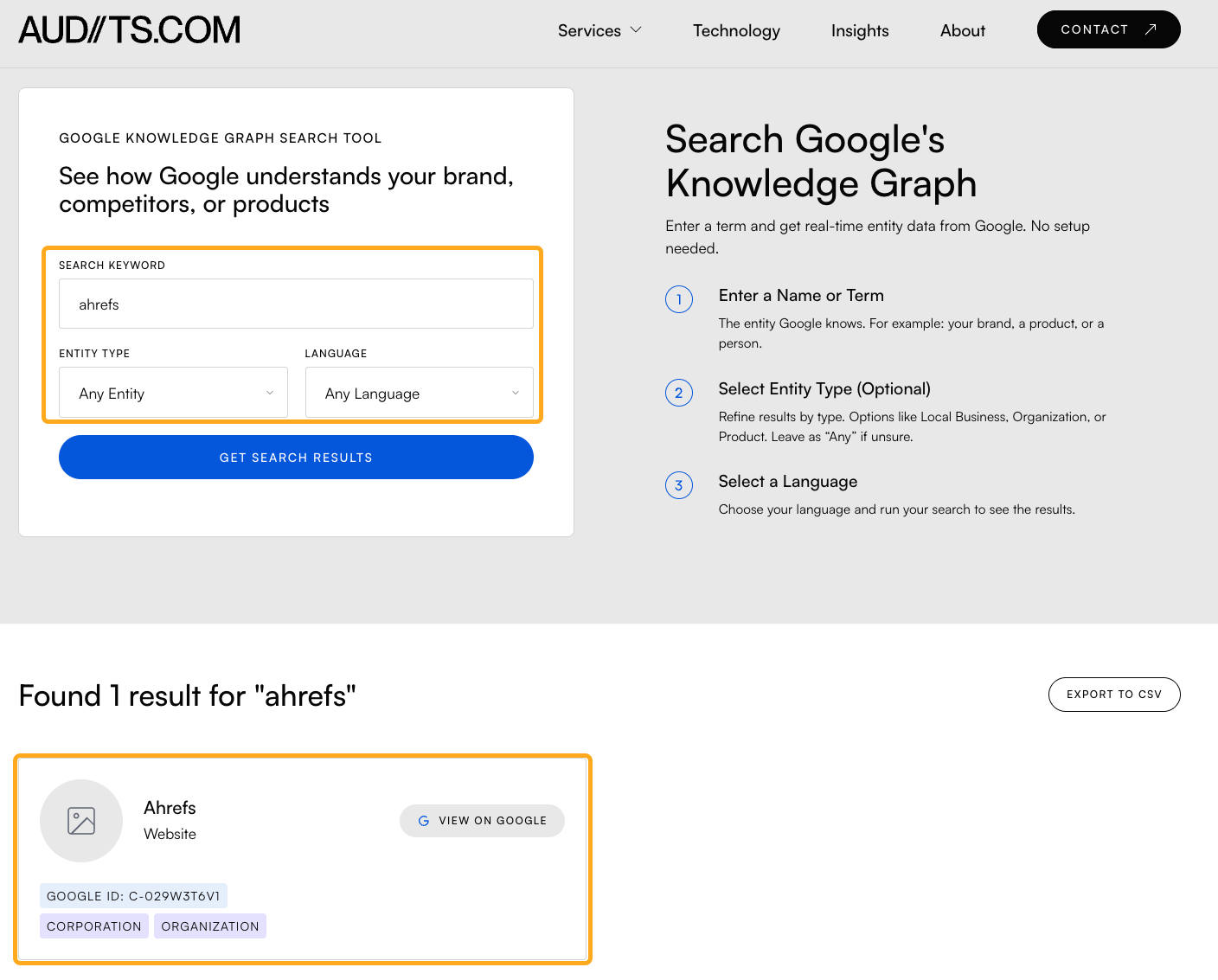
This is useful both as a starting point and as an ongoing check to ensure Google’s understanding of your entity remains accurate as you build more signals.
2. Step up your PR and link building game
If your brand is not recognized as an entity in the Knowledge Graph, it’s so much easier to be included if your company gets talked about on the internet.
Mentions from authoritative publications (like Forbes, TechCrunch, big news outlets, and industry-specific publications) tell Google that your brand may represent a notable entity.
This is the hardest step for most businesses, but also one of the most impactful. Don’t be discouraged if you’re not getting tier-one press yet; the steps below can still move the needle.
3. Use schema markup on your site
Schema.org is the officially recommended markup for structured data. A few things in particular help Google recognize your brand as a distinct entity:
- Use Organization markup on your homepage, which is the most important single URL for establishing your brand identity
- Make sure to use at least the name, logo, URL, and sameAs properties
- In your sameAs array, reference all your social profiles, your Wikidata page, and your Wikipedia page (if you have one)
- Add an @id property pointing to your canonical homepage URL, as this helps Google unambiguously identify your brand’s official entity
- If relevant, link key people (founders, executives) to the brand using Person schema on their bio pages, with a worksFor property pointing back to your Organization
For example, here’s the Basic Organization markup we use at Ahrefs:
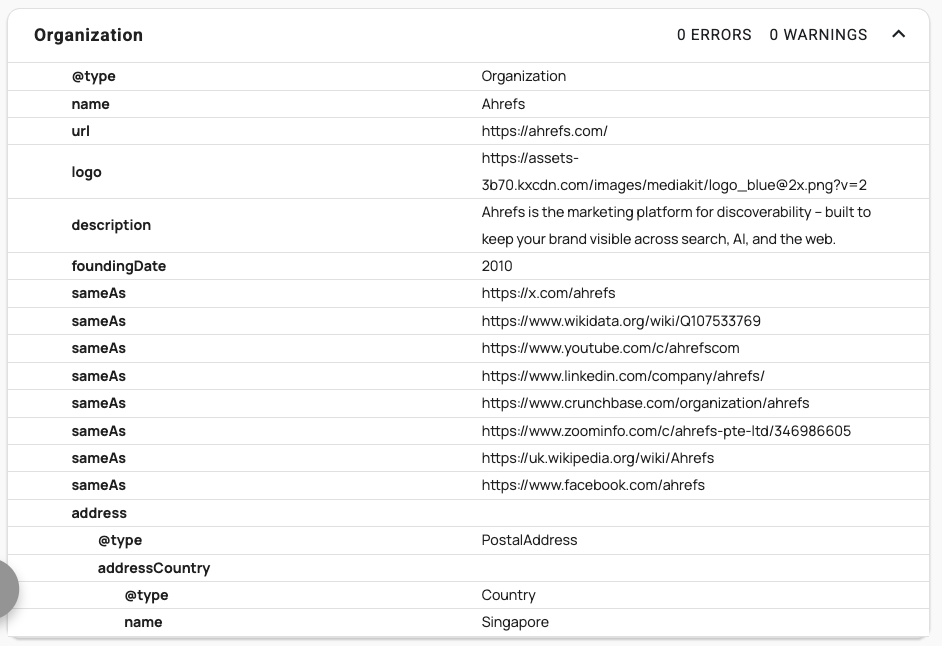
You can validate your markup using the Schema.org validator for a single page or with Ahrefs Site Audit across your entire site.
Why schema validation matters
Fun Fact: Ryan Law, Ahrefs’ Director of Content Marketing, added schema markup to his personal site.
The usual stuff: person, website, organization. It all looked good until one day he noticed Google thought Ahrefs was his personal website!
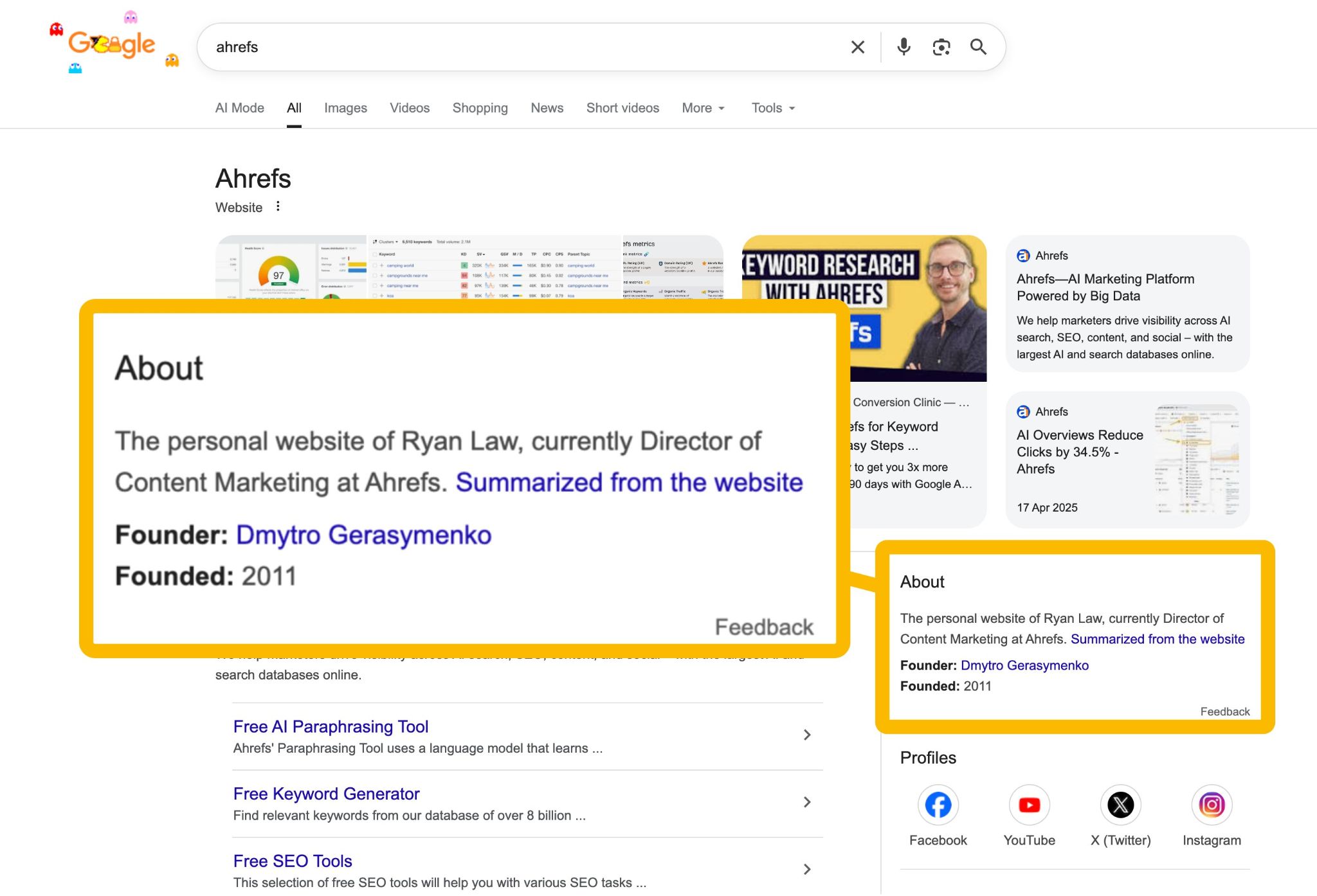
Turns out he had accidentally added Ahrefs’ blog in the sameAs property instead of his author page.
Moral of the story: Always double-check your schema. It is very powerful and can directly affect how your brand is represented on search platforms.
4. Set up a Google Business Profile
If you operate a physical business, creating a Google Business Profile is a must. It helps with brand visibility and authority in both Google Maps and search, giving you a branded local listing that resembles a Knowledge Panel.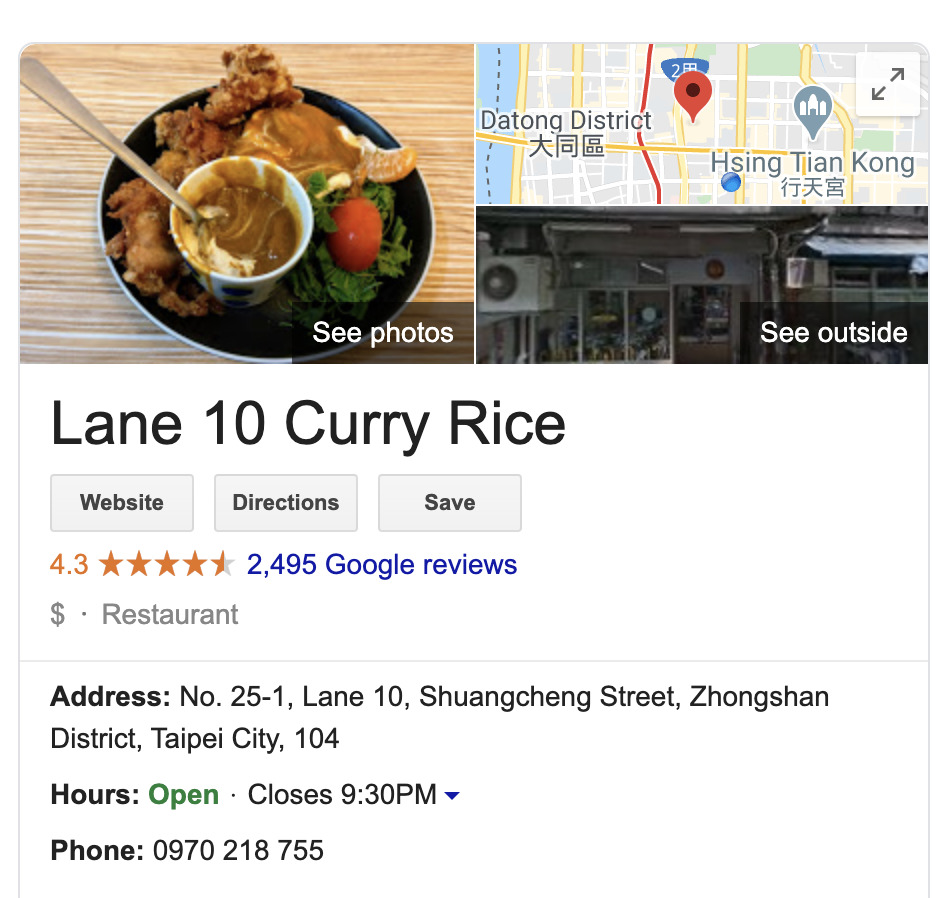
Note that having a Google Business Profile doesn’t guarantee inclusion in the Knowledge Graph. But providing Google with structured, consistent data about your business does increase your chances.
Make sure the name, address, and phone number in your profile exactly match those on your website and social profiles, as inconsistencies can confuse entity resolution.
5. Create a Wikidata entry
Wikidata stores structured data for Wikipedia and other Wikimedia projects. For example, here’s Ahrefs’ entry:
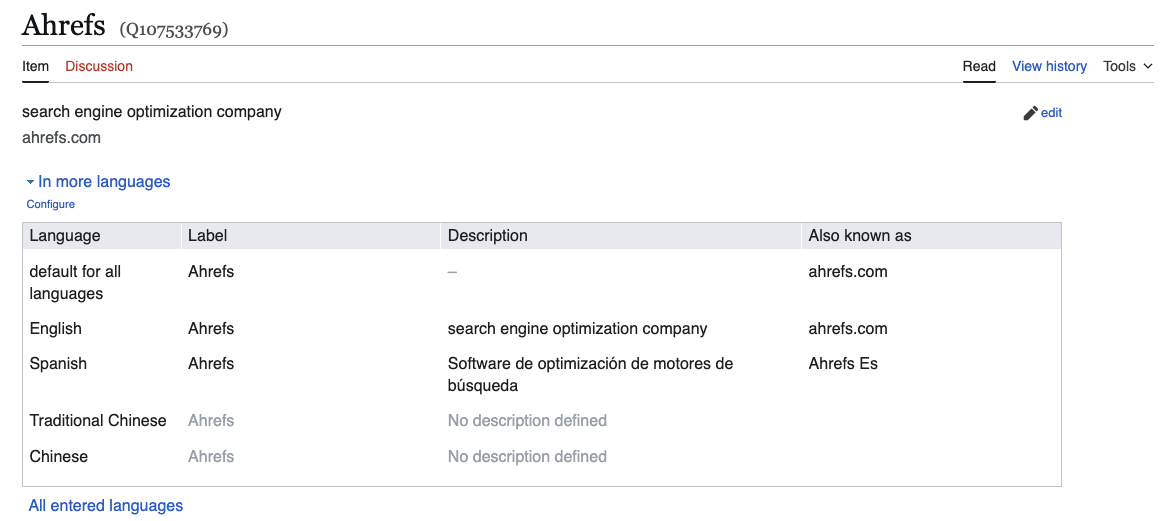
A significant portion of the Knowledge Graph is built from Wikidata, and we’d argue that getting listed there is as important (possibly more important) than getting a Wikipedia page, because it’s considerably more achievable.
Creating a Wikidata item is straightforward, but you’ll need to comply with their Notability policy and back up your data with good sources. Start with their Help portal to understand how the platform works, and then watch this video on adding and editing items for more detailed tips.
Once you have a Wikidata Q-ID, add it to your schema markup’s sameAs array. This can create a direct, machine-readable link between your website and your Knowledge Graph entity.
6. Get a Wikipedia page
Notice we said get rather than create. You can try to create your own Wikipedia page, but you need to adhere strictly to all policies and guidelines.
Only objectively verifiable information backed by trustworthy third-party sources will pass muster.
Your best bet is earning enough press coverage and authoritative mentions that someone unaffiliated with your business creates a Wikipedia page for you. If you do create it yourself, read our thorough guide first and don’t try to find shortcuts.
Attempts at manipulation are frequently flagged by Wikipedia’s editors, and anything dubious sticks in the edit history.
7. Be consistent, everywhere
Consistency is the thread that ties all of the above together. Google cross-references signals about your brand across dozens of sources, including:
- Your website
- Social profiles
- Directories
- Public databases
- Notable press mentions
- And more
Inconsistencies such as different brand names, varying addresses, and mismatched descriptions make it harder for Google to confidently resolve all those signals into a single, well-defined entity.
Audit your brand presence across the web and make sure the basics (name, address, phone number, website URL, brand description) are consistent everywhere they appear.
Google’s Knowledge Panels aren’t perfect. Sometimes they display incorrect information, and this might be true for your branded panel too.
To fix it, claim your Knowledge Panel and get verified by clicking the button below it.
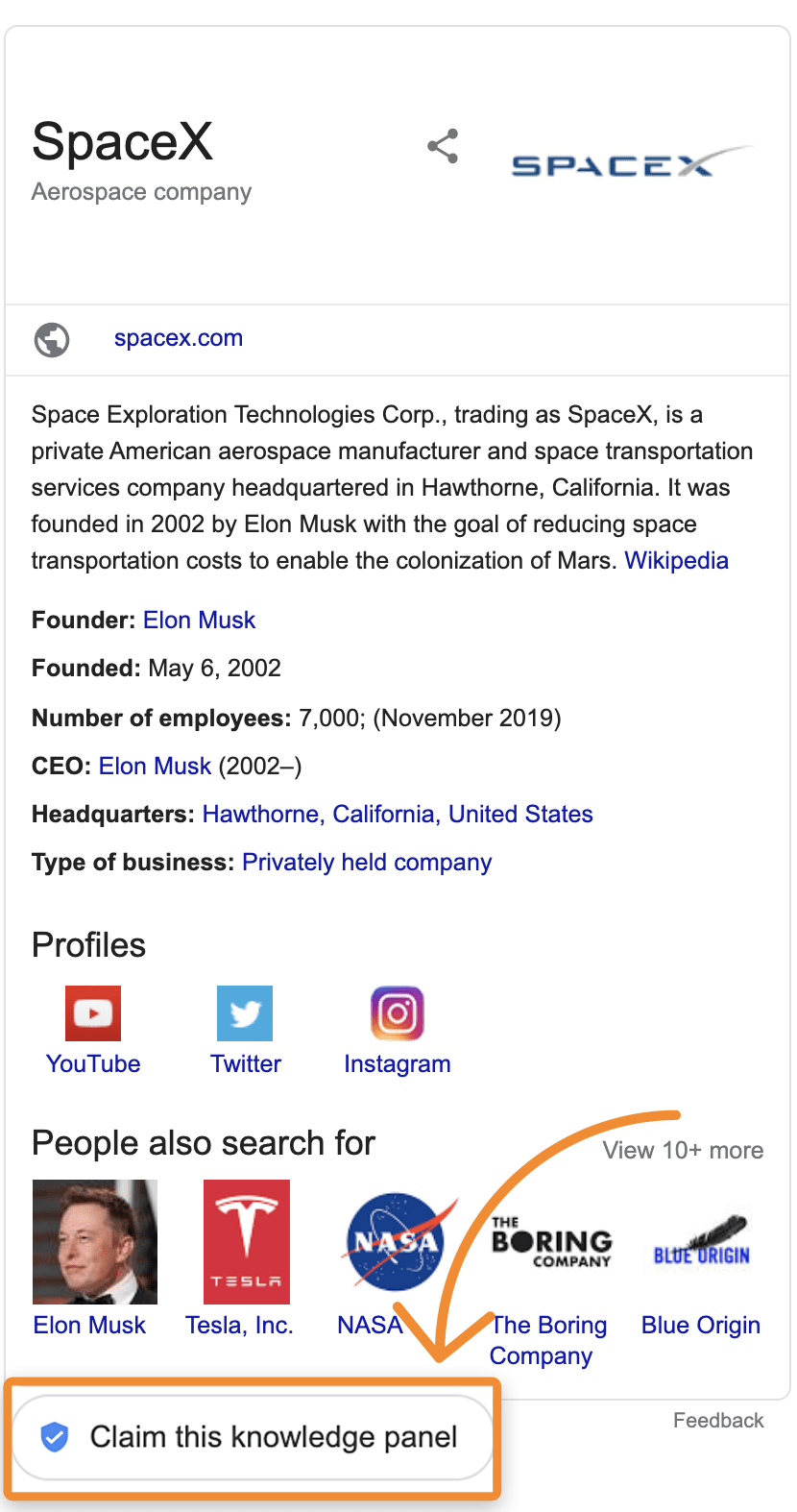
Once verified, you’ll see a “Suggest an edit” button beside the panel whenever you’re logged in to an associated account. Follow Google’s official documentation when submitting edits or requesting data removals.
Final thoughts
When this post was first written in 2020, getting into the Knowledge Graph was primarily about winning a Knowledge Panel, a nice piece of SERP real estate that signaled brand credibility.
That’s still true. But the stakes are higher now.
The Knowledge Graph sits at the core of how Google’s AI products understand the world. AI Overviews, AI Mode, and Gemini all draw on it to resolve entities, verify facts, and decide which brands deserve to be mentioned in AI-generated answers.
Entity optimization (once a fairly niche SEO tactic) is now directly connected to whether your brand shows up in the AI-powered search experiences that are rapidly becoming the default way people get information.
The good news is that the fundamentals haven’t changed: structured data, consistent brand signals, authoritative third-party mentions, and a Wikidata presence remain the building blocks. What’s changed is why they matter and their influence beyond Google’s ten blue links.
[ad_2]
Source_link