
Content gap analysis SEO sounds more complicated than it needs to be.
For a long time, I treated it like a massive research project. Spreadsheets everywhere, endless keyword exports, and very little clarity on what I should actually publish next. The irony is that the answers were sitting right there in Ahrefs the whole time.
Once I simplified the process, content gap became one of the fastest ways to find proven topics, prioritize content that can actually rank, and stop guessing what my site should cover.
In this article, I will walk through exactly how I do gap analysis using Ahrefs, step by step, and how I turn those gaps into publishable content without overthinking it.

Link building cheat sheet
Gain access to the 3-step strategy we use to earn over 86 high-quality backlinks each month.
Why is Content Gap Analysis SEO So Helpful?
Content gap analysis is probably the fastest way I know to turn a blank content calendar into a real content strategy.
Instead of guessing what might work, you start with what is already working for your competitors. If multiple sites in your space are ranking for the same topics and you are not, that is not a theory or a trend. It is a confirmed gap.
That is what makes this approach so effective.
With a single report in Ahrefs, you can uncover dozens of keyword gaps your site could realistically compete for, group them into pages, and map out weeks or even months of content. No brainstorming sessions. No chasing random content ideas.
It also helps you prioritize. Effective content gap analysis quickly highlights which topics are worth your time and which ones are not. If a keyword shows up across several competitors, matches your business goals, and fits your site’s authority level, it moves to the top of the list.
Most importantly, it gives you direction for content creation and your overall content marketing strategy.
Step 1: Pick the Right Competitors
This step matters more than most people think, and it is where content gap analysis often goes wrong.
When you run a content gap report, Ahrefs does not know your business context. It only knows which sites rank for similar keywords. That means it will happily pull blogs, media sites, and SEO content farms that look like competitors on paper but have nothing to do with your product or service.
I start by defining competitors the same way a potential customer would. These are companies solving the same problem, targeting the same audience, and offering a similar product or service. Not sites that just publish content in the same niche.
In our case, it’s other link building agencies like The Hoth and Fat Joe.
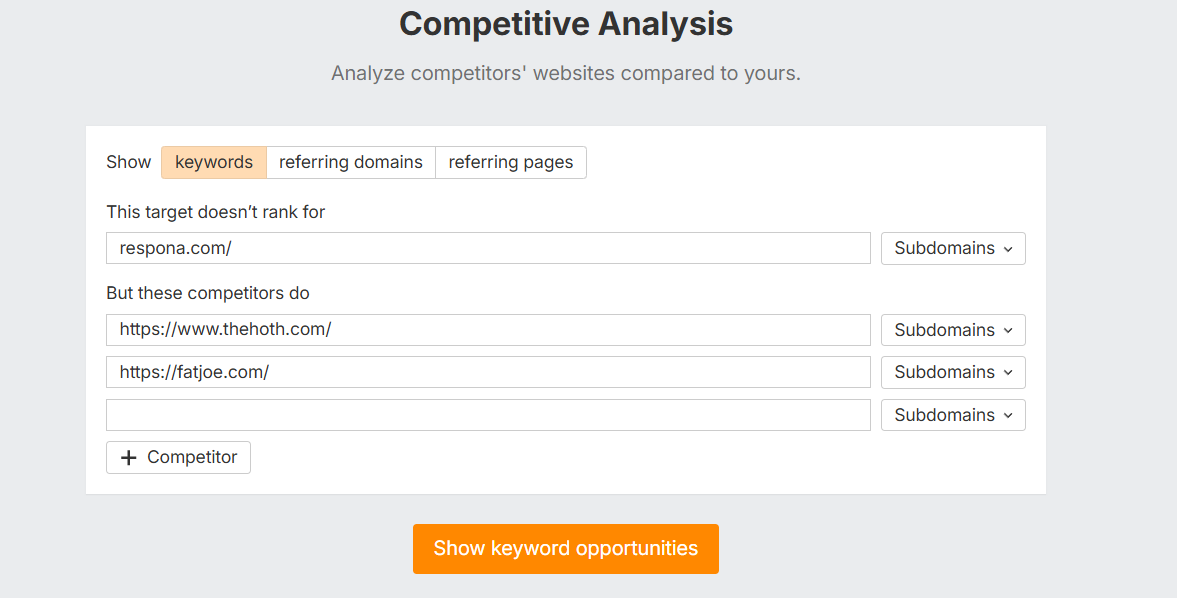
I usually end up with two to five competitors that are a close match. That is more than enough. Adding too many sites introduces noise and pulls the analysis away from commercially relevant topics and existing content gaps.
Step 2: Apply Filters
Once the competitors are set, the raw content gap report is usually overwhelming.
You will see hundreds or even thousands of keyword gaps, most of which are not worth touching.
The first thing I focus on is keyword difficulty. I intentionally bias toward low difficulty keywords, even if the search volume looks unimpressive. Smaller numbers do not scare me here. Low difficulty means weaker competition, clearer search intent, and faster wins.
As a rule of thumb, I avoid keywords with a difficulty score higher than my site’s Domain Rating.
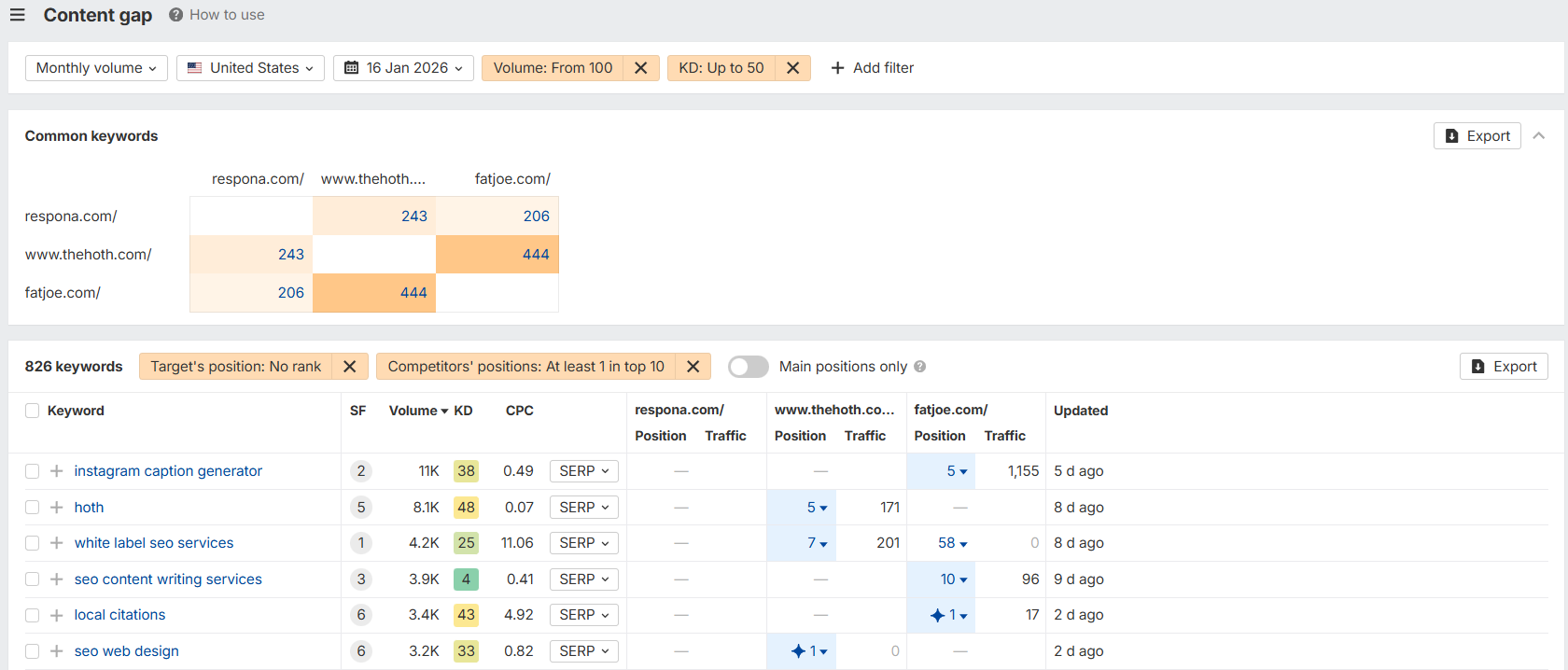
That does not mean ranking is impossible, but it usually means the effort-to-reward ratio is not great, especially when you are building momentum.
Next, I set a reasonable volume floor. I am not chasing zero-volume terms, but I also do not need massive numbers. 100 monthly search volume is just fine.
I also filter out branded terms and anything that does not align with what the product actually does. This sounds obvious, but it is an easy way to waste time if you skip it.
You can cross-reference findings with Google Search Console and Google Analytics to see which existing content is already performing and where the biggest gaps in your current content are.
Step 3: Group Keywords Into Pages, Not Just Lists
This is where content gap analysis turns into an actual content strategy.
A common mistake is treating every keyword in the report as its own article. That approach bloats your site with thin pages and forces them to compete against each other. Instead, I focus on grouping related keywords into a single, strong page.
I start by looking at intent. If several keywords are clearly asking the same question or solving the same problem, they belong together. One page can easily rank for dozens of long tail variations as long as the core intent is covered properly.
Ahrefs makes this easier with parent topics and SERP overviews. When multiple keywords share the same parent topic or return nearly identical search results, that is a clear signal they should be combined into one page for better content optimization.
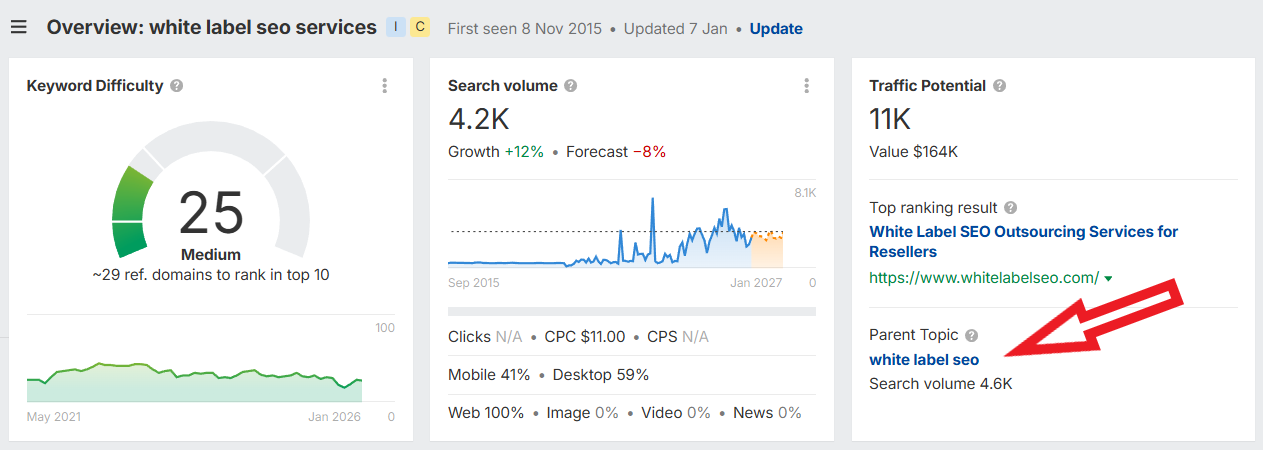
Once grouped, I decide what type of page it should be. Some clusters naturally become in-depth guides. Others work better as comparison pages, templates, glossaries, or landing pages. Let the intent drive the format, not the other way around.
This is also where conducting a content audit helps. Review your existing content to see if you can update and expand current pages instead of always creating new content from scratch.
Step 4: Validate Each Gap With SERP and Parent Topic
Before I turn any gap into content, I sanity check it against the SERP.
Just because a keyword looks good in the content gap report does not mean it is a good fit for a new content piece. The fastest way to catch bad ideas is to open the SERP overview in Ahrefs and see what search engines are actually ranking.
I look for patterns first.
Are the top results blog posts, product pages, comparison articles, or SEO tools?
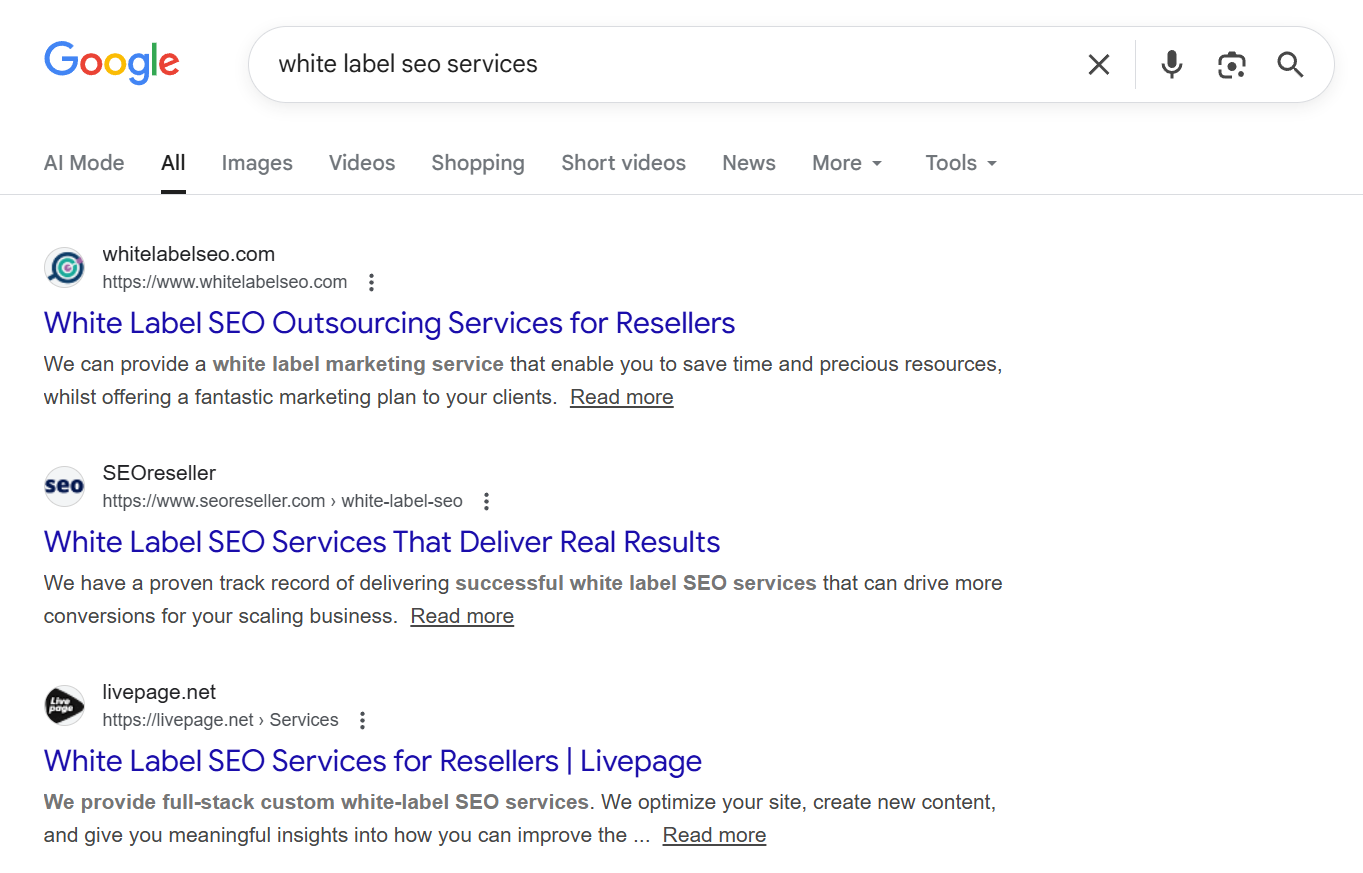
If my planned page does not match that format, it is a red flag. Search intent is very consistent, and fighting it is rarely worth the effort.
Next, I check the parent topic. This step prevents accidental duplication. If several keywords roll up into the same parent topic and the search result looks identical, creating multiple pages would just make them compete with each other. In that case, I merge them into a single, stronger page.
This validation process is crucial for identifying content gaps that actually matter and avoiding wasted effort on competitor content that does not align with your goals.
Step 5: Score and Make Your Content Plan
At this point, I usually have more good page ideas than I can realistically publish.
This is where scoring saves me from relying on gut feeling.
I use a simple opportunity score to decide what gets written first and what can wait. The formula looks like this:
(1 / keyword difficulty) × traffic potential × (CPC + 1) = Opportunity Score
Here is why it works.
Difficulty is inverted on purpose. The lower the difficulty, the higher the score. This naturally pushes easier wins to the top of the list instead of letting high competition keywords dominate the plan.
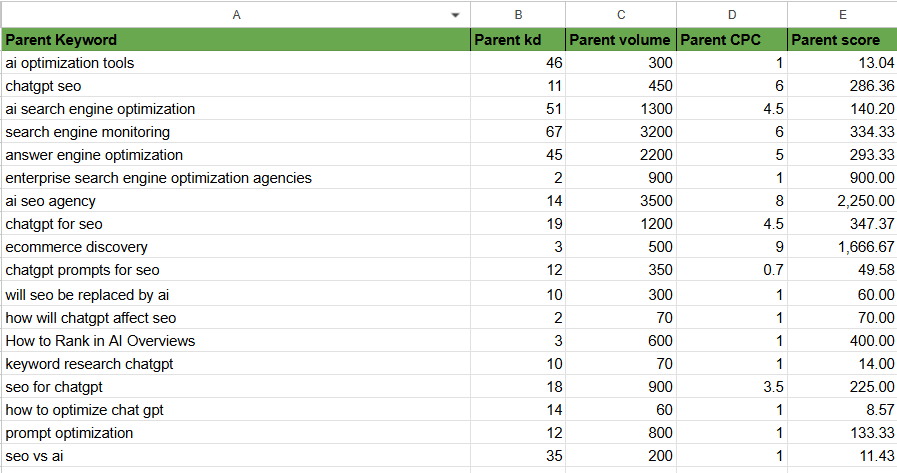
Traffic potential matters more than raw volume. I look at how much traffic the top-ranking pages are actually getting, not just the main keyword’s number. This gives a more realistic picture of your own traffic potential and helps identify the best content opportunities.
CPC acts as a proxy for commercial intent. A higher CPC usually means businesses are willing to pay for that traffic. Adding one prevents zero CPC keywords from collapsing the score entirely.
Once I calculate the score for each page idea, patterns become obvious very quickly. Some pages are low effort and high return for filling content gaps. Others look interesting but would take a lot more time and authority to move.
From there, building the content strategy is easy. I sort by opportunity score, sanity check for business relevance, and map the top pages into a realistic publishing schedule. This approach works for digital marketing agencies, web design firms, and any business looking to improve search engine rankings through better content.
You can also use Google Trends to validate trending topics and ensure your keyword research aligns with current search behavior across search engines.
Link building cheat sheet
Gain access to the 3-step strategy we use to earn over 86 high-quality backlinks each month.
Now Over To You
Content gap analysis takes the guesswork out of SEO.
When you use Ahrefs and other SEO tools the right way, you stop chasing random ideas and start building a content strategy backed by proof. You know what competitors content ranks for, what you can realistically win, and what is actually worth publishing next.
The last piece is authority.
Even the best content plan needs links to compete, especially once you move past the easiest wins. That is where most teams slow down or stall completely.
Our done-for-you link building service handles that part for you.
We take care of prospecting, outreach, relationship building, and placement using fully white-hat methods, so your SEO content has the authority it needs to rank and improve your overall SEO performance.
Frequently Asked Questions (FAQ)
How often should I run a content gap analysis?
I usually run it quarterly or whenever I am planning a new content push. It is also useful after a ranking drop or when launching a new product or site section. Regular gap analysis helps you stay ahead of competitors and identify fresh content opportunities.
How many competitors should I include in Ahrefs?
Two to five competitors is ideal. More than that tends to introduce noise and makes it harder to focus on gaps that actually matter to your business and content strategy.
Should I create a page for every keyword in the content gap report?
No. Most keywords should be grouped into clusters and handled by a single page through advanced content gap analysis. Treating every keyword as its own article usually leads to thin content and internal competition.
What keyword difficulty should I target?
As a rule of thumb, I avoid keywords with a difficulty score higher than my site’s Domain Rating. Lower difficulty keywords are faster to rank and much easier to win, especially when combined with solid technical SEO and an SEO strategy.
Do I need backlinks for content gap keywords?
Yes. Low difficulty keyword gaps can rank with minimal links, but authority still matters as you scale. Strong, relevant backlinks make it much easier for new content to gain traction and improve search engine rankings. You can also leverage social media to amplify your content reach and support your overall SEO optimization efforts.