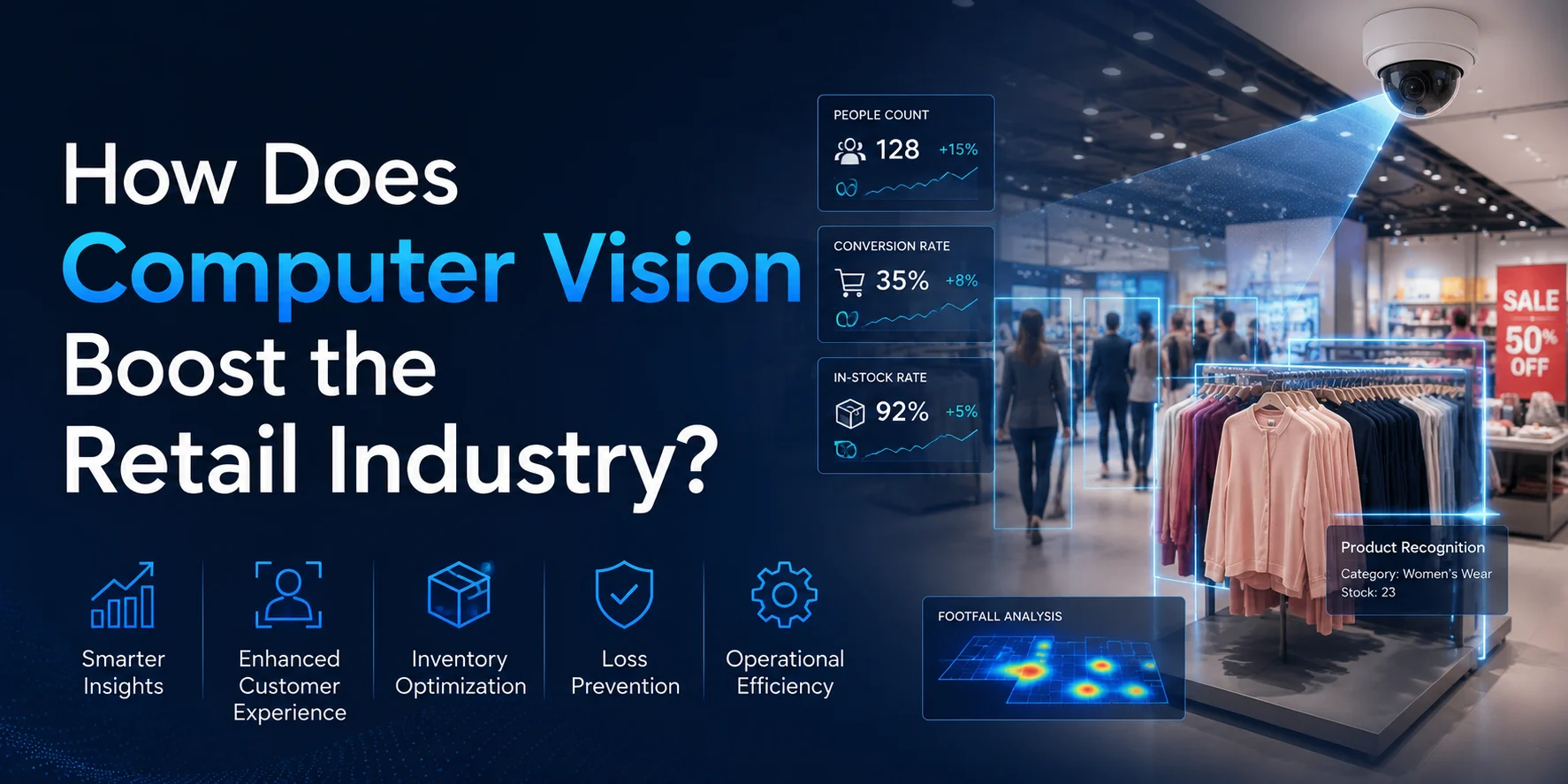
Walk into an Amazon Go store, and you’ll experience something that still feels slightly uncanny the first time. What makes that possible is computer vision, and what Amazon built at scale is becoming accessible to retailers.
Computer vision in retail is a frontier technology reserved for billion-dollar innovation labs. The global computer vision market in retail is experiencing explosive growth, projected to reach between US$12.56 and US$58.29 billion by 2030. It is a deployable capability that mid-market and enterprise retailers are integrating into operations today.
It solves problems like loss prevention, inventory management, customer behaviour analysis, and store operations. This guide explains what computer vision in retail is and what implementation actually looks like.
How is Computer Vision Changing the Retail Landscape?
Computer vision is the ability of a computer system to interpret and understand visual information. This includes images, video feeds, and physical environments captured through cameras and sensors. It uses ML models trained on large datasets of visual examples. These systems can identify objects, count items, recognise patterns, read text, detect anomalies, and track movement in real time.
In a retail context, it refers to cameras and sensors installed throughout a store. A warehouse is connected to a computer vision development company that interprets and extracts operational intelligence from it.
The core technologies underlying retail computer vision include Convolutional Neural Networks (CNNs) for object recognition and spatial analysis. OCR for reading product labels and expiration dates, GANs for image enhancement, and Vision Transformers for converting visual data into structured insights.
Key Benefits of Integrating Computer Vision in Retail
Here is how it benefits retail businesses
Operational Efficiency at Scale
Computer vision development benefits the automation of the most time-consuming and error-prone operational tasks in retail. Such as inventory counting, shelf compliance checking, quality inspection, and checkout processing. Tasks that previously required trained staff spending hours on repetitive manual work. It can be automated, freeing human attention for customer service and complex problem-solving.
Loss Prevention That Actually Works
Retail shrinkage, the combination of shoplifting, employee theft, and administrative error, costs $100 billion annually.
Traditional loss prevention relies on human observation, which is inconsistent and easily defeated by basic techniques. Computer vision systems monitor, detect concealment behaviour, flag suspicious patterns, and alert security staff in real time without inconsistency.
Inventory Accuracy Without the Overhead
Inventory inaccuracy in retail is pervasive and commercially damaging. It creates both overstock situations that tie up capital and out-of-stock situations that lose sales. Computer vision systems can scan shelves, detect when products fall below minimum stock levels, and trigger reorder processes.
The global retail out-of-stock problem costs an estimated $1 trillion annually in lost sales. Automated visual inventory monitoring addresses the root cause directly.
Customer Behaviour Intelligence
Understanding how customers move through a store and which sections attract the most attention. It is where dwell time is highest, and which product placements drive interaction has required expensive manual observation. Computer vision enables store layout optimisation, planogram compliance, and product placement decisions.
Real-life Computer Vision Use Cases in Retail
Here are the real-time use cases of computer vision.
| Retail Computer Vision Use Case | Business Benefits | Technologies Used | Common Challenges |
| Cashier-Less Checkout | Faster checkout experience, reduced waiting time, improved customer convenience | AI cameras, object detection, edge computing, POS integration | High setup costs, infrastructure complexity |
| Shelf Monitoring & Inventory Tracking | Improved inventory accuracy, automated stock management, reduced out-of-stock situations | Computer vision AI, smart cameras, inventory analytics | Real-time data synchronization challenges |
| Customer Behavior Analysis | Personalized shopping experiences, better store layout optimization, improved marketing insights | Facial analytics, heatmaps, AI-powered analytics platforms | Customer privacy and compliance concerns |
| Loss Prevention & Security Monitoring | Reduced theft, improved store security, faster incident detection | Surveillance systems, AI detection models, video analytics | Accuracy of threat detection and false positives |
| Smart Retail Analytics | Better decision-making, operational efficiency, customer trend analysis | Cloud analytics, AI algorithms, data visualization tools | Integration with existing retail systems |
| Automated Checkout & Payment Recognition | Contactless shopping experience, faster transactions, reduced staffing dependency | Visual recognition systems, payment integrations, AI automation | Scalability and implementation costs |
| Personalized In-Store Experiences | Improved customer engagement and loyalty | AI recommendation engines, customer data platforms | Data management and personalization accuracy |
Automated Checkout and Friction-Free Shopping
The most visible application of computer vision in retail is checkout-free, which eliminates the traditional PoS bottleneck. Cameras and sensors track what customers pick up, using object recognition to identify products and quantities.
When the customer leaves, the system calculates the total and processes payment automatically. The commercial benefit is dual, with customer experience improvement through elimination of high-traffic checkout operations.
Shelf Management and Planogram Compliance
Planograms are the strategic layouts that specify exactly where products should be placed on shelves. Compliance with these arrangements is supposed to be maintained consistently across store locations. In practice, manual compliance checking is infrequent and inconsistent.
Computer vision development systems mounted above mobile robots can scan shelves and compare the actual product placement. For FMCG brands, this has direct revenue implications. Shelf management and planogram monitoring is one of the commercial applications of computer vision in retail environments.
Inventory Management and Automated Replenishment
Beyond planogram compliance, computer vision enables fully automated inventory monitoring across warehouses and store floors. Systems scan physical spaces to calculate available stock levels, cross-reference against sales velocity data, and trigger automated replenishment orders without human intervention.
For high-SKU retailers, the operational overhead of manual inventory management is enormous. Computer vision reduces this to continuous automated monitoring with human oversight only for strategic decisions.
Quality Control and Expiration Date Monitoring
For grocery and perishable goods retailers, product quality and expiration date management is crucial. It is both a food safety requirement and a significant source of waste cost. Computer vision systems can read expiration dates using OCR and flag products approaching expiry for promotional markdown.
Physical quality inspection detecting damaged packaging, discoloration is equally automatable. Computer vision treats products as three-dimensional objects, comparing them against reference models to identify deviations that human inspectors working at pace would miss.
Customer Behaviour and Store Traffic Analysis
Computer vision enables continuous, passive analysis of how customers move through retail spaces where customers abandon their shopping journey.
This intelligence replaces expensive, infrequent manual observation studies with a continuous data feed that enables iterative store optimisation. Retailers using this capability report measurable improvements in conversion rates from layout changes informed by actual customer behaviour data rather than category management intuition.
Loss Prevention and Security
Advanced loss prevention through computer vision operates across multiple detection layers. Object concealment detection identifies when customers place items in bags, pockets, or clothing without scanning. Unusual behaviour pattern recognition flags activity consistent with coordinated theft.
Facial recognition against known offender databases provides early warning for repeat incidents. The commercial impact is significant. Even modest improvements in shrinkage rates across a retail chain with high transaction volumes produce material improvements in gross margin without additional operational overhead.
Virtual Try-On and Augmented Reality Experiences
Fashion, accessories, and home decor retailers are using computer vision development to power AR try-on experiences that reduce purchase uncertainty. Customers can see clothing items on their own body image or try different eyewear frames without physical handling.
Zara and several major fashion retailers have deployed this capability commercially. Return rate reduction from AR try-on features represents both cost savings and environmental benefit. It is a combination that is increasingly relevant to the consumer segments these retailers are targeting.
Real-World Examples of Computer Vision in Retail
Amazon Go
The most well-known deployment of checkout-free retail using computer vision. Cameras and sensors throughout the store track every item picked up by every customer. The Just Walk Out technology has been licensed to other retailers, demonstrating the commercial viability of the model beyond Amazon’s own operations.
Walmart
Has deployed computer vision across distribution centres and store operations for inventory management, checkout monitoring at self-service kiosks, and supply chain quality control. Their vision system detects out-of-stock shelves and damaged items across stores at a speed and consistency that manual checking cannot approach.
Sephora
Uses computer vision-powered AR for virtual makeup try-on, allowing customers to see how different products look on their own face before purchasing. The feature has reduced returns and increased average transaction values for customers who engage with it.
Zara
Deploys AR-powered virtual fitting experiences in selected stores, using computer vision to map the customer’s body. The application addresses the fundamental uncertainty of fashion retail.
How to Get Started With Computer Vision in Retail?
Here is how you can implement it in the retail industry.
Phase 1: Define the Use Case and Commercial Objective
The most common implementation failure is starting with the technology rather than the problem. Before evaluating any vendors or infrastructure, define specifically what operational problem you are solving. Inventory accuracy below a defined threshold?
Shrinkage above an acceptable rate? Checkout queuing times that drive abandonment?
The commercial objective defines which computer vision capability you need.
Phase 2: Assess Your Existing Infrastructure
Computer vision deployments build on existing camera and sensor infrastructure where possible. Assess your current CCTV coverage like camera positions, connectivity, and storage capacity. Identify gaps between your current infrastructure and what the target use case requires. Many retailers discover that their existing camera network is suitable with targeted upgrades.
Phase 3: Address Data and Integration Requirements
Computer vision systems generate continuous streams of structured data to connect with your retail systems. Define the integration architecture before implementation begins. Compatibility issues with legacy systems are a common source of implementation delays and computer vision development cost overruns. Many retailers address these challenges by partnering with an AI software development company that can integrate computer vision platforms with existing POS, ERP, inventory, and analytics systems.
Data quality also matters significantly. Models trained on low-quality or poorly labelled visual data produce unreliable outputs, regardless of how sophisticated the algorithm is. Investing in data quality upfront produces better model performance from deployment.
Phase 4: Pilot Before Full Deployment
Deploy in a single location or a single use case before scaling across the estate. A controlled pilot generates real performance data, surfaces integration issues in a low-risk environment, and builds internal confidence in the technology before commitment to full-scale rollout.
Define clear success metrics for the pilot before it begins, but this technology delivers the specific commercial outcome. Metrics like shrinkage rate change or checkout time reduction provide objective evaluation criteria.
Phase 5: Monitor, Refine, and Scale
Computer vision models improve with exposure to real operational data. The initial deployment performance will improve meaningfully over the first 3-6 months as the model processes more real-world scenarios from your specific environment. Plan for an active optimisation period post-deployment rather than treating go-live as the completion point.
Expert Opinion
Computer vision is rapidly becoming one of the most transformative technologies in the retail industry. As customer expectations evolve toward faster, retailers are increasingly adopting AI-driven visual intelligence systems to stay competitive. From cashier-less stores to advanced customer behavior analytics, computer vision is helping businesses improve operational efficiency while enhancing customer engagement. However, successful implementation requires the right balance of AI strategy, infrastructure, data privacy compliance, and system integration. Retailers that invest early in scalable computer vision solutions will be better positioned to drive innovation and improve long-term customer loyalty.
Conclusion
Computer vision in retail has moved firmly beyond the pilot-and-proof-of-concept stage. The retailers deploying it at scale are generating measurable returns across loss prevention.
The competitive dynamic is worth acknowledging directly. Retailers operating with CV-enabled inventory management are making better operational decisions faster than those managing these functions manually.
FAQs
1. How is computer vision used in the retail industry?
Computer vision in retail is used for applications such as cashier-less checkout, shelf monitoring, customer behavior analysis, inventory tracking, facial recognition, and loss prevention. Retailers use AI-powered vision systems to improve operational efficiency, enhance customer experiences, and optimize in-store decision-making.
2. What are the key benefits of implementing computer vision in retail?
The major benefits of computer vision in retail include improved inventory accuracy, reduced theft, faster checkout experiences, personalized customer engagement, better store analytics, and enhanced operational efficiency. It also helps retailers automate repetitive processes and reduce manual dependency.
3. Can small and mid-sized retailers adopt computer vision solutions?
Yes, modern computer vision solutions are becoming more scalable and cost-effective, making them accessible for small and mid-sized retailers. Businesses can implement computer vision gradually for specific use cases such as inventory monitoring, customer analytics, or smart checkout systems.
4. What technologies are required to implement computer vision in retail?
Retail computer vision systems typically require AI algorithms, cameras, cloud infrastructure, edge computing, data analytics platforms, and integration with POS or inventory management systems. Businesses often work with AI and retail technology providers for successful implementation.
5. What challenges do retailers face while implementing computer vision?
Some common challenges include high initial implementation costs, data privacy concerns, system integration complexity, infrastructure requirements, and maintaining AI model accuracy. However, with the right implementation strategy and technology partner, businesses can overcome these challenges effectively.