
Key takeaways
- Social media’s roots stretch back to the 1970s, but the platforms we recognize today began emerging in the late 1990s.
- The 2004 to 2012 period saw explosive growth as Facebook, YouTube, Twitter, and Instagram each redefined how people connect and share content online.
- Short-form video, the creator economy, and algorithm-driven feeds have dominated the 2016 to 2026 era.
- Social media now reaches more than 5 billion users globally, and the next chapter is being shaped by regulation, decentralization, and AI integration.
Social media refers to online platforms that let people create profiles, connect with others, and share user-generated content in real time. It is defined less by any single app and more by a set of shared traits that separate a social network from a website or a chat tool.
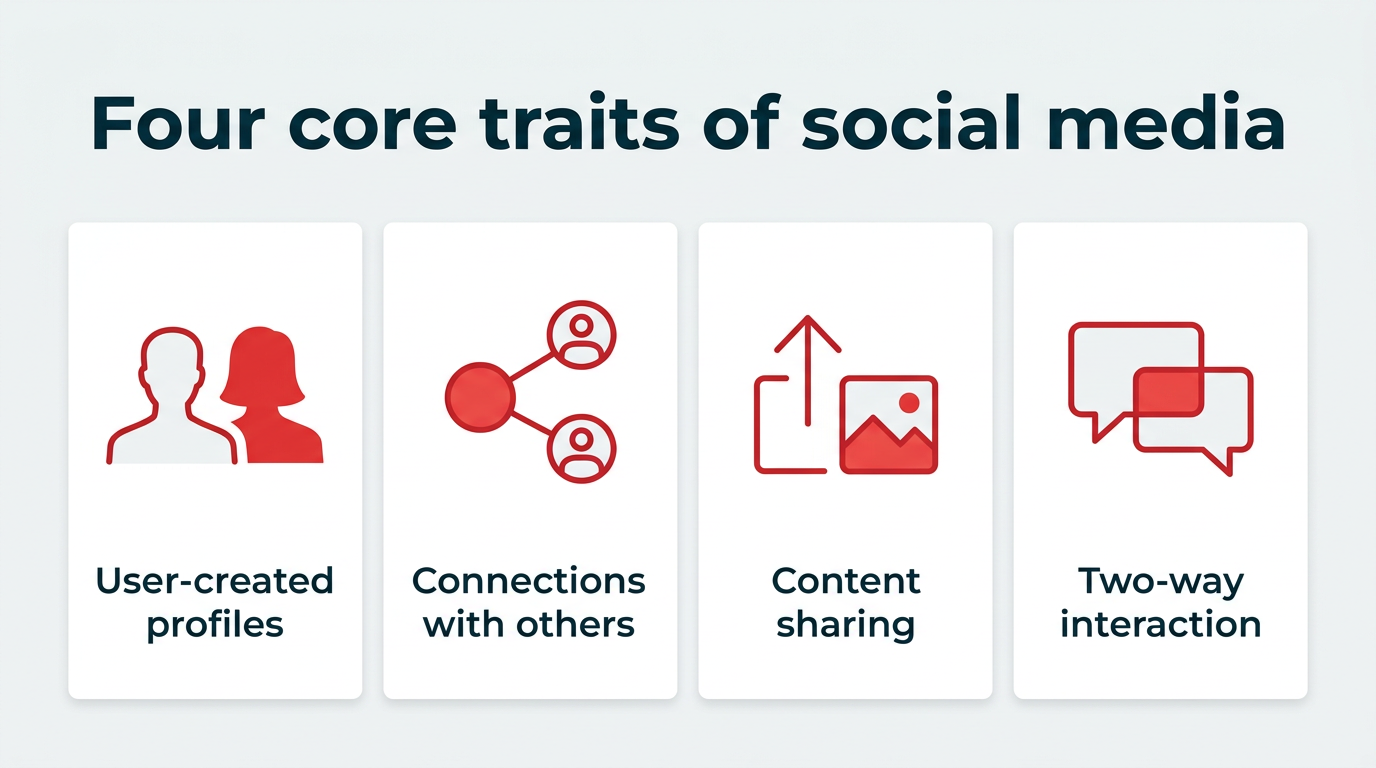
That distinction matters when you try to name the “first” platform, because the answer depends on where you draw the line. Most social media platforms share a few core characteristics:
- User-created profiles: A personal identity or account that represents you on the platform.
- Connections with others: The ability to follow, friend, or link to other users.
- Content sharing: Tools to post text, photos, video, or links to an audience.
- Two-way interaction: Comments, likes, replies, and messages that make communication interactive rather than one-directional.
With that lens in place, the rest of this timeline becomes easier to read as a steady evolution rather than a single invention.
Here is a scannable social media timeline covering the most significant milestones in the history of social media, from the earliest online communities to today.
|
Year |
Milestone |
Significance |
|---|---|---|
|
1973 |
Community Memory |
One of the first public computerized bulletin board systems |
|
1979-1980 |
Usenet |
Often cited as the first open social media application |
|
1988 |
Internet Relay Chat (IRC) |
Popularized real-time group text chat |
|
1994 |
GeoCities |
Let everyday users build and share personal web pages |
|
1997 |
SixDegrees.com |
First widely recognized profile-based social network |
|
1999 |
LiveJournal |
Early blogging and social journaling community |
|
2002 |
Friendster |
Pioneered mainstream social networking |
|
2003 |
Myspace, LinkedIn |
Consumer and business social networking take off |
|
2004 |
Facebook (as “The Facebook”) |
Would become the world’s largest social network |
|
2005 |
YouTube, Reddit |
Video sharing and community aggregation arrive |
|
2006 |
|
Real-time microblogging launches |
|
2007 |
Tumblr, the hashtag |
Microblogging and topic tagging emerge |
|
2009 |
Weibo, Foursquare |
Social media and location sharing grow |
|
2010 |
Instagram, Pinterest |
Mobile-first visual sharing takes hold |
|
2011 |
Snapchat, Twitch |
Ephemeral content and live game streaming launch |
|
2012 |
Facebook hits 1 billion users, buys Instagram |
Social media reaches global scale |
|
2013 |
Vine |
Short-form video begins its rise |
|
2016 |
Instagram Stories, TikTok expands |
Stories format and algorithmic video spread |
|
2018 |
Cambridge Analytica hearings |
Data privacy becomes a global concern |
|
2020 |
Facebook and Instagram Shops |
Social commerce accelerates |
|
2022 |
Elon Musk buys Twitter |
Ownership change reshapes a major platform |
|
2023 |
Threads launches, Twitter rebrands to X |
Platform fragmentation and new challengers |
|
2024-2026 |
AI integration, TikTok regulation, Bluesky growth |
AI, regulation, and decentralization define the era |
Long before profiles and feeds, people were already connecting through networked computers. These proto-social platforms answer the question of when did social media start, and they laid the groundwork for everything that followed.
The PLATO system, developed by the University of Illinois in 1970, had many features of an early social media network but was largely used in academia. Around the same time, Community Memory (1973) set up one of the first public computerized bulletin boards, letting people post and read messages at shared terminals.
These systems were text-only and technical, but they proved something important: people wanted to use computers to talk to each other, not just to run calculations. That desire is the thread that connects a 1970s bulletin board to a modern feed.
How did bulletin boards evolve into buddy lists?
The building blocks of modern social media came together across the 1980s and early 1990s. Tom Truscott and Jim Ellis created Usenet in 1979-1980, a distributed discussion system that is often cited as the first open social media application, which helps answer who created social media.
Internet Relay Chat (IRC) arrived in 1988 and popularized real-time group conversation. GeoCities launched in 1994 and gave people a way to build personal web pages, and AOL Instant Messenger soon made buddy lists and status messages part of everyday online life.
Together, these tools taught a generation the habits, from messaging friends to sharing interests in public, that modern social media platforms would later scale to billions.
The late 1990s and early 2000s brought the first social media platform most people would recognize, along with a rush of profile-based networks. This era is where the modern model, a personal profile plus a list of connections, truly took shape.
Key platforms that launched in this wave include:
- SixDegrees.com (1997): The first widely recognized social network.
- LiveJournal (1999): Early social blogging and journaling.
- Friendster (2002): Mainstream social networking.
- Myspace (2003): Customizable public profiles for millions.
- LinkedIn (2003): Social networking for professionals.
One lighter footnote from the period was AmIHotorNot.com, launched in 2000, which invited users to submit photos so others could rate their attractiveness. The site is rumored to have influenced the creators of Facebook and YouTube before eventually rebranding as a dating app.
How did SixDegrees and Friendster give birth to social networking?
On one of the first true social media sites, SixDegrees.com, you could set up a profile page, create lists of connections, and send messages within networks. The site amassed around 3.5 million registered members before being bought out and shuttering in 2000.
Launched in 2002, Friendster was originally going to be a dating site that would help set up people with friends in common. You could create a profile, include “status updates,” and reveal your mood.
Unfortunately, the site’s spike in popularity in 2003 caught the company by surprise. The flood of traffic took a toll on Friendster’s servers, impacting users, who increasingly looked to connect elsewhere.
How did Myspace and Facebook compete in the platform wars?
Friendster rival Myspace (originally styled as MySpace) quickly became the go-to site for millions of hip teens. Its customizable public profiles (which often featured music, videos, and personal photos) were visible to anyone, a contrast to Friendster’s private profiles.
2005 marked the apex of Myspace. The site had 25 million users and was the fifth most popular site in the US when it sold to NewsCorp. And that marked the beginning of its decline in popularity.
Meanwhile, in 2003, Mark Zuckerberg launched Facemash, described as Harvard University’s answer to Hot or Not. “The Facebook” followed in 2004. Registering its one-millionth user that same year, the site became just “Facebook” in 2005. Around the same time, a tidal wave of other social media sites swept ashore:
- LinkedIn emerged, targeting the business community
- Photosharing sites like Photobucket and Flickr came into being
- Social bookmarking sites like del.ici.ous popped up
- The now ubiquitous platform WordPress was born
- Sites for teens like Nexopia launched, bringing sparkly, customizable profiles with them
- Video-sharing came onto the scene with YouTube
- News aggregator Reddit arrived
Not every challenger stuck. Google made its own run at the space years later with Google Plus, whose invitation-only launch in 2011 generated huge early demand but ultimately could not match the scale of Facebook and Twitter, and it eventually fizzled.
What defined the Web 2.0 era of feeds, sharing, and user-generated content (2004-2010)?
This was the era when social media went mainstream. Real-time feeds, video sharing, and user-generated content moved social platforms from a niche curiosity to a daily habit for millions of people, marking a major step in the evolution of social media.
How did Twitter and YouTube drive the rise of real-time sharing?
Twitter (formerly twttr) took flight in 2006. The first tweet ever, posted by co-founder Jack Dorsey, read “just setting up my twttr.”
YouTube grew just as fast. The buzz grew, and ahead of its acquisition by Google in the fall of 2006, the site reached 100 million videos watched by 20 million dedicated users. In May 2007, YouTube introduced its partnership program, which made it possible for creators to earn real money and essentially marked the beginning of social media influencers.
LinkedIn, by contrast, built a business early. It was the first major network to offer paid premium packages, and LinkedIn celebrated 2006 as the company’s first year “in the black.”
How did hashtags, microblogs, and global expansion shape social media?
Twitter’s real significance was defined by the hashtag, a symbol that has helped political organizers and average citizens mobilize, promote, and create awareness. Hashtags helped plant the seeds for movements such as #Occupy, #BlackLivesMatter, and #MeToo.
Twitter early adopter Chris Messina proposed the hashtag for organizing tweets, and the #SanDiegoFire hashtag soon showed its power by aggregating updates about the California wildfires. In 2009, Twitter capitalized on the hashtag by adding hyperlink capabilities.
The same period gave rise to microblogging. In 2007, the network described as “Twitter meets YouTube and WordPress” arrived when 20-year-old David Karp launched Tumblr from his bedroom, and the term microblogging became widely used to describe the exchange of small amounts of content. Tumblr later became a serious marketing channel, as covered in this guide to advertising on the platform.
Social media was going global, too. China’s Sina Weibo, or simply Weibo, launched in 2009, the same year Facebook and Twitter were banned in the country, and it remains one of the most popular social networks in China. Location-based apps grew alongside it, and Foursquare let users “check in” and earn virtual mayorships, with its geolocation technology later powering location tagging in apps like Snapchat and Instagram.
What defined the mobile and visual era (2010-2016)?
As smartphones spread, social media became mobile-first and visual-first. Photos, short videos, and live streams replaced text updates as the default way to share, reshaping which platforms rose to the top.
How did Instagram and Snapchat harness the power of visual storytelling?
On July 16, 2010, one of the first Instagram photos to be published by co-founder Mike Krieger was an uncaptioned, heavily filtered shot of a marina. Instagram posts have become far more sophisticated since, and Instagram is now among the most downloaded apps globally.
Pinterest went live in closed beta in 2010 and launched in 2011, and pinning quickly became a favorite new hobby and verb. As of late 2025, Pinterest had more than 600 million monthly active users, proving just how popular the site remains.
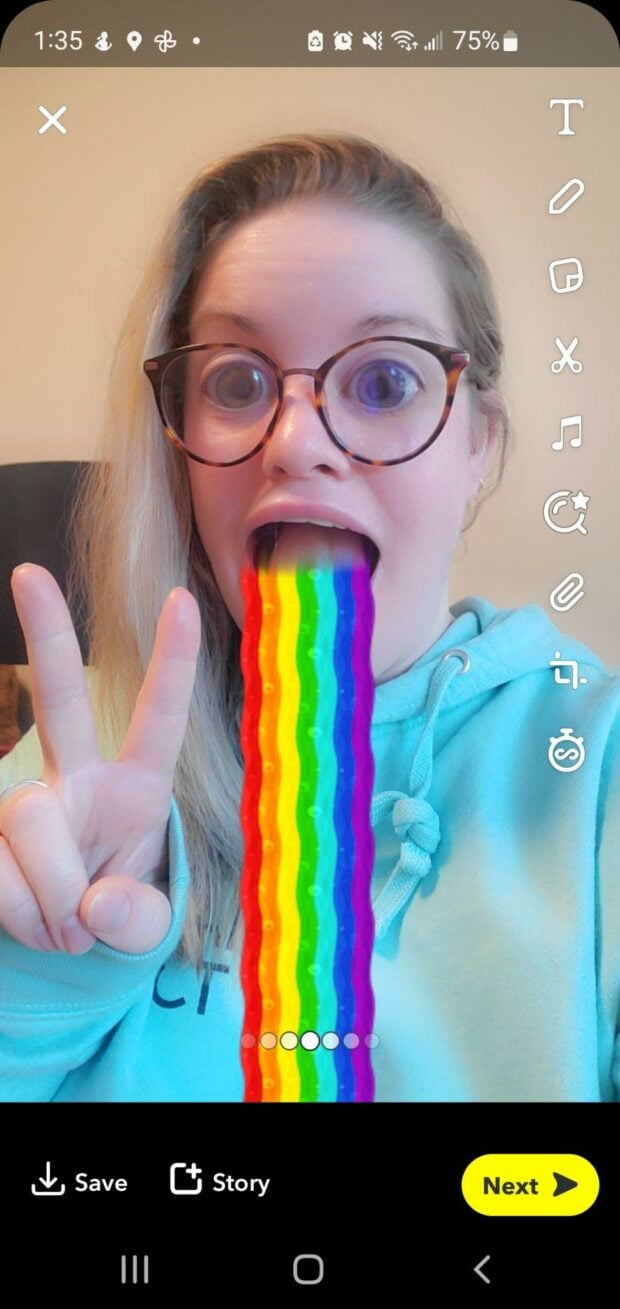
Almost exactly a year after Instagram, soon-to-be rival “Picaboo” launched, quickly rebranding to Snapchat. The app tapped into the ephemeral nature of life’s moments, letting users post content that vanished after 24 hours, which appealed to a teen demographic looking for a space away from their families on Facebook.
Source: Snapchat
How did Facebook reach one billion users and acquire Instagram?
Eight years after its launch from Zuckerberg’s Harvard dorm room, Facebook announced that its user base had reached one billion users. “Helping a billion people connect is amazing, humbling and by far the thing I am most proud of in my life,” Zuckerberg said.
This was also the year Facebook acquired Instagram for a billion dollars, a notable moment in the timeline of social networks.
How did Vine and Twitch spark the live-streaming wars?
Vine launched in 2013 after Twitter bought the video-sharing app before it went live. The premise was simple, since videos could only be up to 6 seconds long, but it quickly spawned a distinct genre of humor that still resonates today. Despite its rapid success, Vine faded once Snapchat and Instagram added their own video-sharing features.
Live video also took off in this period. Twitch, the hugely popular video game live-streaming site, spun out of Justin.tv and drew 45 million unique viewers by 2013 before Amazon scooped it up. Meerkat then kicked off the mobile live-streaming craze, and Twitter’s Periscope won the streaming wars for a while, even earning the iOS app of the year in 2015. Today, live-streaming is a standard feature in TikTok, Instagram, and Facebook.
Visual culture even produced its own record-breaking moment. Twitter proclaimed 2014 the “Year of the Selfie” after Ellen DeGeneres’s Oscar photo was retweeted millions of times. Two years later, Instagram took a page from Snapchat and introduced Stories, letting users post photo and video sequences that disappear within 24 hours.
How did short-form video, the creator economy, and platform shifts define 2016-2022?
The next era belonged to short-form video, the creator economy, and a series of shocks that reshaped who owned the biggest platforms. This is where the evolution of social media accelerated most dramatically.
How did TikTok reshape content discovery?
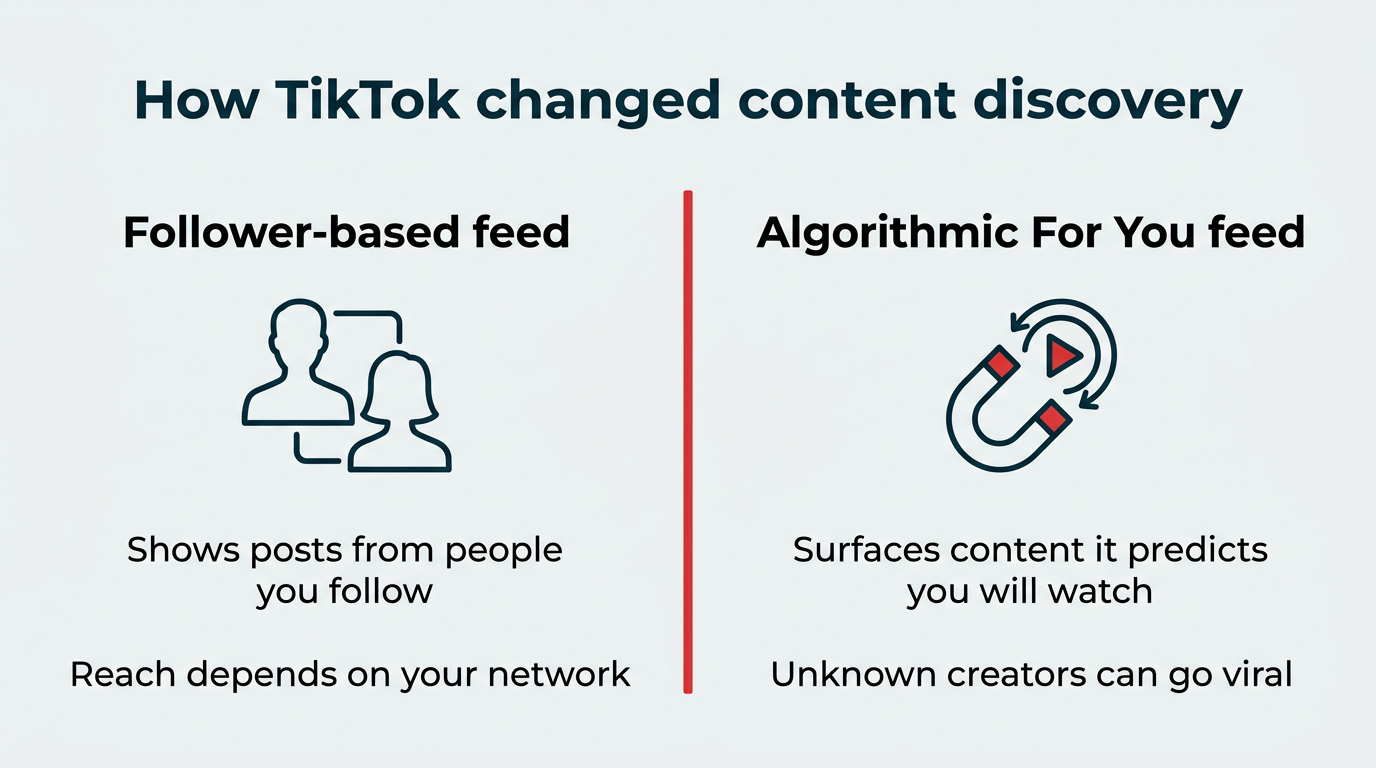
Douyin, an app by ByteDance, was released outside of China in 2017 under the name TikTok, and it changed how social media works. Instead of showing you posts from people you follow, TikTok’s algorithm-driven “For You” feed surfaces content based on what it predicts you will watch, a fundamental shift away from the follower-based model that had defined social media for a decade.
TikTok’s influence on music, fashion, language, and news made TikTok one of the most culturally significant platforms of the era.
How did social commerce, data privacy, and the creator economy evolve?
Creators found more ways to earn during this era. Monetization leveled up with Patreon, created by developer Sam Yam and musician Jack Conte, which lets patrons subscribe to monthly or exclusive creator content. Platforms also expanded their video tools, as Instagram launched IGTV for long-form video in 2018 and debuted Reels in 2020, while Twitter doubled its character limit from 140 to 280 and introduced threads, encouraging brands to make the most of the extra space.
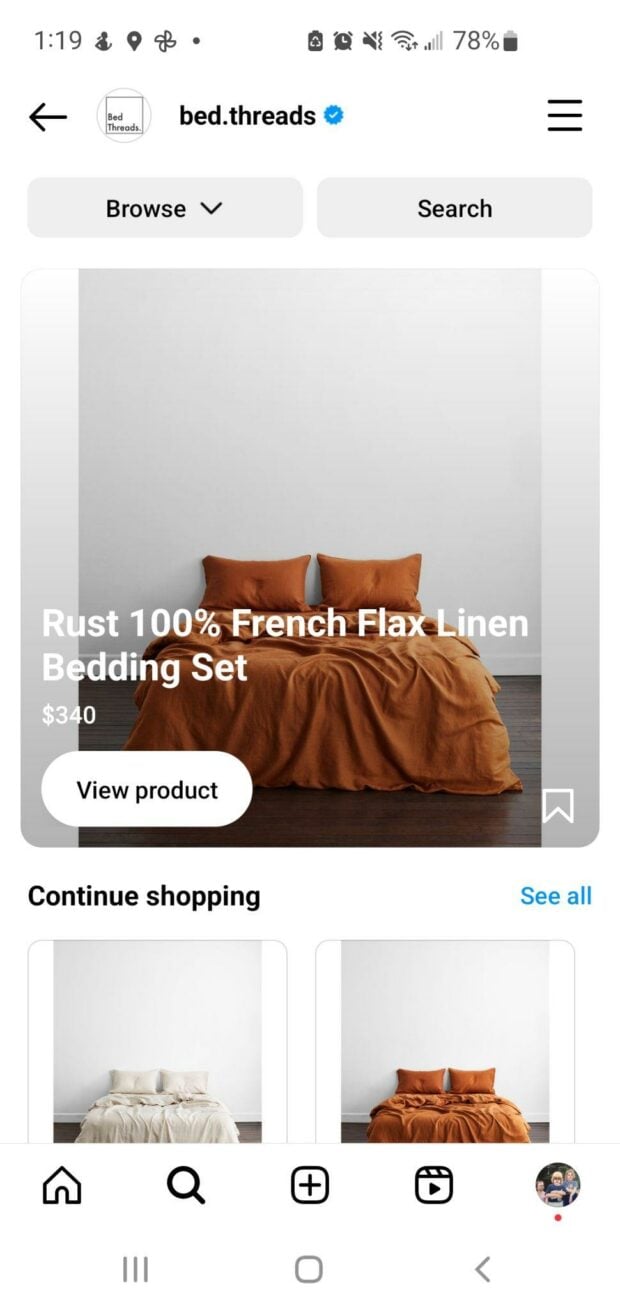
The global pandemic then accelerated shopping on social. Facebook and Instagram introduced Shops in 2020, letting users buy in-app and marking a major step in the rise of social commerce. TikTok Shop soon followed, blending short-form video with live shopping and turning entertainment into a checkout experience.
Source: Bed.threads on Instagram
This era also brought hard questions about trust. In 2018, it was revealed that Facebook allowed a Cambridge Analytica researcher to harvest data from up to 87 million users without their consent, and Zuckerberg testified before the US Congress over data privacy.
Regulators and platforms also grappled with coordinated disinformation campaigns, and Facebook later disclosed that 126 million Americans were exposed to content from foreign agents during the 2016 US election, prompting company representatives to appear before Congress. These events pushed data privacy and content integrity to the center of the social media conversation.
How did Elon Musk’s Twitter purchase fragment the platform landscape?
In 2022, billionaire Elon Musk bought Twitter, and the ownership change triggered a series of updates, including paid verification, visible view counts, and a rare look into the recommendation algorithm. In 2023, the platform rebranded to X, and a wave of advertiser caution and user frustration opened the door for competitors.
That opening reshaped the landscape. Meta launched Threads in 2023 as a text-based rival that signed up millions of users within days, and the decentralized platform Bluesky grew quickly as users looked for alternatives. The result was a more fragmented environment, where audiences and creators spread across several text platforms rather than gathering on one.
The most recent chapter of the history of social media has been defined by artificial intelligence, regulation, and a growing appetite for alternatives to the dominant platforms. Several developments stand out:
- AI moves into the feed: Meta AI, X’s Grok, and generative tools across platforms now help create captions, images, and even full posts, while AI also powers content recommendations.
- TikTok faces regulatory battles: The US pursued divestiture and potential ban measures, and other governments tightened rules around the platform’s data and ownership.
- Threads and Bluesky mature: Meta’s Threads and the decentralized Bluesky both grew into meaningful text-based communities as users diversified where they post.
- Regulation tightens globally: The EU’s Digital Services Act and a wave of US state age-verification laws pushed platforms toward greater accountability and safety controls.
- AI-generated content spreads: Feeds increasingly mix human and AI-created posts, raising fresh questions about authenticity and disclosure.
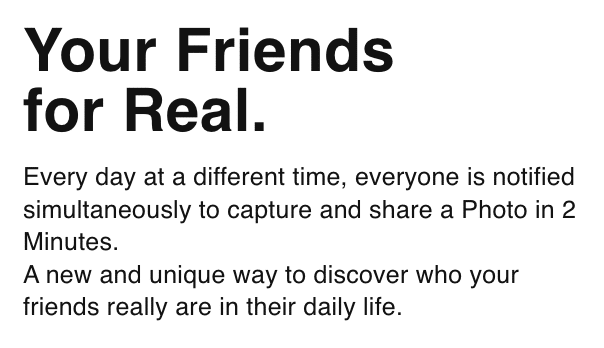
Some experiments faded during this period. The social audio app Clubhouse, which surged during the 2020 lockdowns, struggled to stay relevant as restrictions eased. The photo-sharing app BeReal, briefly the most popular social app in the App Store, saw its buzz fade before being acquired by mobile game maker Voodoo, a reminder that viral novelty rarely guarantees lasting scale.
Source: BeReal
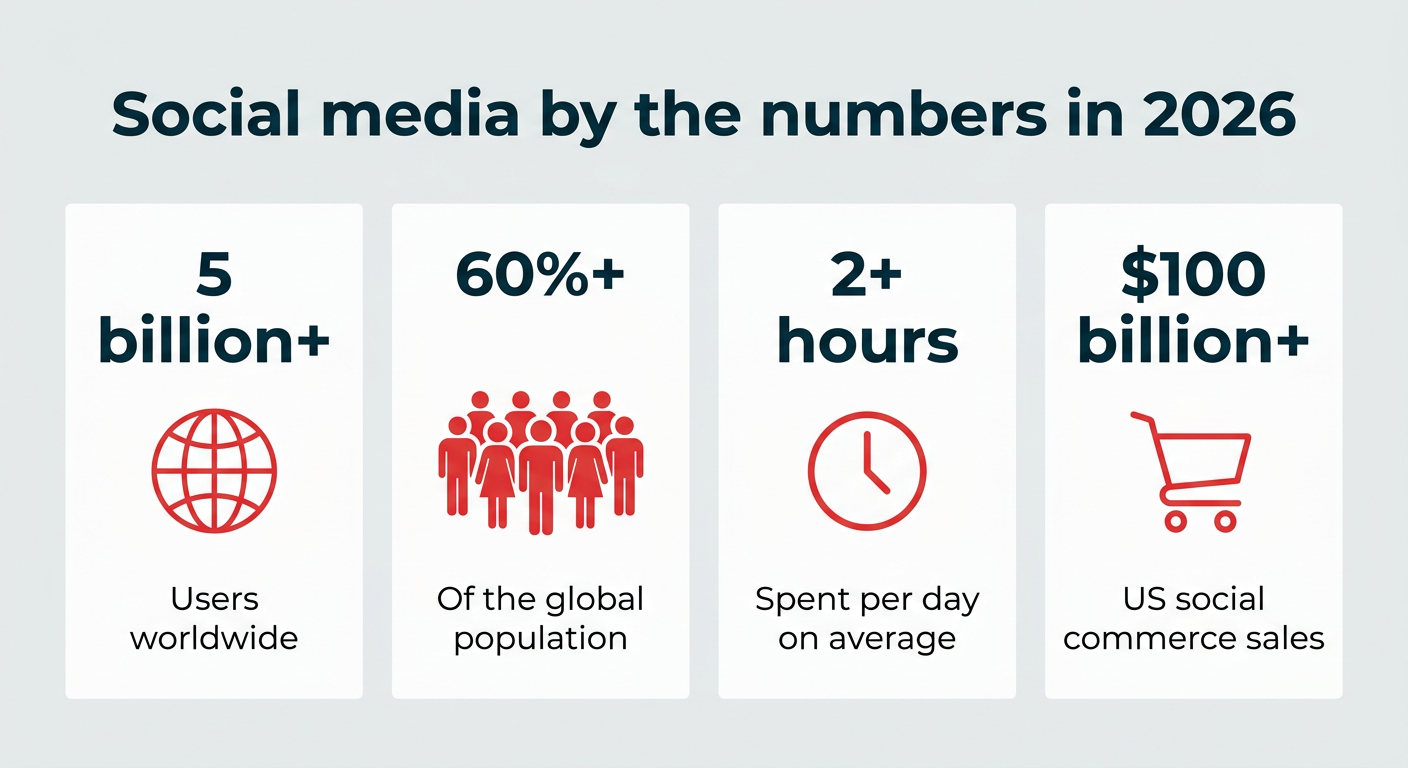
Social media has grown from a niche hobby into a daily habit for most of the connected world. Here are the headline figures that capture its scale in 2026:
- More than 5 billion users worldwide now use social media, representing over 60% of the global population.
- People spend well over two hours per day on social platforms on average.
- Video, both short-form and live, is now the dominant content format across the major apps.
- The most-used platforms by monthly active users remain Facebook, YouTube, Instagram, WhatsApp, and TikTok, with Meta owning four billion-user platforms.
- Social commerce continues to grow, surpassing $100 billion in US sales in 2026, led by TikTok Shop and Instagram.
The table below compares several of the most significant social media platforms by launch year and primary content format.
|
Platform |
Launch year |
Primary content format |
|---|---|---|
|
|
2004 |
Text, photo, and video feed |
|
YouTube |
2005 |
Long and short-form video |
|
|
2010 |
Photo, video, and Stories |
|
TikTok |
2016 (global) |
Short-form video |
|
X (Twitter) |
2006 |
Short text and video |
|
|
2010 |
Visual discovery and pins |
Social media rewired communication from a one-to-many broadcast into a many-to-many conversation. Instead of a handful of publishers speaking to a passive audience, billions of people can now create, share, and respond in real time, which is one of the defining features of the evolution of social media.
That shift changed how we consume news, discover products, and form communities. It created the attention economy, where feeds compete for every spare second, and it gave rise to influencer culture, where individual creators can hold sway over audiences larger than traditional media outlets. It also blurred the line between personal and public, since a single post can reach a global audience in minutes.
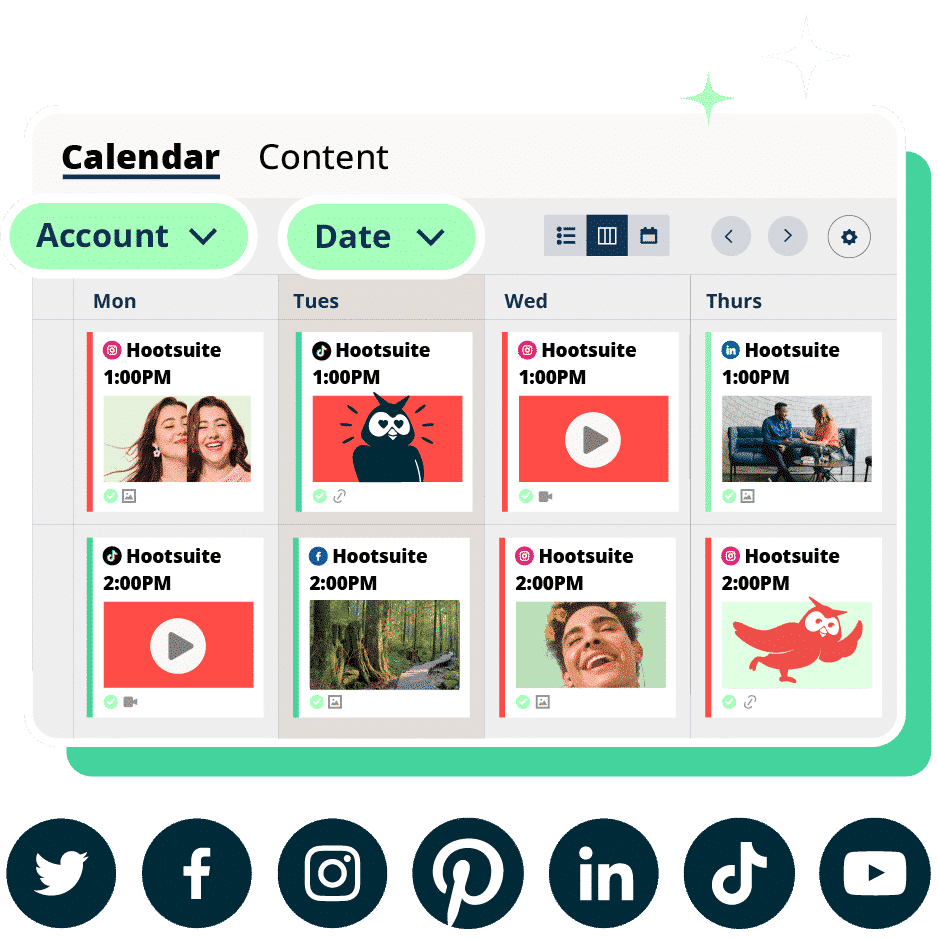
For businesses, social media has become a core strategic function rather than an afterthought. Marketing, customer care, employee advocacy, and employer branding now run through social channels, and enterprise teams need tools built for that scale. With Hootsuite, teams plan, schedule, publish, and measure content in Perch, manage comments and customer conversations in Nest, and track competitors and trends in Lumen. In short, social media turned communication into a two-way, always-on channel that shapes culture and commerce alike.
The history of social media suggests that the next era will be shaped by the same forces that drove every previous one: new formats, new business models, and a constant tug-of-war over trust. Looking at the patterns, a few trends stand out for the future of social media:
- AI-native experiences: Just as the algorithmic feed reshaped discovery, AI will increasingly generate, personalize, and moderate content, changing what shows up in front of us and how it is made.
- Decentralization and platform choice: The fragmentation seen with X, Threads, and Bluesky points toward a future where audiences spread across many platforms rather than concentrating on one.
- Regulation and trust: After a decade of privacy and safety concerns, tighter regulation and clearer accountability will be a permanent feature of how platforms operate.
- Social and commerce converge: With social commerce already mainstream, buying directly inside social apps will keep growing, turning content and checkout into a single experience.
For marketing leaders, the practical takeaway is that a flexible social strategy matters more than betting on any single platform. The teams that adapt to new formats early, respect emerging rules, and meet audiences wherever they gather will be best positioned for whatever comes next.
When did social media start?
Social media’s origins trace back to the early 1970s, when systems like Community Memory (1973) and the university-built PLATO platform allowed users to post messages and interact online. The platforms most people recognize today, built around personal profiles and connections, began appearing in the late 1990s.
What was the first social media platform?
The first widely recognized social media platform was SixDegrees.com, launched in 1997, which let users create profiles, list their connections, and send messages within networks. Earlier systems like Usenet had social features, but SixDegrees is usually credited as the first true social network.
Who created social media and why?
Social media was not created by a single person. Tom Truscott and Jim Ellis created Usenet in 1979-1980 as one of the first open social platforms, and the concept then evolved through the work of many developers and companies who wanted to connect people online.
What came before Myspace?
Before Myspace launched in 2003, platforms like SixDegrees (1997), LiveJournal (1999), and Friendster (2002) pioneered the social networking model with user profiles and online connections. These earlier sites established the profile-plus-connections format that Myspace later popularized.
How has social media evolved over time?
Social media has evolved from text-based bulletin boards in the 1970s and 1980s, through profile-based networks in the late 1990s and 2000s, to the mobile-first, algorithm-driven, short-form video platforms that dominate in 2026. Each era added new formats, from text to photos to video to live and AI-generated content.
How many people use social media today?
As of 2026, more than 5 billion people worldwide use social media, representing over 60% of the global population. That reach makes social platforms one of the most significant communication channels in human history.
Why is Gen Z ditching social media?
Some Gen Z users are reducing their social media use because of concerns about mental health, screen time, and a preference for smaller, more private group communication over public broadcasting. Rather than leaving entirely, many are shifting toward messaging and close-friend features instead of public feeds.
What is a social graph?
A social graph is a digital map of the connections between people on a social media platform, showing who is connected to whom and how they interact. Platforms use the social graph to power friend suggestions, feeds, and recommendations.
How did social media change marketing?
Social media transformed marketing by letting brands reach audiences directly, engage in two-way conversations, and measure campaign performance in real time. That shifted the industry from one-way broadcast advertising toward interactive, data-driven strategies.
What will social media look like in the future?
The future of social media is likely to be shaped by AI-driven personalization, decentralized platforms, tighter regulation, and deeper integration of commerce and creator tools directly into social experiences. Marketers who stay agile across formats and platforms will be best positioned for these shifts.
Save time managing your social media marketing strategy with Hootsuite. Publish and schedule posts, find relevant conversions, measure results, and more â all from one dashboard. Try it free today.