• About Us
  • Disclaimer
  • Contact Us
  • Privacy Policy
Friday, May 22, 2026
mGrowTech
No Result
View All Result
  • Technology And Software
    • Account Based Marketing
    • Channel Marketing
    • Marketing Automation
      • Al, Analytics and Automation
      • Ad Management
  • Digital Marketing
    • Social Media Management
    • Google Marketing
  • Direct Marketing
    • Brand Management
    • Marketing Attribution and Consulting
  • Mobile Marketing
  • Event Management
  • PR Solutions
  • Technology And Software
    • Account Based Marketing
    • Channel Marketing
    • Marketing Automation
      • Al, Analytics and Automation
      • Ad Management
  • Digital Marketing
    • Social Media Management
    • Google Marketing
  • Direct Marketing
    • Brand Management
    • Marketing Attribution and Consulting
  • Mobile Marketing
  • Event Management
  • PR Solutions
No Result
View All Result
mGrowTech
No Result
View All Result
Home Al, Analytics and Automation

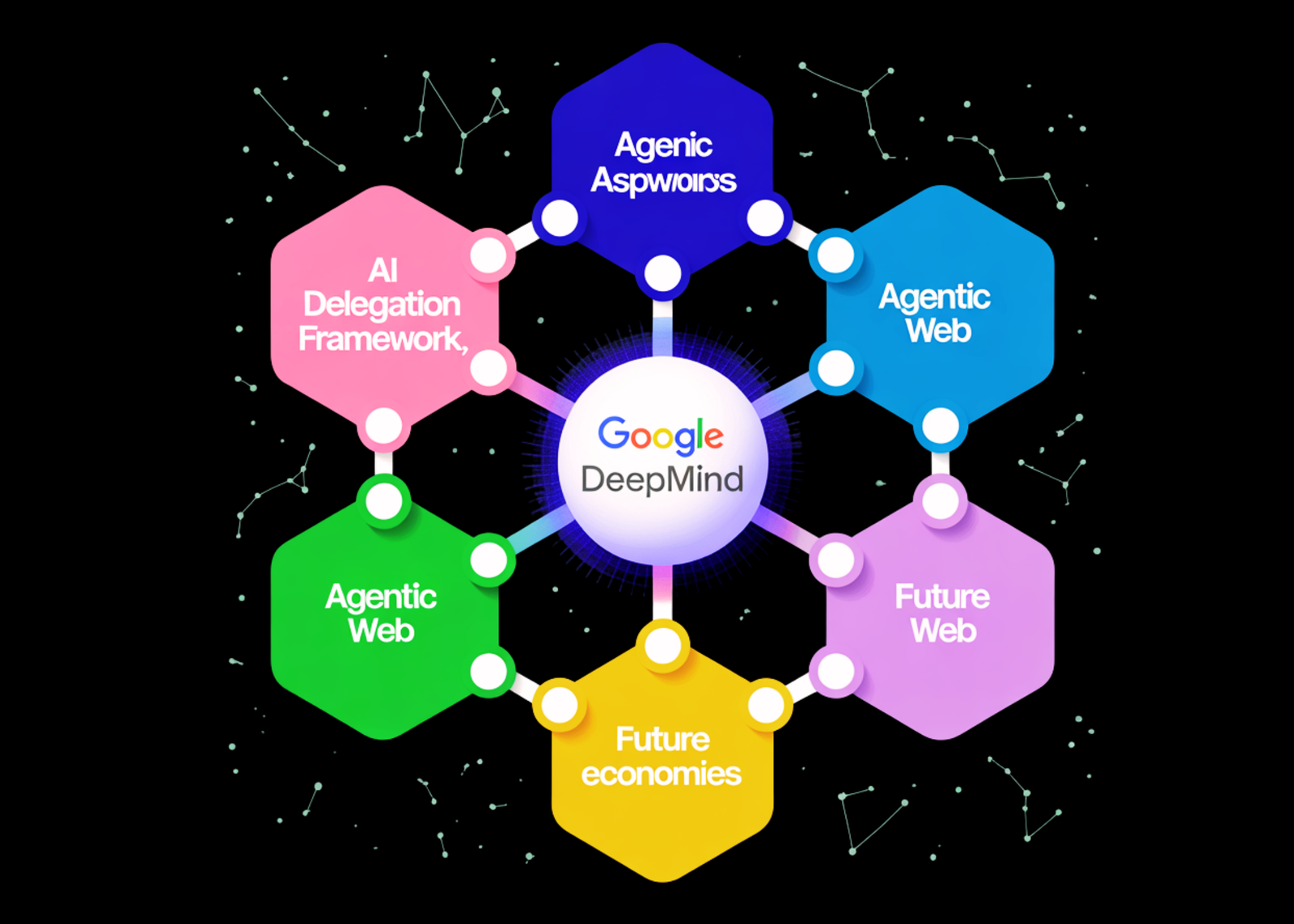
Google DeepMind Proposes New Framework for Intelligent AI Delegation to Secure the Emerging Agentic Web for Future Economies

Josh by Josh
February 16, 2026
in Al, Analytics and Automation
0
Google DeepMind Proposes New Framework for Intelligent AI Delegation to Secure the Emerging Agentic Web for Future Economies

READ ALSO

Justin Solomon appointed associate dean of engineering education | MIT News

Qwen Introduces Qwen3.7-Max: A Reasoning Agent Model With a 1M-Token Context Window


The AI industry is currently obsessed with ‘agents’—autonomous programs that do more than just chat. However, most current multi-agent systems rely on brittle, hard-coded heuristics that fail when the environment changes.

Google DeepMind researchers have proposed a new solution. The research team argued that for the ‘agentic web’ to scale, agents must move beyond simple task-splitting and adopt human-like organizational principles such as authority, responsibility, and accountability.

Defining ‘Intelligent’ Delegation

In standard software, a subroutine is just ‘outsourced’. Intelligent delegation is different. It is a sequence of decisions where a delegator transfers authority and responsibility to a delegatee. This process involves risk assessment, capability matching, and establishing trust.

The 5 Pillars of the Framework

To build this, the research team identified 5 core requirements mapped to specific technical protocols:

Framework Pillar Technical Implementation Core Function
Dynamic Assessment Task Decomposition & Assignment Granularly inferring agent state and capacity.
Adaptive Execution Adaptive Coordination Handling context shifts and runtime failures.
Structural Transparency Monitoring & Verifiable Completion Auditing both the process and the final outcome.
Scalable Market Trust & Reputation & Multi-objective Optimization Efficient, trusted coordination in open markets.
Systemic Resilience Security & Permission Handling Preventing cascading failures and malicious use.

Engineering Strategy: ‘Contract-First’ Decomposition

The most significant shift is contract-first decomposition. Under this principle, a delegator only assigns a task if the outcome can be precisely verified.

If a task is too subjective or complex to verify—like ‘write a compelling research paper’—the system must recursively decompose it. This continues until the sub-tasks match available verification tools, such as unit tests or formal mathematical proofs.

Recursive Verification: The Chain of Custody

In a delegation chain, such as 𝐴 → 𝐵 → 𝐶, accountability is transitive.

  • Agent B is responsible for verifying the work of C.
  • When Agent B returns the result to A, it must provide a full chain of cryptographically signed attestations.
  • Agent A then performs a 2-stage check: verifying B’s direct work and verifying that B correctly verified C.

Security: Tokens and Tunnels

Scaling these chains introduces massive security risks, including Data Exfiltration, Backdoor Implanting, and Model Extraction.

To protect the network, DeepMind team suggests Delegation Capability Tokens (DCTs). Based on technologies like Macaroons or Biscuits, these tokens use ‘cryptographic caveats’ to enforce the principle of least privilege. For example, an agent might receive a token that allows it to READ a specific Google Drive folder but forbids any WRITE operations.

Evaluating Current Protocols

The research team analyzed whether current industry standards are ready for this framework. While these protocols provide a base, they all have ‘missing pieces’ for high-stakes delegation.

  • MCP (Model Context Protocol): Standardizes how models connect to tools. The Gap: It lacks a policy layer to govern permissions across deep delegation chains.
  • A2A (Agent-to-Agent): Manages discovery and task lifecycles. The Gap: It lacks standardized headers for Zero-Knowledge Proofs (ZKPs) or digital signature chains.
  • AP2 (Agent Payments Protocol): Authorizes agents to spend funds. The Gap: It cannot natively verify the quality of the work before releasing payment.
  • UCP (Universal Commerce Protocol): Standardizes commercial transactions. The Gap: It is optimized for shopping/fulfillment, not abstract computational tasks.

Key Takeaways

  • Move Beyond Heuristics: Current AI delegations relies on simple, hard-coded heuristics that are brittle and cannot dynamically adapt to environmental changes or unexpected failures. Intelligent delegation requires an adaptive framework that incorporates transfer of authority, responsibility, and accountability.
  • ‘Contract-First’ Task Decomposition: For complex goals, delegators should use a ‘contract-first’ approach, where tasks are decomposed until the sub-units match specific, automated verification capabilities, such as unit tests or formal proofs.
  • Transitive Accountability in Chains: In long delegation chains (e.g., 𝐴 → 𝐵 → 𝐶), responsibility is transitive. Agent B is responsible for the work of C, and Agent A must verify both B’s direct work and that B correctly verified C’s attestations.
  • Attenuated Security via Tokens: To prevent systemic breaches and the ‘confused deputy problem,’ agents should use Delegation Capability Tokens (DCTs) that provide attenuated authorization. This ensures agents operate under the principle of least privilege, with access restricted to specific subsets of resources and allowable operations.

Check out the Paper here. Also, feel free to follow us on Twitter and don’t forget to join our 100k+ ML SubReddit and Subscribe to our Newsletter. Wait! are you on telegram? now you can join us on telegram as well.


Michal Sutter is a data science professional with a Master of Science in Data Science from the University of Padova. With a solid foundation in statistical analysis, machine learning, and data engineering, Michal excels at transforming complex datasets into actionable insights.


Source_link

Related Posts

Justin Solomon appointed associate dean of engineering education | MIT News
Al, Analytics and Automation

Justin Solomon appointed associate dean of engineering education | MIT News

May 22, 2026
Qwen Introduces Qwen3.7-Max: A Reasoning Agent Model With a 1M-Token Context Window
Al, Analytics and Automation

Qwen Introduces Qwen3.7-Max: A Reasoning Agent Model With a 1M-Token Context Window

May 21, 2026
Effective Context Engineering for AI Agents: A Developer’s Guide
Al, Analytics and Automation

Effective Context Engineering for AI Agents: A Developer’s Guide

May 21, 2026
Technology usually creates jobs for young, skilled workers. Will AI do the same? | MIT News
Al, Analytics and Automation

Technology usually creates jobs for young, skilled workers. Will AI do the same? | MIT News

May 21, 2026
Meet Turbovec: A Rust Vector Index with Python Bindings, and Built on Google’s TurboQuant Algorithm
Al, Analytics and Automation

Meet Turbovec: A Rust Vector Index with Python Bindings, and Built on Google’s TurboQuant Algorithm

May 21, 2026
Building AI Agents in Python with Pydantic AI
Al, Analytics and Automation

Building AI Agents in Python with Pydantic AI

May 20, 2026
Next Post
How Ricursive Intelligence raised $335M at a $4B valuation in 4 months

How Ricursive Intelligence raised $335M at a $4B valuation in 4 months

POPULAR NEWS

Trump ends trade talks with Canada over a digital services tax

Trump ends trade talks with Canada over a digital services tax

June 28, 2025
15 Trending Songs on TikTok in 2025 (+ How to Use Them)

15 Trending Songs on TikTok in 2025 (+ How to Use Them)

June 18, 2025
Communication Effectiveness Skills For Business Leaders

Communication Effectiveness Skills For Business Leaders

June 10, 2025
App Development Cost in Singapore: Pricing Breakdown & Insights

App Development Cost in Singapore: Pricing Breakdown & Insights

June 22, 2025
Comparing the Top 7 Large Language Models LLMs/Systems for Coding in 2025

Comparing the Top 7 Large Language Models LLMs/Systems for Coding in 2025

November 4, 2025

EDITOR'S PICK

I Tried 7 Best Video Conferencing Software: Who Wins?

I Tried 7 Best Video Conferencing Software: Who Wins?

November 22, 2025
Luvr Chatbot Review: Key Features & Pricing

Luvr Chatbot Review: Key Features & Pricing

March 4, 2026
Bruce Mau Design Reimagines the McMichael: A New Identity for Canada’s Iconic Art Destination

Bruce Mau Design Reimagines the McMichael: A New Identity for Canada’s Iconic Art Destination

February 4, 2026
Considering A New Website? – Accrue Performance Marketing Inc.

Considering A New Website? – Accrue Performance Marketing Inc.

July 22, 2025

About

We bring you the best Premium WordPress Themes that perfect for news, magazine, personal blog, etc. Check our landing page for details.

Follow us

Categories

  • Account Based Marketing
  • Ad Management
  • Al, Analytics and Automation
  • Brand Management
  • Channel Marketing
  • Digital Marketing
  • Direct Marketing
  • Event Management
  • Google Marketing
  • Marketing Attribution and Consulting
  • Marketing Automation
  • Mobile Marketing
  • PR Solutions
  • Social Media Management
  • Technology And Software
  • Uncategorized

Recent Posts

  • How to measure AI search visibility: KPIs & reporting
  • Un résumé intelligent de vos contacts CRM 🪄- Webmecanik
  • You landed the media hit. The headline isn’t what you expected. Now what?
  • LinkedIn Crossclimb Answer Today for May 22, 2026 (Puzzle #752)
  • About Us
  • Disclaimer
  • Contact Us
  • Privacy Policy
No Result
View All Result
  • Technology And Software
    • Account Based Marketing
    • Channel Marketing
    • Marketing Automation
      • Al, Analytics and Automation
      • Ad Management
  • Digital Marketing
    • Social Media Management
    • Google Marketing
  • Direct Marketing
    • Brand Management
    • Marketing Attribution and Consulting
  • Mobile Marketing
  • Event Management
  • PR Solutions