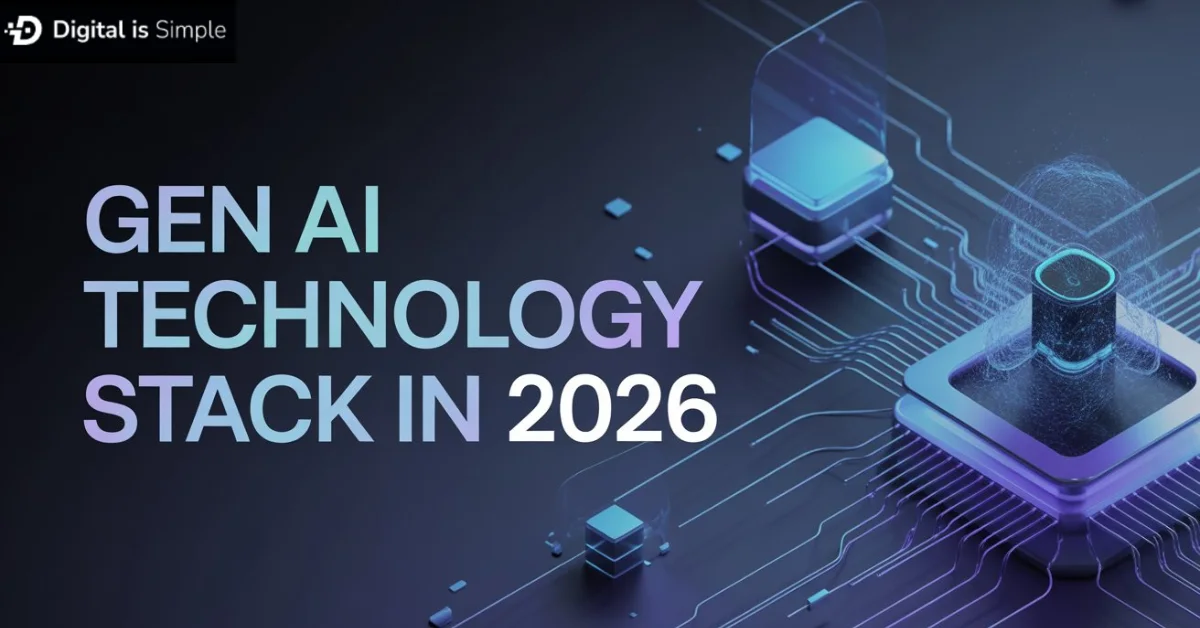
Every business exploring artificial intelligence today runs into the same question: where do you actually start? The answer often lies in understanding the Gen AI technology stack — the complete set of technologies that power how AI systems are built, trained, and deployed.
Without the right stack in place, even the most ambitious AI projects tend to stall. Many teams build in silos, use mismatched tools, or skip critical infrastructure layers entirely. This guide breaks down each component of the Gen AI technology stack in plain language, so business leaders and beginners alike can make informed decisions before investing time and money.
What Is a Gen AI Technology Stack?
A Gen AI technology stack is a layered combination of tools, models, frameworks, and infrastructure used to develop and run generative AI applications. Think of it like the engine inside a car. The user only sees the output, but underneath, multiple components are working together.
The stack covers everything from data storage and model selection to deployment pipelines and monitoring systems. Each layer depends on the one below it. If any layer is weak or missing, the entire system underperforms.
In 2026, the stack has grown more structured and more sophisticated. Businesses are no longer experimenting in isolation. They are building production-grade AI systems that need to be reliable, scalable, and cost-efficient.
The Core Layers of the Gen AI Technology Stack
Infrastructure and Compute
This is the foundation that everything else runs on. It includes the physical and cloud hardware GPUs, TPUs, and AI accelerators that handle the heavy computing required to train and run large AI models.
Cloud providers like AWS, Google Cloud, and Microsoft Azure dominate this space. They offer on-demand compute resources that scale with your workload. Most businesses in 2026 use a hybrid approach, combining cloud flexibility with on-premise control for sensitive data.
Containerization tools like Docker and orchestration platforms like Kubernetes are also part of this layer. They keep workloads organized, portable, and efficient across different environments.
Data Management and Pipelines
AI is only as good as the data feeding it. This layer covers how raw data is collected, cleaned, stored, and prepared for model training. Tools like Apache Spark and Apache Hadoop handle the processing of large, complex datasets.
Data lakes and cloud warehouses such as Snowflake and Google BigQuery store structured and unstructured data at scale. Keeping raw and processed data separated is a best practice that speeds up iteration and reduces errors later in the pipeline.
Poor data management is one of the most common reasons AI projects fail in production. Businesses that invest in clean, well-governed data pipelines consistently see better model performance.
The Model Layer
This is the heart of the Gen AI technology stack. It includes the large language models (LLMs), foundation models, and specialized models that power generative AI applications.
Popular foundation models in 2026 include GPT-4o, Claude, Gemini, and open-source options like Meta’s Llama. Most businesses start with a pre-trained foundation model and then fine-tune it on their own data to improve accuracy for specific tasks.
Fine-tuning is far more cost-effective than training a model from scratch. Platforms like Hugging Face make it straightforward to access, customize, and deploy a wide range of models without needing a full research team.
Frameworks for Training and Development
Development frameworks are the toolkits that engineers use to build and optimize AI models. The most widely used in 2026 are PyTorch, TensorFlow, and JAX. PyTorch in particular has become the go-to framework for both research and production environments.
LangChain and LlamaIndex are also central to this layer for businesses building LLM-powered applications. They handle the orchestration of prompts, memory, tools, and retrieval logic. This matters because most real-world AI apps involve more than a single model call — they involve chained reasoning steps.
Key Tools Powering the Gen AI Technology Stack in 2026
Orchestration and Agents
AI agents are one of the defining trends of 2026. Unlike simple chatbots, agents can reason through multi-step tasks, use external tools, browse the web, write code, and take actions autonomously.
Frameworks like Pydantic AI, CrewAI, and Anthropic’s Model Context Protocol (MCP) are widely used to build and manage these agents. Orchestration tools coordinate how agents communicate, which tools they access, and how tasks are delegated between them.
Businesses exploring the range of generative AI use cases from customer service automation to document processing and internal knowledge management will find that agent-based architectures unlock capabilities that traditional software simply cannot replicate.
Retrieval-Augmented Generation (RAG)
RAG is a technique that lets AI models access relevant external documents or databases before generating a response. Instead of relying purely on what was baked into training, the model retrieves specific, up-to-date context first.
This makes AI outputs more accurate, current, and grounded in real information. Vector databases like Pinecone, Weaviate, and Qdrant are the storage backbone of RAG pipelines. They enable fast semantic search across large document collections.
RAG has become a standard component in enterprise AI stacks because it reduces hallucinations and makes AI responses far more trustworthy.
MLOps and Model Lifecycle Management
Building a model is only half the work. The other half is keeping it performing well over time. MLOps platforms handle model versioning, experiment tracking, automated deployment, and continuous monitoring.
MLflow remains one of the most widely adopted open-source options. Cloud-native alternatives like AWS SageMaker and Weights and Biases offer more integrated environments for larger teams. Without proper MLOps, models drift, degrade, and become unreliable without anyone noticing.
Application Layer: Where AI Meets the Business
The application layer is where the Gen AI technology stack becomes visible to end users. This includes customer-facing chatbots, internal productivity tools, code assistants, content generators, and automated reporting systems.
APIs connect the model and orchestration layers to front-end interfaces built in frameworks like React or Next.js. Streaming capabilities allow applications to return results in real time rather than waiting for a full response to be generated.
Businesses working with a skilled generative AI development company typically build this layer with scalability in mind from day one. Retrofitting a production application to handle ten times the traffic is far harder than designing for growth from the start.
How to Choose the Right Gen AI Technology Stack for Your Business
There is no single stack that works for every business. The right combination depends on your industry, data type, team size, and specific goals.
Here are a few practical guidelines to consider:
Start with your use case, not your tools. Identify what problem you are solving before evaluating any specific platform or model. The use case determines the architecture.
Prioritize interoperability. In 2026, multi-model routing is increasingly standard. Businesses benefit from stacks that are not locked into a single vendor, allowing them to switch or combine models as needed.
Build observability in from the start. Monitoring, logging, and evaluation should not be afterthoughts. Teams that treat evaluation as a continuous process — not just a launch step — outperform those that check it once and move on.
Plan for cost from day one. Inference costs, storage, and GPU compute can grow quickly. Understanding the cost of generative AI development before committing to a stack helps businesses avoid budget surprises three months into a project.
Common Mistakes to Avoid When Building Your Gen AI Stack
Many teams rush to deploy and skip foundational steps that matter enormously later. Here are mistakes that frequently derail AI projects:
Skipping data governance is perhaps the most costly error. Without clean, well-labeled data and clear ownership, models underperform and debugging becomes a nightmare.
Over-engineering the stack too early is another trap. Starting lean and adding complexity only when necessary keeps teams moving fast and reduces technical debt.
Many of these issues are part of broader common gen AI development mistakes that teams encounter early, and addressing them proactively can save significant time, cost, and effort later in the project lifecycle.
Frequently Asked Questions
Q1. What is a Gen AI technology stack and why does it matter for businesses?
A Gen AI technology stack is the full set of tools, models, frameworks, and infrastructure used to build generative AI applications. It matters because without the right foundation, AI projects either fail to reach production or underperform at scale. A well-designed stack determines how fast you can build, how reliably the system runs, and how much it costs to operate.
Q2. Do businesses need to build their own AI models to have a Gen AI stack?
Not at all. Most businesses in 2026 start with pre-trained foundation models and fine-tune them for their specific needs. Building a model from scratch is expensive and unnecessary for the majority of use cases. The stack is about how you connect, customize, and deploy existing models, not just creating new ones.
Q3. What is the difference between LangChain, LlamaIndex, and RAG?
LangChain and LlamaIndex are orchestration frameworks used to build LLM-powered applications. RAG (Retrieval-Augmented Generation) is a technique those frameworks often support. RAG allows the model to retrieve relevant documents before generating an answer, which improves accuracy and reduces hallucinations.
Q4. How much does it cost to build a production-ready Gen AI stack?
Costs vary significantly depending on cloud compute, model choices, team size, and deployment complexity. A basic proof-of-concept can be built for a few thousand dollars, while enterprise-grade systems can run into hundreds of thousands annually. Careful architecture decisions early on have a major impact on ongoing operating costs.
Q5. What skills does a team need to build and maintain a Gen AI technology stack?
A capable team typically includes ML engineers for model development, data engineers for pipelines, backend developers for APIs and integrations, and MLOps specialists for deployment and monitoring. For smaller businesses, partnering with an experienced development team is often more practical than hiring all these roles internally.