[ad_1]
AI visibility platforms, like Radix or Promptwatch, have found G2 to be the most cited software review platform.
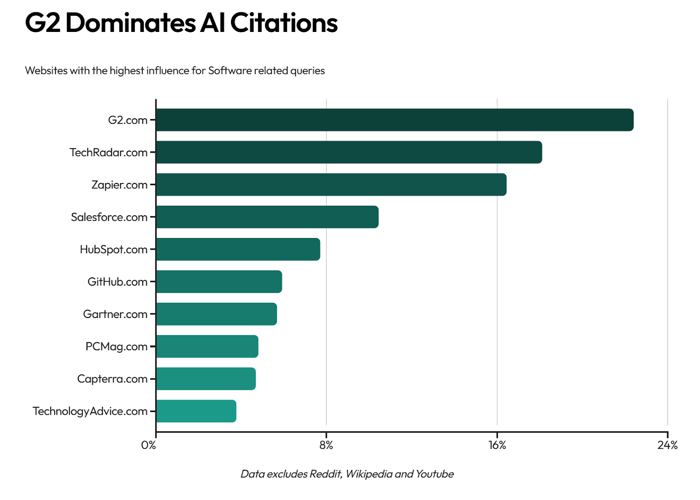
Radix analyzed 10,000+ searches on ChatGPT, Perplexity, and Google’s AI Overviews and found G2 has “the highest influence for software-related queries” with 22.4%.
Additionally, PromptWatch found G2 to be the most visible B2B software review platform across 100 million+ clicks, citations, and mentions from AI search like ChatGPT, tracked across 3,000+ websites.
The data suggests that G2 has a meaningful impact on software searches on LLMs (e.g., ChatGPT, Perplexity, Gemini, Claude, etc.). As an independent researcher, I wanted to see if I could detect a relationship in our data and validate the claims.
To get there, I analyzed 30,000 AI citations and share of voice (SoV) from Profound, which span across 500 software categories on G2.
- Citations: A site, G2 in this case, is cited in an LLM with a link back to it.
- SoV: The number of citations a site gets divided by the total available number of citations
What the data revealed
Categories with more G2 Reviews get more AI citations and a higher SoV. When ChatGPT, Perplexity, or Claude need to recommend software, they cite G2 among the first. Here’s what I found.
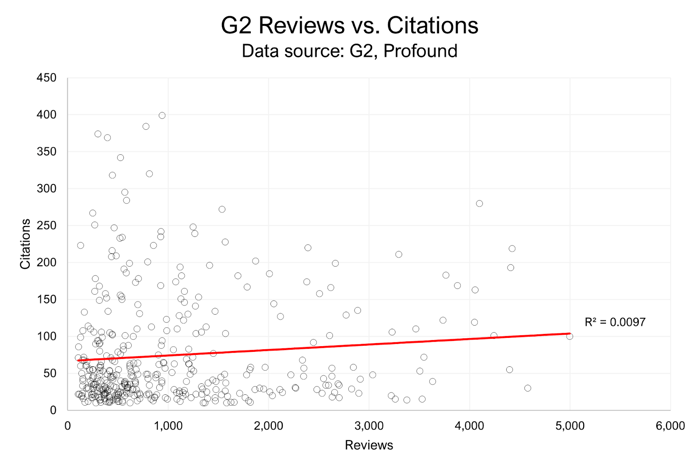
1. More reviews are linked with more citations
The data shows a small but reliable relationship between LLM citations and G2 software reviews (regression coefficient: 0.097, 95%, CI: 0.004 to 0.191, R-squared: 0.009).
Categories with 10% more reviews have 2% more citations. That’s after removing outliers, controlling for category size, and using conservative statistical methods. The relationship is clean.
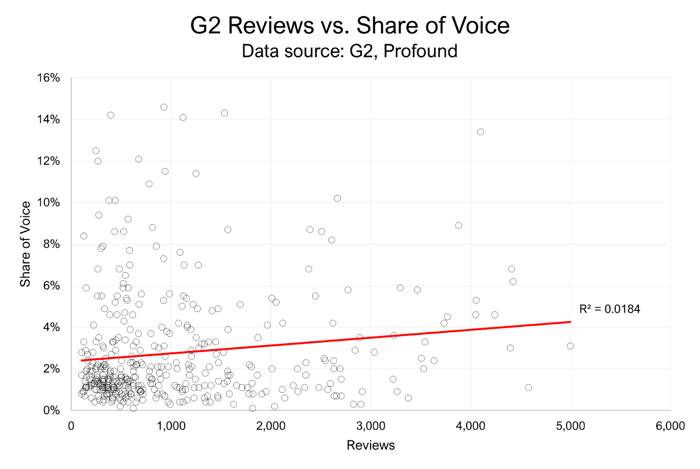
2. Categories with more reviews have a higher SoV
I also found a small but reliable relationship between G2 Reviews and SoV (regression coefficient: 0.113, 95% CI: 0.016 to 0.210, R-squared: 0.012).
If reviews rise by 10%, SoV increases by roughly 0.2-2.0%.
What does all this mean?
The number of citations and the SoV are primarily determined by factors outside this analysis: brand authority, content quality, model training data, organic search visibility, and cross-web mentions. Reviews explain less than 2% of the variance, which means they’re a small piece of a larger puzzle.
But why G2 specifically?
AI models face a verification problem. They need scalable, structured signals to assess software quality. G2 provides three attributes that matter: verified buyers (reduces noise), standardized schema (machine-readable), and review velocity (current market activity). With more than 3 million verified reviews and the highest organic traffic in software categories, G2 offers signal density that other platforms can’t match.
A 10% increase in reviews correlating with a 2% increase in citations sounds modest. But consider the baseline: most categories receive limited AI citations. A 2% lift on a low base may be practically negligible. However, in high-volume categories where hundreds of citations occur monthly, a 2% shift could meaningfully alter competitive positioning. In winner-take-most categories where the top three results capture disproportionate attention, small citation advantages compound.
What matters isn’t your raw review count, but your position relative to competitors in your category. A category with 500 reviews where you hold 200 positions has a different impact than a category with 5,000 reviews where you hold 200.
Why this matters now
The buying journey is transforming. In G2’s August 2025 survey of 1,000+ B2B software buyers, 87% reported that AI chatbots are changing how they research products. Half now start their buying journey in an AI chatbot instead of Google — a 71% jump in just four months.
The real disruption is in shortlist creation. AI chat is now the top source buyers use to build software shortlists — ahead of review sites, vendor websites, and salespeople. They’re one-shotting decisions that used to take hours. A prompt like “give me three CRM solutions for a hospital that work on iPads” instantly creates a shortlist.
When we asked buyers which sources they trust to research software solutions, AI chat ranked first. Above vendor websites. Above salespeople.
When a procurement director asks Claude to share the “best CRM for 50-person teams” today, they’re getting a synthesized answer from sources the AI model trusts. G2 is one of those sources. The software industry treats G2 as a customer success box to check. The data suggests it’s become a distribution channel — not the only one, but a measurable one.
What actions you can take based on these research insights
The best way to apply the data is to invest in reviews and G2 Profiles:
- Write a profile description (+250 characters) that clearly highlights your unique positioning and value props.
- Add detailed pricing information to your G2 Profile.
- Drive more reviews to your G2 Profile, such as by linking to your G2 Profile page from other channels.
- Initiate and engage with discussions about your product and market.
Methodology
To conduct this research, we used the following methodology and approach:
We took 500 random G2 categories and assessed:
- Approved reviews in the last 12 months
- Citations and SoV in the last 4 weeks
We removed rows where:
- Citations in the last 4 weeks are under 10
- Visibility score is 0 percent
- Approved reviews in the last 12 months are below 100 approved reviews
- Reviews were significant outliers
For the outcome, the median was unchanged, which supports that pruning did not bias the center of the distribution.
We analyzed the regression coefficient, 95% confidence interval, sample size, and R-squared.
Limitations include the following:
- Cross-sectional design limits causal inference: This analysis examines associations at a single point in time (reviews from the prior 12 months, citations from a 4-week window). We cannot distinguish whether reviews drive citations, citations drive reviews, or both are jointly determined by unobserved factors such as brand strength or market positioning. Time-series or panel data would be required to establish temporal precedence.
- Omitted variable bias: The low R² values (0.009-0.012) indicate that review volume explains less than 2% of the variation in citations and SoV. The remaining 98% is attributable to factors outside the model, including brand authority, content quality, model training data, organic search visibility, and market maturity. Without controls for these confounders, our coefficients may be biased.
- Aggregation at the category level: We analyze categories rather than individual products, which obscures within-category heterogeneity. Categories with identical review counts but different distributions across products may exhibit different AI citation patterns. Product-level analysis would provide more granular insights but would require different data collection.
- Sample restrictions affect generalizability: We excluded categories with fewer than 100 reviews, fewer than 10 citations, or extreme outlier values. While this improves statistical properties, it limits our ability to generalize to small categories, emerging markets, or products with atypical review patterns. The pruning maintained the median, suggesting central tendency is preserved, but tail behavior remains unexamined.
- Single platform analysis: This study focuses exclusively on G2. Other review platforms (like Capterra, TrustRadius, etc.) and information sources (like Reddit and industry blogs) also influence AI model outputs. G2’s dominance in software categories may not extend to other verticals, and multi-platform effects remain unquantified.
- Model specification assumptions: We use log transformations to address skewness and assume linear relationships on the transformed scale. Alternative functional forms (like polynomial and interaction terms) or modeling approaches (such as generalized linear models and quantile regression) could reveal non-linearities or heterogeneous effects across the distribution.
- Measurement considerations: Citations and SoV depend on Profound’s tracking methodology and query selection. Different tracking tools, query sets, or AI models may produce different citation patterns. Review counts depend on G2’s verification process, which may introduce selection effects.
These limitations suggest our estimates should be interpreted as suggestive associations rather than causal effects. The relationship between reviews and AI citations is statistically detectable but operates within a complex system of multiple influence factors.
[ad_2]
Source_link