Artificial intelligence is no longer something businesses can treat as a future technology. From customer service and sales to finance, healthcare, manufacturing, retail, and logistics, companies are already using AI to automate work, analyse information, improve decisions, and create better customer experiences. However, simply adding an AI chatbot or connecting an existing AI API to a website does not automatically create business value.
Every business works differently. It has its own customers, processes, data, technology stack, goals, and challenges. A solution that works well for one organisation may not work as effectively for another. This is where custom AI solutions become valuable.
All of these organisations are using AI, but they don’t need the same AI solution. That is the real value of custom AI for business. It isn’t necessarily about building an AI model from scratch. This guide explores how custom AI solutions work, what businesses can build with them, the development process, and how to decide whether working with a custom AI development company is the right approach.
What Are Custom AI Solutions?
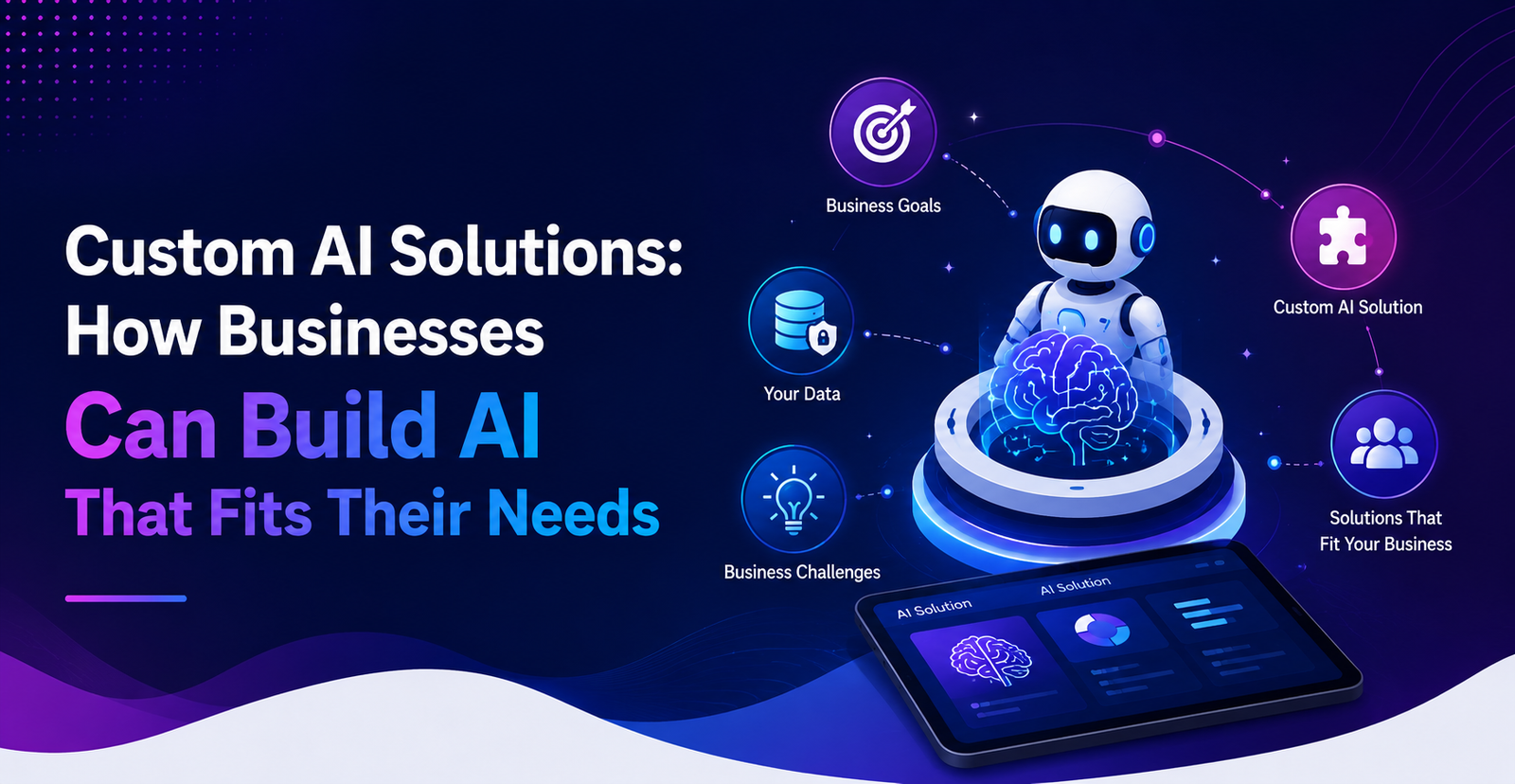
Custom AI solutions are artificial intelligence systems designed, developed, or adapted to address the specific requirements of a business. Unlike generic AI products, which are built to serve a broad market, custom solutions can be tailored to a company’s data, workflows, users, industry requirements, and business objectives.
This distinction is important because custom AI doesn’t necessarily mean developing an entirely new AI model.
A business could use an existing large language model and connect it to its internal knowledge base. It could use a pre-trained computer vision model and customise it for a particular manufacturing environment. It could build a recommendation engine using its own customer data or develop a predictive model around its historical business information.
Does Your Business Need a Custom AI Solution?
A business can purchase an AI writing tool, customer-support platform, analytics product, or chatbot within a short period. However, problems can arise when the organization tries to use that tool across complex business processes.
The AI may not understand internal terminology. It may not have access to the right company data. It may not integrate with the CRM or ERP. It may not follow the organisation’s approval process. It may also lack the security and governance controls required by an enterprise.
This creates a gap between using AI and using AI effectively. Custom AI helps close that gap. Businesses can design AI systems around the information and processes that matter most to them. This can make AI more relevant to employees and customers while helping organisations automate tasks that generic tools may not handle well.
The underlying model may be similar, but the business value can be very different. That is why AI solutions for businesses increasingly need to be evaluated based on how well they fit the organisation rather than how impressive the underlying AI model looks.
What Can Businesses Build With Custom AI Solutions?
The right solution depends on the organisation’s industry, data, processes, and objectives.
AI-Powered Customer Support
Customer service is one of the most practical areas for custom AI.
A basic chatbot can answer frequently asked questions, but a customised AI support system can go much further. It can connect with a company’s knowledge base, product catalogue, CRM, order management system, and support history.
This allows the system to provide more relevant responses based on the customer’s context.
Predictive Analytics
Businesses generate large amounts of operational data, but collecting data doesn’t automatically lead to better decisions.
Custom AI can analyse historical information to identify patterns and make predictions.
Retailers can use AI to forecast demand. Manufacturers can predict equipment failures. Financial companies can identify unusual behaviour. SaaS companies can predict customer churn.
Intelligent Document Processing
Many businesses still spend significant time processing documents manually.
Invoices, contracts, applications, reports, forms, purchase orders, and insurance documents may contain valuable information.
Custom AI can help identify documents, extract relevant information, classify them, compare fields, and send information into other business systems.
Personalised Recommendation Systems
Recommendation engines are another strong use case for custom AI.
Instead of presenting every customer with the same products or content, businesses can use AI to analyse factors such as previous interactions, preferences, purchases, browsing behaviour, and product characteristics.
Retail platforms can recommend products. Streaming services can suggest content. B2B platforms can recommend relevant services or resources.
AI-Powered Internal Assistants
AI doesn’t only have to face customers. Businesses can create internal AI assistants for employees. Hire AI developers to answer questions about company policies. These solutions can reduce the amount of time employees spend searching for information.
Instead of opening multiple systems and searching through documents, employees can interact with a single AI interface that retrieves relevant information from approved sources.
Key Benefits of Custom Artificial Intelligence Solutions
The technology can be designed around the business.
A Better Fit for Business Requirements
Generic tools are built for the average user. Businesses, however, rarely operate like the average user. They have specific approval processes, terminology, customer journeys, policies, data structures, and operational requirements. Custom AI allows these requirements to become part of the solution.
Greater Use of Proprietary Data
Business data can be one of an organisation’s most valuable assets.
Custom AI can be designed to work with:
- Industry-specific datasets
This can help organisations turn existing data into actionable insights.
However, data quality remains critical. A sophisticated AI system cannot compensate for poor, outdated, incomplete, or inconsistent data.
Better Workflow Automation
Generic AI may complete an individual task. Custom AI can connect multiple tasks. For example, an AI system could receive a customer request, identify the customer’s account, retrieve relevant information, determine the appropriate response, update the CRM, and notify an employee if human intervention is required.
That is more valuable than simply generating a response. It turns AI into an operational capability.
Improved Customer Experience
Custom AI can also make customer interactions more relevant.
AI consulting services can design AI around its products, policies, customer history, and communication style.
This can result in faster support, more relevant recommendations, personalised experiences, and easier access to information.
Greater Control and Scalability
Businesses may also choose custom AI because they need more control over how the technology operates. Enterprise environments may require specific security controls, user permissions, and data governance policies.
A custom architecture can be designed with these requirements from the beginning.
How Does the Custom AI Development Process Work?
Choosing an AI model before understanding the actual requirement can lead to unnecessary complexity and spending.
Step 1: Identify the Business Problem
The first question should be:
What are we trying to improve?
Perhaps customer support is too expensive. Maybe employees spend too much time searching for information. Perhaps demand forecasting is unreliable. This creates a measurable starting point.
Step 2: Define Business Goals and KPIs
The next step is to determine what success looks like.
Depending on the project, KPIs could include:
- Reduced processing time
- Higher conversion rates
- Improved forecast accuracy
- Increased employee productivity
- Higher customer satisfaction
Without measurable goals, it becomes difficult to determine whether the AI investment has actually worked.
Step 3: Assess Data Readiness
AI depends heavily on data. Before development begins, businesses need to understand what data is available, where it is stored, how reliable it is, and whether it can legally and securely be used.
Data may need to be cleaned, structured, labelled, transformed, or consolidated. This stage is often underestimated, but it can have a major impact on project timelines and outcomes.
Step 4: Select the Right AI Approach
Not every problem needs the same technology.
Depending on the requirement, the solution could use:
If the problem involves predicting equipment failure, a machine learning model may be more suitable.
Step 5: Design the AI Architecture
The architecture needs to consider more than the AI model.
A typical enterprise system may involve:
Business application → AI layer → Model → Data/RAG layer → APIs → Enterprise systems → Security and monitoring
The architecture should account for scalability, security, integration, performance, and future requirements.
Step 6: Develop and Integrate
Once the architecture is defined, developers can build the AI solution and connect it with the business ecosystem.
This may involve integrating:
The objective is to make AI part of the workflow rather than creating another isolated application.
Step 7: Test and Evaluate
AI requires a different approach to testing than traditional software.
The team needs to evaluate accuracy, reliability, consistency, security, performance, and user experience.
For generative AI development services, testing may also involve checking whether the system provides unsupported information or produces responses that don’t follow business rules.
Step 8: Deploy, Monitor, and Improve
From a production perspective, AI development doesn’t end when the solution goes live. Business data changes, user behaviour evolves, models and APIs are updated, and business requirements change. That’s why we recommend treating monitoring, evaluation, security reviews, and ongoing optimisation as part of the AI development lifecycle rather than as optional post-launch activities.
The Future of Custom AI for Business
The future of custom AI for business is likely to be less about companies building enormous AI models themselves and more about organisations combining existing AI capabilities with their own data, workflows, and business knowledge.
Agentic AI will increasingly help businesses automate multi-step processes rather than simply answer questions. Multimodal AI can allow applications to work with combinations of text, images, audio, video, and structured data.
Domain-specific AI systems can become more useful for specialised industries where general-purpose tools aren’t enough. Enterprise knowledge systems can make internal information easier to access. AI-powered automation can connect decision-making with actual business processes. A business with strong proprietary data, well-designed workflows, secure integrations, and a clear AI strategy can potentially create more value from existing models than a business that simply purchases the latest AI technology.
Conclusion
The best custom AI solutions begin with a business problem. They don’t begin with a decision to use the newest model, framework, or AI platform. Before investing in custom artificial intelligence solutions, businesses should understand what they want to improve, what data they have, what technology already exists, and where customisation can create measurable value.
Sometimes the right answer will be an off-the-shelf product. Sometimes it will be an existing AI model combined with RAG and custom workflows.
For more specialised requirements, a fully customised AI system may be justified. And for businesses without the required internal expertise, working with a reliable AI development partner can reduce technical and operational risks.
Frequently Asked Questions
Q1. What are custom AI solutions?
Custom AI solutions are AI-powered applications or systems designed or adapted around a specific business’s data, workflows, requirements, and objectives. They can include AI models, RAG, machine learning, AI agents, automation, and integrations.
Q2. What is custom AI development?
Custom AI development is the process of designing, building, integrating, testing, deploying, and maintaining an AI solution around specific business requirements rather than relying entirely on a generic AI product.
Q3. How can custom AI solutions benefit businesses?
Custom AI can help businesses automate workflows, analyse data, personalise customer experiences, improve decision-making, reduce repetitive work, connect business systems, and create AI capabilities tailored to specific operational requirements.
Q4. What is the difference between custom AI and off-the-shelf AI?
Custom AI is designed or adapted around specific business requirements, while off-the-shelf AI provides pre-built capabilities for broader use cases. Custom AI generally offers greater flexibility and control, while off-the-shelf solutions typically provide faster deployment.
Q5. How much does custom AI development cost?
The cost depends on factors such as AI complexity, data preparation, model selection, integrations, security, infrastructure, testing, and maintenance. Businesses should consider the total cost of ownership rather than only the initial development investment.