
[ad_1]
Key takeaways:
- Enterprise AI implementation is no longer an experimental initiative. It has become a board-level business transformation priority across UK industries.
- Enterprise AI costs vary significantly, ranging from £40,000 proof-of-concepts to multi-million-pound transformation programmes.
- Strong ROI comes from combining productivity improvements, revenue growth, customer retention, and risk reduction rather than focusing solely on cost savings.
- Organisations that establish governance, data readiness, and operational frameworks early are more likely to achieve sustainable long-term returns.
The initial wave of excitement around generative AI has matured into a more pragmatic focus on enterprise value. Across UK boardrooms, conversations have shifted away from experimentation and towards execution. The question is no longer whether artificial intelligence can create value. Most organisations have already seen evidence of that. The real questions are what it costs, where it pays back, and how to run it without tripping over data privacy obligations or creating audit gaps that surface two years later.
Many enterprises have achieved promising results through pilot programmes. Far fewer have succeeded in scaling those initiatives into production environments that integrate with existing systems, operational processes, and risk frameworks.
According to Deloitte’s State of AI 2026 report, 66% of organisations globally now report productivity gains from AI adoption. Yet the same research notes that only 20% have successfully monetised those gains through revenue growth with most still anchored in pilot-stage deployments that never achieve production scale.
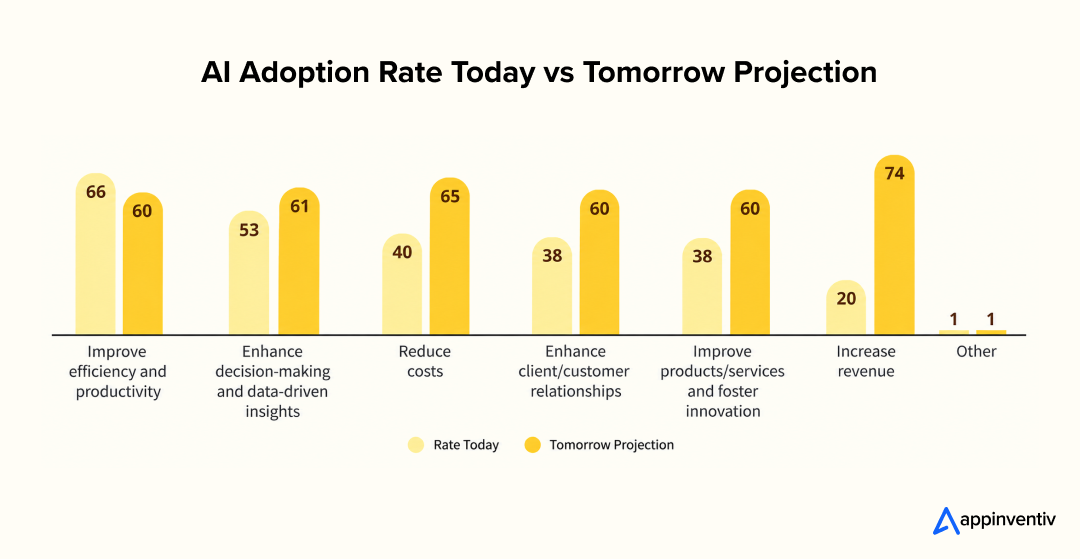
The UK sits at the centre of this tension. As the world’s third-largest AI market valued at $92 billion in 2024, British enterprises are under genuine pressure to move. At the same time, the regulatory landscape, data sovereignty obligations, and board-level expectations around audit readiness create implementation constraints that simply don’t apply in the same way elsewhere.
This blog addresses what enterprise leaders actually need to know about AI implementation in the UK: realistic cost structures, use cases that are delivering measurable returns, and a practical framework for building AI programmes that survive contact with organisational reality.
Considering AI implementation for your enterprise?
Partner with Appinventiv to identify high-value use cases, establish governance frameworks, and create a roadmap aligned with growth, efficiency, and ROI.
Understanding Enterprise AI Implementation in the UK: Beyond Chatbots and Automation
Enterprise AI implementation is different from standalone AI tools. It requires a coordinated architecture that connects data, models, applications, governance, and business processes.
What Enterprise AI Actually Means
Enterprise AI refers to purpose-built, production-grade artificial intelligence systems in the UK integrated into core business processes. They involve significant engineering decisions around data pipelines, model selection, deployment architecture, and ongoing operational governance.
The distinction matters because the failure modes differ. Most pilots fail not because the technology doesn’t work, but because the supporting architecture like data quality, integration layer, monitoring, retraining cadence was never built to production standard.
The Four Layers of Enterprise AI Architecture
| Layer | Function | UK Governance Consideration |
|---|---|---|
| Data Layer | Ingestion, cleansing, storage, lineage | UK GDPR, data residency, ICO compliance |
| AI/ML Layer | Model training, evaluation, versioning | Model explainability, bias auditing |
| Application Layer | APIs, UX, workflow integration | Change management, access controls |
| Governance & Security Layer | Monitoring, drift detection, audit trails | NCSC Cyber Essentials, board reporting |
Enterprise AI vs. Traditional Automation
Traditional transformation programmes focus on digitising existing processes. Enterprise AI implementation in the UK introduces adaptive systems capable of learning, improving, and generating new insights over time. This changes both the technology architecture and the governance requirements surrounding business operations.
| Dimension | Traditional Automation | Enterprise AI |
|---|---|---|
| Logic | Rule-based, static | Adaptive, self-improving |
| Outputs | Predictable, fixed | Context-aware, probabilistic |
| Scalability | Linear, bounded | Non-linear, compounding |
| Maintenance | Manual rule updates | MLOps-driven retraining |
| Risk Profile | Low ambiguity | Requires explainability controls |
This distinction becomes particularly important when evaluating ROI. Traditional automation projects typically produce incremental gains. AI initiatives often create entirely new revenue opportunities while reducing operational risk.
Why Many AI Initiatives Fail Before Delivering ROI
The gap between AI ambition and AI value is not a technology problem. It is an organisational one. Most UK enterprises that struggle to scale AI past pilot stage share the same structural weaknesses: fragmented data estates, absent KPI frameworks, and governance designed after deployment rather than before it.
Top Reasons AI Projects Underperform
- Poor data quality and entrenched data silos that prevent model training at the required fidelity
- No executive sponsor with accountability for both the technical delivery and the business outcome
- KPIs defined as ‘improve efficiency’ rather than as measurable, time-bound, monetisable targets
- Skills and talent gaps that leave MLOps, data engineering, and AI governance under-resourced
- Compliance and governance frameworks bolted on post-deployment, rather than designed into the architecture
- Pilot environments that bear no resemblance to production in data volume, integration complexity, or user load
Warning Signs Your AI Programme Is Heading Toward Failure
Recognising early indicators of project distress saves substantial capital. Review your current technology initiatives against this strict checklist.
- The pilot has been running for more than six months with no defined production milestone
- Data preparation is still ongoing when model development was supposed to have started
- There is no named owner for model performance post-deployment
- Procurement and legal have not been involved in AI vendor or infrastructure decisions
- The board has been briefed on AI capability but not on AI risk or governance obligations
- Success metrics are qualitative or anecdotal rather than tied to business outcomes
Organisations that address these issues early generally achieve faster adoption and stronger ROI outcomes.
What Are Some Major Enterprise AI Use Cases Across Industries in the UK?
A general-purpose model is worth little until it is pointed at a specific industry problem. Working through proven use cases shows executive teams where AI fits their own workflows, and sets an honest expectation of what it can do today. The AI implementation use cases for UK below represent the programmes most likely to achieve ROI within 12 to 24 months, provided that the underlying data infrastructure is sound and the governance model is in place before deployment.
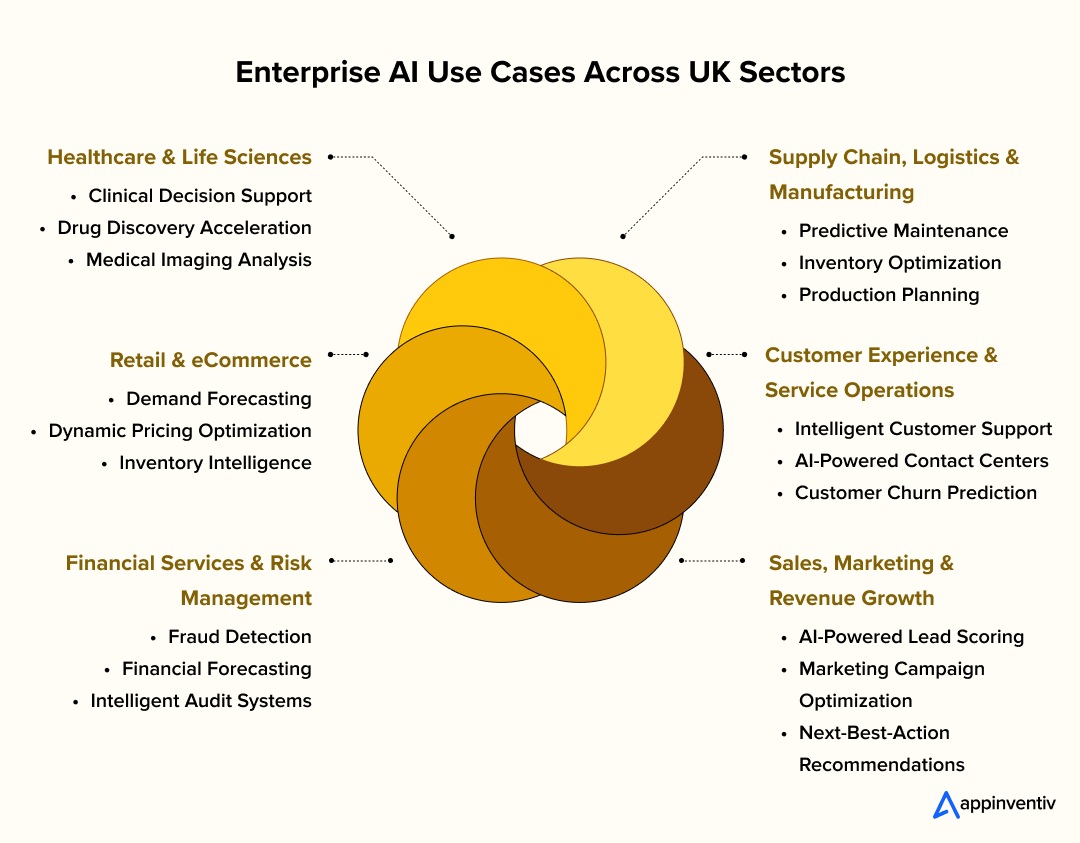
Healthcare & Life Sciences
- Clinical Decision Support: AI systems in UK healthcare read a patient’s full history against current medical literature and surfaces diagnoses worth weighing. Adverse drug interactions are flagged in the moment, before a prescription is written. Results? Fewer errors. A shorter route to safe treatment.
- Drug Discovery Acceleration: Predictive models simulate molecular interactions at a scale no lab bench can match. Compound screening that once took years now takes months. Research and development budgets shrink accordingly.
- Medical Imaging Analysis: Computer vision picks out anomalies in X-rays, MRI and CT scans that a tired eye can miss. And it does it fast. Early intervention becomes possible for critical conditions. Radiologists carry less of the repetitive load.
Retail & eCommerce
- Demand Forecasting: AI models for demand forecasting pull in past sales, local weather and social media sentiment, then turn it into a forecast of what stock is actually needed. Results? Omission of two most frustrating and most expensive errors: overstock and stockout situations.
- Dynamic Pricing Optimisation: Prices move on their own. They react to competitor activity, warehouse stock and demand surges. Margins hold automatically, with no manual intervention.
- Inventory Intelligence: Point computer vision at the warehouse camera feeds and stock movement becomes visible as it happens. Picking routes tighten. Misplaced items get found, no barcode scanning required.
Financial Services & Risk Management
- Fraud Detection: Neural networks measure each transaction against an account’s normal behaviour and flag what does not fit. The check runs in milliseconds. Fast enough to block a fraudulent transfer before the funds settle.
- Financial Forecasting: Deep learning models weigh macroeconomic indicators against market history and live news feeds. What comes back is a sharper read on cash flow swings and where investment risk is building, with real statistical confidence.
- Intelligent Audit Systems: Rather than a thin sample of manual spot checks, machine learning lets auditors test most of the transaction set. Financial oversight gets broader and audit cycles get shorter.
Supply Chain, Logistics & Manufacturing
- Predictive Maintenance: Internet of Things sensors on the equipment stream vibration and temperature data into anomaly detection models. The model sees a failure coming, often days out. Repairs get scheduled on your terms, not during an unplanned and costly line stoppage.
- Inventory Optimisation: Safety stock no longer sits at a fixed number. Algorithms adjust it across regional distribution centres as lead times wobble and consumer demand signals shift.
- Production Planning: Machine learning lines up the manufacturing schedule with the raw material actually on hand and what each machine can take. Less idle time on the floor. Better overall equipment effectiveness.
Customer Experience & Service Operations
- Intelligent Customer Support: Conversational interfaces handle the routine work: account inquiries, password resets, policy questions. When an issue turns complex or a customer turns frustrated, it escalates to a human agent with the full conversation context already attached.
- AI-Powered Contact Centres: Voice recognition transcribes the call as it happens and reads the caller’s mood at the same time. The agent is prompted with a response that fits both the history and the tone.
- Customer Churn Prediction: Falling usage, a spike in support tickets, or a recent billing dispute. Models read these as warning signs and pick out accounts drifting towards cancellation, then trigger a targeted retention campaign before they leave.
Sales, Marketing & Revenue Growth
- AI-Powered Lead Scoring: Algorithms rank inbound prospects on firmographic data and how deeply they have engaged with the site. Sales reps call the highest-intent buyers first. Conversion rates follow.
- Marketing Campaign Optimisation: Thousands of ad copy and image combinations get tested at once across platforms. Budget shifts automatically towards the best-performing creative, while it is still performing.
- Next-Best-Action Recommendations: Sales enablement tools comb through past client interactions and market data, then suggest the talking point or piece of collateral most likely to land in an upcoming negotiation.
How Much Does Enterprise AI Implementation Cost in the UK?
There is no single answer to what enterprise AI costs. On average, the implementation cost of enterprise AI software ranges between £40,000 and £2M or more, depending on several critical components. The figures below reflect typical UK delivery cost, including the governance overhead that regulated organisations cannot skip.
Cost by Project Complexity
| AI Initiative Type | Estimated Cost Range (GBP) | Typical Duration |
|---|---|---|
| AI Proof of Concept | £30,000 – £100,000 | 3–4 months |
| Department-Level Solution | £100,000 – £500,000 | 4–6 months |
| Enterprise AI Platform | £500,000 – £2M+ | 6–12 months |
| AI Transformation Programme | £2M – £10M+ | 12 months – 2 years |
Cost Breakdown by Development Stage
| Stage | Cost Allocation (Approx.) | Key Deliverable |
|---|---|---|
| AI Strategy and Discovery | 18–15% | Opportunity assessment, data audit |
| Data Engineering and Preparation | 20–30% | Pipelines, cleansing, feature stores |
| Model Development and Training | 20–25% | Model selection, training, evaluation |
| AI Infrastructure Setup | 10–15% | Cloud/on-premise environment, MLOps |
| Integration and Deployment | 15–20% | API layer, UI, workflow integration |
| Governance and Compliance | 5–10% | Explainability, audit trails, DPIA |
| Continuous Optimisation | Ongoing | Monitoring, retraining, drift management |
Factors Affecting AI Implementation Costs in the UK
Data Complexity: Highly unstructured or incredibly dirty data requires more time and effort in cleansing them, which significantly inflates engineering costs.
Number of Integrations: Connecting the model to ten outdated legacy systems costs exponentially more than integrating with two modern, well-documented APIs.
Regulatory Requirements: Meeting strict compliance standards such as the NHS Data Security and Protection Toolkit demands rigorous architecture testing and external validation.
Model Selection: Using off-the-shelf APIs appears cheaper initially but incurs high long-term token costs. Training bespoke models requires heavy upfront capital but dramatically lowers long-term operational expenses.
Security Requirements: High-security environments require sovereign cloud deployments or on-premise hardware. This pushes infrastructure costs substantially higher than standard public cloud deployments.
Hidden Costs Most Organisations Overlook
Besides the upfront investment factors (given above), there are some hidden elements too that significantly drive up the AI model development cost in the UK. The hidden factors include but are not limited to:
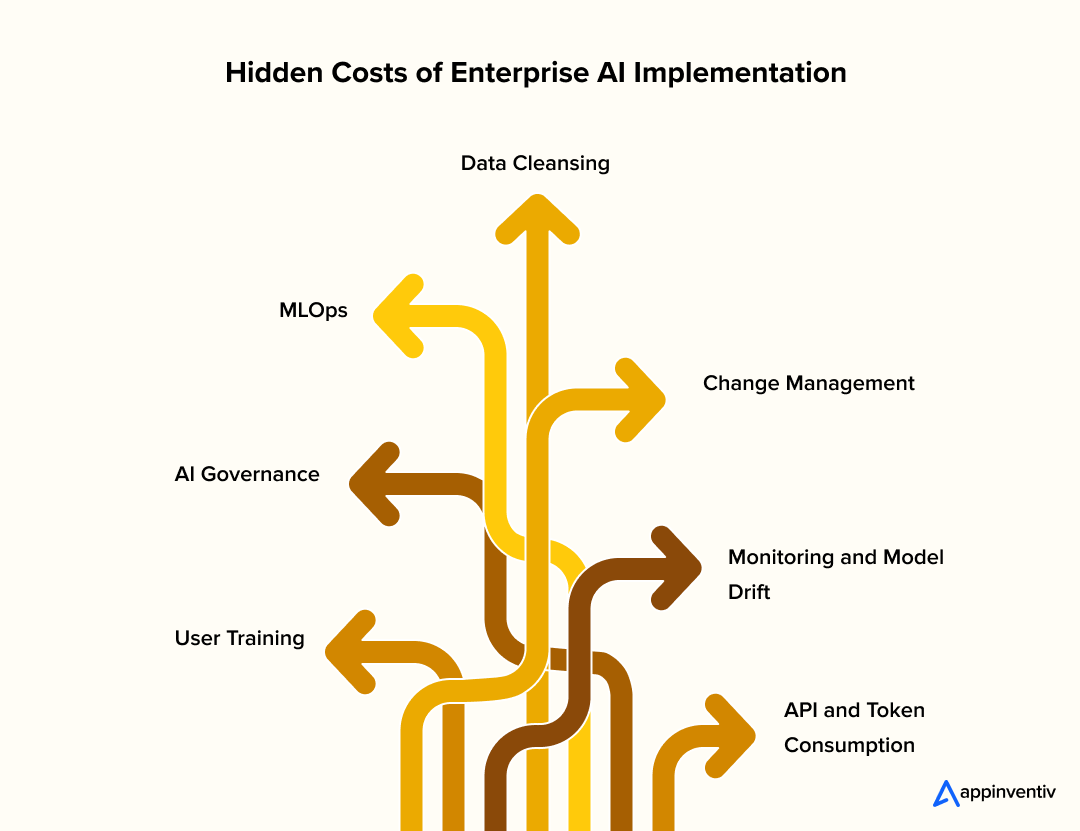
- Data cleansing and remediation: Often 30–40% of total data engineering effort once actual data quality is assessed
- MLOps infrastructure: The tooling required to retrain, monitor, and version models in production is frequently absent from initial budgets
- AI governance and compliance: Data Protection Impact Assessments, model cards, and audit-trail infrastructure have real resource costs
- Model drift and monitoring: Models degrade over time as data distributions shift; unmonitored models create both performance and regulatory risk
- API and token consumption: For generative AI components, inference costs at scale can exceed initial infrastructure estimates by a significant margin.
What is the ROI of Enterprise AI Implementation: How to Calculate IT?
ROI measurement in AI programmes requires more precision than most organisations apply. The relevant benefits extend well beyond cost reduction. They include revenue impact, risk reduction, and employee productivity gains that compound over time. Getting the measurement framework right before deployment is not optional; it’s the basis on which continued investment will be justified to boards and audit committees.
The ROI Framework
The baseline formula:
| ROI = ((Total Benefits – Total Investment) ÷ Total Investment) × 100 |
|---|
In practice, ‘Total Benefits’ should be disaggregated across five value categories:
- Revenue growth: Incremental revenue from AI-enabled personalisation, cross-sell, or new product capability
- Productivity gains: Measurable reduction in labour hours for defined processes, expressed as FTE cost savings
- Operational efficiency: Reduction in process cycle times, error rates, or rework volumes
- Risk reduction: Avoidance of regulatory fines, fraud losses, or unplanned downtime costs
- Customer retention: Modelled lifetime value impact of reduced churn, calculated using cohort data
Illustrative Example
A UK financial services firm deploys an AI-powered fraud detection model.
Annual investment: £350,000 (including development, infrastructure, and ongoing optimisation).
Annual fraud loss reduction: £1.2M. Compliance overhead reduction (fewer false positive investigations): £180,000.
Total annual benefit: £1.38M.
| ROI = ((£1,380,000 – £350,000) / £350,000) × 100 = 294% |
|---|
This is not atypical for well-scoped fraud detection or compliance automation programmes in regulated environments. The key variable is whether the ‘Total Benefits’ calculation was built on actual baseline data rather than on industry benchmarks applied loosely.
How to Implement Enterprise AI: A Step-by-Step Process
The difference between successful AI deployment in the UK that reach production and those that stall in pilot is almost always execution discipline, specifically, the rigour applied to opportunity assessment, data readiness evaluation, and governance design before a single model is trained. The framework below reflects the AI implementation best practices used on enterprise programmes across regulated UK industries.
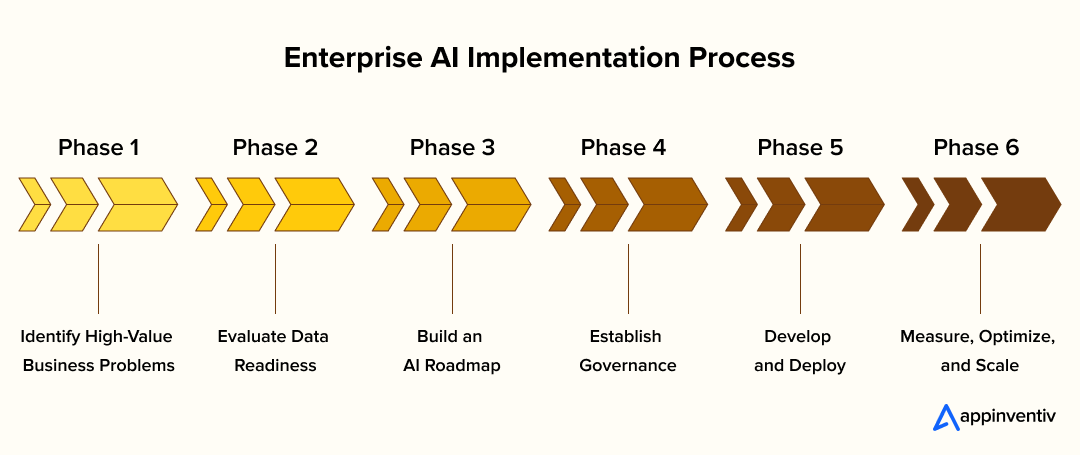
Phase 1: Identify High-Value Business Problems
Look closely at your most expensive operational bottlenecks. Technology leaders often buy an advanced model first and then search for a place to use it. Reverse that thinking. Audit your workflows to find high-volume manual tasks where human error actively costs the business money. Sometimes a basic automated script solves the issue. Reserve machine learning for areas demanding context and probabilistic reasoning.
Phase 2: Evaluate Data Readiness
Your model is only as capable as the historical data feeding it. Companies frequently attempt to train algorithms on heavily siloed, fragmented databases. It rarely works out. Run a blunt assessment of your data landscape before committing capital. Check for privacy constraints, format consistency, and storage accessibility. If information sits trapped in legacy systems, data remediation must become your priority.
Phase 3: Build an AI Roadmap
Trying to overhaul an entire department at once usually ends poorly. Create a deployment matrix that weighs potential business value against actual engineering effort. Target a specific workflow capable of demonstrating a hard financial return within a single quarter. Securing a small, undeniable win early proves the concept to skeptical stakeholders. That trust unlocks board funding for more complex transformations later.
Phase 4: Establish Governance
Never treat compliance as a final hurdle to clear right before launch. In the UK regulatory environment, governance dictates foundational architecture. Map out UK GDPR requirements, strict access limits, and data masking rules before developers start building. For systems handling sensitive operational choices, hardcode human oversight triggers from the very beginning.
Phase 5: Develop and Deploy
Leaving the safety of a pristine engineering sandbox exposes your system to reality. Live edge cases will behave completely differently than your cleansed training data. Run a tightly restricted pilot with a small user group who understands the tool is learning. Keep legacy fallbacks fully active. Once security audits confirm stability under actual load, begin a slow release across the wider company.
Phase 6: Measure, Optimise, and Scale
Going live marks the start of the operational lifecycle, not the end. Algorithms drift as the raw data they process shifts over time. Accuracy degrades rapidly without an operational team monitoring the performance dashboards. Set a strict retraining schedule. Gather blunt feedback from the staff using the interface daily, and use those insights to refine the workflow continuously.
Also Read: Al-Powered Software Development in the UK: Key Opportunities and Compliance Risks
Looking to reduce operational costs and improve decision-making with AI?
Partner with Appinventiv to develop AI solutions that drive efficiency, automate complex processes, and unlock measurable business value.
Future Trends Shaping Enterprise AI in the UK: 2026–2030
Entrepreneurs in the UK planning AI investments today must consider how emerging technologies will influence the businesses impact in the coming years. Organisations building scalable foundations today will be better positioned to capitalise on future innovations.
Key software development trends in the UK expected to influence enterprise AI strategy include:
Multimodal AI Systems: Future platforms will combine text, image, video, voice, and structured data analysis in the UK.
Industry-Specific Foundation Models: Sector specialised models will deliver stronger performance in regulated industries.
AI-Powered Decision Intelligence: Decision-support platforms will become increasingly embedded within executive operations.
AI Governance Platforms: Governance tooling will mature alongside regulatory expectations.
Sovereign and Private AI Infrastructure: Growing concerns around data control will accelerate investment in private AI environments and sovereign infrastructure strategies.
Enterprise AI Agents: Autonomous agentic AI systems will increasingly support sequences of actions: querying systems, making decisions, triggering downstream processes, and adapting their approach based on intermediate results.
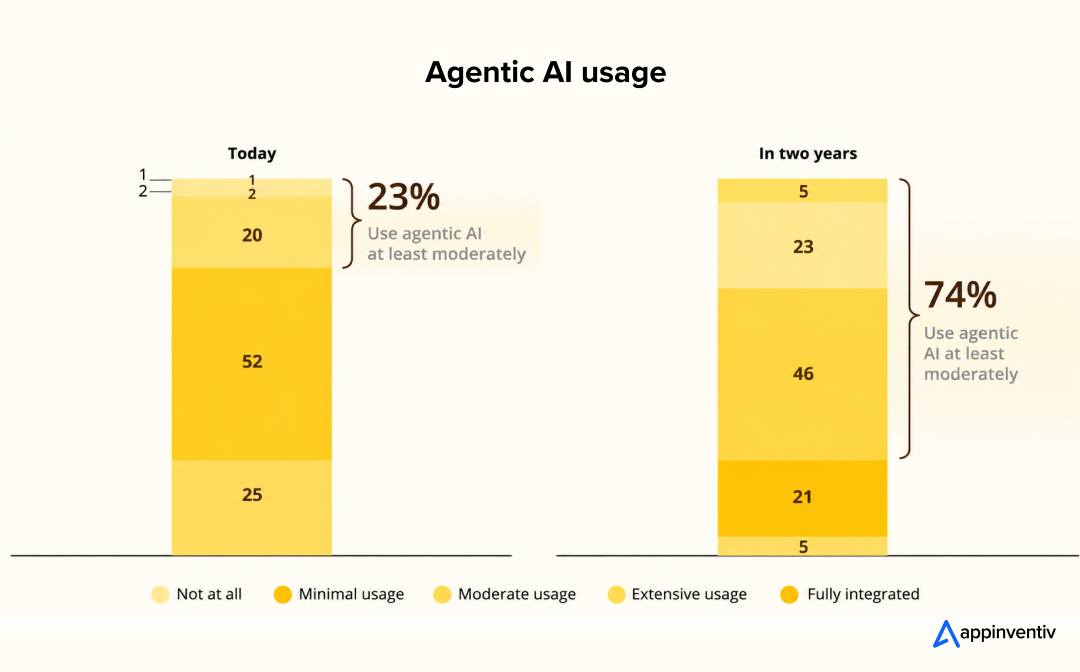
Deloitte’s 2025 research notes that agentic AI adoption is poised to rise sharply [nearly 3 in 4 companies (74%)] within the next two years. However, only 23% organisations currently use agentic AI systems moderately. It is a gap that creates material operational and reputational risk for early movers who deploy without adequate oversight.
How Appinventiv Helps Enterprises with AI Implementation in the UK?
UK organisations are no longer evaluating whether to adopt AI. They are determining how to implement it responsibly, scale it efficiently, and generate measurable value. To do it responsibly, they need a trusted digital engineering partner like Appinventiv.
As a custom AI development company in UK with over 11+ years of experience in delivery, we have successfully delivered 300+ AI powered solutions across 35+ industries and achieved 97% client satisfaction rate in EU market.
A Snapshot of Our AI Delivery Excellence
A team of 1600+ technology experts sits behind that record, including 200+ data scientists and AI engineers focused on AI implementation in the UK. The numbers give a sense of the depth:
| Delivery metric | Figure |
|---|---|
| AI-powered solutions delivered | 300+ |
| Data scientists and AI engineers onboard | 200+ |
| Custom AI models trained and deployed | 150+ |
| Enterprise AI integrations completed | 75+ |
| Bespoke LLMs fine-tuned | 50+ |
| Strategic AI partnerships | 5+ |
Recognition has followed the work. Appinventiv featured in the Deloitte Technology Fast 50 India for two consecutive years on the strength of exponential growth and was named a leader in AI-first engineering by the Economic Times.
Our core delivery of AI services include:
- AI strategy and consulting
- Enterprise AI product development
- Generative AI solutions
- MLOps and AI infrastructure
- AI governance and compliance
- End-to-end enterprise transformation
Our dedicated AI Strategy and Consulting teams work closely with your executive board to map high-yield opportunities, ensuring absolute alignment with commercial objectives. From there, our enterprise AI product development squads build secure, scalable architectures tailored precisely to your proprietary data. We implement rigorous MLOps and AI infrastructure solutions. This guarantees that your models remain highly accurate and performant as user demand scales.
Business Impact
The point of all this is the outcome, not the architecture. Across recent enterprise engagements the pattern holds: decision-making around 75% faster, AI prediction accuracy near 98%, time-to-market up to 10x quicker, and operating costs down by an average of 40%.
Ready to move your AI programme from pilot to production? Contact Appinventiv today to explore a delivery model aligned to your governance requirements, data estate, and commercial objectives.
FAQs
Q. How do enterprises choose the right AI implementation partner?
A. Evaluate partners on their track record in regulated UK industries, their governance and compliance frameworks, their MLOps capability, and their approach to knowledge transfer. A partner who cannot demonstrate production-grade deployments in comparable environments, not just pilot-stage demos, carries meaningful delivery risk for enterprise programmes.
Q. What are the compliance and data privacy concerns in AI implementation in the UK?
A. UK enterprises must navigate UK GDPR obligations, ICO guidance on automated decision-making, sector-specific frameworks such as DORA for financial services and DSPT for healthcare, and NCSC Cyber Essentials requirements for AI-touching systems.
Data residency, keeping training data and model outputs within UK or EEA infrastructure, is an increasingly common board-level requirement, particularly in government and financial services.
Q. How long does AI implementation take in the UK?
A. The timeline for AI implementation varies, depending on several factors like data complexity, the number of integrations, regulatory design requirements and the project complexity. For instance:
- A proof of concept typically runs 3-4 months.
- Department-level solutions take 4-6 months from kickoff to production deployment.
- Enterprise AI platform builds and transformation programmes require 6-12 months to 2 years, depending on data complexity, the number of integrations, and regulatory design requirements.
The most common cause of timeline overrun is data readiness assessment underestimating the remediation effort required before model training can begin.
Q. What are the biggest challenges in AI implementation?
A. Data quality and fragmented data estates remain the primary technical barrier. Beyond that, the most consequential challenges are absence of executive accountability for business outcomes, KPIs that cannot be measured against pre-implementation baselines, and governance frameworks that are designed retrospectively. In UK-regulated industries, compliance architecture designed post-deployment rather than before it creates both regulatory risk and rework cost.
[ad_2]
Source_link