So, you are thinking of agentic AI development or just curious about Agentic AI and its application to your business.
Most probably, you already have a rudimentary understanding that normal AI is your model that works with your text prompts. Compared to that, Agentic AI in real life means AI that, instead of simply replying, can think, plan, use tools, take actions, and work step-by-step toward a goal.
What are Agentic AI Design Patterns, and the Role it Plays
Think of Agentic design patterns as the blueprint or brain map of how the AI works. However, unlike your brain, you can have complete control when it comes to either choosing or creating an Agentic AI design pattern for your business application.
Your decision will decide:
- How your Agentic AI thinks
- How Agentic AI makes decisions
- How Agentic AI uses tools
- How multiple Agents AIs work together
It’s the structure behind how AI breaks down a problem, decides what to do next, uses the right tools, and works with other AI agents, or humans.
In business terms, it’s like the difference between hiring someone with no onboarding versus one who’s been given a clear process, workflow, and role. Both are smart, but only one is actually useful.
Think of it like this.
If agentic AI is the employee, the design pattern is how that employee is trained to think, work, and collaborate.
Why Does Agentic AI Patterns Even Matter for Business?
Business problems are dynamic and have no fixed templates. That’s why businesses are relying more and more on undertaking multi-agent system development approach.
Because real business problems don’t look like
- “Summarize this sales data”
They look like:
- Pull last quarter’s numbers → compare against targets → identify which regions are underperforming → Compare it with historic trends→ figure out why → recommend where to reallocate budget → put it in a format the CFO can present on Friday
Here’s what design patterns actually do for a business:
- They turn AI from a tool into a teammate. Instead of someone typing a prompt and copy-pasting the answer, you get AI that actually moves work forward.
- They reduce errors. Structured AI systems catch their own mistakes before they reach you.
- They scale without hiring. You can run complex, multi-step workflows without adding headcount.
- They make AI reliable. Patterns create predictable, repeatable behavior, and not one-off magic tricks.
Different Types of Agentic AI Design Patterns Explained
Let’s now talk about some of the Agentic AI design patterns designs you can use to develop Agentic AI to create a transforming enterprise platform.
Let’s walk you through each one, one by one, without any jargon, just real-world examples that make sense if you’ve ever sat in a business meeting.
1. Tool-Use Pattern: AI That Actually Does the Work

What it is & How It Works: Modern-day Agentic no longer just thinks and analyses but also acts. So, these Agentic AI systems can connect to your systems, software, or tools and take actual actions. System designed for this purpose uses the Tool use Agentic AI design pattern
How It Can Have Real Life Impact on your Business: Your sales team closes a deal. Instead of someone manually updating the CRM, sending a welcome email, generating an invoice, and notifying the fulfilment team, the Agentic AI does all of it automatically because it’s connected to those tools.
Why it matters for Businesses: This delivers real business impact and streamlines your customer onboarding process. Your present system of manually onboarding customers with some assistance from traditional AI models (hopefully you are doing that already) is outdated and messy.
2. Planning Pattern: AI That Thinks Before It Acts

What it is & How It Works: Most AI tools today respond to what you ask. The Planning Pattern takes it further, the AI receives a goal, builds a structured plan to achieve it, and works through each step in sequence before delivering an output. It thinks before it acts, not after.
How It Can Have Real Life Impact on your Business: You tell the AI: “Prepare a business review for the board.” It doesn’t ask you follow-up questions or dump raw information at you. It figures out what data to pull, what comparisons matter, what the narrative should be, and structures the entire thing, step by step, before it lands in your inbox.
Why it matters for Businesses: Most executives we speak to are still assigning this kind of work to a junior analyst who takes three days, misses context, and needs two rounds of revision. That’s not an analyst problem, it’s a process problem. The Planning Pattern solves it.
3. Reflection Pattern: AI That Checks Its Own Work

What it is & How It Works: One of the biggest complaints about AI in business is that someone still has to check everything it produces. The Reflection Pattern addresses this directly, the AI completes a task, then reviews its own output against a standard, catches what’s wrong, fixes it, and only then hands it over. Systems built with this pattern essentially have a built-in QA layer.
How It Can Have Real Life Impact on your Business: You ask the AI to draft a vendor contract clause. It writes it, reviews it against your standard terms, flags a potential conflict, rewrites the clause, and then routes it to you for final sign-off, not the other way around.
Why it matters for Businesses: Right now, your team is the safety net for AI output. That defeats half the purpose of using AI in the first place. The Reflection Pattern flips that, AI becomes its own first line of review, and your team steps in only when it actually matters.
4. Multi-Agent Pattern: AI Working as a Team

What it is & How It Works: A single AI agent has limits, it can only do so much at once. The Multi-Agent Pattern solves this by deploying multiple AI agents simultaneously, each with a distinct role, working in parallel and feeding into a single consolidated output. Think of it less like a tool and more like a specialist team.
How It Can Have Real Life Impacton your Business: You’re launching a new product. One agent researches the competitive landscape. Another drafts the go-to-market messaging. A third checks it for compliance. A fourth packages everything into a launch brief. They work at the same time, and you get a finished, coordinated output in a fraction of the time it would take one person to do each step sequentially.
Why it matters for Businesses: Hiring four specialists to do this work takes weeks of coordination and significant budget. Running it through a well-designed multi-agent system takes hours. If you’re still treating AI as a solo tool, you’re only getting a fraction of what it’s capable of.
You might be interested in reading: Agentic AI Systems Explained
5. Voice & Conversation Pattern: AI That Talks With People

What it is & How It Works: This agentic AI framework enables you to hold a real, back-and-forth conversation, over voice or chat, and take meaningful action based on what it understands. It’s not a scripted chatbot. It listens, interprets context, and responds in a way that actually moves the situation forward.
How It Can Have Real Life Impact on your Business: A customer calls your support line at 11pm about a billing issue. Your purpose-built Agentic AI for customer support answers, understands the problem in full, checks the account, issues the correction, and sends a confirmation email, all without a single human being involved or woken up.
Why it matters for Businesses: Your current support model, whether human agents, scripted bots, or a frustrating IVR system, is costing you more than you think. Not just in salaries, but in customer satisfaction scores and churn. This Agentic AI design pattern replaces deflection with resolution, and that’s a very different business outcome.
6. Orchestration Pattern: The AI Manager

What it is & How It Works: As businesses deploy more AI agents, someone, or something, needs to manage them. The AI agent orchestration pattern does exactly that. One AI acts as the coordinator, assigning tasks to the right agents, tracking progress, handling dependencies, and consolidating everything into a final output. It’s the management layer that makes multi-agent systems actually work in practice.
How It Can Have Real Life Impact on your Business: You say: “Run the monthly client reporting process.” The orchestrator AI triggers the data pull, routes it to the analysis agent, sends the output to the formatting agent, and delivers the final deck to your inbox, in the right order, without you project-managing any of it.
Why it matters for Businesses: Without this pattern, AI systems in large organizations become siloed and chaotic, different tools, different outputs, no coordination. Orchestration is what turns a collection of AI tools into an actual operating system for your business.
7. Memory Pattern: AI That Remembers

What it is & How It Works: By default, most AI interactions are stateless, every conversation starts from zero. The Memory Pattern changes this. The Agentic AI memory pattern design retains context from past interactions, learns from them, and applies that knowledge to future conversations. Over time, it builds a working understanding of your business, your clients, and your preferences.
How It Can Have Real Life Impact on your Business: A key client calls for the third time this quarter. Instead of asking them to repeat themselves, the AI already knows their history, their previous complaint, the resolution they were promised, and how they prefer to communicate, and responds accordingly, from the first sentence.
Why it matters for Businesses: Customers and clients notice when they have to re-explain themselves. It signals disorganization and erodes trust. The Memory Pattern eliminates that entirely, and at scale, that improvement in experience directly impacts retention numbers.
8. Computer-Use Pattern: AI That Runs the Software

What it is & How It Works: Most business software was not built with AI integration in mind. The Computer-Use Agentic AI design pattern works around that, the AI operates software interfaces the same way a human would. It logs in, navigates screens, clicks buttons, fills forms, and extracts or inputs data. No API required or any custom integration; it just uses the software as a human would.
How It Can Have Real Life Impact on your Business: Every Monday, someone on your team spends two hours pulling data from three different portals, copying it into a spreadsheet, and emailing a summary to stakeholders. With this pattern, the AI handles the entire process automatically, before your team has even opened their laptops.
Why it matters for Businesses: Every business has a version of this Monday morning task. Multiply it across departments and weeks, and you’re looking at a significant amount of skilled employee time being spent on work that produces zero strategic value. This pattern eliminates it cleanly.
9. Simulation Pattern: AI That Tests Before You Commit

What it is & How It Works: Decisions in business carry risk, and most of that risk comes from not knowing how things will play out. The Simulation Pattern addresses this by having the AI run through multiple scenarios before any real action is taken. It models outcomes, surfaces risks, and flags the options most likely to go wrong, so you can adjust your approach before it costs you.
How It Can Have Real Life Impact on your Business: Before your team rolls out a new pricing model, the AI simulates how different customer segments would likely respond. It flags the segments most at risk of churning at the new price point, so you can either adjust the model or build a retention plan before launch, not after.
Why it matters for Businesses: Most pricing, expansion, and product decisions in mid-sized companies are made on intuition, benchmarks, and hope. The Simulation Pattern gives you a structured way to pressure-test those decisions before they’re live, and that’s the kind of risk management that used to require expensive consultants.
10. Monitoring Pattern: AI That Watches So You Don’t Have To

What it is & How It Works: No business can have a human watching every system, transaction, and process in real time. The Monitoring Pattern fills that gap, the AI runs continuously in the background, observing your systems against defined parameters, and surfaces only what needs human attention. Everything else it handles or logs quietly.
How It Can Have Real Life Impact on your Business: Your finance team isn’t reviewing every transaction; they can’t. But an AI monitoring agent is. It flags the vendor being paid twice, the expense running 40% above average, and the contract renewal two weeks away from lapsing, so the right person can investigate before it becomes a problem.
Why it matters for Businesses: The issues that cost businesses the most are rarely dramatic, they’re the slow leaks. A duplicate payment here, a missed renewal there, an anomaly that nobody caught for three months. This pattern catches them in real time, and at a cost that’s a fraction of what those leaks would have cost you.
11. Collaborative Multi-Agent Pattern: AI That Debates
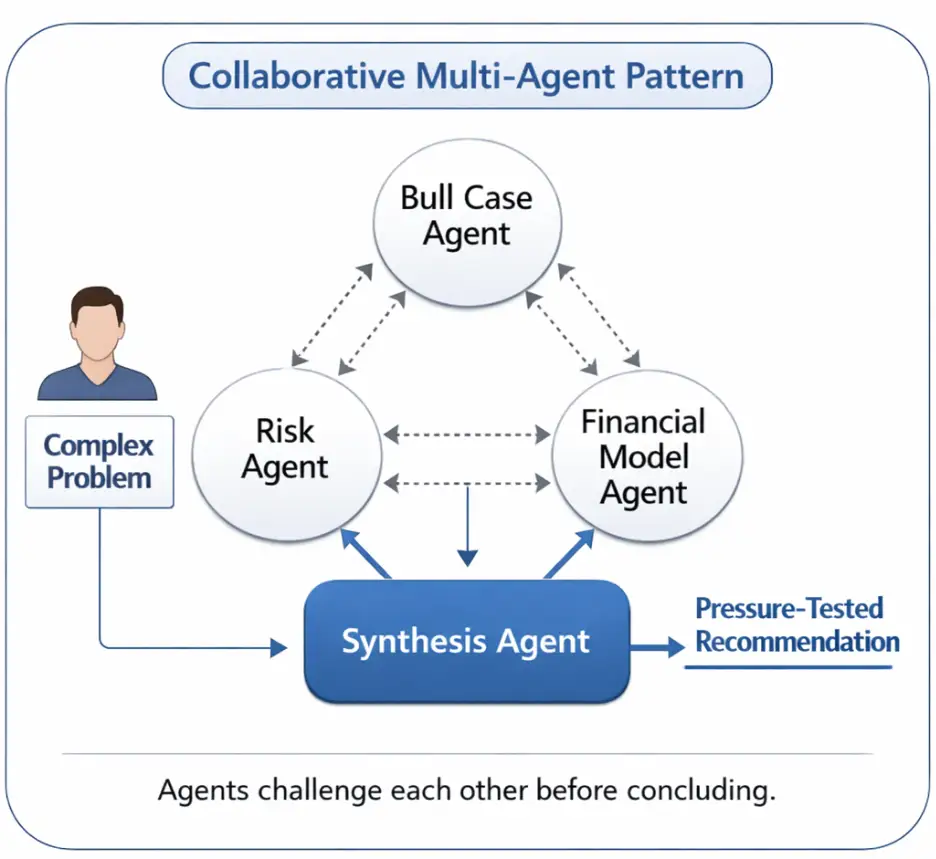
What it is & How It Works: For complex, high-stakes decisions, a single perspective, even an AI one, isn’t enough. The Collaborative Multi-Agent Pattern brings together multiple AI agents with different specializations to work through a problem together. They challenge each other’s assumptions, cross-check outputs, and only converge on a recommendation once it’s been internally stress-tested.
How It Can Have Real Life Impact on your Business: You’re evaluating whether to enter a new market. One AI agent builds the bull case. Another systematically stress-tests every assumption. A third models the financial risk under different entry scenarios. What you receive isn’t a single AI’s view, it’s a recommendation that has already been argued, challenged, and refined before it reaches you.
Why it matters for Businesses: High-stakes decisions made on unchallenged analysis are where businesses lose the most money. Your leadership team debates before it decides, your AI system should too. This pattern is what makes that possible, and it means the analysis you’re basing decisions on has already survived scrutiny before it ever reaches the boardroom.
Quick Recap of Agentic Design Pattern
| Pattern | Think of it as… |
| Tool-Use | An employee who has access to all your systems |
| Planning | A project manager who maps out the work |
| Reflection | A QA reviewer who checks before submitting |
| Multi-Agent | A specialist team working in parallel |
| Voice | A frontline rep available 24/7 |
| Orchestration | A chief of staff coordinating everything |
| Memory | A colleague who actually remembers what was discussed |
| Computer-Use | Someone who handles the repetitive screen work |
| Simulation | A risk analyst running scenarios before you decide |
| Monitoring | An auditor who never sleeps |
| Collaborative | A team that debates before they deliver |
Final Verdict
If your business is using AI just to write emails faster or summarize documents, that’s fine, but you’re leaving most of the value on the table.
The real opportunity isn’t in AI that answers questions. It’s in Agentic AI that runs workflows, catches errors, coordinates work, and operates your business processes with minimal hand-holding.
That’s what these design patterns make possible.
You don’t need to understand how they’re built. But knowing what they can do, and asking your teams or vendors whether they’re using them, puts you ahead of most executives I’ve spoken to.
The companies that figure this out first won’t just be more efficient. They’ll be structurally different from their competitors.
FAQ
1. Do I need to be technical to use agentic AI in my business?
Not necessarily, you don’t understand how your CRM’s database is structured, but you still use it to run your sales pipeline. The same logic applies here. At the end of the day, Agentic AI is another tool or software that you will use in your business operation.
2. Which pattern should a business start with?
Start with Tool-Use and Orchestration. They plug directly into what your business already does, existing workflows, software, or processes, without requiring you to redesign anything from scratch.
3. Is this just automation with a fancy name?
Traditional automation is rigid. It follows a fixed script, and the moment something unexpected happens, it breaks or escalates to a human. Agentic AI can read the situation, make a judgment call, and handle things it was never explicitly programmed for..
4. How do I know if my current AI vendor is actually building with these patterns?
Ask them one question: “Does your AI take autonomous multi-step action on its own, or does it generate a response that a human then has to act on?”. If they hesitate, or if the answer is the second one, you have a glorified chatbot, not an agentic system. Most vendors won’t volunteer this distinction. You have to ask for it.