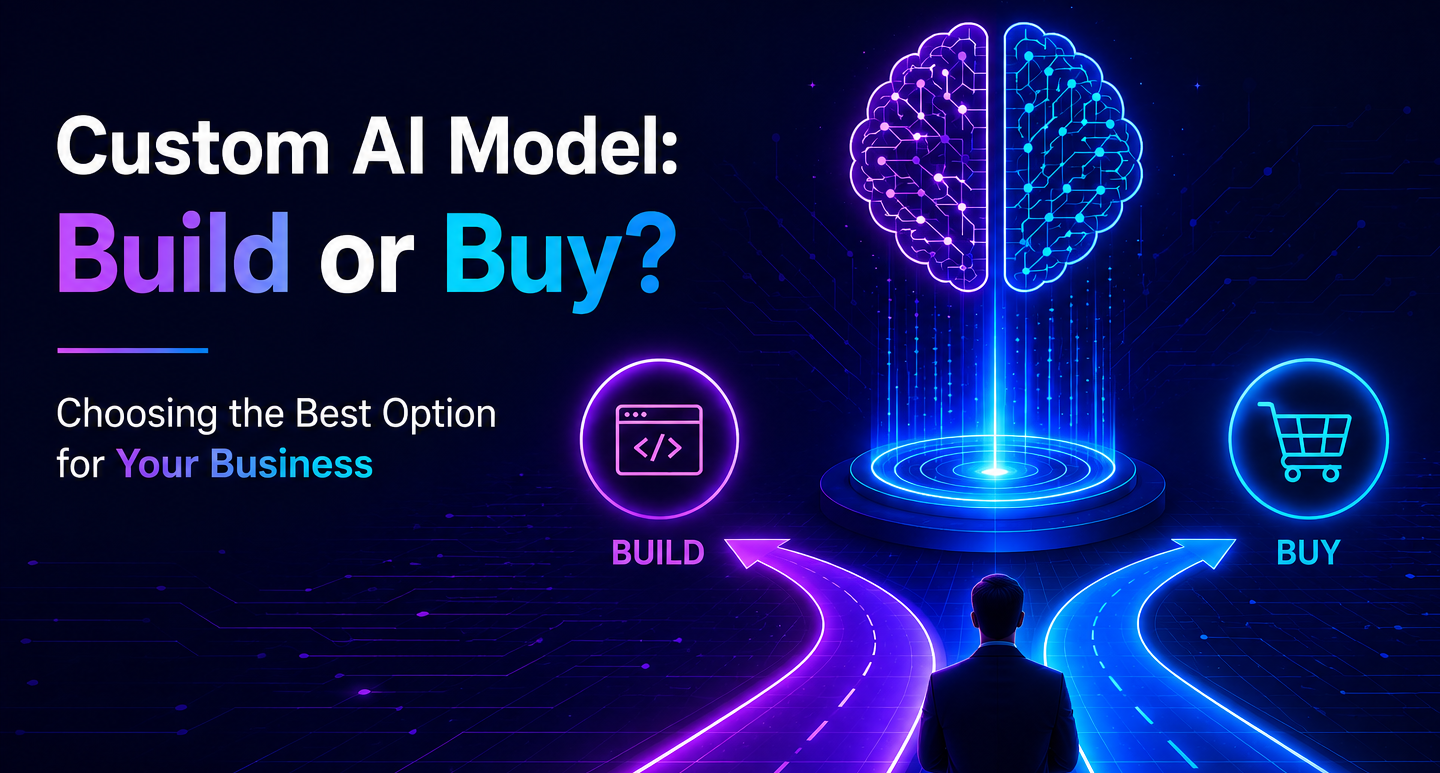
Artificial intelligence has moved from being an experimental technology to becoming a practical business tool. Companies are using AI to automate repetitive work, analyse large datasets, improve customer experiences, detect risks, support employees, and build smarter products. But once a business identifies an AI opportunity, another question quickly follows:
Should we build our own AI solution or buy an existing one?
It sounds like a simple technology decision. In reality, it can affect your budget, implementation timeline, internal team, data strategy, security, scalability, and even your competitive position.
AI development company can customise existing models through retrieval-augmented generation (RAG), fine-tuning, model tuning, proprietary data, business rules, APIs, and integrations.
In many cases, this middle ground can deliver the control of custom AI without the cost and complexity of building everything from zero. So, the real question isn’t simply build vs buy AI. This guide explains how to answer that question and decide whether to build, buy, customise, or use a hybrid approach.
What Is Custom AI Model Development?
Custom AI model development involves creating or adapting an AI capability specifically around a company’s data, users, workflows, business rules, and objectives.
That definition is broader than simply training a new model.
A custom AI solution could involve:
- Developing a machine learning model for a specialised prediction
- Fine-tuning an existing model for a specific task
- Connecting a pre-trained model to proprietary information using RAG
- Building custom AI agents around an existing foundation model
- Creating proprietary recommendation or forecasting systems
- Integrating AI with CRM, ERP, eCommerce, or internal applications
- Adding business-specific rules, workflows, and guardrails
This distinction matters because businesses sometimes assume that going custom means building a foundation model from the ground up. That is rarely necessary.
Does Custom AI Mean Training a Model From Scratch?
This is why a business should first identify what needs to be customised before deciding what needs to be built.
| Approach | What It Involves | Typical Use |
| Prompting | Giving an existing model better instructions | Content and productivity |
| RAG | Connecting AI to private business knowledge | Enterprise assistants |
| Model tuning | Optimising model behaviour for a particular task | Specialised outputs |
| Fine-tuning | Further adapting a pre-trained model | Domain-specific applications |
| Custom model development | Developing a specialised model | Highly unique requirements |
| Complete AI solution | Model + data + workflows + integrations | Enterprise applications |
AI consulting company may not need a new model. It may simply need an existing model to
Build vs Buy AI: What Are Your Actual Options?
The traditional build vs. buy AI discussion is becoming more nuanced.
Businesses now have at least four practical options.
-
Build AI In-House
Your internal team designs, develops, deploys, and maintains the AI system.
This provides the greatest level of control but also requires considerable expertise and resources.
It makes sense when AI is central to your product or competitive advantage.
-
Buy an Existing AI Solution
You choose an existing platform or AI product that already solves your problem.
This is usually attractive when the use case is standard and speed matters.
For example, if your goal is simply to summarise meetings, you probably don’t need to develop your own AI model.
-
Partner With an AI Development Company
AI integration services can work with an experienced AI development partner to design and implement a solution.
This is useful when the organisation understands the business problem but doesn’t have enough internal AI engineering, data science, or infrastructure expertise.
-
Take a Hybrid Approach
A hybrid model combines existing AI technology with custom development.
This can give businesses the speed of existing technology while still allowing them to build the parts that genuinely differentiate their operations.
Current enterprise AI guidance increasingly treats build, buy, and partner as strategic alternatives rather than a simple binary decision.
When Should a Business Build a Custom AI Model?
So, when should a business build a custom AI model?
Your AI Use Case Is Highly Specialised
If your AI needs to perform a task that general-purpose systems weren’t designed for, custom development becomes more attractive.
Examples include:
- Specialised fraud detection
- Equipment failure prediction
- Industry-specific forecasting
- Proprietary recommendation engines
- Manufacturing defect detection
Your Proprietary Data Is a Competitive Advantage
Data can be one of the strongest reasons to customise AI.
Suppose your business has ten years of:
That information may contain patterns that generic AI systems don’t understand in the same way.
A custom solution can be designed to make better use of this proprietary information.
AI Is Part of Your Core Product
If AI is the product, relying entirely on someone else’s generic capabilities can become a strategic limitation.
A company selling an AI-powered financial analysis platform has a different requirement from a manufacturing business that simply wants an AI assistant for internal employees.
If AI directly influences your competitive differentiation, greater control may justify greater investment.
You Need Strong Data or Behavioural Control
Some businesses have strict requirements around:
In these situations, having more control over the architecture can be important.
Existing Solutions Don’t Fit Your Workflow
An off-the-shelf product may look perfect during a demonstration but become difficult to use when it encounters your real processes.
This can happen when your organisation has:
- Complex approval processes
- Unusual data structures
- Industry-specific rules
Custom AI can be designed around those requirements instead of forcing the business to change everything to fit the software.
When Is Buying an AI Solution the Better Choice?
Custom AI isn’t always the smart option.
Sometimes buying is exactly what a business should do.
The Problem Is Already Solved
If hundreds or thousands of businesses already use AI successfully for a particular task, there’s a good chance you don’t need to reinvent it.
For example, if your requirement is simply to summarise meetings, classify standard documents, or provide general writing assistance, an existing AI product may already provide sufficient value.
You Need Results Quickly
Time has a business cost. If your organisation needs an AI solution in weeks rather than months, buying an established platform may provide faster time to value.
You can deploy the solution, measure adoption, and decide later whether deeper customisation is necessary.
You Don’t Have the Required AI Expertise
Building AI isn’t only about hiring someone who knows machine learning.
Production AI can require:
Building internally without the right capabilities can create long-term maintenance challenges.
AI Isn’t Your Competitive Differentiator
This is perhaps the simplest test.
Ask:
Does this AI capability make our business different, or does it simply help us operate more efficiently?
If it’s simply an operational utility and an existing product does the job well, buying can be the sensible choice.
Custom AI Model vs. Pre-Trained Model: Which One Should You Choose?
The custom AI model vs. pre-trained model decision is slightly different from build vs. buy.
A pre-trained model has already learned patterns from large datasets and can perform a broad range of tasks.
This gives businesses an important advantage: they don’t have to start from zero.
Pre-trained models can provide:
- Lower initial development effort
- Broad language or prediction capabilities
- Existing infrastructure
But general capability doesn’t always mean business-specific capability.
A pre-trained model may not know:
- Your proprietary terminology
- Your customer-specific rules
- Your operational processes
- Your internal documentation
That’s where customisation comes in.
How AI RAG Development Can Give Existing Models Business-Specific Knowledge
One of the most useful alternatives to full model training is AI RAG development.
RAG stands for Retrieval-Augmented Generation. In simple terms, RAG allows an AI system to retrieve relevant information from a trusted knowledge source before generating its answer.
A general AI model may not know your company’s latest policy.
A RAG-based system can search your approved internal documents, retrieve the relevant policy, and use that information to generate an answer.
Why Use RAG Instead of Training a Model on Everything?
Your pricing policy might change next month. Your product documentation might change next week.
You don’t necessarily want to retrain a model every time information changes.
With RAG, the knowledge source can be updated independently while the AI system retrieves the latest relevant information.
Custom AI architectures increasingly use retrieval approaches to ground AI responses in proprietary enterprise information rather than relying only on general training data.
When Is RAG a Good Choice?
RAG can be particularly useful for:
- Enterprise knowledge assistants
- Product information systems
A useful rule is:
If the problem is that AI doesn’t know your business information, you may need better retrieval, not necessarily a completely new model.
AI Model Training vs. AI Model Tuning: What’s the Difference?
The terms AI model training and AI model tuning are often used interchangeably, but they can describe different levels of work.
AI Model Training
Training involves teaching a model through data and optimisation.
For a business, this can involve:
- Monitoring it in production
The data preparation stage itself can become a major part of an AI project. Enterprise AI guidance emphasises data quality, data strategy, and governance as foundational elements of successful custom AI initiatives.
AI Model Tuning
Model tuning generally focuses on improving or adapting an existing model for a specific purpose.
For example, you might tune a model to:
- Better understand industry terminology
- Follow a particular output structure
- Produce more consistent responses
- Handle a specialised task
- Follow domain-specific examples
This can be substantially more practical than building a model completely from scratch.
What Does Custom AI Development Cost?
One of the first questions business leaders ask is:
| Cost Factor | Why It Matters |
| Data preparation | Data may need cleaning, labelling, validation, and governance |
| Model complexity | More complex systems require more engineering |
| Training | Training can require significant compute resources |
| RAG | Requires retrieval, embeddings, data pipelines, and evaluation |
| Integrations | CRM, ERP, APIs, databases, and applications add complexity |
| Security | Enterprise controls increase architecture and testing requirements |
| Infrastructure | Hosting and inference costs continue after launch |
| Monitoring | AI systems need ongoing evaluation |
| Maintenance | Models and business requirements change over time |
How much does custom AI development cost?
The honest answer is: it depends heavily on what you are building.
Hire AI developers for a simple AI workflow using an existing model can require dramatically less investment than training and maintaining a specialised model.
Is Custom AI Worth the Investment?
The answer to “is custom AI worth the investment?” depends on the value created by the customisation.
Custom AI can be worth the investment when it:
- Generates additional revenue
- Reduces significant operating costs
- Automates expensive manual work
- Improves decision-making
- Creates a differentiated product
- Uses proprietary data effectively
- Improves accuracy for critical workflows
- Reduces dependence on manual processes
This is why business leaders should start with a simple calculation:
Custom AI should be treated as a business investment, not a technology trophy.
Common Mistakes Businesses Make When Choosing Custom or Off-the-Shelf AI
Choosing Custom AI Because It Sounds More Advanced
“Custom” sounds sophisticated, but sophistication isn’t the same as value.
If an existing solution solves your problem, rebuilding it may not make sense.
Choosing the Cheapest Option
The lowest initial price isn’t always the lowest total cost.
Integration, customisation, training, security, and maintenance can change the calculation.
Ignoring Data Quality
A sophisticated model cannot magically fix poor business data.
Before investing in AI, assess:
Assuming Every AI Problem Requires Training
This is one of the biggest misconceptions.
Some problems can be solved with:
Before full model training becomes necessary.
Underestimating Maintenance
AI isn’t “build once and forget.” Models, data, user expectations, regulations, and business processes change.
Production AI needs monitoring and continuous improvement. Modern custom AI practices increasingly incorporate MLOps/LLMOps for monitoring, iteration, and ongoing optimisation.
Ignoring Integration
The AI model may be excellent, but if it cannot access the systems where your business data lives, its practical value can be limited.
Building Without Success Metrics
“Implement AI” isn’t a measurable business goal.
Instead define:
Reduce document-processing time by 50%. Or increase customer-support self-service resolution by 25%. That gives the project a clear target.
Enterprise AI Solutions Require More Than a Model
A common mistake is thinking the AI model is the entire solution.
In an enterprise environment, the use cases of Generative AI is usually just one layer.
A broader architecture may look like:
Business Application
↓
AI Application Layer
↓
Model / LLM
↓
RAG & Business Data
↓
APIs & Enterprise Integrations
↓
CRM / ERP / Databases
↓
Security, Monitoring & Governance
This is why enterprise AI solutions need to account for architecture, identity, data governance, security, monitoring, integration, and human oversight.
Build, Buy, or Customise? Here’s the practical answer
There is no universal winner in the build vs buy AI debate.
Choose Buy When:
You need a standard AI capability, want faster deployment, and an existing solution meets most of your requirements.
Choose Custom When:
Your use case is unique, your proprietary data matters, AI creates competitive differentiation, or existing products cannot meet important requirements.
Choose Partner When:
You need custom AI but don’t have the internal expertise, infrastructure, or capacity to build and maintain it alone.
Choose Hybrid When:
You want the speed of existing models combined with the control of proprietary data, RAG, tuning, workflows, and integrations.
The smartest decision may therefore be to buy the commodity and build the differentiator.
If an AI model’s general intelligence is not what makes your business unique, there may be little value in recreating it.
But if the value lies in how AI understands your data, follows your workflows, makes specialised decisions, or delivers a differentiated customer experience, that’s where customisation can become a strategic investment.
Conclusion
The decision should consider business value, data uniqueness, security, control, integration complexity, time to value, internal expertise, scalability, and total cost of ownership.
Most importantly, custom AI should not be viewed as an all-or-nothing investment.
A thoughtful business can start small, validate the use case, use existing models where they make sense, customise the areas that create differentiation, and scale the solution as the value becomes clear.
Frequently Asked Questions
Q1. What is custom AI model development?
Custom AI model development involves creating or adapting AI capabilities around a business’s specific data, workflows, users, and objectives. It can include model training, fine-tuning, RAG, custom AI agents, proprietary data pipelines, business rules, and integrations rather than always requiring a model to be trained from scratch.
Q2. What is the difference between custom AI and off-the-shelf AI?
Custom AI is designed or adapted for specific business requirements, while off-the-shelf AI provides pre-built capabilities for common use cases. Custom AI generally offers greater control and flexibility but requires more investment and expertise.
Q3. When should a business build a custom AI model?
A business should consider building a custom AI model when the use case is highly specialised, proprietary data provides a competitive advantage, AI is central to the product, strict control is required, or existing solutions cannot meet critical performance, security, or workflow requirements.
Q4. Is custom AI worth the investment?
Custom AI can be worth the investment when it creates measurable revenue, reduces high operating costs, improves critical processes, or provides competitive differentiation. It may not be worthwhile when an existing solution already meets the business requirements or when the expected value is too small to justify development and ongoing maintenance.
Q5. How much does custom AI development cost?
Custom AI development costs depend on data preparation, model complexity, training or tuning requirements, RAG, integrations, security, infrastructure, testing, and ongoing maintenance. Businesses should evaluate total cost of ownership rather than comparing only the initial development cost with an AI subscription.