[ad_1]
To identify the best calendar apps, I evaluated 15+ tools and shortlisted Google Calendar, Microsoft Outlook, Zoom Workplace, ClickUp, Calendly Sales, Reclaim.ai, Zoho Mail, Acuity Scheduling, and Apollo.io.
The constant juggling of work tasks, personal events, and last-minute changes often left me feeling overwhelmed and disorganized. Between missed deadlines, overlapping meetings, and the sheer chaos of managing personal and professional commitments, I knew I needed a solution.
When I finally decided to take control, I realized I needed one of the best calendar apps to streamline scheduling and bring order to the madness.
For years, I relied on a mishmash of sticky notes, scattered phone reminders, and mental math to keep track of my schedule — and let’s just say it wasn’t working. Important events slipped through the cracks, meetings overlapped, and planning my day became a source of stress rather than clarity.
After countless hours of research, I’ve tested 15+ of the best calendar apps. I’ve analyzed their features, usability, and what G2 reviewers had to say to identify the ones that truly stand out. In this article, I’m sharing my findings so you can choose the app that’s right for you.
Whether you’re managing a packed work schedule, coordinating with a team, or just trying to remember your dentist appointment, there’s an app here that can simplify your life and help you stay organized.
9 best calendar apps: My picks for 2026
- Google Workspace: Best for Google ecosystem integration
Syncs effortlessly with Gmail, Meet, Drive, and other Google tools. ($7/user/month) - Microsoft Outlook: Best for email and calendar management
Combines powerful email and calendar tools on one platform. ($8.3/user/month) - Zoom Workplace: Best for scheduling video-first meetings
Enables scheduling and joining Zoom meetings directly from the calendar. ($14.16/user/mo) - ClickUp: Best for calendar-integrated project scheduling
Connects tasks, deadlines, and team schedules in one flexible calendar view. ($7/user/month) - Calendly: Best for frictionless client scheduling:
Automates meeting booking with CRM integration and smart routing. ($10/user/mo) - Reclaim.ai: Best for AI-driven time management:
Uses AI to auto-schedule tasks, habits, and focus time blocks. ($10/user/month) - Zoho Mail: Best for lightweight productivity on a budget
Offers simple scheduling with Zoho’s all-in-one business suite.
($1/user/mo) - Acuity Scheduling: Best for small business appointment booking:
Allows self-booking appointments with custom forms and payments. ($16/month) - Apollo.io: Best for customizable sales meeting workflows:
Enables sales-driven booking links with automated prospecting workflows. ($49/user/month)
*These calendar apps are top-rated in their category, according to G2 Grid Reports. I’ve also added their monthly pricing to make comparisons easier for you.
My top 9 best calendar app recommendations for 2026
A calendar app is a digital tool designed to help you organize, schedule, and track your daily activities, appointments, and tasks in one convenient place. These tools helped me go beyond traditional paper calendars and offered features like reminders and event integrations, making them one of my favorite tools to stay productive.
When I first started at G2, managing my time felt like a constant challenge — one that still makes me cringe. I once scheduled multiple back-to-back meetings without realizing they overlapped, leaving me scrambling between tabs, trying to juggle calls. That chaos made me realize how crucial it is to have a reliable calendar app to streamline my schedule.
Not just me, but organizations that are keen on dedicated fixed time slots for meetings, syncs or projects also understand the value of time management. This is why the calendar app market size was valued at USD 5.71 billion in 2024 and is projected to reach USD 16.37 billion by 2030, growing at a CAGR of 10.4%, according to a trusted research report.
As I switched to a calendar app, scheduling became effortless. I could quickly identify available time slots without endless back-and-forth emails, integrate video calls seamlessly, and ensure no meeting or task slipped through the cracks. These apps transformed my workflow, reduced stress, and allowed me to focus on the work that truly mattered.
How did I find and evaluate these best calendar apps?
I didn’t just skim app store ratings or rely on my personal preferences. To build a well-rounded view of the best calendar apps, I started with G2’s grid reports, which are trusted for ranking tools based on verified user reviews and market presence. This helped me shortlist widely used apps and lesser-known contenders with a strong foundation.
I also used AI-powered tools to analyze hundreds of user reviews on G2. This surfaced recurring patterns around scheduling efficiency, interface design, customer support, and syncing capabilities. These insights gave a clear picture of how these apps perform daily and the common drawbacks users deal with.
In cases where I couldn’t personally test a tool due to accessibility restrictions, I consulted a professional with hands-on experience and also factored in verified G2 reviews and G2 scores. These professionals actively manage multiple projects and calendars across teams, which helps uncover deeper usability patterns for cross-validation.
The screenshots used in this analysis are a mix of visuals taken from the verified G2 profile and publicly available data to give complete coverage. I also paid close attention to front-end UI, notifications, integrations, and customer support services.
What I look for in a calendar app
When selecting a calendar app, I prioritize a few key features that make managing my time more efficient:
- Easy scheduling: Managing meetings across different time zones can be a nightmare without the right tools. I need an app that can detect time zones automatically, analyze mutual availability, and suggest optimal meeting slots without constant back-and-forth communication. This is especially helpful when coordinating with remote teams or clients in various parts of the world. By automating these tasks, the app saves me time, reduces scheduling conflicts, and ensures meetings are set up efficiently, even when working with complex global schedules.
- Collaboration features: Seamless team coordination is essential for productivity. I often must share my calendar with colleagues for group scheduling, project planning, or aligning deadlines. An app that allows me to add collaborators easily customize access permissions (e.g., view-only or full-edit rights), and view others’ availability simplifies this process. This eliminates the need for long email chains or manual checks, ensuring everyone stays on the same page.
- User-friendly interface: With a packed schedule, I don’t want to waste time navigating a cluttered or overly complex app. A clean, intuitive interface lets me view my day, week, or month at a glance, ensuring I never miss an important task or meeting. Features like color-coded events, drag-and-drop scheduling, and customizable layouts make it easier to organize my time and adapt the calendar to my workflow. By minimizing the learning curve and navigation time, I can focus on my priorities instead of struggling with the tool itself.
- Artificial intelligence assistance: AI can take scheduling to the next level by offering features like conflict detection, automatic rescheduling, and meeting prioritization based on urgency or importance. AI can also learn my habits, such as preferred meeting times or recurring tasks, and proactively suggest schedules that align with my routines. This helps reduce decision fatigue, ensures that my schedule is optimized, and even prevents overbooking by identifying gaps or overlaps in advance.
- Mobile access: Since I’m often away from my desk, having robust mobile access to my calendar ensures I can stay organized no matter where I am. A responsive app with a fully functional mobile version allows me to schedule, reschedule, or cancel events on the go. Features like offline access, mobile notifications, and quick syncing with desktop versions make it easy to manage my day without missing a beat. This is particularly useful during travel or when unexpected changes arise.
- Payment integration: For events or appointments that involve payments, such as consultations, workshops, or freelance gigs, having built-in payment processing tools is invaluable. It eliminates the hassle of juggling third-party platforms and the calendar app, allowing me to handle scheduling and transactions in one place. This streamlines my workflow and enhances the experience for clients or participants by making the process seamless and professional.
- Customizable notifications and reminders: Effective time management relies on timely reminders, but a one-size-fits-all approach doesn’t work for everyone. The best calendar app should allow customizable notifications for different events and tasks. For example, I might want a reminder an hour before a meeting, but a full day’s notice for an important deadline. Adjusting these reminders based on priority or event type helps me stay organized and prepared without being overwhelmed by constant pings.
Ultimately, the right calendar app should save me time, reduce stress, and provide me with the tools to manage my workday easily, allowing me to focus on what matters most.
The list below contains genuine user reviews from our best calendar software category page. To be included in this category, software must:
- Allow scheduling from individual or collaborating users
- Enable users to share collaborative calendars
- Feature customizable viewing options (e.g., day, week, month, year)
- Facilitate scheduling of tasks, meetings, appointments, or events
This data was pulled from G2 in 2026. Some reviews have been edited for clarity.
1. Google Workspace: Best for Google ecosystem integration
I’ve used Google Calendar, part of the Google Workspace suite, for over five years now, and it’s definitely become an essential part of my daily routine.
What I’ve always liked is how effortlessly everything syncs across devices, making scheduling so much easier. Being a category leader for calendar apps grid on G2, it offers seamless integration with other Google services, like Gmail and Google Meet, which is super convenient.
Whenever I get a meeting invite via email, it automatically adds all the details to my calendar. If it’s a Google Meet session, the link is right there, making it simple to jump into the meeting.
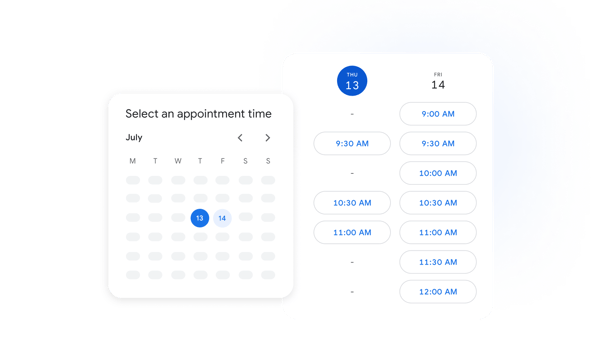
When setting up meetings, I can check someone’s availability in real-time. The “Find a Time” feature makes scheduling easier by showing available slots, so I don’t have to deal with the usual back-and-forth emails, especially when coordinating meetings across different time zones.
Another thing I really appreciate is the reminder notifications. Whether it’s an email or pop-up alert, it ensures I don’t miss important meetings or deadlines. Plus, I can set specific times for these reminders, allowing me to stay on top of tasks at the right moment.
 Source: Google Workspace
That said, there are a few areas where I think the Calendar experience could be even more intuitive. While the default views, like Day, Week, and Month, cover most planning needs, I’ve often wished for a more detailed “Agenda View” that groups meetings by type or priority, perhaps with collapsible sections.
On hectic days with back-to-back meetings, that structure would make it easier to focus on what matters most. Based on G2 feedback, a number of users would also welcome more intelligent filtering or organization tools within the calendar view to reduce visual overload.
I wish there were greater control over guest permissions. Right now, the options are somewhat limited. I’ve found myself in situations where event details were accidentally changed or unexpected invitees were added simply because the settings weren’t granular enough.
Giving event hosts more precise controls, like restricting guest edits or disabling the ability to forward invites, would go a long way toward improving collaboration. However, several G2 reviewers think these can create a gap in environments where multiple stakeholders are involved in sensitive or time-specific scheduling.
What I like about Google Workspace:
- I love how effortlessly my devices stay synchronized, with real-time updates across all of them. Any changes I make to my schedule are instantly reflected on all devices.
- It’s so convenient that meeting invites automatically populate with Google Meet links. This feature eliminates the need to add video conferencing details manually.
What G2 users like about Google Workspace:
“Google Workspace provides a simple and reliable platform for communication, collaboration, and productivity. Gmail, Google Meet, Drive, Docs, Sheets, and Calendar work seamlessly together, making it easy for teams to collaborate regardless of location. Real-time editing and file sharing significantly reduce the need for version control and email attachments.”
– Google Workspace review, Thomas G.
What I dislike about Google Workspace:
- Although the navigation was seamless, I experienced limited control over guest permissions. This made it challenging to restrict editing or prevent others from inviting participants.
- I noticed that there was a lack of a detailed “Agenda View.” This made it difficult to assess my schedule and prioritize tasks effectively and quickly.
What G2 users dislike about Google Workspace:
“Managing permissions can sometimes be confusing, and occasional interface changes require users to adjust workflows.”
– Google Workspace review, Addy B.
Related: Google Workspace also works well beyond scheduling. Since it can support quick notes, shared docs, and meeting context in one place, it’s worth exploring some of the best note-taking apps that can also help you manage your time better.
2. Microsoft Outlook: Best for email and calendar management
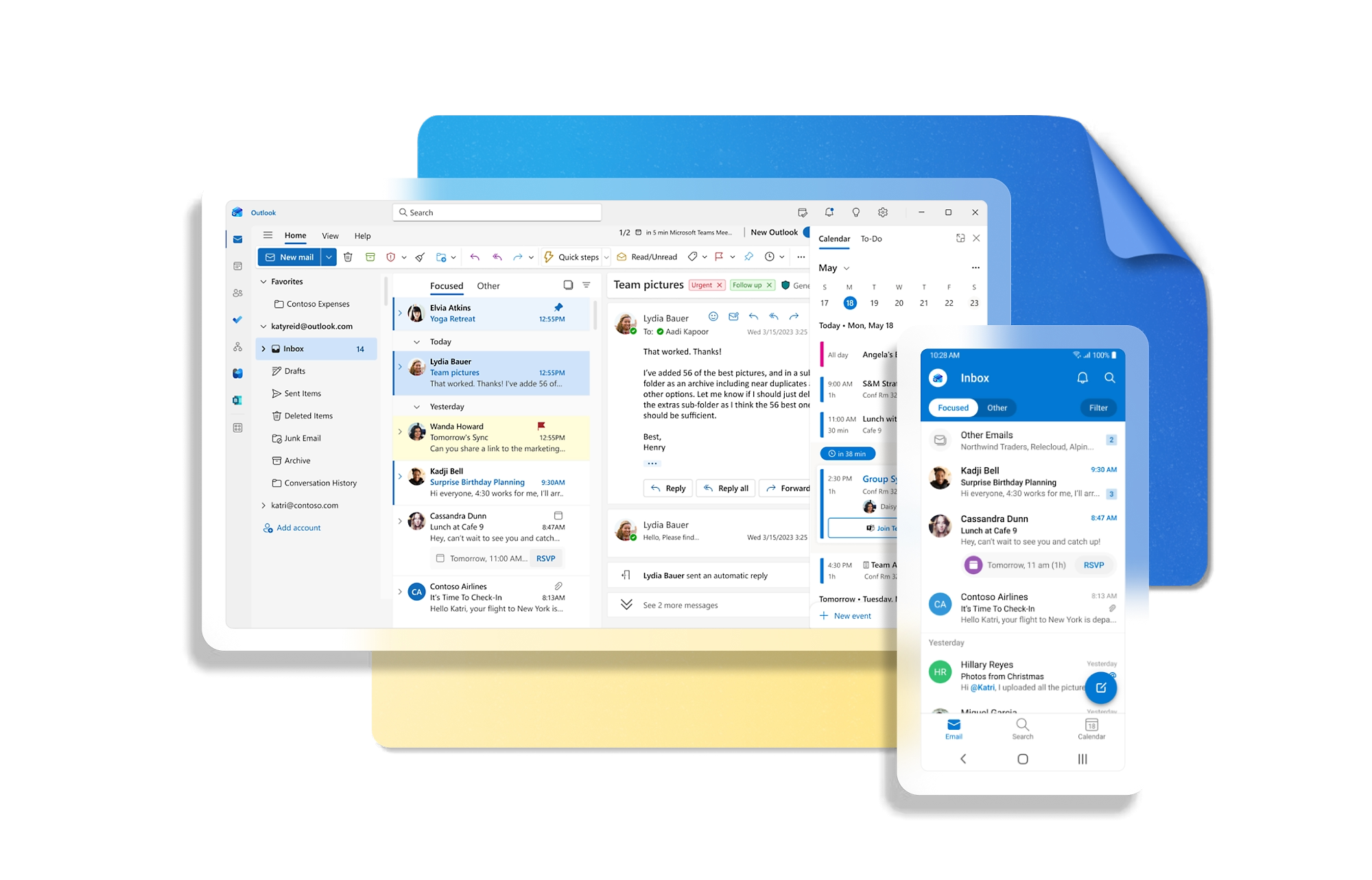
Before working with Microsoft Outlook (part of Microsoft 365), I was already familiar with its reputation within the Microsoft ecosystem, so I had high expectations. Outlook Calendar focuses on the calendar functionality tied to your Outlook email account.
I was curious to see how well it would integrate with the entire Microsoft 365 suite, and I was pleasantly surprised by how effortlessly it worked. Integrating Microsoft Teams for video calls and collaboration within calendar invites was especially convenient. The ability to add OneDrive files directly to events and easily sync emails from Outlook into calendar invites helped streamline my day-to-day tasks.
 Source: Microsoft Outlook
According to user experiences shared on G2, the initial learning curve with Outlook Calendar can feel a bit steep. It was hard to scroll through the platform’s many options and menus, and it also made the interface cluttered to newcomers.
In terms of navigation, I feel it is better to opt for customization. G2 reviewers also recommend customizing the view settings early on to better navigate the system and enhance usability.
However, I feel that the Integration across Microsoft 365 services, as highlighted in G2 feedback, is where Outlook Calendar shines. G2 users frequently cite the effortless connection with Microsoft Teams for video conferencing and the ability to attach OneDrive files directly to calendar invites as standout features.
I feel these integrations greatly streamline everyday workflows by tying communication, collaboration, and scheduling together in one ecosystem.
What I like about Microsoft Outlook:
- I enjoyed seamless integration with the Microsoft 365 suite. It allowed me to manage emails, documents, and calendar events in one unified platform.
- Integrating Microsoft Teams and OneDrive links into calendar invites was effortless. This helped participants prepare for the meeting in advance and streamlined meeting coordination.
What G2 users like about Microsoft Outlook:
“What I like most about Microsoft Outlook is that it’s simple, organized, and easy to use. Unlike Gmail, where long email conversations can sometimes get grouped into a single thread and become confusing, Outlook makes it much easier to view and manage emails. I can quickly find emails from the same sender, check them by date, and track conversations without getting lost.
The search feature is fast, folders and categories help keep my inbox organized, and the calendar integration makes it easy to manage meetings and appointments. Overall, Outlook provides a clean and professional email experience that helps me stay organized and work more efficiently.”
– Microsoft Outlook review, Abhishek S.
What I dislike about Google Workspace:
- Although the interface was navigable, I found it a bit overwhelming, with too many options and menus. The cluttered design made it hard to focus on what was important.
- The default views were a bit confusing and slowed navigation for new users like myself.
What G2 users dislike about Google Workspace:
“One area where Microsoft Outlook could improve is its performance when managing very large mailboxes or long email threads, as it can occasionally become slow or take extra time to sync.”
– Microsoft Outlook review, Navin M.
Related: Google and Microsoft offer two of the most widely used email platforms in the market. See which one comes out ahead in our detailed comparison of Outlook vs. Gmail.
3. Zoom Workplace: Best for scheduling video-first meetings
Having used Zoom Calendar, part of the Zoom Workplace suite, extensively to manage personal and professional schedules, I’ve come to appreciate its many features and integrations.
One of the standout aspects of Zoom Calendar is how seamlessly it syncs with Google Calendar and Outlook. This ensures that all my meetings, including Zoom links, are automatically added without any extra effort.
Zoom Workplace’s integration with payment solutions is particularly useful for hosting webinars and paid events. The ability to accept payments directly within the platform streamlined the booking process, making it incredibly convenient for the participants and me.
Zoom Calendar also integrates with task management tools like Asana and Trello. This integration allows me to automatically link meeting events to specific tasks, providing an all-in-one platform for tracking deadlines and action items.
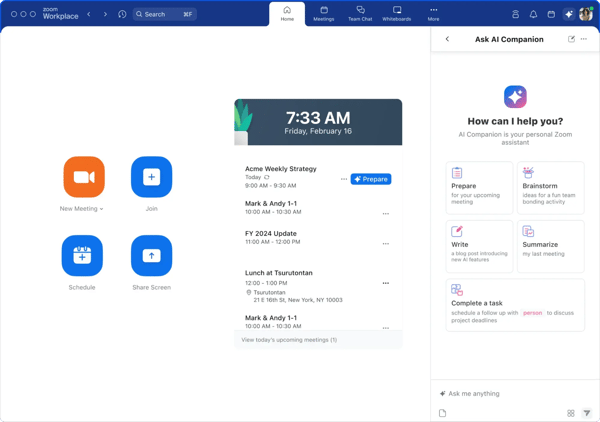
That said, users on G2 have flagged a few areas for improvement. Time zone management, for instance, has occasionally left me confused, particularly when scheduling meetings across multiple regions.
Some reviewers pointed out that time zone adjustments don’t always sync perfectly, making it essential to double-check event times when coordinating internationally.
In terms of notifications, I found out that Zoom Calendar provides functional reminders, but its customization options are somewhat limited. If you rely heavily on tailored alert schedules, more flexibility in setting reminders would help further optimize time management.
What I like about Zoom Workplace:
- The integration with Google Calendar and Outlook was smooth. I could easily sync events across platforms, eliminating the hassle of managing multiple calendars.
- Payment integration for webinars and paid events was simple. I was able to handle transactions directly within the app, which saved time.
What G2 users like about Zoom Workplace:
“It makes communication and collaboration simple through high- quality video meetings, chat, screen sharing, and file sharing in one platform.”
– Zoom Workplace review, Niteesh H.
What I dislike about Zoom Workplace:
- Although it was easy to schedule appointments, I encountered some issues with time zone syncing, which sometimes caused scheduling issues.
- The limited notification customization didn’t allow me to tailor alerts to my preferences. As a result, I often missed important reminders or received unnecessary notifications.
What G2 users dislike about Zoom Workplace:
“Sometimes, it is lagging but it is very rare. The main problem would be that the free version of Zoom can only hold up to 40-minute meetings.”
– Zoom Workplace review, Rejee T.
4. ClickUp: Best for calendar-integrated project scheduling
ClickUp changed how I think about calendar management. Instead of treating scheduling as a separate task, it brings calendars directly into my project workflow, so deadlines, tasks, and team availability stay connected in one place.
What I liked most was the Calendar view. It gave me a clear weekly look at my tasks and deadlines without having to open a separate calendar app. I could also switch between Calendar, List, and Board views without re-entering any data, which made it easier to manage projects from different angles.
I also appreciated how team-friendly the setup felt. I could stay in Calendar view while others worked from List or Board view, and we were still aligned on the same tasks, due dates, and priorities. Adding tasks to someone else’s calendar also felt simple, which made team scheduling smoother.
The Google Calendar integration was another helpful addition. Pulling meetings and events into ClickUp reduced the need to bounce between apps and made my schedule feel easier to manage throughout the day.
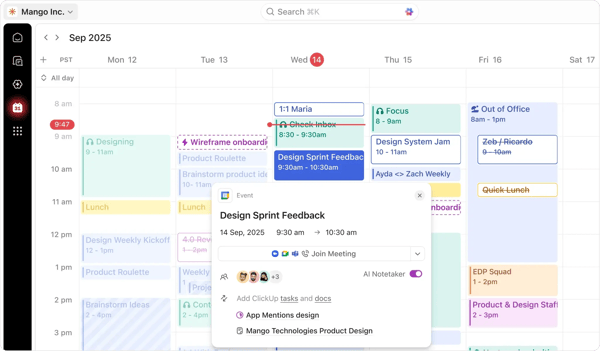
That said, I noticed, along with several G2 reviewers, that the Calendar view could be more refined. Agenda items can sometimes get cut off, and finding assigned tasks by project or client may take a few extra clicks.
I also found that Google Calendar syncing, while useful, may need occasional attention. Some G2 reviewers mention that availability does not always update instantly during busier schedules, so teams may need to double-check synced events when timing is critical.
What I like about ClickUp:
- The Calendar view gave me a clean weekly overview of tasks and deadlines without leaving the platform. It quickly became my default way to plan the day.
- Switching between Calendar, List, and Board views made project scheduling more flexible. My team could work in the format they preferred while staying connected to the same tasks and due dates.
What G2 users like about ClickUp:
“All my professional, and sometimes personal, tasks are noted here in the calendar. The timeframes in which I’m supposed to work and complete tasks are easy to navigate and follow. Keeping a record and tracking performance is also straightforward. Adding work to another employee’s calendar is similar to adding it to my own, so it feels familiar and easy to do.”
– ClickUp review, Ritika S.
What I dislike about ClickUp:
- Although the Calendar view is useful, I found that agenda items could be easier to read. A clearer display for assigned tasks by project or client would make planning smoother.
- While the Google Calendar integration helped centralize my schedule, syncing could be more consistent. Real-time availability updates would make the experience more reliable during busy periods.
What G2 users dislike about ClickUp:
“I think the interface, especially for people who are beginners, could be more lenient and easier to understand because it’s a bit clustered. It took me a week to fully understand how to use ClickUp. A friendlier, easier interface would be helpful.”
– ClickUp review, Lilitha S.
5. Calendly: Best for frictionless client scheduling
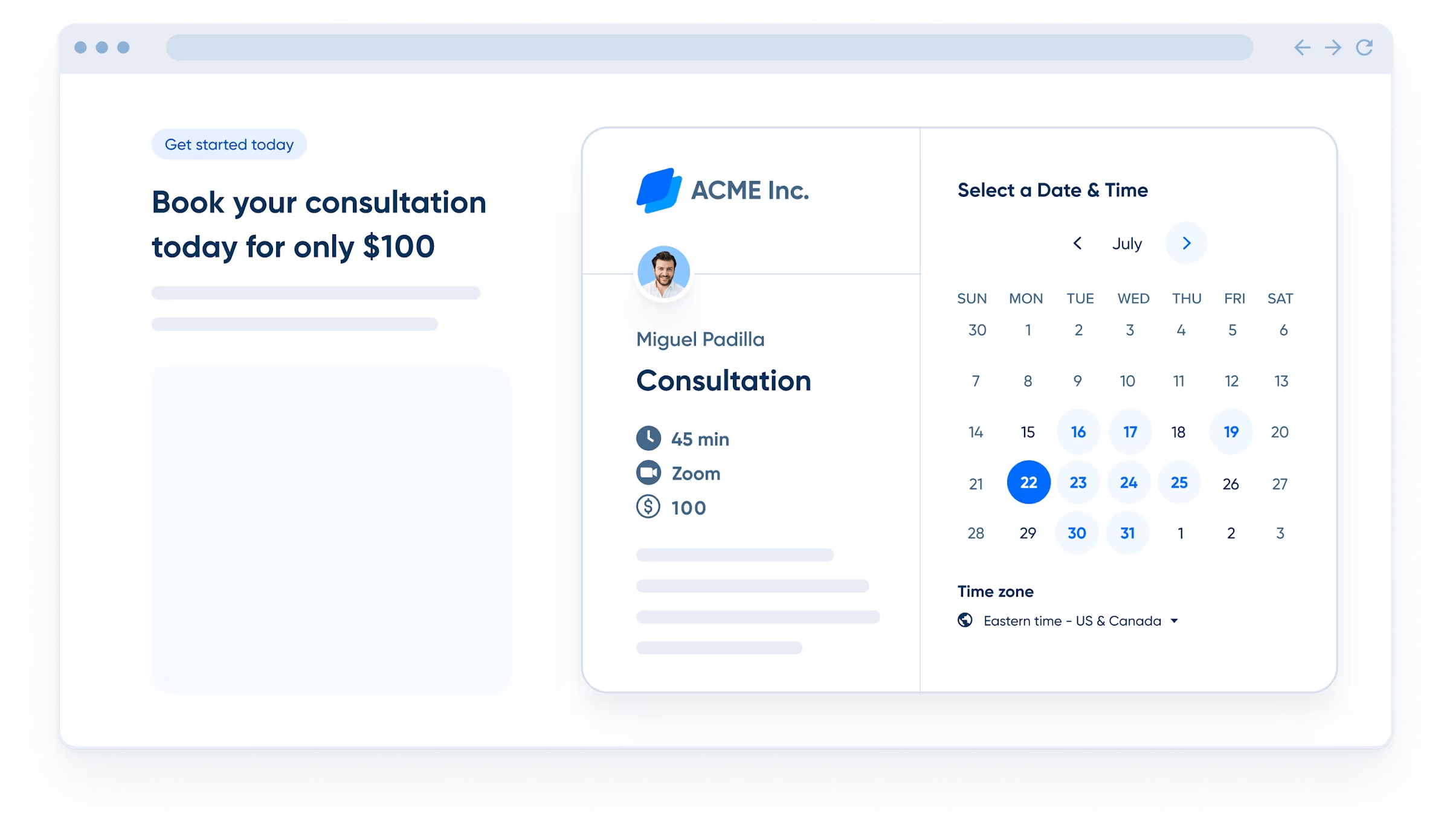
Calendly has been a total game-changer for me. It eliminates the back-and-forth emails I used to deal with when scheduling meetings. By sharing my scheduling link, others can pick a time that suits them based on my availability.
The automatic blocking of unavailable times and syncing with my Google Calendar ensures no double-booking or missed appointments. It has also saved me a lot of time coordinating schedules.
I also really like the ability to customize my booking page. I can add personalized questions, various meeting types, and time slots, which gives it a more tailored feel for my clients.
Integrating payments via Stripe or PayPal has also been especially useful. It allows me to collect payments upfront before confirming sales, streamlining the entire process for my clients.
 Source: Calendly
Still, other G2 reviewers and I have noted some limitations. For instance, Calendly doesn’t offer a native video conferencing solution. Although the platform integrates smoothly with Zoom and other tools, the dependence on third-party services can sometimes add unnecessary steps to the setup.
Additionally, more advanced features, such as integrations with Salesforce, Zapier, and other advanced automation options, are only available through premium plans.
As several G2 users point out, this pricing model may pose challenges for smaller teams or solo professionals who need those capabilities but have tighter budgets.
I also noticed client notification was mentioned in G2 reviews. While I can set calendar-based reminders for myself, the lack of an in-platform feature to send automatic reminders to clients means I sometimes have to follow up manually. Adding this capability would enhance the reliability of the meeting experience for both sides.
What I like about Calendly Sales:
- It eliminated back-and-forth emails by letting others pick a meeting time based on my availability. This feature made scheduling more efficient and reduced the hassle of coordinating with multiple people.
- Syncing with Google Calendar helped block unavailable times, preventing double-booking. It ensured that my calendar was always up-to-date, saving me from scheduling conflicts.
What G2 users like about Calendly Sales:
“Calendly is super easy to use. The interface feels very intuitive, and it’s always easy to find what I’m looking for. The integrations work great, performance has been solid, and the pricing seems okay for what it offers.”
– Calendly review, Holly R.
What I dislike about Calendly Sales:
- Although Calendly offers video conferencing abilities, I missed having a native video conferencing feature, which relies on third-party tools like Zoom. It made the experience less seamless.
- Some advanced features, like integrations with Salesforce or Zapier, were only available on expensive premium plans, which I can’t access unless I upgrade.
What G2 users dislike about Calendly Sales:
“One thing I’ve noticed is that calendar syncing can sometimes take a bit of time to update availability correctly. It doesn’t happen all the time, but during busier schedules I’ve run into a few cases where the timing didn’t reflect properly and I had to manually adjust it afterward.
Some of the routing and availability settings also felt a little confusing at first, especially when I was managing multiple meeting types at the same time. Basic scheduling is straightforward, but the more advanced setup definitely takes some trial and error to get right.”
– Calendly review, Kaleem A.
6. Reclaim.ai: Best for AI-driven time management
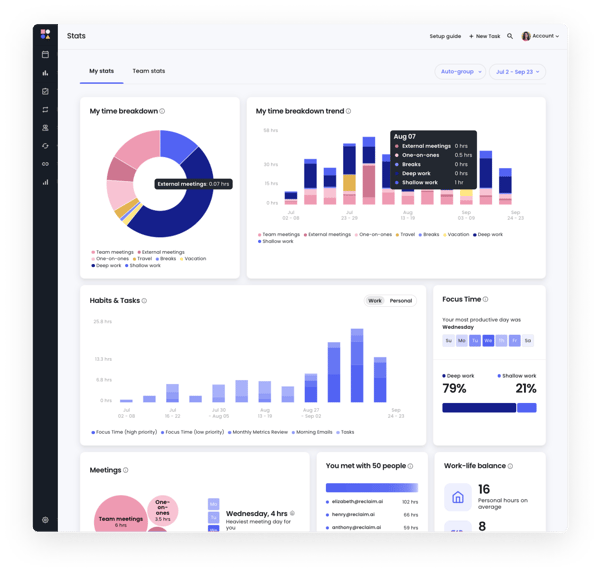
Reclaim.ai has been a game-changer for my time management. The AI-driven scheduling automatically analyzes my work habits and task priorities, allowing me to focus more on my work rather than constantly managing my calendar. For instance, if a meeting is canceled or rescheduled, Reclaim adjusts my calendar in real-time, ensuring that nothing gets overlooked and that my schedule remains optimized.
One of my favorite features is the advanced time-blocking. It recommends the best times for meetings and tasks and helps prioritize deep work by adjusting if meetings run late. This has allowed me to consistently find focus time, even during busy days, without the stress of manually adjusting my schedule.
 Source: Reclaim.ai
That said, I made out, similar to several G2 reviewers, that there’s a learning curve when getting into the more advanced features. I found the customization of AI behavior and task prioritization settings a bit technical, especially for those used to more minimalistic tools.
Also, while the platform integrates smoothly with Google Calendar and Outlook, I struggled to integrate it with other calendar services, as it appeared to be constricting.
Despite these nuances, I widely agree that once you’re set up, Reclaim.ai offers powerful automation that minimizes context-switching and boosts focus in ways traditional calendars simply can’t.
What I like about Reclaim.ai:
- AI scheduling optimized my calendar in real time. It automatically adjusted for any overlapping meetings, allowing me to avoid scheduling errors.
- The advanced time-blocking feature helped me prioritize deep work and focus time. By allocating dedicated blocks for important tasks, I maintained productivity without interruptions.
What G2 users like about Reclaim.ai:
“Reclaim.ai keeps my calendar organized without requiring constant manual planning. I can add tasks, set priorities, and the platform automatically finds the best time for them around my meetings. It has made managing work and personal schedules much easier and helps me stay on track.”
– Reclaim.ai review, Muzammil M.
What I dislike about Reclaim.ai:
- While the platform offers robust advanced features, I found them challenging to learn. The complexity of options requires users to engage in a learning curve.
- I noticed limited integration with calendars outside of Google and Outlook, which was restrictive. This lack of compatibility made syncing my schedule across different platforms challenging.
What G2 users dislike about Reclaim.ai:
“I don’t like that there’s no app or actual calendar that I can use on my Android phone. I’d like to have an app that has all my calendars in one space so I don’t have to switch between each one. It would also be nice if it could integrate with chat apps, as I have daily tasks I like to copy over when needed.”
– Reclaim.ai review, Isai M.
7. Zoho Mail: Best for lightweight productivity on a budget
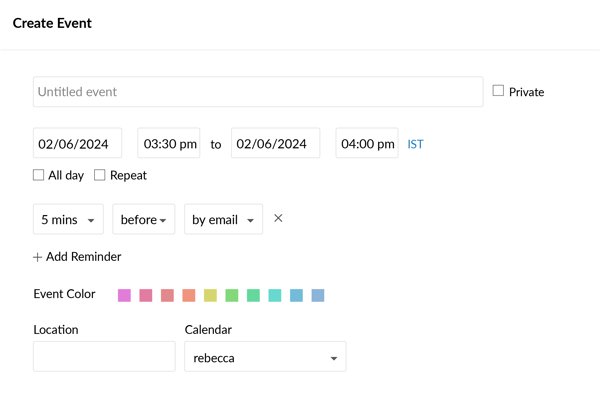
Initially, I hesitated to use Zoho Mail Calendar because I assumed it might be overly complex, given its deep integration with Zoho CRM and its reputation for robust business tools.
I expected the calendar to be tailored more for advanced CRM functionalities, potentially making it cumbersome for everyday use. However, I was pleasantly surprised by how intuitive and user-friendly it was. One of Zoho Mail Calendar’s biggest advantages is how seamlessly it connects with other apps in the Zoho suite. If you’re already using Zoho products, the calendar naturally complements these tools, keeping everything in sync without switching between platforms.
 Source: Zoho Mail
Collaboration features also earn high praise among G2 users. I particularly liked features like creating shared calendars, inviting multiple team members, and easily syncing departmental schedules, which are frequently mentioned as significant productivity boosts.
As reflected in my analysis and G2 feedback, these collaboration tools make Zoho Mail Calendar a practical choice for teams needing to coordinate across projects and time zones.
However, not all aspects are on par with newer competitors. While Zoho Mail calendar is reliable and feature-rich, its interface felt somewhat outdated to me, compared to the alternatives like Google Calendar and Outlook.
G2 reviewers agree that the navigation between daily, weekly, and monthly views could have been smoother, and the visual design lacks the polish that some users expect from modern calendar tools.
What I like about Zoho Mail:
- It seamlessly integrates with other Zoho apps, enhancing overall functionality. This integration allowed me to manage tasks, emails, and meetings in one cohesive ecosystem, boosting productivity.
- The team collaboration features, like shared calendars, were excellent for coordination. It made it easy to align schedules and keep everyone on the same page, reducing the risk of miscommunication.
What G2 users like about Zoho Mail:
“I liked that it let me get started right away with a free plan, while others charged even for their lowest tier. That made it easy to see how everything works and to realise how useful it is. The ui is a bit complex to understand at first as there are many features available. I’m not sure if all these features would be useful to me.”
– Zoho Mail review, Janani A.
What I dislike about Zoho Mail:
- I noticed that the interface felt a bit clunky, and the design lacked the modern, intuitive feel that would have made scheduling faster and more enjoyable.
- Switching between views wasn’t smooth. The lag between transitions disrupted my workflow and made it harder to manage my calendar effectively.
What G2 users dislike about Zoho Mail:
“One thing I dislike about Zoho Mail is that some advanced features and integrations are limited to higher-priced plans. The interface can also feel slightly less intuitive compared to Gmail, especially for new users managing multiple settings and admin controls.”
– Zoho Mail review, Ramdeep S.
Related: Explore top team collaboration tools and streamline communication, project management, and workflow all in one place.
8. Acuity Scheduling: Best for small business appointment booking
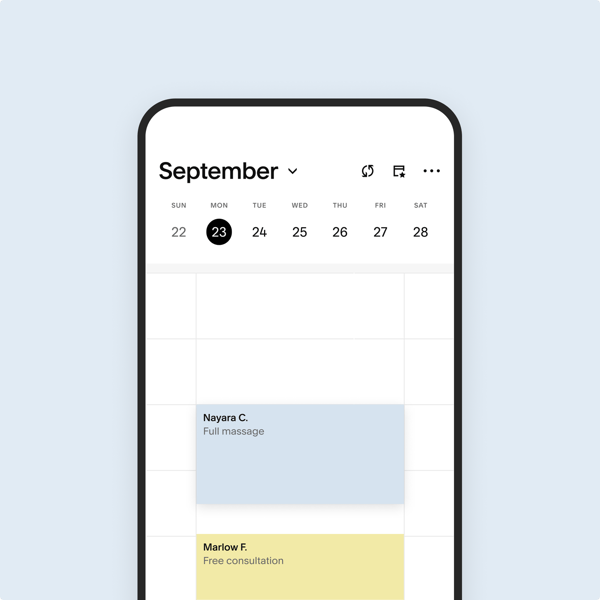
When I used the calendar feature in Acuity Scheduling, I was impressed by its highly customizable booking pages. The ability to fully tailor the design to match my brand made the whole scheduling process feel cohesive and professional, which was a pleasant surprise.
I also felt that the detailed client profiles were a great feature. Storing contact details, appointment history, and custom fields for specific data like client preferences or special requests made it easy to personalize interactions and build stronger relationships.
 Source: Acuity Scheduling
The integration with payment gateways like Stripe and PayPal was incredibly convenient. It simplified the payment process by allowing clients to pay when booking, which not only made scheduling more efficient but also helped manage cash flow smoothly.
However, I noticed, just like other G2 reviewers, that Acuity Scheduling comes with a learning curve. The platform offers a wealth of features, from custom intake forms to workflow automation, but setting them up takes time.
I also experienced some trial and error before getting comfortable with its more advanced settings. Still, once you’re familiar with the interface, it becomes a powerful tool for running a client-centric business.
What I like about Acuity Scheduling:
- Customizable booking pages offered a professional, branded scheduling experience. This feature allowed me to create a consistent, polished look aligned with my brand.
- Client profiles helped foster personalized interactions. By storing important details and preferences, I could tailor my communications and meetings to meet each client’s needs better.
What G2 users like about Acuity Scheduling:
“I use Acuity Scheduling for scheduling health coaching appointments, and I find it very customizable and user-friendly for both my team and clients. The ability to customize our schedules, adjust appointment times, and send automated emails to clients is great because it allows a more automated process with communication between clients and requires less manual upkeep to manage appointments. We have many team members who use the platform, making it easier for everyone to manage their availability and appointments effectively. Although the initial setup was time-consuming, it was very intuitive. I like most everything about it.”
– Acuity Scheduling review, Abigail L.
What I dislike about Acuity Scheduling:
- Although the platform’s calendar feature is great, it has a bit of a learning curve, especially when exploring advanced features.
- I also noticed that setting up features like intake forms and workflows took time and trial and error to perfect. While powerful, these features lacked a bit of intuitiveness.
What G2 users dislike about Acuity Scheduling:
“I found the integration with Squarespace restrictive, and the scheduler options were confusing initially, then limited as I became familiar with the service. This, together with the high cost of the additional suvbscription led me to switch to another provider.”
– Acuity Scheduling review, Mark B.
9. Apollo.io: Best for customizable sales meeting workflows
Having been familiar with Apollo.io‘s reputation for sales engagement and prospecting, I was curious to see how its calendar feature would perform.
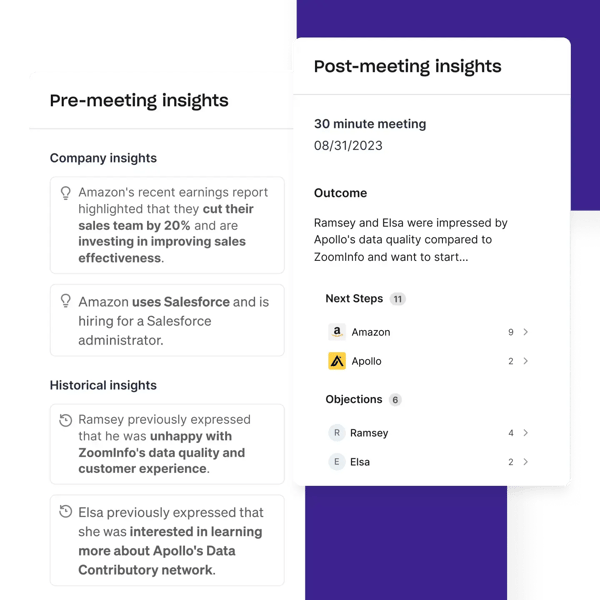
One standout aspect was the ability to design meeting templates with fields like objectives and key discussion points. This feature significantly streamlined the meeting process by ensuring each meeting had a strong agenda.
 Source: Apolli.io
The smooth integration with CRM platforms also allowed for quick access to prospect data. Pulling prospect information directly into the calendar removed the need to toggle between multiple platforms, allowing for faster decision-making and a more organized workflow. This was particularly valuable when handling a high volume of prospects and meetings, as it allowed me to manage them with ease and precision.
That said, some limitations have been flagged in my experience and the G2 community. While the meeting templates are helpful, customization options within the calendar itself remain pretty basic.
G2 feedback often points out the lack of flexibility in setting up specialized rules for different meeting types or applying detailed parameters for recurring events. I also felt that these features could make workflows even more tailored.
Moreover, while Apollo.io excels in sales-related meetings, G2 user data highlights the lack of standard calendar features like event categorization or task management platform integrations, making it less versatile for balancing professional and personal schedules.
What I like about Apollo.io:
- The customizable meeting templates with objectives and discussion points made scheduling more organized. It helped ensure that every meeting had a clear agenda, which improved preparation and focus.
- CRM integration worked smoothly, improving scheduling efficiency. It allowed me to schedule meetings directly from the CRM, saving time and reducing the need to switch between apps.
What G2 users like about Apollo.io:
“What I like best about Apollo is its combination of accurate contact data, advanced prospecting filters, and outreach capabilities in a single platform. It helps me quickly identify the right decision-makers, build highly targeted lists, and engage prospects efficiently, which significantly reduces prospecting time and increases meeting bookings.”
– Apollo.io review, Satya R.
What I dislike about Apollo.io:
- I found limited customization options for recurring events and meeting types. This made it harder to tailor my calendar to my specific needs and resulted in manual adjustments.
- Although it helped with time management, it lacked a bit in event categorization and task management, which would have been helpful.
What G2 users dislike about Apollo.io:
“The meeting scheduling tool feels clunky and could be improved with a more intuitive interface, better automation, and fewer manual steps.”
– Apollo.io review, Verified User in Information Technology and Services
Best calendar apps: Frequently asked questions (FAQs)
Q1. What is the top calendar app for personal use?
Google Calendar is a leading option for personal scheduling. It is user-friendly, syncs seamlessly across devices, and integrates effectively with other Google services. Users can sync personal and work calendars to view everything in one place, with the option to adjust privacy settings to keep personal events private.
Q2. Which is the best-shared calendar app?
The Teamup Calendar is an excellent choice for team projects or shared deadlines. It allows multiple users to manage and view events with customizable permissions, making collaboration smooth and efficient.
Q3. Are there free calendar options available?
Google Calendar is a popular free option that offers essential features like cross-device syncing, easy event creation, and reminders. Another great free choice is Outlook Calendar, which integrates seamlessly with Microsoft apps.
Q4. Is Google Calendar better than Apple?
Google Calendar is often preferred for its superior cross-platform compatibility, especially for users with various devices. While iCal (Apple Calendar) is excellent for Mac and iPhone users, it tends to feel more restrictive outside the Apple ecosystem.
Q5. What calendar apps support payment integrations for booking appointments?
Calendly is a top choice for appointment scheduling with payment integration. It connects effortlessly with Stripe and PayPal, simplifying paid bookings. Acuity Scheduling is another great option, supporting payments via Square, PayPal, and Stripe.
Don’t worry, I time everything perfectly!
In my experience, the best calendar app depends on your unique needs and how it fits into your workflow.
A calendar that syncs effortlessly across devices and works well with other services is key for those looking for simplicity and seamless integration. If you need more advanced features, such as natural language input or enhanced task management, it’s worth considering apps with those specific capabilities.
Ultimately, the right calendar app should help you stay organized, manage your time effectively, and integrate smoothly into your daily routine.
I’ve found that collaboration tools help you stay organized and productive, no matter the project. Explore the best tool now!
[ad_2]
Source_link