Reading Time: 16 minutes
Here is a scenario most marketers have lived: a campaign goes out to 50,000 people. The audience logic made sense when you built it. But that was three weeks ago, and by the time the campaign landed, a meaningful chunk of that list had already converted on their own, gone quiet, or moved somewhere else in their journey entirely.
This is a legacy system’s segmentation issue. And it is one that static, rules-based audience building tends to make worse over time, because the rules do not update when behavior does.
AI customer segmentation is built to solve this problem. Not just to make audience building faster, though it does that too. The more significant advantage is that segments can reflect what customers are actually doing right now, catch patterns that manual filters miss, and connect more directly to the outcomes marketers are trying to drive.
This guide covers what AI customer segmentation is, how it works, where it has the most impact across different industries, and how platforms like MoEngage make it practical to use at scale.
What Is AI Customer Segmentation?
AI customer segmentation is the process of using machine learning and behavioral data to group customers based on shared patterns, predicted actions, and real-time signals, rather than only fixed demographic rules or manually defined filters.
Traditional segmentation is useful for well-understood, stable audiences. You know you want to reach women aged 25 to 34 who purchased in the last 60 days, so you build that filter. The problem is that this approach assumes the past is a reliable guide to the present, and often it’s not. A customer who fit that profile last month might be churning now, or may have just converted. A segment you defined in Q3 might be missing your highest-intent users in Q4.
AI-based segmentation works differently. Instead of starting with a filter, you start with a behavior pattern or a campaign outcome, and machine learning identifies the customers who fit that profile. It can surface audiences you would not have thought to build, catch disengagement signals before they escalate, and update audiences as customer behavior shifts. For teams running campaigns across fast-moving customer journeys, that difference is critical to reaching the correct audience with the most relevant message.
How Does AI-Based Customer Segmentation Work?
AI customer segmentation analyzes customer data, recognizes patterns, and helps marketers create or refine audiences based on what those patterns reveal. In practice, the workflow moves through a few key steps.
- Customer data comes in from multiple sources. App behavior, purchase history, email engagement, web activity, loyalty signals. The broader and more current the data, the more useful the resulting segments.
- Machine learning analyzes for patterns. Rather than looking for what you defined, it looks for clusters, affinities, risk signals, and behavior trends you might not have seen. Customer segmentation with machine learning is particularly strong here because it can process far more variables across far more users than any manual process.
- Useful segments are identified, recommended, or refined. High-intent purchasers. Churn-risk subscribers. Discount-responsive users. Price-sensitive shoppers with rising shopping cart value. The output depends on what signals you feed in and what outcomes you are optimizing for.
- Segments evolve as behavior changes. This is one of the most important advantages of AI-powered customer segmentation. Audiences do not stay frozen until someone manually updates a filter. A customer who moves from at-risk to re-engaged gets reclassified automatically.
- Marketers activate campaigns against those segments. Segments only create value when they connect to execution. The best platforms close the loop between audience discovery and campaign launch without requiring you to export data or switch tools.
One thing worth being clear about: AI in customer segmentation does not replace strategic thinking. It makes it faster to act on data you already have, surface opportunities you might have missed, and respond when behavior shifts.
5 Benefits of Using AI for Customer Segmentation
1. More Precise Targeting Based on Real Behavior
Geographic and demographic filters still have a place. But they do not tell you much about current intent. AI customer segmentation adds the layer that tends to drive campaign performance: what is this customer doing right now, and what are they likely to do next?
Instead of one campaign to everyone who bought in the last 90 days, you can identify who is likely to buy again, who needs a stronger incentive to convert, and who you should actually leave alone for a week. Those are three different campaigns with three different expected outcomes.
2. Faster Audience Discovery at Scale
Manual segmentation does not scale well. As data volumes grow and customer journeys get more complex, building accurate audiences by hand takes longer and leaves more room for error. Lean teams feel this most acutely.
AI for marketing customer segmentation speeds up discovery. It can surface relevant audiences faster, reduce the manual filtering required, and make it easier to find high-value segments that are not obvious from rules alone. The time saved in audience building is time available for testing and campaign improvement.
3. More Dynamic Segments That Stay Relevant
A customer who was highly engaged last week may be showing early disengagement signals now. Someone who looked low-intent a few days ago may suddenly be demonstrating clear purchase behavior. Static rules do not catch that kind of movement.
AI-powered customer segmentation produces audiences that update based on new signals, which means your campaigns are working against a more accurate picture of who your customers are right now, not who they were when someone last rebuilt the segment.
4. Better Personalization Across the Customer Journey
The quality of your personalization is limited by the quality of your segmentation. If the underlying audience logic is too broad, the messages built on it will be too. Sending a single offer to a mixed audience is not personalization, it is volume.
AI and customer segmentation together support more granular, behavior-driven targeting: more relevant content paths for different groups, better message sequencing based on lifecycle stage, and a higher chance that a personalized message actually feels personal to the person receiving it.
5. Stronger Campaign Efficiency and Performance
Better segmentation tends to produce better results. More relevant audiences can mean higher engagement, less wasted spend, and more efficient use of channel budget and creative resources.
The business case for AI-based customer segmentation is ultimately about prioritization. Not every audience deserves the same investment. AI helps marketing teams identify which segments are most likely to drive revenue, retention, or long-term value, and focus effort there.
Real-Life Segmentation Examples Across Industries
Understanding the value of AI customer segmentation is the easy part. The harder question is what it looks like in practice, and which capabilities matter when you are trying to apply it across real campaigns with real constraints.
The examples below show how different industries apply AI-driven customer segmentation to solve different problems, from onboarding and retention to upsell, visit frequency, and churn prevention. The common thread is not the channel or the offer. It is the ability to identify the right audience faster and act on behavior more precisely.
1. BFSI: Onboarding Segmentation by Intent, Not Timeline
In banking and financial services, segmentation has to balance relevance with trust. One strong use case for AI customer segmentation in banking is onboarding new customers based on real-time behavioral signals rather than placing everyone into the same fixed nurture sequence.
AI customer segmentation in banking can identify which users are ready for a cross-sell conversation, which need more product education before they will take action, and which are showing early lapse signals that call for a different kind of outreach altogether. A new customer who views premium product information twice in their first week is not the same as someone who has not logged in since sign-up. They should not receive the same message.
Trust Bank put this into practice using MoEngage’s Predictive Segments to identify users who were soon to become dormant, achieving 91.8% prediction accuracy. That kind of precision lets teams intervene at the right moment rather than after the window has already closed.
2. Ecommerce and Retail: Increasing Average Order Value with Smarter Segmentation
In ecommerce, one of the clearest uses of AI-driven customer segmentation is identifying customers who are most likely to increase basket size, respond to bundle offers, or convert on cross-sell recommendations.
Rather than treating all recent shoppers the same, marketers can group customers by product affinity, price sensitivity, browsing depth, repeat purchase patterns, and engagement with past promotions. A customer who browses premium products for fifteen minutes and exits is not the same audience as one who adds items at a lower price tier and converts quickly. They should receive different offers.
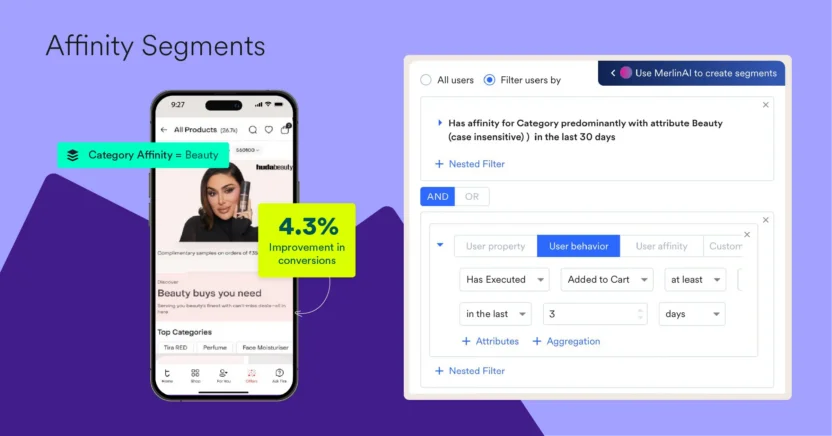
Tira, one of India’s leading tech-first luxury beauty retailer, used MoEngage’s Affinity Segments to filter for customers with a strong affinity for the Beauty category who had also added to cart in the last three days. The result was a 4.3% improvement in conversions, without changing the offer, just the audience.
3. QSR and Restaurant: Driving Repeat Visits with Timing-Based Segmentation
For quick-service restaurant brands, AI customer segmentation is less about broad demographics and more about timing, frequency, and habit. The question is not who eats out. It is who is likely to visit in the next 72 hours and what message, if any, would move that forward.
AI can segment loyalty members by visit cadence, preferred menu items, time-of-day patterns, and lapse risk. A customer who visits twice a week and has not been in for 12 days is a different audience than someone who visits monthly and is right on schedule. Sending them the same promotional push is not particularly efficient for either one.
The ability to separate customers who need a prompt to return, customers who are already likely to visit without any outreach, and customers who will respond to a specific type of offer or timing window. That distinction reduces over-discounting and improves efficiency across the loyalty program.
Domino’s put this into practice at scale. Using MoEngage, their “Cheesy Rewards” loyalty program sends nudges like “You’re X points away from a free pizza” through over six automated journeys, each triggered by where a customer actually is in their engagement cycle rather than on a fixed calendar. The loyalty program ended up generating more than 20% more revenue and orders than the rest of their database. Read the full story here.
4. Media and Entertainment: Reducing Churn Through Content Affinity Modeling
In media and entertainment, AI-powered customer segmentation is particularly useful for understanding which subscribers are genuinely engaged and which are passively drifting toward cancellation.
A streaming or content brand might use AI to group users by genre preference, session frequency, binge behavior, and early disengagement signals. The broad labels of active versus inactive miss too much nuance. A subscriber who finished a full series and then went quiet for three weeks is a very different retention case than someone whose session length has been declining consistently for two months.
Affinity modeling surfaces meaningful subgroups based on what people watch, how often they return, and which behaviors tend to precede cancellation. That gives retention campaigns a real audience to work with rather than a catch-all inactive bucket.
SoundCloud took a different approach to the same challenge. Rather than relying on manual audience builds, they used MoEngage’s Warehouse Segments to activate their data warehouse directly and build audiences without manual effort, eliminating the need for a separate reverse ETL tool entirely. The result was faster, more timely segmentation with less operational overhead, and additional use cases they could not support before.
5. Casino and Hospitality: Real-Time Segmentation for High-Stakes Guest Moments
In casino and hospitality, the cost of a mistimed or irrelevant message is felt immediately. A guest who just upgraded their loyalty tier expects to hear about it now, not in the next batch send. A VIP who has not visited in three weeks is a different conversation than one who visits every weekend. The segmentation has to reflect that.
AI can separate high-value guests from casual visitors, identify lapse risk before it becomes churn, and differentiate promotional treatment based on what actually motivates each profile. The goal is to apply the right intensity of outreach to each guest, not the same playbook to everyone.
Foxwoods Resort Casino, one of the largest resort destinations in North America, used MoEngage to move away from broad mass emails toward smaller, more targeted campaigns built around real-time guest behavior. By consolidating email, SMS, and push onto a single platform, their team got a unified view of each guest for the first time, which meant communication across channels could finally be coordinated rather than managed in pieces. Email open rates increased by 5 percentage points within the first few months, and the team shifted time previously spent on manual campaign execution toward strategy.
Best AI Customer Segmentation Tools for Marketers
The best platforms do more than help you organize audiences. They help you discover segments faster, sharpen them with predictive and behavioral data, and connect them to campaign execution without turning segmentation into a separate analytics exercise.
Here is what to look for when evaluating AI Customer Segmentation tools:
- Natural language segment discovery. Marketers should be able to describe the audience they want in plain language, not construct it through nested filter logic.
- Predictive and behavior-based segmentation. The platform should support segments built from real-time behavior, historical activity, and forward-looking signals like churn likelihood or conversion probability.
- Dynamic audience refresh. Segments should update as customer behavior changes, not require manual rebuilds every time something shifts.
- Cross-channel activation. It should be easy to move those audiences into push, email, in-app, SMS, and web campaigns without exporting lists between systems.
- Clear audience insights. AI should make segmentation easier to understand and explain, not turn it into a mystery box where the marketer cannot see the logic.
- Fast path from insight to campaign. The best tools reduce the gap between identifying a segment and launching a campaign against it.
Based on these capabilities, below are some AI Customer Segmentation tools for you to check out:
1. MoEngage
Best for: Marketers who want to move from AI customer segmentation to cross-channel execution without stitching together separate tools for audience discovery, campaign orchestration, and personalization.
What it does well: MoEngage is a customer engagement platform where segmentation is the foundation connecting analytics to campaign delivery. That means marketers can build a segment and activate it without exporting data or switching systems. The AI component, Merlin AI, covers segmentation across several distinct capabilities:
- Merlin AI Segment Assist: Marketers can build segments by describing what they are looking for in plain English. A prompt like “customers who started a credit card application in the last 7 days for a premium card type but did not complete it” translates directly into a filter-based segment. Under the hood, Segment Assist uses large language model capabilities combined with Retrieval-Augmented Generation (RAG) to map natural language inputs to the exact event and attribute names in your specific workspace. This is what makes it useful, not just the natural language piece, but the fact that it understands your data model, not a generic one.
- AI-Generated Event and Attribute Descriptions: Merlin AI Event and Attribute Descriptions is a companion feature that adds context and metadata to your events and attributes so Segment Assist can interpret your data more accurately. It matters most in accounts with large or complex event taxonomies where attribute naming is not always intuitive.
- RFM Analysis: MoEngage’s RFM analysis buckets customers into cohorts based on how recently they purchased, how often, and how much they have spent. The resulting groups, Champions, Potential Loyalists, At Risk, and others, give marketers a fast way to identify and act on meaningful customer tiers without building those audiences manually. Segments are actionable directly from the same screen.
- Affinity Segments: Affinity Segments go beyond demographic filters to automatically analyze the interests, preferences, and behavioral tendencies of each customer. Filters like “Predominantly” let you identify users who favor certain product categories, content types, or actions more than others, giving campaigns a more accurate behavioral foundation.
- Profile AI: A data agent that enriches individual user profiles with AI-generated insights: churn likelihood scores, preferred channels and send times, average order value, favorite categories, and similar user profiles. These enrichments feed directly into more precise segmentation downstream.
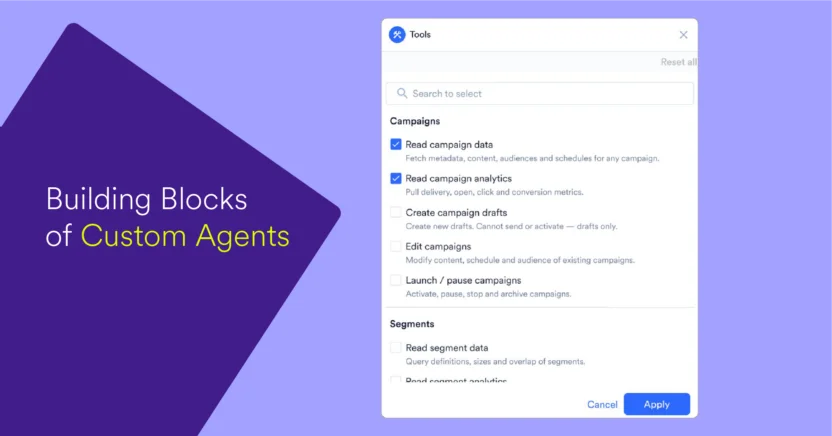
- Merlin AI Custom Agents: Custom Agents let lifecycle and CRM teams build workflow agents that run continuously on top of MoEngage data. You can give an agent segment-specific tools like reading segment data, querying segment sizes, and analyzing overlap, then trigger it on a schedule or manually. Every action the agent takes is logged, so teams can see exactly what data it pulled, what it decided, and what it sent. For segmentation specifically, a useful application is a Campaign QA Agent that checks audience hygiene before a campaign goes out, flagging things like overlapping suppression lists or segments that have drifted from their original intent. Another is a Performance Analyst agent that monitors how different segments are responding over time and surfaces what is working without anyone needing to pull a manual report.
Why it may not be the best choice: Teams looking for a lightweight point solution focused only on audience analytics, rather than a full customer engagement platform, may find MoEngage broader than they need.
2. Klaviyo
Best for: Ecommerce brands running email-heavy programs, particularly on Shopify or similar platforms.
What it does well: Klaviyo’s AI segmentation is built around its email and SMS channels. It supports predictive analytics like next purchase date, churn risk, and expected lifetime value, and makes it relatively straightforward to build segments from those predictions for email flows.
Why it may not be the best choice: If your segmentation needs to carry across mobile push, in-app, and broader journey orchestration, Klaviyo starts to show its limits. It is more of a channel-first tool than a full engagement platform.
3. Optimove
Best for: Retention-focused teams, particularly in gaming, sports betting, and loyalty-heavy verticals.
What it does well: Optimove is built around the idea that segments should not be static. Its focus is on how audiences evolve over time and how to adapt campaigns accordingly. The platform is strong for churn modeling, micro-segmentation, and sequential campaign logic.
Why it may not be the best choice: Teams that need broad orchestration across channels beyond the core retention motion may find it narrower than platforms built to handle the full lifecycle.
4. Bloomreach
Best for: Commerce-oriented teams where personalization is tightly tied to web and product experiences.
What it does well: Bloomreach brings strong recommendation logic and experience personalization to ecommerce. Its segmentation is closely tied to on-site behavior and merchandising decisions, which makes it effective when the core goal is personalizing what customers see on the website vs. reaching them across channels.
Why it may not be the best choice: If segmentation needs to power cross-channel campaigns beyond the web layer, Bloomreach may require more supplementation than a broader engagement platform would.
5. Braze
Best for: Enterprise marketing teams that need real-time cross-channel engagement with strong data infrastructure and technical resources to support it.
What it does well: Braze is a capable platform for teams that need robust behavioral segmentation tied to multi-channel campaign execution. Its Canvas Flow journey builder gives technical teams a lot of flexibility, and its more recent AI additions, including the BrazeAI Operator and Agent Console, reflect a push into agentic workflows.
Why it may not be the best choice: Braze rewards teams with engineering support. Getting the most out of its segmentation and personalization capabilities typically requires Liquid templating knowledge, data schema familiarity, and ongoing technical involvement. For marketing teams that want to move quickly without heavy developer dependency, that can slow things down. Pricing also starts significantly higher than most alternatives.
| Capability | MoEngage | Klaviyo | Optimove | Bloomreach | Braze |
| Natural language segmentation | Yes (Segment Assist) | No | No | No | Yes |
| Predictive segmentation | Yes | Yes | Yes | Limited | Yes |
| Dynamic audience refresh | Yes | Yes | Yes | Yes | Yes |
| Cross-channel activation | Yes (Full Stack) | Email/SMS-focused | Limited | Web-first | Yes |
| RFM analysis | Yes | Yes | Yes | No | Limited |
| No-code setup | Yes | Yes | Partial | Partial | No |
How To Build AI Customer Segments with MoEngage
The real value of AI customer segmentation is not just discovering better audiences. It’s turning those audiences into live campaigns without losing momentum between insight and execution. Here’s how that works in practice using MoEngage:
Step 1: Start with the campaign goal
Before building any segment, define what it needs to accomplish. Are you driving repeat purchases? Reducing early churn? Improving activation for new users? Identifying high-intent customers before a seasonal moment? Starting with the goal shapes what signals matter and keeps segmentation tied to something measurable, rather than just to an interesting audience characteristic.
Step 2: Use Merlin AI Segment Assist to find the audience
Navigate to Segment > Create Segment in the MoEngage dashboard and select “Use Merlin AI to create segments.” Describe the audience in plain language. Segment Assist generates the query automatically, mapping your prompt to the actual event and attribute names in your workspace. From there, you can activate the segment directly or open it in filter view to add nested conditions manually.
Step 3: Refine with predictive and behavioral signals
After the initial audience is identified, layer in additional signals: recency score, frequency behavior, affinity for specific product categories, churn likelihood, or predicted conversion probability. These signals move the segment from a broad audience idea to a campaign-ready audience with sharper relevance.
Step 4: Activate across channels and let segments evolve
Use the segment across journeys and channels. As customer behavior changes, the audience continues to update, keeping campaigns aligned with current signals. For ongoing use cases, a Custom Agent can be configured to monitor segment performance, surface changes over time, or flag audience hygiene issues before they affect campaign results.
MoEngage Merlin AI: Machine Learning for Customer Segmentation
Many platforms help marketers analyze audiences. Fewer make it fast and practical to get from a campaign idea to a usable, campaign-ready segment without depending on a data team or spending an afternoon rebuilding filter logic.
That is the role Merlin AI plays within MoEngage. It connects audience discovery to execution across three core capabilities:
Faster segment discovery
The biggest friction in segmentation for most teams is not knowing what is possible. They stick to simple filters because the platform’s event taxonomy is too complex to navigate, or they wait for a data team to build more sophisticated audiences.
MoEngage’s Segment Assist removes that friction. Marketers can describe what they are looking for in plain English and get a filter-based segment back immediately. The RAG architecture means Segment Assist understands your specific workspace’s data model, not a generic interpretation of the prompt. Two companies can use the same platform and name their events completely differently. Segment Assist adapts to your taxonomy, not the other way around.
Stronger predictive targeting
Static segmentation tells you what customers have done. RFM analysis goes a step further by organizing that behavior into meaningful cohorts, so you can see at a glance who your best customers are, who is slipping, and who needs a different kind of attention. Predictive Segments layer on top of that with forward-looking signals like churn likelihood and conversion propensity, helping marketers act on where a customer is headed, not just where they have been.
Combined with Profile AI’s individual-level enrichments, marketers can build segments that reflect not just past behavior but current trajectory.
This is particularly useful for campaigns where timing is everything. A travel brand needs to know the moment a customer’s flight changes so they can get updated gate information before they’re already at the wrong terminal. A media app wants to reach fans with a live score update while the game is still being played, not an hour later. A pharmacy needs to notify a patient the moment their prescription is ready, not on a batch send schedule that goes out at 9am regardless of when the order was filled. In each case, the segment and the signal already exist. The question is whether your platform can act on them fast enough to matter.
Better activation across the lifecycle
AI customer segmentation only creates value when it connects to execution. Because Merlin AI sits within MoEngage’s campaign and journey infrastructure, marketers can move from a segment to a live campaign on the same platform.
Custom Agents extend this further by making segments part of an ongoing workflow rather than a one-time build. A Campaign QA Agent, for example, can be configured to check the target segment of a scheduled campaign before it goes out, flagging list hygiene issues, overlapping audiences, or segments that have drifted in size. A Performance Analyst Agent can track how key segments are responding over time and surface what is changing, so the marketing team is not the last to know when something shifts.
That closes the loop between audience intelligence and campaign performance in a way that most teams currently manage manually.
Stop Leaving the Right Audience on the Table
Most marketing teams are not starting from zero. The signals are there. The behavioral data is there. The customers who are about to churn, the ones who are ready to buy again, the ones who would respond to a completely different message than the one you sent last week. They are all in your platform right now.
The question is how fast you can find them and do something about it before the moment passes.
That is what AI segmentation is built for. The platforms that do it best are the ones where finding the right audience and launching a campaign against it happen in the same place, not two tools and an export file apart.
If you want to see how MoEngage and Merlin AI work in practice, book a demo.
AI Customer Segmentation: Frequently Asked Questions
What is the difference between traditional and AI customer segmentation?
Traditional segmentation uses fixed rules based on demographic or historical data. For example, customers aged 25–34 who purchased in the last 60 days. AI customer segmentation goes further by analyzing behavioral patterns, real-time signals, and predictive indicators to identify audiences based on current intent and likely next actions. The key difference is that AI segments update dynamically as customer behavior changes, rather than staying frozen until someone manually rebuilds them.
What data does AI customer segmentation use?
AI customer segmentation typically draws on behavioral data (app activity, website visits, content engagement), transactional data (purchase history, cart behavior, order value), and engagement signals (email opens, push notification responses, loyalty activity). The broader and more current the data, the more useful the resulting segments.
How does AI customer segmentation improve personalization?
Better segmentation produces better personalization. When audience logic is built on real-time behavior and predictive signals rather than broad demographic filters, the messages built on that logic are more relevant to the people receiving them. AI customer segmentation enables more granular targeting: different content paths, offers, and timing for different audience groups, rather than a single message sent to a broad list.
What industries benefit most from AI customer segmentation?
Any industry with high customer data volume and fast-moving behavior benefits from AI customer segmentation. BFSI, ecommerce, QSR, media and entertainment, and gaming are among the strongest use cases, largely because customer intent shifts quickly in these verticals and the cost of a mistimed or irrelevant message is measurable. That said, the underlying capability, identifying the right audience faster and responding to behavioral shifts, is applicable across most B2C verticals.
Can small or lean marketing teams use AI customer segmentation?
Yes, and in some ways lean teams benefit more. Manual segmentation at scale is time-intensive, and lean teams often have the least capacity for it. Platforms like MoEngage with natural language segment discovery (Merlin AI Segment Assist) let marketers build and activate complex audience logic without requiring a data analyst or lengthy filter construction. Faster discovery means faster execution, which matters more when headcount is limited.
The post AI Customer Segmentation: Benefits, Uses, and Examples appeared first on MoEngage.