Artificial intelligence has transformed from a simple research object into an effective tool for businesses. Enterprises of all types and sizes are implementing AI across their operations, customer communication, fundraising on the web, logistics, and decision-making. The rising computing capacity, cloud infrastructure, and data access have made Enterprise AI one of the main drivers of digital transformation.
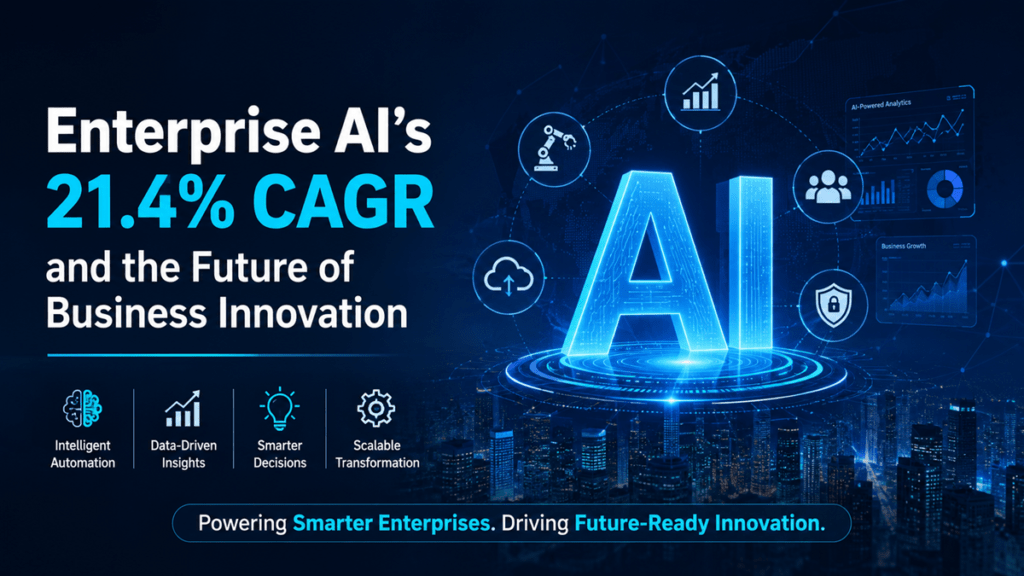
According to Data Intelo, the global Enterprise AI market is expected to grow at a compound annual growth rate (CAGR) of 21.4% throughout the expected period. The rapid growth is linked to the growing investments in intelligent automation, predictive analytics and generative AI solutions which aid firms in improving their efficiency.
Rather than replacing human experts, enterprise AI has emerged as a decision-support system to help organizations process larger volumes of data, detect hidden trends, and respond quickly to market changes.
Also Read: Top 10 Enterprise Tech Trends to Watch in 2026
Enterprise AI is Changing Key Business Processes
Enterprise AI is no more confined to the technology sector. Industries such as manufacturing, healthcare, banking, retail, logistics, telecommunications, and public sector organizations are all being impacted by AI technology.
Several reasons are speeding up the process of its adoption:
| Business Function | AI Contribution | Business Impact |
| Customer Service | Intelligent chatbot and virtual assistant | Faster response times and 24/7 support |
| Supply Chain | Demand forecasting and inventory optimization | Reduced stock shortages and operational cost |
| Finance | Fraud detection & risk analysis | Improved financial security & compliance |
| Manufacturing | Predictive maintenance | Lower equipment downtime & maintenance expenses |
| Human Resources | Resume screening & workforce analytics | Faster recruitment & improved talent management |
Studies conducted recently indicate that around 80 per cent of firms may have adopted or are testing new artificial intelligence solutions in their operations and more than 60 per cent of major companies have utilized them in at least one critical business operation. This steady increase indicates that the usage of artificial intelligence will go from pilot programs to full business adoption.
Also Read: Top 10 Agentic AI Platforms for Enterprise in 2026: Buyer’s Guide
The Influence of Quality Data on AI Decision-Making
The success of corporate artificial intelligence companies strongly depends on the quality of the data and its accessibility. Today, organizations generate huge amounts of structured and unstructured data derived from ERP systems, IoT devices, financial instruments, customer interactions and cloud services.
Giant companies process terabytes of operational data on daily basis so manual work is becoming more and more impossible. Using machine-learning based analytics platforms, it becomes possible to analyze millions of records in a few moments which allows decision-makers to discover the weak spots of their business operations, make forecasts about demand or find out potential threats.
Generative AI’s Potential for Enterprises
Generative AI has opened a significant chapter in the history of enterprise innovation. Unlike earlier generations of AI technology that was generally limited to classification and prediction, Generative AI can generate reports, source codes, business documentation, product designs or knowledge summary.
More and more companies are using Generative AI in several areas of work:
- Preparing technical documentation and internal reports
- Using AI-assisted coding for faster software development
- Helping the customer service representatives by means of virtual agents
- Formulating summaries of extensive business documentation
- Creating personalized marketing and communication pieces.
It has been reported that the application of Generative AI can boost the productivity of knowledge workers by 20% to 40% in different types of administrative and analytical tasks. Rather than replacing jobs, companies try to reorganize the processes so that employees could concentrate on planning, innovation, and customer contact while Generative AI would be doing repetitive work.
How Crucial Responsible Artificial Intelligence Has Become for Companies
The fast-growing acceptance of AI technology drives organizations to take care of their governance, transparency, and compliance. AI-dependent enterprise systems now provide a basis for important decisions including hiring, approvals, healthcare, and cybersecurity making it essential to introduce responsible AI technology.
A recent survey shows that over 70% of executives regard AI governance as being important in their strategic planning. Companies are now coming with policies on how to adopt AI technologies that cover validation of models, data protection, possible biases, explainability, and human-based supervision of operations.
The introduction of frameworks that support responsible AI has resulted in minimizing operational risks but increasing the level of trust in AI-powered systems among customers, employees, and regulatory bodies.
Also Read: AI in IT Operations (AIOps) 2026: 12 Best Tools to Automate Your NOC
Innovation Unique to Each Sector Gaining Momentum
Enterprise AI is showing efficiency improvements in many fields, with the implementation of this technology varying from sector to sector based on their needs.
In healthcare, AI is introduced for analyzing medical images, hospital scheduling, and supporting clinical decisions. Manufacturing enterprises employ predictive maintenance systems to reduce unplanned failures of equipment by 30-50%. Financial organizations continue to implement advanced fraud detection on the AI basis which is able to process thousands of transactions per second.
Retailers are working on inventing new applications for inventory management and systems that personalize customer service, while logistics providers are implementing AI-based routing technology to lower transportation costs and improve delivery quality. Even governmental bodies apply AI for automating administrative processes and boosting cybersecurity.
The Future of Enterprise AI
The expected compound annual growth rate (CAGR) of 21.4% shows that enterprise AI is starting an era of stable worldwide development and not just a temporary phase of trials. Further improvements in software and hardware infrastructure, machine learning algorithms, cloud applications, and enterprise data management should lead to more extensive use of AI technologies by companies of all scales.
In the future, the new enterprise AI technologies should become even more self-sufficient, cooperative, and integrated into standard business processes. Devices for decision making, bots, automated working flows, and real-time forecasting are expected to become standard features instead of methods of competitive advantage.
The facilities of AI helped in forming a huge quantity of operational data that leads to the process of making sense of the information through enterprise AI usage. Those companies that manage to merge high-quality data, proper governance, and effective infrastructure should be able to enhance their operational efficiency, make decisions based on reliable information, and gain competitive advantage over rivals.