Key takeaways:
- Supply chain automation in Australia is a compliance investment. Modern Slavery Act reform, APRA CPS 230 obligations, etc. are creating mandatory automation requirements.
- AI supply chain automation delivers measurable outcomes when deployed against well-defined use cases with pre-established KPIs.
- Data architecture and ERP integration quality determine whether automation delivers or disappoints.
- The cost of the supply chain automation software development in Australia ranges between AUD 70,000 and AUD 700,000 or more.
Australia’s supply chain infrastructure is under compound pressure. Geographic distance adds cost and lead time to every import corridor. Labour shortages have exposed the fragility of manual warehouse and logistics operations. And a tightening regulatory environment, spanning the Modern Slavery Act 2018, the Security of Critical Infrastructure (SOCI) Act, and APRA CPS 230, has made supply chain transparency a board-level obligation, not an operational afterthought.
The numbers reflect the urgency. Australia’s supply chain management software market reached $646.8 million in 2025 and is projected to reach $1,550.3 million by 2034, at a CAGR of 9.89%. Separately, 68% of Australian enterprises planned to increase spending on supply chain software and analytics over the following two years, per October 2025 industry surveys. The investment direction is clear.
What is less clear for many organisations is where to start, what to build, and how to sequence the transformation without disrupting live operations. That is where the architecture of supply chain automation software development in Australia matters. This blog addresses all such critical concerns for decision makers in the nation.
Looking to build supply chain automation capabilities tailored to Australian regulatory and operational requirements?
Speak with Appinventiv’s supply chain experts today
Understanding the Core Components and Working Principles of Supply Chain Automation Software
Supply chain automation software is not a single product. It is an orchestration layer that connects components like planning, procurement, warehousing, and logistics into a unified, rules-driven or AI-driven operating environment. Understanding that distinction matters before making any investment decision.
Core Components of the Automation Ecosystem
A mature architecture does not rely on a single application. It requires integrating several distinct functional modules to establish comprehensive control over physical and digital assets. The primary systems include:
- Transport Management Systems (TMS): These modules calculate optimal freight routes, manage carrier contracts, and track domestic linehaul movements in real time.
- Warehouse Management Systems (WMS): These platforms orchestrate inventory placement, picking logic, and labour allocation to maximise facility throughput.
- Supply Chain Planning Modules: These analytical engines ingest market data to align production schedules with anticipated demand fluctuations.
- Procurement and Sourcing Platforms: These systems evaluate supplier performance, enforce contract compliance, and execute automated purchase orders.
- Manufacturing Execution Systems (MES): These tools bridge the gap between planning and the factory floor, controlling production materials and machine operations.
The harder question is whether these components talk to each other or operate as isolated records. A standalone WMS that doesn’t connect to the demand planning module will optimise warehouse operations for the wrong inventory mix. A TMS that doesn’t integrate with the supplier management system won’t flag lead-time blowouts before they cascade into stockouts. Australian enterprises with complex supplier networks and long replenishment corridors feel this problem acutely.
Key Processes That Can Be Automated
- Demand Planning: Statistical models process historical data and market signals to generate accurate procurement requirements without manual estimation.
- Procurement: Software automatically triggers purchase orders when inventory reaches predefined thresholds, enforcing vendor agreements seamlessly.
- Inventory Management: Real-time tracking mechanisms reconcile physical stock levels across multiple distribution centres simultaneously.
- Warehouse Operations: Intelligent algorithms direct picking sequences and consolidate orders to reduce unnecessary movement on the facility floor.
- Transportation Management: Automated dispatch algorithms select the most cost-effective carriers based on current rate cards and delivery windows.
- Supplier Management: Automated dashboards measure vendor delivery times, quality compliance, and pricing stability against contractual obligations.
- Compliance and Documentation: Platforms generate necessary customs declarations, safety logs, and provenance records required for domestic regulatory adherence.
- Order Fulfillment: The software coordinates picking, packing, and dispatch sequencing to ensure precise delivery commitments are met.
Evaluating these workflows reveals why relying on standard applications often falls short. Investing in custom supply chain automation software development in Australia allows you to architect systems that directly address the operational realities of your specific industry vertical.
Supply Chain Automation Use Cases in Different Australian Sectors
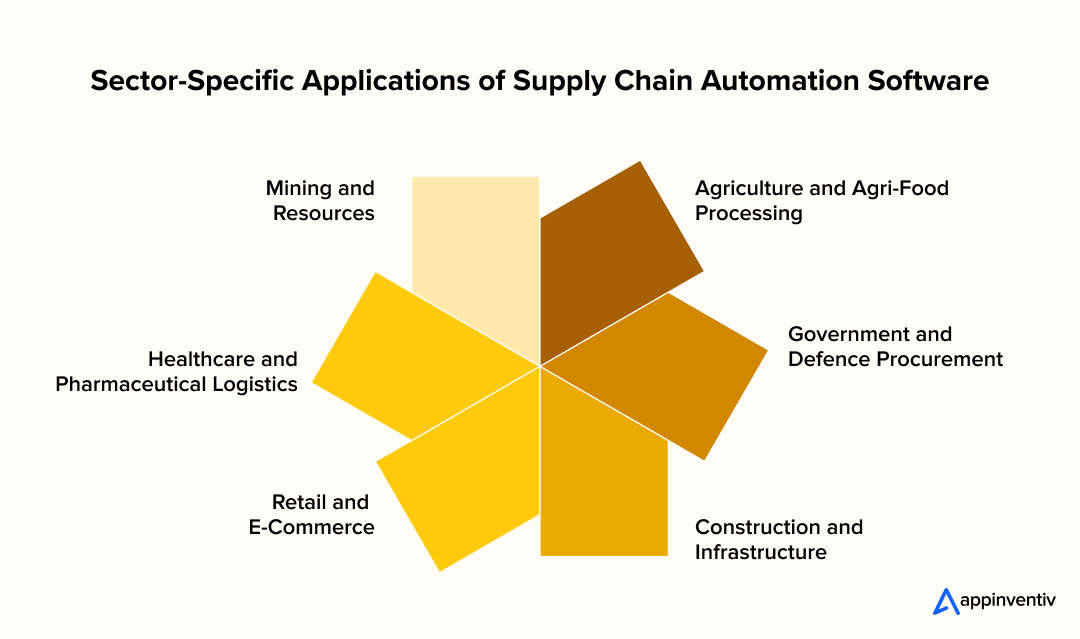
Understanding the use cases of developing supply chain automation software in Australia requires sector-specific analysis. The decision to develop supply chain automation software in Australia looks different in every sector. The use cases that matter in mining have little overlap with what healthcare networks need. The compliance drivers are different, the data environments are different, and the ROI timelines reflect different capital structures.
Mining and Resources
Australia’s mining sector leads automation adoption nationally, deploying autonomous drilling systems, inspection technologies, and material transportation solutions across Western Australia and Queensland operations. At the supply chain software level, the priorities are critical spares inventory management, vendor-managed inventory (VMI) for remote sites, and integrating autonomous haulage systems with procurement and maintenance platforms.
Regulatory pressure from the SOCI Act obligations on critical mineral supply chains adds a compliance dimension that generic platforms are not built to handle.
Healthcare and Pharmaceutical Logistics
AI-powered tools in healthcare supply chains enable more precise forecasting of supply needs, minimising overstock and preventing critical shortages, while enhanced visibility into usage patterns helps ensure the right supplies are available at the right time.
In the Australian context, TGA-compliant cold chain management, hospital consumable automation, and medical device traceability are the primary automation use cases. Data sovereignty requirements under the Privacy Act 1988 also constrain cloud architecture decisions for health sector supply chain platforms.
Retail and eCommerce
Omnichannel fulfilment in Australia has compressed the margin for inventory error. Demand signals from physical stores, online channels, and third-party marketplaces need to be consolidated in near-real-time and translated into replenishment actions at the SKU level, that’s not a job for weekly planning cycles.
Supply chain automation tools that synchronise these signals and trigger automated replenishment are now standard expectation for mid-to-large Australian retailers.
Agriculture and Agri-Food Processing
Agri-food export supply chains operate under biosecurity and traceability requirements that vary by destination market. Japan, South Korea, and the EU each have specific phytosanitary and food safety documentation requirements that need to be prepared correctly or shipments get held.
Government and Defence Procurement
Commonwealth procurement sits within the Commonwealth Procurement Rules framework, with specific obligations around supplier panel management, value-for-money documentation, and probity record-keeping. Defence supply chains carry classification requirements that sit on top of those baseline obligations.
Enterprise supply chain automation in government focuses on contract lifecycle management, supplier performance tracking against panel KPIs, and audit-ready documentation trails that hold up to Australian National Audit Office scrutiny. Probity and auditability aren’t optional features here, they’re the primary design constraint.
Construction and Infrastructure
Large infrastructure projects funded through the Federal Government’s infrastructure pipeline involve subcontractor networks whose compliance obligations, including WHS documentation, insurance verification, and Modern Slavery Act reporting, change across the life of a project.
Supply chain automation for construction focuses on materials scheduling against project programme milestones, subcontractor compliance tracking, and procurement spend analysis across concurrent project portfolios. The non-repeating nature of construction procurement makes data standardisation particularly challenging and typically requires more custom development work than other sectors.
What Are the Business Benefits of Supply Chain Automation for Australian Sectors
The supply chain automation business benefits for Australian sectors go well beyond cost reduction. When the software is built correctly and integrated fully, it restructures how decisions are made, how risk is managed, and how regulatory obligations are met, continuously and at scale.
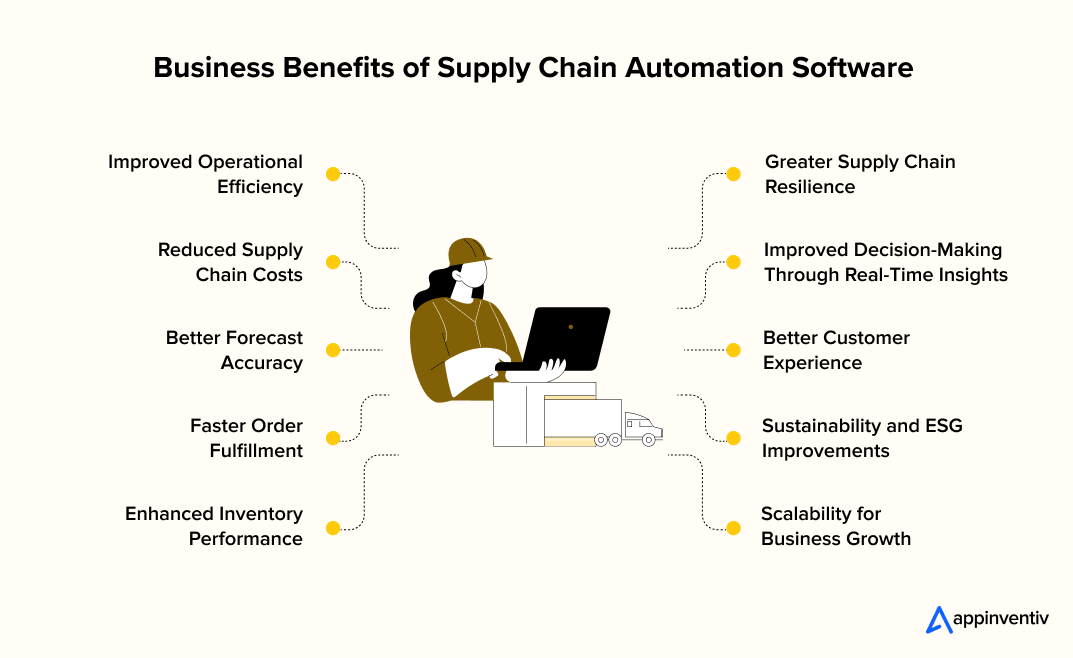
Improved Operational Efficiency
Automated workflows eliminate manual data entry, handoff delays, and approval bottlenecks that slow procurement cycles and warehouse throughput. In food processing, documented efficiency gains of 50% have been recorded through cobot integration supported by software orchestration layers.
Reduced Supply Chain Costs
Transportation and warehousing represent significant overheads. Automated systems continuously analyse carrier rate cards and consolidation opportunities to select the most cost-effective shipping methods, driving down the overall logistics cost by 5–20%.
Better Forecast Accuracy
AI supply chain automation applied to demand forecasting reduces prediction errors by 20–50%, according to McKinsey research. For enterprises managing seasonal demand volatility or complex multi-region distribution networks, that accuracy uplift directly reduces both stockouts and excess inventory carrying costs.
Faster Order Fulfilment
Automated order routing, warehouse task management, and carrier dispatch reduce order-to-ship cycle times significantly. For omnichannel retailers, the ability to fulfil from the nearest available inventory node, automatically, is the capability that determines customer experience at scale.
Enhanced Inventory Performance
Inventory level reductions of 20–30% are achievable through automation-driven replenishment logic and real-time stock visibility. For enterprises holding working capital in slow-moving safety stock, that reduction has a direct impact on balance sheet efficiency.
Greater Supply Chain Resilience
Automated supplier risk monitoring, alternative sourcing workflows, and disruption scenario modelling give enterprises the ability to respond to geopolitical shocks, freight disruptions, or supplier failures in hours rather than days. For critical infrastructure operators, this capability is now an obligation under SOCI Act CIRMP requirements.
Improved Decision-Making Through Real-Time Insights
Supply chain automation tools that surface real-time dashboards, exception alerts, and predictive analytics change the nature of supply chain leadership. Decisions that previously required manual data collation across multiple systems can be made from a single operational view, within the decision window that actually matters.
Better Customer Experience
Accurate delivery commitments, proactive exception notifications, and faster returns processing are direct outputs of supply chain automation. For B2B enterprises, that reliability is a procurement criterion. For consumer-facing businesses, it is a retention driver.
Sustainability and ESG Improvements
Scope 3 emissions tracking embedded in procurement and AI driven logistics platforms enables enterprises to measure, report, and reduce supply chain carbon output. For ASX-listed companies under ASIC mandatory climate disclosure obligations, automated emissions accounting is a reporting prerequisite.
Scalability for Business Growth
Custom-built enterprise supply chain automation in Australia scales with business growth without requiring platform replacement. That architectural advantage is particularly relevant for enterprises entering new geographic markets, integrating acquisitions, or expanding product ranges.
Supply Chain Automation ROI: Quantified Business Impact
Enterprise investment decisions require defensible numbers. The figures below reflect documented outcomes from AI-driven supply chain deployments, drawn from McKinsey and SCLAA research.
| Benefit Area | Documented Impact |
|---|---|
| Forecasting accuracy improvement | 20–50% error reduction |
| Logistics cost reduction | 5–20% |
| Inventory level reduction | 20–30% |
| Procurement spend reduction | 5–15% |
| Operational efficiency (food processing) | Up to 50% |
Technology Stack Powering Modern Supply Chain Automation Software
The technology choices made at the architecture stage determine the platform’s longevity, integration surface, and compliance posture. For Australian enterprises building custom supply chain automation software, the following components represent the current production-grade stack.
Artificial Intelligence and Machine Learning
AI models in Australian enterprises form the cognitive core of the platform. You need to deploy machine learning algorithms for precise demand forecasting and anomaly detection to flag unusual procurement patterns.
IoT and Edge Computing
IoT sensors embedded in cold chain assets, shipping containers, and warehouse equipment provide the real-time telemetry that makes automated decision-making reliable. Edge computing at port facilities, distribution centres, and remote mining sites enables local processing of sensor data, reducing latency and addressing data sovereignty constraints under Australian law.
Blockchain and Distributed Ledger Technology
Blockchain-based traceability platforms provide immutable audit trails for supplier provenance, which directly support Modern Slavery Act documentation requirements. Smart contracts automate payment release on delivery confirmation, reducing accounts payable processing costs and disputes in complex multi-tier supplier networks.
Robotic Process Automation (RPA)
Administrative friction drains resources. RPA bots handle high-volume transactional tasks across legacy systems. These digital workers execute invoice processing, compile compliance reporting data, and perform automated purchase order matching, eliminating human error from routine data entry.
Cloud-Native Architecture and API Integration
Modern systems must communicate seamlessly. Cloud-native applications utilise microservices and robust API gateways. This approach ensures reliable ERP connectors, supports multi-cloud deployments for data sovereignty, and creates secure bridges to integrate aging legacy infrastructure.
Digital Twins
Testing strategies in the real world is risky. Digital twins create a complete virtual replica of your logistics network. This allows operations teams to run supply chain simulations and model disruption scenarios safely, identifying vulnerabilities before they impact physical operations.
The Australian Regulatory Stack Shaping Automation Requirements
For enterprises operating under Australian law, supply chain automation is as much a compliance exercise as an efficiency one. Four regulatory frameworks directly influence what the software must do and how it must be built.
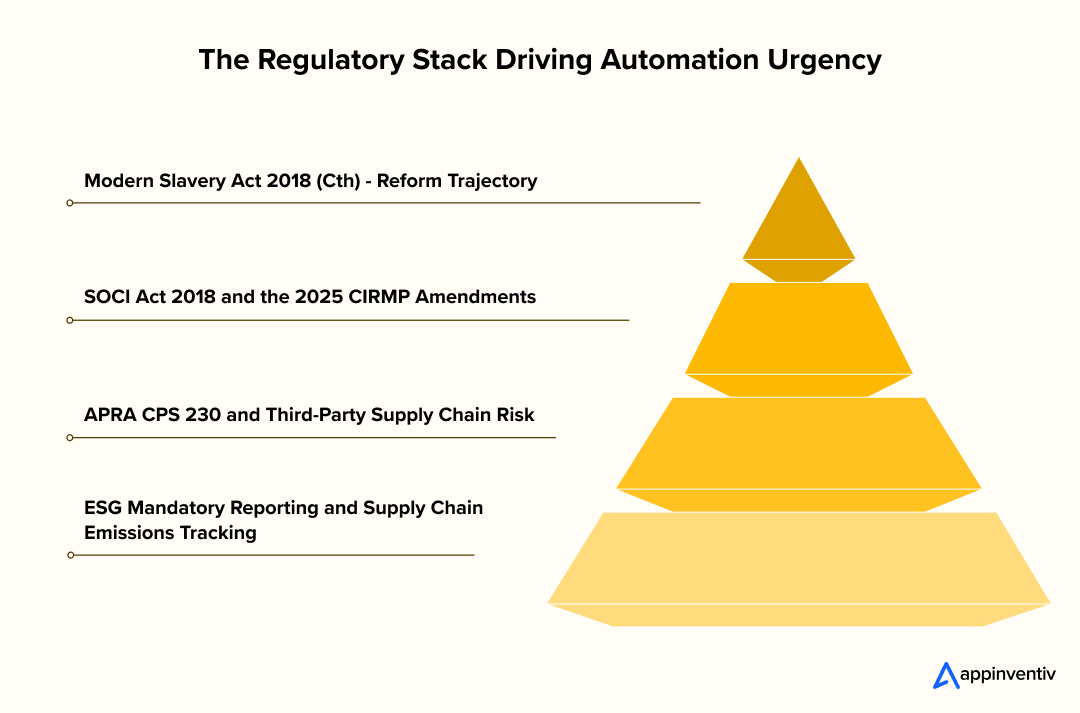
Modern Slavery Act 2018 (Cth): From Reporting to Due Diligence
The Modern Slavery Act 2018 currently requires entities with annual consolidated revenue above $100 million to submit annual statements covering supply chain risks. The government opened a public consultation in July 2025 on strengthening the law, with reforms pointing toward mandatory human rights due diligence obligations and civil penalty mechanisms for non-compliant entities. Businesses still relying on spreadsheet-based reporting will be structurally exposed when penalties are introduced.
Automated supply chain traceability tools provide the evidentiary infrastructure needed for meaningful compliance. Supplier heat maps, audit workflow automation, and document-generation modules can produce defensible, evidence-based statements rather than generic policy declarations.
SOCI Act 2018 and the 2025 CIRMP Amendments
Australia’s Department of Home Affairs proposed significant amendments to the Critical Infrastructure Risk Management Program (CIRMP) Rules under the SOCI Act in 2025, introducing more prescriptive obligations across cyber, supply chain, and personnel security domains. Responsible entities in ports, freight, energy, water, and defence supply networks must now demonstrate active, evidence-driven risk management, not baseline compliance.
Automated risk registers, supplier dependency mapping, and real-time incident notification workflows are no longer optional architecture considerations for critical infrastructure operators. They are regulatory obligations embedded in the CIRMP framework.
APRA CPS 230 and Third-Party Supply Chain Exposure
APRA CPS 230 introduced binding requirements for regulated entities to identify, assess, and manage risks arising from material service provider relationships, including supply chain dependencies. A failure at a key logistics or procurement provider can trigger a cyber or data breach at the regulated entity, with downstream regulatory investigation and reputational consequences.
For financial services firms, insurers, and superannuation funds with supply chain exposure, CPS 230 compliance requires automated third-party risk registers, contractual obligation tracking, and continuous monitoring capabilities built into the supply chain software architecture.
ESG Mandatory Reporting and Scope 3 Emissions
ASIC’s mandatory climate-related financial disclosure requirements, aligned to TCFD and ISSB standards, now require large Australian entities to report on Scope 3 emissions, which originate primarily in supply chains.
Manual emissions tracking across multi-tier supplier networks is not viable at scale. Automated carbon accounting modules, integrated directly into procurement and logistics platforms, are becoming a core architecture requirement for ASX-listed companies preparing for mandatory disclosure cycles.
How to Develop Supply Chain Automation Software: A Step-by-Step Approach
When organisations choose to develop supply chain automation software in Australia, the sequence of implementation steps matters as much as the technology selected. A phased, capability-led development approach reduces implementation risk and accelerates time to measurable value, which is as follows:
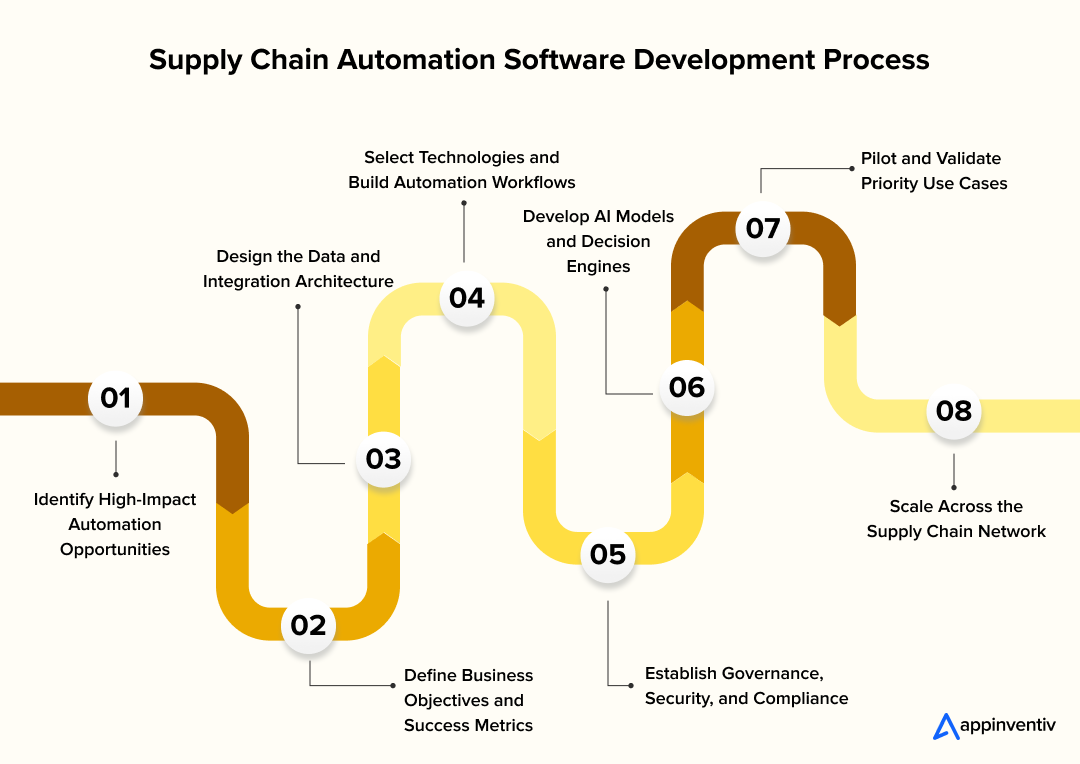
Step 1: Identify High-Impact Automation Opportunities
Map existing supply chain processes against three dimensions: cost per transaction, error rate, and compliance risk exposure. The processes that score highest across all three are the right starting points.
Step 2: Define Business Objectives and Success Metrics
The next vital step is to establish baseline KPIs for each automation target. Whether the objective is a 15% reduction in freight costs or achieving continuous Modern Slavery Act compliance, these metrics guide every subsequent architectural decision.
Step 3: Design the Data and Integration Architecture
The data layer is the most consequential architectural decision. Poorly structured master data, fragmented system integrations, and unresolved data sovereignty questions undermine automation at scale. Define the integration architecture, ERP connectors, API standards and data residency controls before selecting technologies.
Step 4: Select Technologies and Build Automation Workflows
Based on the architecture, next you need to select the appropriate technology stack. Match AI supply chain automation capabilities to specific forecasting, routing, or compliance use cases. Build automation workflows as modular, testable components that can be updated independently.
Step 5: Establish Governance, Security, and Compliance
Supply chain platforms handle commercially sensitive and regulatory-relevant data. Security architecture must align with ASD Essential Eight controls at a minimum, and with ISO 27001 and SOC2 standards for enterprises operating in regulated industries. Governance frameworks should define data access controls, change management procedures, and audit trail requirements.
Step 6: Develop AI Models and Decision Engines
AI models require training data, validation frameworks, and human-in-the-loop oversight protocols before deployment in live supply chain environments. Build explainability into model outputs so that procurement and logistics decisions supported by AI can be justified to auditors, regulators, and counterparties.
Step 7: Pilot and Validate Priority Use Cases
Run controlled pilots on two to three high-priority use cases before scaling. Use the pilot phase to validate integration stability, data quality, and user adoption; not just technical functionality. Pilot outcomes should directly inform the business case for the next development phase.
Step 8: Scale Across the Supply Chain Network
Scaling automation requires change management as much as technical deployment. Supplier onboarding to new data-sharing protocols, workforce transition from manual to exception-handling roles, and executive reporting reconfiguration all require structured programme management alongside the software rollout.
Ready to transform your supply chain into a data-driven operation?
From procurement and logistics to inventory management and supplier visibility, we help enterprises build automation solutions that deliver measurable business outcomes.
The Future of Supply Chain Automation in Australia
Looking ahead, AI supply chain automation will evolve from a supportive tool into an autonomous driver of operational execution.
A major shift involves agentic AI. Grand View Research’s forecast indicates that the agentic AI market in Australia will grow from under $36.9 million in 2024 to $435.1 million by 2030. These autonomous supply chain agents will replace rigid rules-based workflows, possessing the capability to independently evaluate supplier risk, negotiate basic procurement terms, and reroute shipments without human oversight.
Furthermore, Scope 3 carbon tracking will become deeply embedded in procurement workflows to satisfy ASIC mandatory climate disclosures. Sustainability integration will expand, leveraging electric automation technologies that consume as little as 0.1 kW per hour to align directly with Australia’s Net Zero emissions targets.
In the long horizon, quantum computing applications will be tackling large-scale logistics optimisation, processing variables that currently overwhelm traditional supercomputers.
How Appinventiv Helps with Custom Supply Chain Automation Software Development in Australia?
Australian supply chain projects fail for predictable reasons. The integration architecture wasn’t designed for the existing ERP environment. The compliance requirements were treated as an afterthought. The vendor had global credentials but no understanding of how Australia’s regulatory obligations like Modern Slavery Act reporting, SOCI Act CIRMP requirements, APRA CPS 230 third-party risk controls, etc. translate into actual software behaviour.
Appinventiv’s supply chain software developers in Australia work from a different starting point. We have spent 11+ years delivering enterprise technology across 35+ Australian industry verticals, which means the regulatory context, the legacy infrastructure constraints, and the procurement governance requirements that shape what supply chain automation actually needs to do here are built into the delivery methodology, not discovered mid-project.
What that looks like in practice:
Our team of 1600+ tech experts has delivered 3000+ digital assets across Australian enterprises, spanning custom WMS and TMS builds, AI-driven demand forecasting engines, IoT-integrated cold chain compliance platforms, and ERP-connected procurement automation across SAP, Oracle, and Microsoft Dynamics environments.
We have delivered these across mining, healthcare, retail, agri-food, government, and construction sectors, each with its own compliance obligations, data environments, and integration complexity.
For regulated industries, the security posture matters as much as the functional capability. We hold ISO 27001, ISO 9001, and SOC2 certifications with a 99.5% security compliance SLA. For government and defence clients, our approved supplier credentials are a procurement prerequisite.
We hold approved status on the Queensland Government ICTSS and Local Buy LGA panels, with DTA-recognised ICT supplier status for federal engagements.
Our supply chain services cover the full engagement lifecycle: strategy and process assessment, architecture design, custom software development, ERP and legacy system integration, cloud deployment across AWS, Azure, and GCP, and post-deployment support with defined SLAs.
Ranked among APAC’s High-Growth Companies by Statista and the Financial Times for two consecutive years, we bring both the delivery depth and the governance credentials that Australian enterprise procurement teams require.
For enterprise decision-makers at the point of evaluating supply chain automation as a strategic investment, the right conversation starts with current process maturity, data quality, and compliance exposure. That structured assessment is where Appinventiv engages, and it’s where the foundation for a platform that actually performs gets built.
Speak with Appinventiv’s supply chain automation team today to get started.
FAQs
Q. How much does supply chain automation software cost?
A. The cost of supply chain automation software development in Australia typically ranges between AUD 70,000 and AUD 700,000 or more. The cost varies depending on the scope of integration, data volume, and the complexity of the AI models required.
For example, basic platforms with limited capabilities range between AUD 70,000 –150,000. End-to-end platforms covering procurement, logistics, compliance, and inventory management across multiple systems run to AUD 500,000 –1,000,000 and above.
Q. What are the benefits of automated supply chain management software?
A. The documented business benefits of automated supply chain management software include 5–20% logistics cost reduction, 20–30% inventory holding reduction, 20–50% improvement in forecast accuracy, faster procurement and fulfilment cycle times, and reduced manual compliance burden.
For Australian enterprises, the compliance and ESG reporting benefits have become increasingly significant alongside the operational efficiency gains, particularly for entities with Modern Slavery Act, SOCI Act, and ASIC climate disclosure obligations.
Q. What is supply chain automation?
A. Supply chain automation is the strategic deployment of technology to manage data, documentation, and decision-making across procurement, warehousing, and transportation. Rather than relying on human intervention, the system uses intelligent algorithms to automatically route inventory and coordinate vendor actions.
Q. Will SCM be replaced by AI?
A. AI will not replace the entire discipline of supply chain management. Instead, autonomous supply chain tools will absorb the repetitive analytical and administrative tasks. This shift forces the workforce to transition from tactical data entry toward strategic network design and relationship management.
Q. How is automation reshaping supply chains in Australia?
A. Automation fundamentally restructures how local enterprises combat geographic isolation and labour shortages. It allows companies to operate micro-fulfillment models, accurately predict domestic freight disruptions, and seamlessly manage the expanding compliance burden of local privacy and ESG reporting.
Q. How does supply chain automation work?
A. Supply chain automation platforms function by connecting siloed data across the enterprise. When a change occurs in demand or supplier availability, the central orchestration platform instantly updates transport schedules, triggers purchase orders, and adjusts warehouse labor allocations without requiring a manager to manually approve the workflow.
Q. Which industries benefit most from supply chain automation?
A. While all sectors gain efficiency, the most significant use cases of developing supply chain automation software in Australia occur in highly regulated and complex environments. Healthcare, mining, food processing, and large-scale retail see the fastest returns due to their heavy reliance on compliance, cold-chain integrity, and precise inventory allocation.