Key Takeaways
- BLE platforms link physical assets to core databases. This connectivity changes raw data into fast operational choices.
- A structured deployment schedule protects technology investments and stops dropped wireless connections across your firm.
- Strong security requires automated device checks and encrypted channels across the entire path, from initial hardware setup to cloud networks.
- Machine learning models study sensor streams. They flag upcoming equipment failures to protect factory production assembly lines.
- Wise planning secures your network links. This system structure preserves your long-term asset capital.
Enterprises do not struggle to collect data. They struggle to connect it. A modern hospital runs hundreds of wireless medical devices every day. Factories track tools, manufacturing sensors, and production assets across multiple sites.
Retailers monitor inventory through smart shelves and handheld scanners. Every device generates operational data. Why does this data lack value? It fails to reach business software, corporate databases, and decision systems.
Connected devices are now core business infrastructure. The BLE module market is projected to reach $68.27 billion by 2032, reflecting accelerating enterprise adoption. Leaders want constant visibility, low-power connectivity, and secure data exchange. They need direct integration with cloud software, ERP systems, healthcare records, and AI models.
Bluetooth Low Energy (BLE) system integration provides a practical communication layer for these deployments. The technology uses little power. It discovers devices quickly. This makes it ideal for battery-powered hardware that transmits small data packets over long periods.
The BLE system integration links individual devices into unified systems. It connects hardware, mobile applications, gateways, code interfaces, and cloud services into a single data flow. This link helps corporate executives make faster choices. It provides clear asset visibility. Your operations become fully connected, and your entire company grows steadily.
50% Less Rework Starts Here
Validate your BLE architecture before development begins and prevent costly integration challenges during enterprise deployment.

How BLE Fits Into Enterprise Connected Ecosystems
Companies rarely rely on one wireless technology. A factory, hospital, or warehouse runs dozens of systems that send data every second. BLE plays a specific role. It connects low-power devices to the software platforms that run your business.
Connecting Physical Hardware to Digital Systems
BLE operates at the edge of your network. It enables wearables, medical devices, sensors, tags, scanners, and machines to communicate with mobile apps or gateways. These gateways send the data to cloud platforms through web interfaces and messaging protocols. Then your main business software processes the information.
Part of a Broader Network
BLE does not replace Wi-Fi, 5G, Zigbee, or Thread. Every technology serves a separate purpose.
- BLE handles short-range communication for battery-powered hardware.
- Wi-Fi moves high-bandwidth data and provides internet access.
- 5G links distribute assets across long distances.
- Zigbee and Thread build networks for smart buildings and factory automation.
These technologies work together. Each protocol handles the specific job it does best.
Also Read: Zigbee and Z-Wave – Choosing the Right Wireless Protocol for Smart Home Automation
Generating Value After Connection
A BLE device creates financial value only when its data reaches your core systems. Modern setups link BLE with inventory software, health records, databases, and AI models. This link turns simple hardware data into clear facts. You can use these facts for machine maintenance, asset tracking, patient care, and automated workflows.
This integration makes BLE an important part of corporate modernization. It is no longer just a simple wireless tool. It serves as the data link connecting physical assets to your software and daily business decisions.
Enterprise BLE System Connectivity Strategies
No single technical setup fits every project. A workout application that links to a smartwatch requires different features than a hospital tracking thousands of medical tools or a plant tracking production machinery.
The right setup choice relies on device density, response times, network uptime, security needs, and business system links. Every company faces distinct operational environments and technical hurdles.
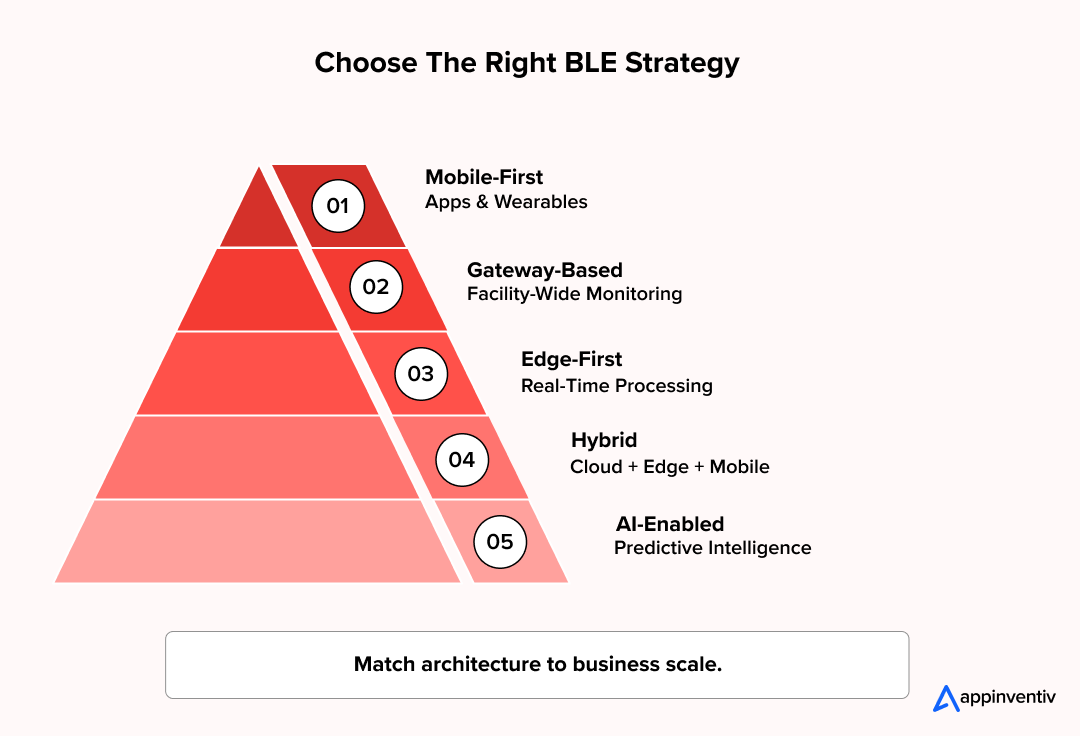
Mobile-First Connectivity
BLE integration with mobile apps turns phones or tablets into hubs that find nearby hardware, trade data, and send updates to cloud applications. This setup functions well when users remain near the tracking hardware throughout the work shift.
- Suitable for: patient health applications, fitness tools, consumer products, field operations
- Benefits: low initial costs, fast deployment, direct user contact, simple hardware setup
- Weaknesses: requires a phone, lacks constant tracking, scales only with active users
Gateway-Based Connectivity
BLE gateway system integration replaces consumer phones with dedicated gateways. These tools gather data from multiple sensors and transmit it via wires, Wi-Fi, or cellular networks. This model keeps your data collection steady without relying on employees to carry hardware routers.
- Suitable for: smart hospitals, warehouses, retail stores, industrial centers, asset tracking
- Benefits: continuous data collection, centralized hardware control, stronger scaling, independent of users
- Weaknesses: hardware costs increase, gateway placement changes coverage limits
Edge-First Connectivity
Systems process data near the source instead of sending every event to cloud servers. Industrial edge hubs filter and study data, then forward key facts to business platforms, a capability that becomes even more powerful when combined with edge AI for real-time decision-making at the source.
- Suitable for: factory assembly, predictive repairs, utility plants, critical settings
- Benefits: low data lag, smaller bandwidth needs, local uptime during network drops, fast responses
- Weaknesses: complex setup, edge hardware requires regular updates
Hybrid Connectivity
Large companies rarely deploy a single pattern. Combined systems blend mobile applications, hardware gateways, edge tools, and cloud storage into a unified platform. Field technicians use phones for setups.
Fixed gateways gather data daily. Edge tools check critical alerts locally, and cloud systems compile records for corporate reporting. This deep coordination supports multiple business goals at once.
- Suitable for: multi-site firms, health networks, logistics, smart factories, corporate buildings
- Benefits: constant system uptime, flexible setup models, massive hardware tracking, varied work support
- Weaknesses: complex architecture design, strict project governance needed
Machine Learning Connectivity
Automated systems build upon earlier patterns. Hardware gathers data, edge platforms sort the inputs, and smart models spot trends to guide corporate choices. Teams deploy these programs to anticipate factory errors or automatically track storage room assets.
- Production uses: predictive repairs, asset use metrics, patient risk alerts, indoor tracking, anomaly detection, supply counts.
- This system integrates stream tools, data stores, and code pipelines with enterprise data platforms to provide teams with live operational metrics.
Strategy Evaluation
| Strategy | Best For | Scaling | Cost | Corporate Uses |
|---|---|---|---|---|
| Mobile-First | User tools | Medium | Low | Trackers, patient tools and field work |
| Gateway-Based | Full facilities | High | Medium | Asset tracking, clinics, storage hubs |
| Edge-First | Low lag | High | High | Assembly, automation, utility grids |
| Hybrid | Big networks | Very High | High | Multi-site firms, supply chains |
| AI-Enabled | Data choices | Enterprise | High | Smart repairs, automated choices |
Requirement Alignment
| Corporate Need | Chosen Strategy |
|---|---|
| Mobile apps | Mobile-First |
| Constant indoor tracking | Gateway-Based |
| Low lag operations | Edge-First |
| Multi-site company setups | Hybrid |
| Automated metrics | Hybrid with smart tools |
Understanding the strategies of BLE system integration means recognizing that your choice relies on data movement, not just hardware links. Most large firms start with basic setups and then grow into hybrid systems that combine edge tools, cloud storage, and predictive analytics.
This growth allows teams to track thousands of devices without rebuilding their whole core platform. Leaders must analyze data paths before choosing hardware components.
Wise planning prevents data loss and secures network links across the entire firm. Reliable systems preserve your long-term capital and shield core systems from common failures.
Enterprise BLE System Architecture
Enterprise Bluetooth Low Energy (BLE) system integration does more than connect a device to a phone. A reliable BLE system integration supports secure data sharing and device tracking. Data must move reliably from sensors to operations software. Leaders need a clear view of this architecture to plan investments. Every layer has a specific job.
Architecture Flow
BLE Devices → Gateways and Apps → Security Layer → Cloud Storage → Enterprise Software
Layer 1: BLE Devices
This layer covers BLE devices integration with operational hardware that collects field data and shares data points with mobile applications or hardware gateways.
Key examples in this layer include wearable trackers, medical monitors, environmental sensors, and inventory tags. Enterprises planning this layer can also explore IoT wearables development to understand adoption strategies at scale. Additionally, smart locks, factory machinery, and barcode scanners act as the primary endpoints for data generation.
Layer 2: Gateways and Mobile Apps
This layer securely connects the hardware, verifies each device, and manages active connections. BLE integration with mobile apps utilizes iOS, Android, and cross-platform platforms to read data directly. For stationary setups, BLE gateway system integration serves as a critical bridge to forward information to the broader network.
BLE technology in embedded systems relies on the integration of BLE stacks across embedded firmware, mobile operating systems, and backend services. Bluetooth in embedded system deployments typically runs the Bluetooth stack on RTOS platforms such as Zephyr RTOS or FreeRTOS, while resource-constrained peripherals use bare-metal architectures.
Standard BLE profiles and GATT services provide a common communication model before custom characteristics are added for specialized devices.
Layer 3: Integration Layer
The integration layer converts raw data into useful corporate information, standardizing facts for your databases. This layer handles essential background tasks such as device verification, API management, event-driven communication, MQTT messaging, Apache Kafka event streaming, and message routing. It also oversees data translation, integration with sensors and peripherals, identity security, and the distribution of firmware updates across the fleet.
Layer 4: Cloud Platform
Cloud tools collect data from thousands of devices to store information for business use. Enterprises exploring this layer can benefit from a deeper understanding of cloud computing for businesses before finalizing their infrastructure. They also facilitate deep data analysis, machine learning execution, and centralized device management to track performance across the enterprise.
Layer 5: Enterprise Systems
This layer converts device data into corporate strategy, helping teams make daily choices. Data is integrated into ERP systems for inventory tracking, CRM for customer products, and health records for patient monitoring, which is where enterprise application integration becomes the connecting layer across these platforms.
Furthermore, this information flows into manufacturing and warehouse software, reporting dashboards, and predictive analytics tools.
Data Flow Across the Architecture
A BLE device transmits data via standard services. A mobile application or gateway captures the transmission. The gateway sends the data through secure APIs to the cloud. Cloud systems verify the information. They store the data. The system then delivers the data to enterprise applications like ERP or CRM systems. Analytics tools use the data for automation and business reports.
Also Read: ERP Software Integration: A Symphony of Efficiency and Growth
System Technology Stack
| System Layer | Technology Options |
|---|---|
| Mobile Development | Swift, Kotlin, Flutter, React Native |
| BLE Tools | CoreBluetooth, Android BLE APIs, Nordic Library |
| Embedded Firmware | Zephyr RTOS, FreeRTOS, Nordic SDK |
| API Tools | REST, GraphQL, gRPC |
| Messaging | MQTT, Apache Kafka, RabbitMQ |
| Backend | Java, .NET, Node.js, Python |
| Cloud Platforms | AWS IoT Core, Microsoft Azure IoT, AWS Lambda |
| Databases | PostgreSQL, MongoDB, DynamoDB, InfluxDB |
| Monitoring | Grafana, Prometheus, OpenTelemetry |
| Security | TLS 1.3, OAuth 2.0, JWT, X.509 |
Enterprise BLE Deployment Roadmap
Following the right BLE system integration steps starts with early planning. Rushing the process risks dropped connections and broken data. A clear schedule cuts these threats and protects your investment.
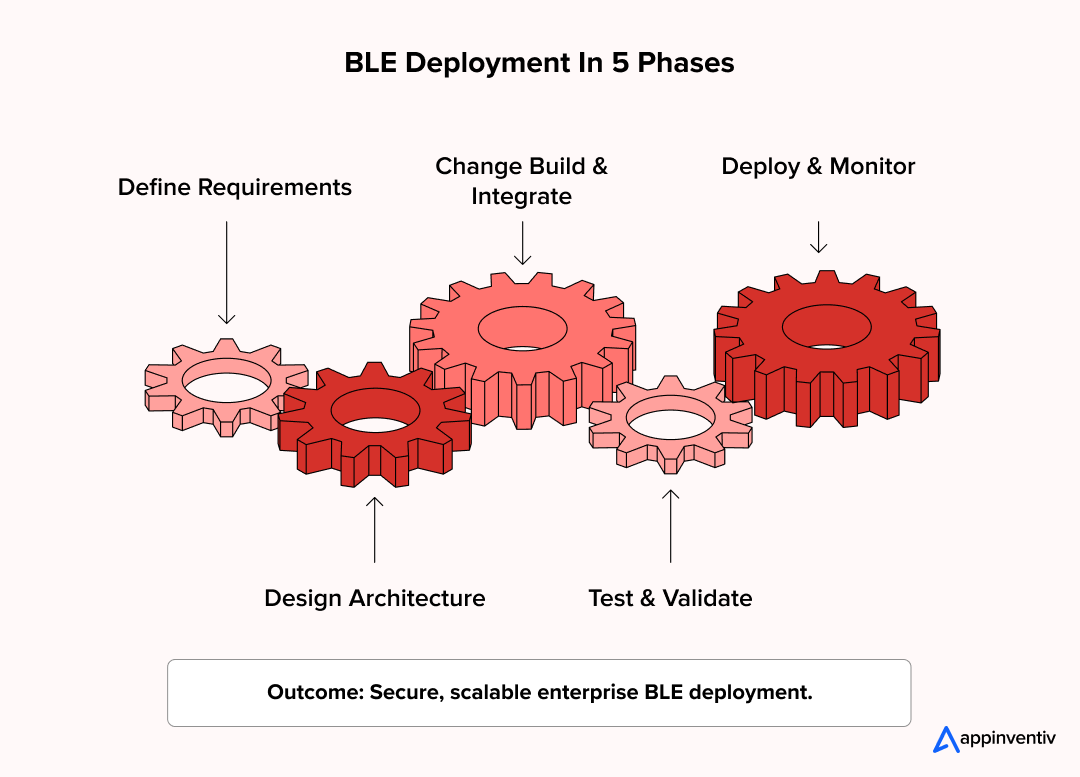
Phase 1: Requirements and Goals
First, define your business objectives and performance metrics. Calculate your total device counts and battery needs. Check security rules and compliance mandates to establish a clear project scope.
Phase 2: Architecture and Components
Next, choose between mobile apps, hardware gateways, or hybrid setups. Select hardware based on battery life and sensor features, keeping integration of BLE in embedded systems a core design priority. Map out your cloud servers, databases, and encryption keys to create a technical blueprint.
Phase 3: Software Development
Engineering teams handle BLE integration with mobile apps, backend APIs, and device management services. Bluetooth in embedded system development follows an asynchronous programming model where scanning, advertising, pairing, notifications, and reconnection events occur independently. Teams implement communication logic, register hardware, and connect backend services into a complete software platform.
Phase 4: System Integration
BLE system integration ensures sensor data reaches your main business applications, a process that sits within the wider framework of IT integration that streamlines systems for efficiency and growth. This creates a linked data network.
Phase 5: Testing and Scaling
Testing proves the network operates under real stress. Check connection uptime, run traffic stress tests, and verify backup plans. Review BLE logs to diagnose pairing failures, dropped connections, packet loss, and characteristic read or write errors before production deployment. Finally, launch the system, monitor active hardware, and apply security patches regularly.
This step-by-step plan keeps your wireless project predictable. It gives your teams a clear path to manage thousands of sensors securely.
Also Read: Wearable App Development: Benefits, Applications, Features, Development Process and More
Enterprise Use Cases of BLE Systems Across Industries
The applications of BLE in embedded systems solve active business problems, not simple connectivity issues. The radio link forms the first step. Real value shows up after device data reaches the corporate platforms that teams operate every day.
Healthcare: Finding Medical Equipment Quickly
Hospital operations teams waste time searching for missing tools. Infusion pumps, wheelchairs, portable monitors, and ECG machines are constantly being moved between wards, and connecting them to hospital software requires a clear medical device integration strategy. Staff lose precious hours on these searches.
Many clinics attach BLE tags to these assets and link them to a Real-Time Location System (RTLS), part of a broader shift toward wearable technology in healthcare that is reshaping patient care delivery. This location data feeds straight into hospital dashboards and inventory tools.
AZ Groeninge Hospital in Belgium deployed this pattern for 7,800 medical assets. The hospital reduced equipment search times from 8 minutes to under 2 minutes. Improved tracking reduced extra hardware purchases and increased daily equipment usage rates.
Manufacturing: Moving Machine Data to Maintenance Teams
Factory gear creates thousands of data points daily. Temperature, vibration, and motor health indicators show wear. Engineers need these metrics to prevent sudden mechanical breakdowns.
BLE sensors gather these numbers from production lines. Edge gateways collect the streams. They forward the data to Manufacturing Execution Systems (MES) or predictive maintenance software.
Siemens runs this connected factory pattern across its main digital facilities. Wireless sensors and edge computing help mechanics spot machinery bugs early. This method reduces factory downtime and protects assembly-line quotas.
Retail: Guiding Shoppers Indoors
Finding specific items inside large retail stores troubles many buyers. Retailers deploy BLE beacons to make indoor mapping precise.
A buyer’s smartphone picks up beacon signals. The device shows immediate map updates inside the facility. This system aids shelf navigation and product discovery.
Target added Bluetooth beacons across stores to improve positioning inside its mobile application. Shoppers locate products quickly, even in deep layouts where GPS tools fail.
Logistics and Warehousing: Tracking Mobile Inventory
Distribution hubs manage thousands of pallets, forklifts, and shipping containers daily. Misplacing cargo creates supply chain stalls.
BLE asset tags help crews monitor material moves indoors. Satellites cannot track items inside metal warehouses, but local gateways gather these positions. The systems sync with Warehouse Management Systems (WMS) and shipping logs. Logistics firms use BLE networks to remove manual inventory counts.
Smart Buildings: Adjusting Facilities Based on Occupancy
Modern offices do not run climate systems on rigid timers. They modify building operations based on room occupancy data.
BLE sensors pick up desk usage and room choices. Building Management Systems (BMS) use these metrics to control lighting and HVAC systems.
Signify deploys Bluetooth-connected lighting systems inside corporate offices. The light tubes handle positioning and occupancy sensing without separate tracking hardware.
Energy and Utilities: Monitoring Remote Power Assets
Field technicians cannot check every power transformer or electrical substation daily. Automated monitoring fills this operational gap.
BLE sensors track remote gear and send metrics to local gateways. Edge software screens the streams. It sends urgent alerts to SCADA databases and maintenance apps. Utility firms use these tools to prioritize repairs by actual equipment wear.
BLE integration use cases stay uniform across fields, with BLE handling the final meters between hardware and networks. Corporate tools and analytics systems manage the rest. This architecture converts raw numbers into operational facts for teams to act on daily.
Move Beyond BLE Proof Of Concepts
Build enterprise-grade BLE platforms that support thousands of devices, business systems, and future AI initiatives.

BLE vs Wi-Fi vs Zigbee vs NFC vs Thread
Corporate networks rely on multiple wireless tools, and no single standard fits every project, which is why understanding IoT connectivity solutions helps teams choose the right protocol mix for their deployment.
The advantages of BLE technology include conserving battery life and operating well over short distances. Wi-Fi moves large files quickly. Zigbee and Thread connect large hardware networks. NFC manages secure connections at close range.
The table below details how these common wireless choices perform.
| Technology | Normal Range | Power Needed | Delay | Speed | Main Business Uses | Best For |
|---|---|---|---|---|---|---|
| Bluetooth Low Energy (BLE) | 10 to 100 meters | Very Low | Low | Up to 2 Mbps | Asset tracking, medical monitors, location tags | Battery-powered devices |
| Wi-Fi | 30 to 100 meters | High | Low | Several Gbps | Video streams, main networks, security cameras | Massive data loads |
| Zigbee | 10 to 100 meters | Low | Low | 250 Kbps | Smart lights, building controls, plant grids | Large mesh setups |
| Thread | 10 to 100 meters | Low | Low | 250 Kbps | Commercial setups, connected building tools | Secure mesh networks |
| NFC | Under 10 centimeters | Very Low | Very Low | 424 Kbps | Door badges, ID checks, quick hardware pairing | Instant tap security |
Most operations do not rely on just one choice. Big firms pair BLE with Wi-Fi or cellular networks to cover distinct needs. Hardware sensors send small data packs via BLE to local hubs. Main systems and cloud databases then collect these details to run company analytics.
Corporate Security and Compliance
Security dictates the success of corporate wireless projects. Every new sensor creates a fresh entry point for hackers. Security plans must protect hardware from initial setup to cloud tracking.
Secure Pairing and Encryption
Use LE Secure Connections with AES-128 CCM encryption to protect BLE communication. Secure data moving between gateways, APIs, and cloud platforms with TLS 1.2 or TLS 1.3.
Device Identity and Authentication
Select BLE security modes and levels based on deployment risk. Build trust through secure pairing and bonding mechanisms, apply strong authentication models, and protect device credentials with centralized key management. Restrict access through role-based permissions.
Secure OTA Updates
Sign firmware updates with digital signatures, verify files before installation, and deliver code through encrypted channels. Regular updates reduce exposure to newly discovered BLE security vulnerabilities.
Compliance Requirements
Match defense rules with industry mandates during early planning. Hospitals track patient data in accordance with HIPAA rules, making it critical that any connected application follows HIPAA-compliant app development standards from the ground up.
Firms that manage customer files comply with GDPR requirements. Corporate security matches ISO 27001 models, and plants rely on IEC 62443 standards.
Strong wireless security safeguards daily company operations. It guards buyer details and corporate databases connected to your field hardware.
AI-Driven BLE Applications
BLE hardware produces a constant stream of operational data. This data has low value on its own. Machine learning models find answers that basic software charts miss, and connecting them to BLE data streams often depends on a solid AI API integration layer that routes sensor inputs into analytical workflows. These answers help teams act before errors grow.
Predictive Maintenance
Sensors gather movement, heat, and pressure metrics from active machinery. AI programs compare live numbers against records to flag failing parts. This step alerts repair crews before a factory shutdown occurs.
Asset Intelligence
Hospitals and logistics centers track thousands of moving tools, and when this location data connects to clinical records, it opens the door for AI in EHR systems to surface deeper operational and patient insights. Operations managers use these facts to improve equipment usage rates.
Digital Twins
A digital twin mirrors a physical asset in real time. BLE sensors continuously update the model with live operating data. Engineering teams compare simulated conditions with real equipment performance, identify wear patterns early, and test process changes before applying them on the factory floor.
Businesses exploring this capability can learn more about digital twin technology and its applications across industries.
Anomaly Detection
Some machinery errors do not match known failure types. Machine learning models screen incoming streams to flag numbers that stray from normal operations. This action alerts teams to unusual hardware behavior long before standard alarms sound.
Predictive Healthcare
Remote monitoring systems combine medical hardware with smart software to watch patient health over time, a model that reflects the broader impact of AI wearable technology across industries. Instead of reacting to a single bad reading, doctors receive alerts when several indicators point to a growing medical risk, which aligns with the broader field of predictive analytics in healthcare and its real-world clinical applications.
Workflow Automation
Data can trigger business tasks automatically without manual entry, which is a core principle of business process automation that BLE-connected workflows help put into practice. Medical tools arriving in a clinic room change their status in the software. Cycle completions prompt downstream tracking systems through automated events.
AI gives context to data points. Teams that pair connected hardware with cloud analytics spot system trends faster and spend less time reacting to emergencies.
Common BLE System Integration Challenges (and Best Practices)
Most corporate wireless projects face identical technical roadblocks. Moving from a small pilot to a full production deployment requires solving these issues early. Timely preparation separates successful programs from failed trials.
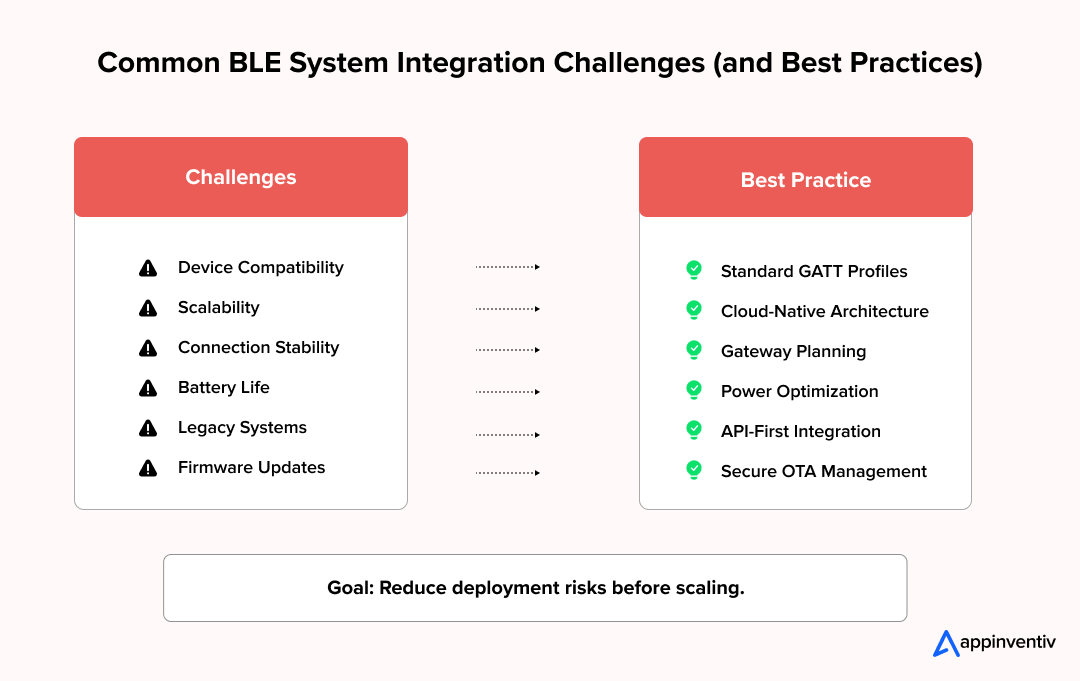
Hardware Matching
- Operational Difficulty: Devices from different vendors use unique formats. They share data through distinct characteristics and custom profiles. This structural mismatch causes serious compatibility issues during BLE devices integration.
- Best Route: Set strict profile rules before buying components. Test device matching during early discovery rounds. Build a standard translation layer to isolate vendor code from your core business application.
Network Scaling
- Operational Difficulty: A small trial with 20 tools operates differently from a network tracking 20,000 corporate endpoints across 10 regional facilities. High traffic loads can crash weak networks.
- Best Route: Deploy cloud-native tools and event-driven architectures. Set up a central control platform to manage large-scale hardware deployments, fleet management, and device lifecycles.
Connection Uptime
- Operational Difficulty: Physical walls, metal shelving, and competing wireless networks can interfere with radio waves. Antenna design, enclosure materials, and RF interference all affect BLE range and connection stability.
- Best Route: Map out router locations carefully. Track signal strength metrics constantly. Program your tools to reconnect automatically. Run tests in noisy factory settings rather than clean labs.
Battery Management
- Operational Difficulty: Constant signal broadcasting and continuous scanning rapidly drain battery power. This rapid drain increases manual upkeep expenses and requires frequent asset replacement.
- Best Route: Tune advertising intervals, scan windows, and connection parameters. Apply effective power management and power optimization techniques, transmit only essential data, and place devices in deep sleep during idle periods.
Old Software Links
- Operational Difficulty: Many firms run older ERP, MES, or warehouse management systems that were never built to process constant live data streams, a core reason why a clear legacy application modernization strategy must precede any BLE integration effort.
- Best Route: Connect tracking tools to business software through secure APIs. Use message tools like MQTT or Apache Kafka instead of writing messy direct point-to-point links.
Firmware Control
- Operational Difficulty: Updating code across thousands of active field devices is difficult without a central master control setup, especially given the complexities of integration of BLE in embedded systems. Manual updates waste engineering hours.
- Best Route: Deploy secure over-the-air update channels. Require digital signatures on all update files. Verify file safety before installation. Track version history across the fleet.
Data Matching
- Operational Difficulty: Trackers operate in remote zones with spotty network coverage. Data sets become mismatched after the network connection returns.
- Best Route: Save data locally on the device during drops. Add a precise time stamp to every operational event. Apply automated retry logic. Sync data through reliable queues.
Corporate projects rely on complete planning, not single choices. Leaders must prepare every tier, including hardware, cloud storage, and corporate databases. Early preparation removes risk and creates room for business growth without expensive platform overhauls.
Cost of BLE System Integration
The cost of BLE gateway system integration ranges from $50,000 to over $500,000, depending on deployment scale. Total expenses depend on your hardware volume, software details, security needs, and project scale.
| Project Scope | Estimated Cost (USD) | Timeline |
|---|---|---|
| Small Trial | $50,000 to $100,000 | 2 to 3 months |
| Department Level | $100,000 to $250,000 | 3 to 6 months |
| Full Corporate Scale | $250,000 to $500,000+ | 6 to 12 months |
Chief financial factors include:
- Total count and model of tracking tags
- Mobile application development
- Cloud infrastructure and backend services
- ERP, CRM, EHR, MES, or WMS integrations
- Security, compliance, and OTA firmware management
- Existing legacy systems and modernization requirements
- Testing across multiple devices and operating systems
Upgrading an active network saves time. Building a brand-new platform offers design choices but requires more funding for backend servers, asset security, and ongoing maintenance. Your decision relies on your current software stack and growth plans.
Your Architecture Determines Long-Term ROI
Deploy secure BLE platforms that support enterprise integrations, AI, compliance, and large-scale connected device ecosystems.

Future Outlook and Trends in BLE
Wireless tracking systems are shifting from local links to core corporate platforms. New upgrades allow companies to track massive device fleets over longer distances.
- Upgraded Hardware Performance: New chips provide longer communication ranges and higher speeds. Teams can expand their tracking networks without rebuilding their core infrastructure.
- Unified Corporate Platforms: “New setups blend Bluetooth, Wi-Fi, 5G, and artificial intelligence into a single corporate system, reflecting how cloud in digital transformation is reshaping how enterprises manage connected operations.
- Precision Tracking: Location beacons expand tracking accuracy inside large buildings. Native phone programs simplify how developers code corporate applications.
- Stronger Signal Reliability: Better antenna setups improve radio performance in tight corporate settings. Warehouses, hospitals, and factories gain steady connection uptime.
- Database Synchronization: Corporate leaders look beyond simple hardware connections. The true challenge lies in moving field data into business apps and databases without delay.
Future BLE system integration will rely on integrated software ecosystems, secure boot, OTA updates, and cloud-native device management rather than hardware improvements alone, reflecting broader enterprise technology integration strategies that are reshaping how modern organizations scale.
How Appinventiv Solves Enterprise BLE System Integration Challenges
Appinventiv, a trusted wearable device app development company, builds dependable wireless networks. Our engineers securely connect field hardware to corporate databases. We manage the entire pipeline, including firmware setups, cloud storage, and ERP links. Our work helps teams deploy systems quickly, from initial testing to full production.
Corporate Capabilities
- System Links: Connect tracking platforms with active corporate software via APIs.
- Device Control: Run cross-platform operations for various manufacturer models.
- Network Scaling: Build cloud backends that handle thousands of active trackers.
- Rule Compliance: Meet strict legal requirements like HIPAA and GDPR.
- Embedded Engineering: Develop Bluetooth in embedded system firmware, manage BLE stack integration, support secure OTA updates, and maintain device lifecycles across large BLE deployments.
Team Performance
Our corporate history shows the scale of the tracking programs we deliver.
- 30+ tech experts
- 120+ hardware projects delivered
- 10M+ applications downloaded
- 95% client satisfaction score
Our engineers design secure systems that integrate hardware and cloud databases into a single corporate platform. Our tech group handles database setup, mobile app development, and machine learning tools to protect your capital assets. We build stable networks through proven BLE system integration, ready for massive company growth and long-term operational success.
Let’s connect and build a secure, scalable BLE system today.
Frequently Asked Questions
Q. What devices commonly use BLE technology?
A. Enterprises rely on BLE system integration across several hardware types. Standard examples include wearable health trackers, medical monitors, environmental sensors, and inventory tags. Smart door locks, factory machinery sensors, and handheld barcode scanners operate as primary endpoints for data generation.
Q. Why is BLE important for IoT devices?
A. BLE hardware provides reliable wireless links with very low power needs. Many trackers run on small batteries for years. Examples include medical sensors, wearable monitors, and asset tags. The radio standard supports these long lifespans and maintains stable connections. It links smoothly with consumer phones, routers, and cloud platforms. Your teams can send this data directly to ERP, EHR, or warehouse software to track operations in real time.
Q. How does a Bluetooth Gateway work?
A. The BLE gateway system integration serves a central hub role between field sensors and your company network. The hardware scans for nearby transmitters, gathers data points, and forwards the packets to cloud platforms over Wi-Fi, Ethernet, or cellular links. Most corporate hubs support standard data protocols like MQTT or REST APIs. This design connects raw sensor data to your backend tools. The hub eliminates the need for individual internet links for each sensor, simplifying fleet control.
Q. How does a Bluetooth Gateway work for asset tracking?
A. Crews attach small tags to factory equipment, pallets, forklifts, or medical tools. Gateways installed across the building pick up these radio waves and measure signal strength. The hubs send these metrics to a location tracking database. Software counts the exact coordinates and updates executive dashboards instantly. Managers connect these feeds to ERP or warehouse software to cut equipment search times and monitor asset moves.
Q. How easy is it to integrate Bluetooth Gateways into an existing asset tracking system?
The setup difficulty relies on your current software setup. Open APIs and messaging tools like MQTT make BLE gateway system integration simple. Most modern gateways share data in standard formats. Backend tools read these streams without deep recoding. Obstacles arise with old databases or custom protocols. Teams must add middleware or API connectors to sync the data with your main ERP software. Early architecture planning cuts setup hours and clears a path for growth.