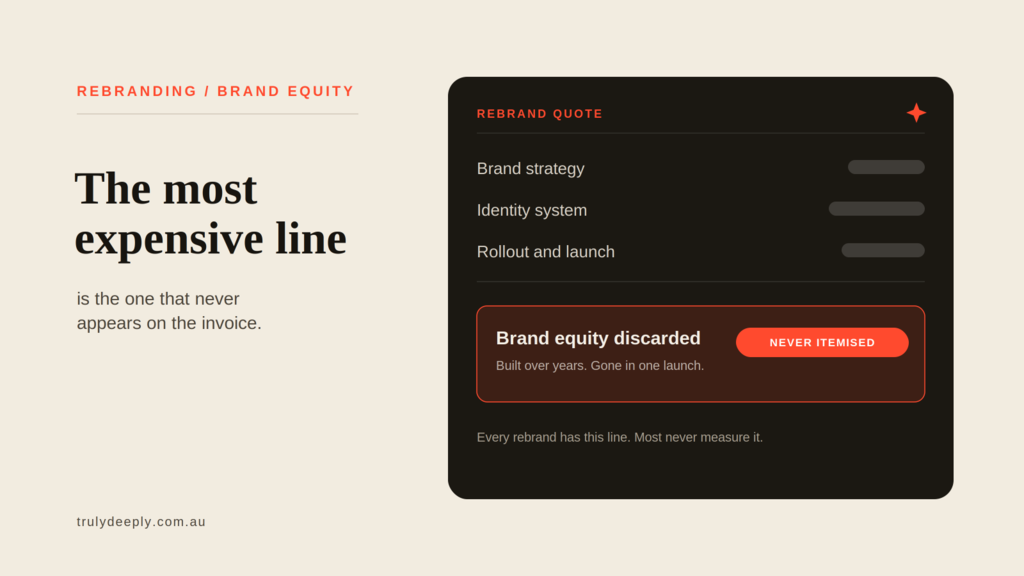
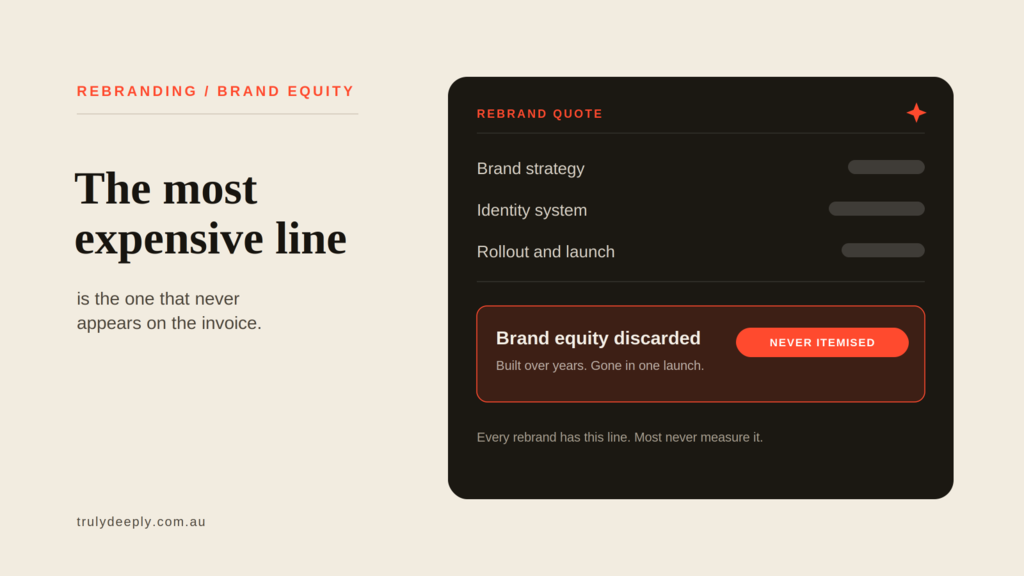
The most expensive line on a rebrand invoice could the one that never appears on it.
It isn’t the strategy, the identity system or the rollout. It’s the brand equity you quietly throw away the moment you retire the colour, the symbol or the shape that customers were using to find you. You can’t see it on the invoice. You see it later, in a recognition dip, a flat quarter, a competitor who suddenly looks more familiar than you do.
Rebrands fail in public for all sorts of reasons. The most common one, and the least understood, is this: in the rush to look new, brands erase the very things that made them easy to choose.
What you are actually risking
The assets in question have a name.
Distinctive brand assets are the non-name cues that trigger your brand in a buyer’s memory: a colour, a logo, a shape, a character, a sound, a tagline, a typeface. Think of the Cadbury purple, the Toblerone triangle, or the ‘da dum’ when you turn on Netflix. None of them is the brand name, yet each one summons the brand instantly.
This isn’t an aesthetic idea. It’s a measurable one. It been mapped most rigorously by Professor Jenni Romaniuk and the Ehrenberg-Bass Institute in Adelaide, whose work underpins much of how serious marketers think about distinctiveness today. Their finding, put simply: these cues are memory structures, built through years of consistent exposure, and they are what let a buyer recognise and choose you quickly, often before they consciously weigh you against anyone else.
It’s worth being precise here, because the terms get muddled. Distinctiveness is not the same as differentiation. Differentiation is about being different on paper, a better proposition, a sharper position. Distinctiveness is about being recognisable in the moment of choice. You can win the first and still lose the second, and it is the second that a careless rebrand puts at risk. This applies well beyond supermarket shelves, too. A professional services firm’s colour, name, typographic style and tone are distinctive assets exactly as a soft drink’s packaging is. The category changes. The principle does not.
Why rebrands keep destroying them
If distinctive assets are so valuable, why do capable teams keep discarding them? Usually for reasons that feel entirely sensible in the room.
A new leader arrives and wants a mark of their own. The team has grown tired of the current identity, forgetting that you get sick of your own assets years before your market even notices them. Someone decides the brand looks dated, and quietly mistakes “familiar” for “old.” And underneath all of it sits the single most expensive assumption in branding: that a rebrand is a fresh start, a blank page, a chance to begin again.
It is not. A rebrand is an act of evolution performed on an asset that already carries value, and treating it as a reset throws that value away.
The cautionary tales are famous for a reason.
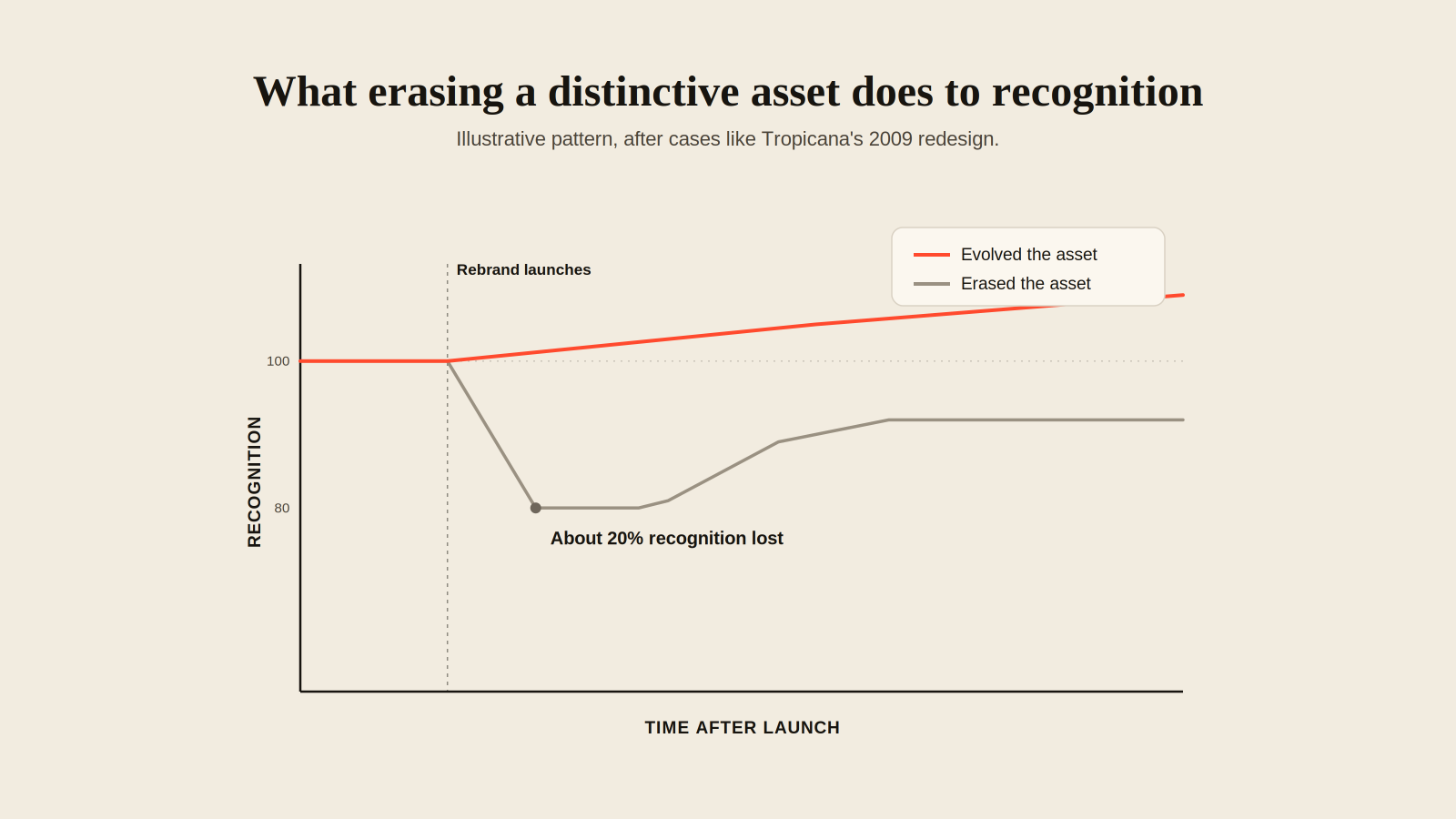
In 2009 Tropicana replaced the orange-and-straw image that shoppers used to spot it on the shelf with a generic glass of juice. Within two months sales had fallen by around 20%, a loss estimated near thirty million dollars, and the company reversed the change. Remarkably, it came close to repeating the mistake in 2024 with another redesign that drew the same backlash. The lesson did not stick, which tells you how strong the pull toward “new” really is.
Jaguar offers a more complicated and recent example. When the brand dropped its leaping-cat heritage for a minimalist identity and a campaign that showed no cars, European sales collapsed in early 2025. Some of that fall reflected a deliberate production halt rather than the rebrand itself, so the simple “the logo killed it” story is too neat. But the strategic gamble is real: Jaguar walked away from the cues its existing buyers recognised, betting that new, unfamiliar audiences would more than replace them. Awareness rose. Whether unfamiliarity converts into sales is the open question, and it is a very expensive question to have left open.
Before you touch anything, know what you own
The discipline that prevents these mistakes is unglamorous and almost always skipped. Before changing a single element, audit what you actually own in your customers’ minds.
A useful tool for this is Romaniuk’s Distinctive Asset Grid, which scores each of your brand cues on two axes. Fame is how many people in your market link the asset to your brand. Uniqueness is how exclusively it points to you rather than a competitor. A rough working standard is 50% on both. Crucially, you test this unprompted, showing people the asset without the name, because the moment you lead the witness your assets look far stronger than they are.
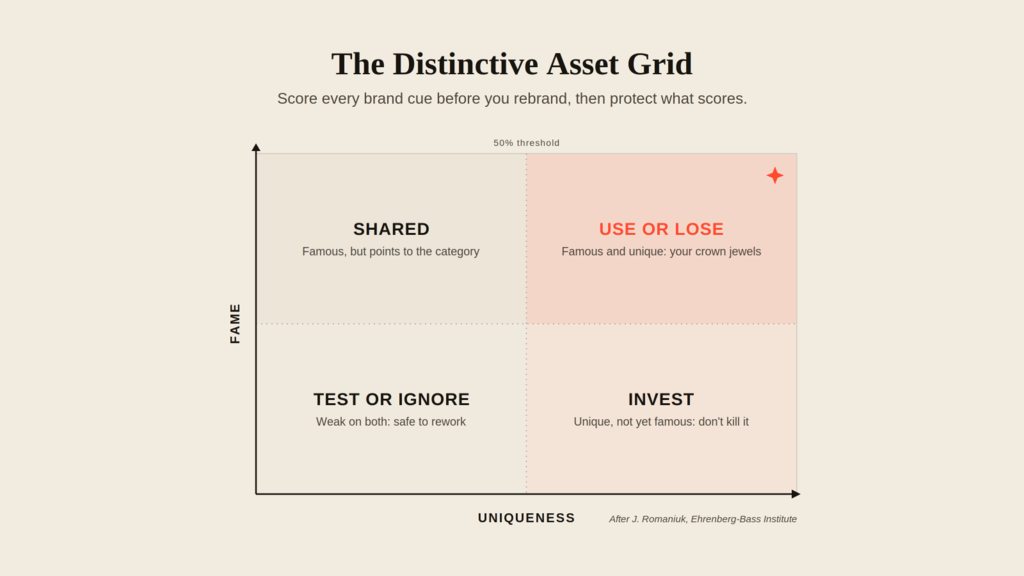
Every cue then lands in one of four positions, and each carries a clear instruction.
- Use or lose. Famous and unique. These are your crown jewels, the cues that can stand in for your name entirely. In a rebrand, you touch these last, if at all.
- Invest. Unique but not yet famous. High-potential assets that simply need more time and exposure. These are the ones brands kill too early, abandoning them right before they would have paid off.
- Shared. Famous but not unique. Recognisable, but pointing to the whole category rather than to you. Think of the interchangeable sage-green palettes of wellness brands, or the identical clean sans-serifs of tech. Familiar, and forgettable.
- Test or ignore. Weak on both. New or simply not working. This is the genuinely safe territory to rework.
Run this audit and the rebrand brief rewrites itself, because now you can see which changes are free and which ones are quietly setting fire to equity.
This is exactly the discipline a Brand Assets and Equity Review is built to provide, and at Truly Deeply it is the step we recommend before any major rebrand begins. Rather than trusting the room’s instincts about what matters, the review maps what your brand actually owns in the minds of the people who buy from you: which cues carry recognition, which carry real value, and which are quietly doing nothing at all. It turns the rebrand brief from a question of taste into a question of evidence, so you change what is safe to change and protect what would be costly to lose. It is the difference between evolving from a position of strength and gambling with equity you never properly measured.
The decision rule: preserve, evolve, retire
With the grid in front of you, the rebrand decision becomes far less a matter of taste and far more a matter of evidence.
Preserve the use-or-lose assets. Carry them across the rebrand untouched, or close to it, even if the team is bored of them. Evolve the high-potential and shared assets deliberately, strengthening what is nearly yours and reworking what points to the category. Retire only what tests genuinely weak.
The classic failure is doing the exact reverse: keeping the generic logo because leadership is attached to it, and binning the one strange, vivid, unmistakable thing the market actually remembers you by. Personal preference in the boardroom is not a measure of brand value. The grid is.
How to evolve without erasing
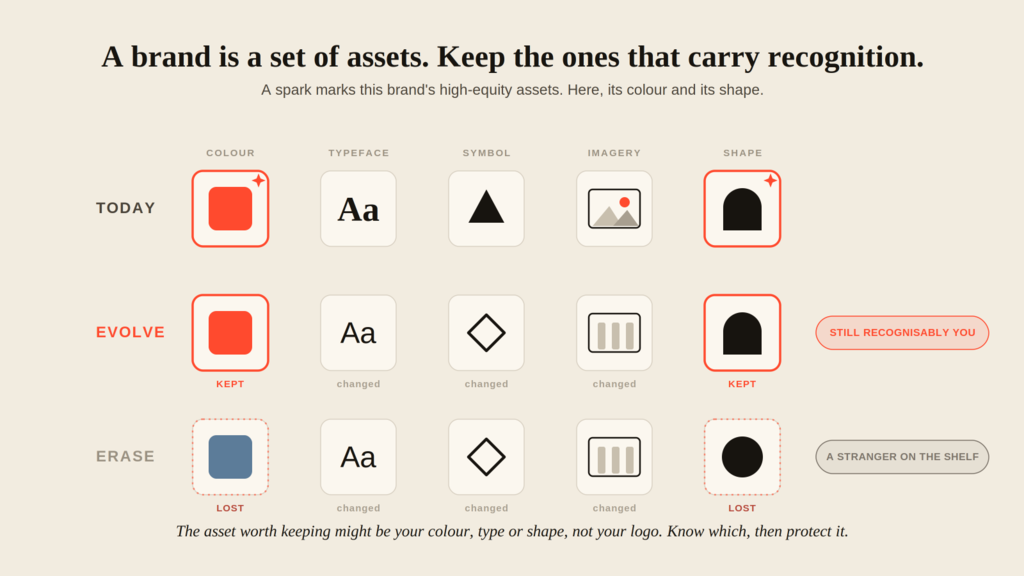
Protecting equity does not mean freezing the brand. It means changing it the way a careful surgeon operates, not the way a demolition crew works.
Bridge rather than cut. Hold one or two hero assets constant while everything else shifts, so the new brand connects visibly to the one buyers already know. Stage the change rather than detonating it all at once, which gives recognition time to transfer. Test before you commit, using simple unbranded recognition checks to see whether people still find you. And then, the least exciting and most important instruction of all: be consistent, relentlessly, for years. The memory structures you are protecting were built by repetition, and the clock resets every time you chop and change.
None of this is an argument for timidity. Distinctive does not mean dated, and consistent does not mean boring. The most distinctive brands on earth are also among the most creative. They have simply understood the difference between the things they are free to reinvent and the few things they must never surrender.
When a clean break is the right call
Everything above defends the equity you have built. But it would be dishonest to pretend a clean break is never the right answer, because sometimes it plainly is. The discipline is not “never change everything.” It is “never change everything by accident.”
There situations where starting over is the sound, evidence-led decision rather than the reckless one.
The first is when your equity has turned negative, when the associations attached to your name are working against you. After a serious reputational hit, or when a brand is fused to a past it needs to leave behind, recognition becomes a liability, not an asset, and the goal shifts from preserving memory to replacing it.
The second is when you are genuinely a different business: a merger, a pivot or a move into a new market can leave the old brand describing a company that no longer exists, and carrying the old cues forward would only mislead the people you now want to reach.
The third is the quietest of all, and the audit reveals it. When your assets test weak on both fame and uniqueness across the board, there is simply little equity to protect, and a bold, genuinely new identity becomes the faster path rather than the destructive one. To these you can add the forced cases, where a lost trademark or a separation from a parent company makes a new name non-negotiable.
The thread running through all of them is the same one running through this whole piece. A clean break should be a conclusion you arrive at from evidence, not a reflex you reach for out of boredom or a new leader’s appetite for change. And even when the decision is right, go in with your eyes open. Starting over means choosing to spend years rebuilding recognition from nothing, and that cost should be named, budgeted and deliberate, not discovered in a flat quarter eighteen months later. The grid is what tells you which conversation you are actually in: whether you have equity worth defending, or a blank slate worth using.
The real test
If you are rebranding to build on what you have, the aim is to strengthen memory, not reset it. The goal is not a completely new brand. It is a stronger one.
The businesses that come out of a rebrand ahead are the ones that knew exactly what they owned before they changed a thing, protected it on purpose, and let everything else evolve around it. The ones that come out behind are the ones who confused looking new with being better, and paid for the difference in a currency that never showed up on the quote.
Know what you own. Then decide, with evidence, what to protect, what to evolve, and what to let go. Sometimes that means a clean break, taken on purpose and with the cost in full view. What you never want is to erase by accident, and find out too late what it was worth.
Michael Hughes
Michael is Managing Partner and Strategy Director at Truly Deeply.
Truly Deeply is a Melbourne brand strategy and creative agency. When rebranding, we recommend starting with a Brand Assets and Equity Review, so you know exactly what you own before you change a thing, and evolve without losing the equity that makes you worth choosing.
Want to find out more? Contact us.