[ad_1]
Summary
Predictive analytics helps businesses anticipate customer behavior and act before it happens. By combining AI with real-time data, brands can improve targeting, automate engagement, and drive better business outcomes.
Most marketing teams run campaigns based on what customers already did. Predictive analytics flips that model. It uses historical data and machine learning to forecast behavior before it happens, so you can target the right customers at the right moment with the right offer.
The difference between tracking past actions and forecasting future ones determines whether you’re reacting to churn or preventing it, whether you’re discounting customers who’d buy anyway or reaching the ones on the fence.
What is predictive analytics?
Predictive analytics answers “what will happen next.” Descriptive analytics tells you what already happened. The distinction matters because most marketing teams are drowning in analytics dashboards that show yesterday’s metrics but offer no guidance on tomorrow’s decisions.
At its core, predictive analytics applies machine learning (ML) algorithms to historical data to generate probability scores for future outcomes. A churn model, for example, doesn’t just flag customers who stopped buying. It calculates the likelihood that each active customer will stop buying in an upcoming period.
Many marketers confuse behavioral tracking with forecasting. Tools like Amplitude, Mixpanel, and Hotjar track what users did. They show you funnels, retention curves, and session recordings. Predictive models forecast what users will do. They output probability scores you can act on.
How does predictive analytics differ from business intelligence (BI) and behavioral analytics?
If your goal is to understand past performance, start with business intelligence. If your goal is to anticipate future behavior, you need predictive analytics.
- BI tools (Tableau, Looker): Visualize historical trends and build dashboards. They don’t build custom machine learning models
- Predictive analytics: Uses ML models to forecast specific future actions like churn, purchase, or conversion
Which model families should you use for each use case?
Different business problems require different mathematical approaches.
- Classification: Binary outcomes like churn yes/no. Measured by area under the curve (AUC), precision, recall
- Regression: Continuous values like customer lifetime value. Measured by root mean square error (RMSE), mean absolute error (MAE)
- Time-series forecasting: Demand and revenue projections. Measured by mean absolute percentage error (MAPE), RMSE
- Survival analysis: Time-to-event predictions like time-to-churn. Measured by concordance index
- Uplift modeling: Incremental treatment effect. Measured by Qini curve
Most marketing use cases start with classification or regression. Survival and uplift models deliver high value but require experimentation infrastructure.
Why does predictive analytics matter for marketing teams?
Consider a retention campaign. You can send a discount to your entire database, or you can target only the customers most likely to churn. The second approach costs less and converts better. Resources go to persuadable customers, not people who were going to buy anyway.
Model accuracy only matters relative to the cost of errors. A churn model with modest precision can still be profitable if the intervention cost is low compared to the value of a retained customer.
- Reduced wasted spend: Stop offering discounts to customers who plan to buy anyway
- Higher conversion rates: Reach out exactly when a user shows high intent
- Improved customer lifetime value: Identify high-value cohorts early and nurture them
- Faster campaign iteration: Automate audience selection based on real-time probability scores
How do model metrics connect to business outcomes?
AUC and precision are proxies, not goals. The actual goal is profit or margin protection.
Threshold selection determines your business outcome. A higher threshold means fewer but higher-confidence predictions. A lower threshold means broader reach but more false positives. If a discount is inexpensive compared to the value of a retained customer, you can tolerate fairly low precision and still break even. Most teams never do this math.
What are the core marketing use cases for predictive analytics?
- Churn propensity: Predicts likelihood to leave within a specific window. Works well when tied to a clear time horizon
- Customer lifetime value: Predicts total future spend. Helps allocate acquisition budgets effectively
- Lead scoring: Predicts likelihood to close to better aligns sales and marketing efforts
- Next-best-action: Predicts the optimal offer or channel. Drives personalization at scale
- Send-time optimization: Predicts when each user is most likely to engage
- Demand forecasting: Predicts future sales volume for inventory and budget planning
What are the common pitfalls, and how do you measure real lift?
Teams build models that look perfect in validation but fail in production. This usually happens because the model trained on data that leaked future information.
Data leakage occurs when your training data includes signals that won’t be available at prediction time.
- Remove all features computed after the prediction point
- Ensure the target variable doesn’t accidentally bleed into input features
- Use strict time-based splits for training and testing data
Incrementality testing is the only way to prove a model drives value. Hold out a random control group and measure the difference in outcomes. Propensity scores alone don’t prove causation. If you want to see what predictive segments look like when they’re built to activate (and prove lift), book a demo.
What are predictive analytics examples in marketing and retail?
How does churn propensity modeling work?
Define the target variable precisely: “Did the customer make a purchase in the period following the prediction date?” Different churn models require different features and serve different use cases.
Key features include days since last purchase, purchase frequency trends, engagement recency, and support ticket history. To activate, target the highest-risk segment by churn probability with a retention offer. Always hold out a control group to measure incremental lift.
Propensity models identify who is likely to churn, not who is persuadable. Uplift modeling addresses this but requires experimentation infrastructure.
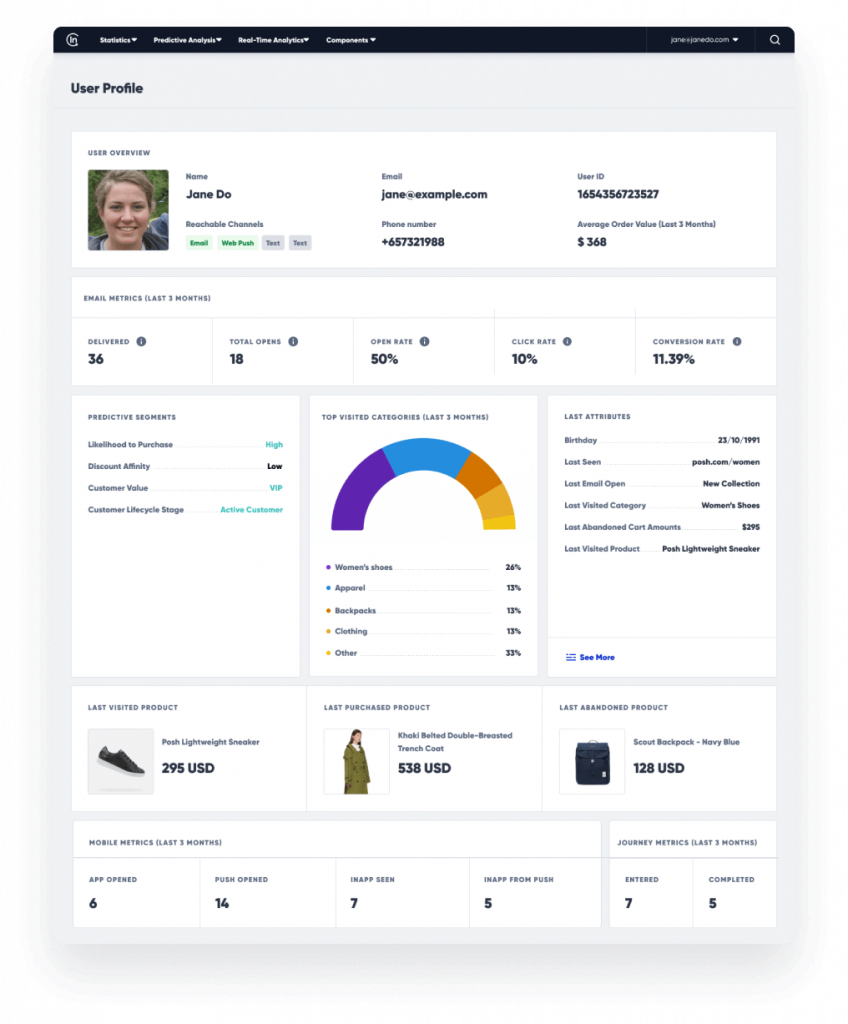
How does customer lifetime value prediction work?
Customer lifetime value (CLV) prediction is often confused with revenue forecasting. CLV predicts the total value of a customer over their entire relationship with the brand, not just next-month revenue.
- Regression-based: Predict CLV directly using historical features. Simpler but less interpretable
- Probabilistic: Model purchase frequency and monetary value separately, then combine. More interpretable but requires specific data structure
CLV models trained on short observation windows systematically underestimate long-term value. Use a sufficiently long history of data when possible.
How does lead scoring support sales prioritization?
The goal of lead scoring is to help sales teams prioritize, not to maximize AUC. A model that ranks leads correctly but doesn’t integrate with sales workflows provides no value.
Key features include firmographic data, engagement signals like email opens and page views, and source channel. Segment leads into tiers and define SLAs for sales follow-up by tier. If sales doesn’t trust the scores, they won’t use them.

How do next-best-action models improve offer optimization?
Propensity models predict who is likely to convert. Uplift models predict who is likely to convert because of the treatment. The difference matters for ROI.
A customer with a high purchase propensity is likely to buy without a discount. Targeting them wastes margin. Uplift modeling identifies customers who are undecided. This requires experimentation data: you need a control group that didn’t receive the offer to train the model.
How does retail demand forecasting work?
Demand forecasting predicts future sales volume, enabling inventory optimization and marketing budget allocation.
Key considerations include seasonality, promotional effects, and external factors like holidays. ARIMA works for simple patterns. Prophet handles seasonality with interpretability. Gradient boosting with lag features handles complex patterns.
Forecasting during promotions often requires separate models or explicit promotion features to avoid mixing baseline demand with promo-driven demand. If you’re ready to turn these predictions into triggered journeys across channels (without waiting on another quarter-long integration), book a demo.
Predictive analytics platforms vary widely in depth, from behavioral analytics tools to systems that support custom forecasting models. These tools typically focus on historical behavior rather than custom forecasting workflows.
- BI/visual forecasting (Tableau, Looker): Good for dashboards and simple trend extrapolation, not custom ML
- Automated machine learning (AutoML) platforms (DataRobot, H2O): Good for teams without data scientists who need custom models
- Machine learning (ML) libraries (scikit-learn, XGBoost): For teams with data science capabilities
- Machine learning operations (MLOps)/monitoring (MLflow, Evidently): For production model management
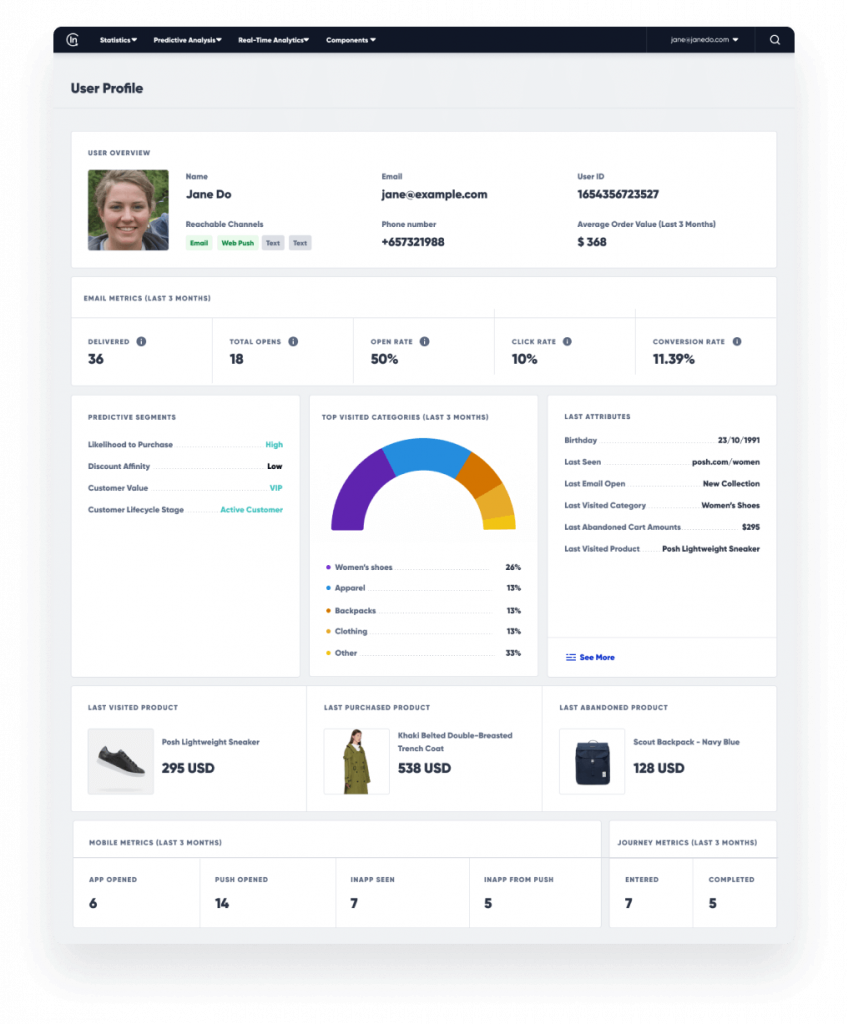
- CDP/marketing platforms with predictive features: Provide pre-built predictive segments and scores
What are the forecasting limits of business intelligence (BI) tools?
BI tools like Tableau and Power BI offer built-in forecasting for trend lines and time series. These are useful for quick projections but limited: they don’t support custom features, can’t handle complex patterns, and don’t integrate with activation workflows.
Best for executive dashboards and scenario planning. Not for custom propensity models or real-time scoring.
When should teams without data scientists use AutoML?
AutoML platforms automate feature engineering, model selection, and hyperparameter tuning. They’re good for teams without ML expertise who need custom models and rapid prototyping.
AutoML can overfit if not carefully validated. It also creates governance challenges if models aren’t documented.
How do CDP and product analytics tools handle predictive features?
Some analytics tools provide pre-built propensity scores based on behavioral data. These features can support quick activation, while custom model workflows offer more control over features, validation, and methodology.
Treat these outputs as directional signals within a broader predictive workflow. They’re a starting point, not a replacement for custom predictive analytics.
How should teams handle governance, ethics, and responsible predictive analytics?
Models that discriminate, lack explainability, or violate privacy create legal and reputational risk. Governance isn’t optional for enterprise teams.
How do you detect bias and evaluate fairness?
Bias can enter through training data, feature selection, or threshold setting.
- Demographic parity: Equal prediction rates across groups
- Equalized odds: Equal true positive and false positive rates across groups
No metric is universally correct. The choice depends on context and legal requirements. Mitigation approaches include resampling, threshold adjustment by group, and removing sensitive features.
How do you document and explain the model?
- Shapley additive explanations (SHAP): Shows feature contribution for individual predictions
- Local interpretable model-agnostic explanations (LIME): Provides local approximations of model behavior
- Feature importance: Gives a global ranking of which inputs matter most
Model cards document intended use, training data, performance metrics, limitations, and fairness considerations. Explainability is required for regulated industries and increasingly expected by customers.
What privacy and compliance considerations matter most?
- Data minimization: Only collect and use data necessary for the prediction task
- Consent: Ensure customers consent to automated decision-making where legally required
- Retention: Define how long model training data and predictions remain stored
- Personally identifiable information (PII) handling: Anonymize or pseudonymize data wherever possible
How does Insider One turn predictions into action?
Most teams can build models but struggle to activate them in real time across channels. The gap between insight and execution is where value gets lost.
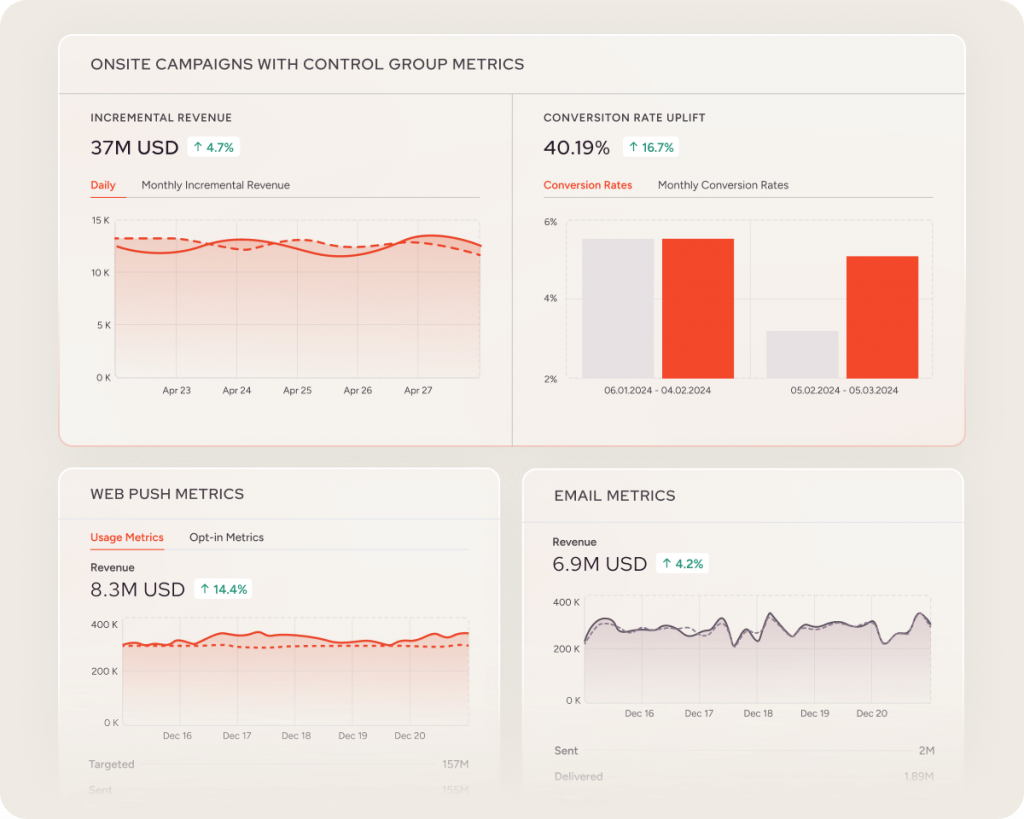
Insider One bridges this gap. Our unified customer data platform (CDP) collects and unifies the data. Sirius AI™, Insider One’s extensive set of AI capabilities, powers pre-built predictive segments for churn, CLV, and discount affinity. Architect, Insider One’s customer journey orchestration solution, activates those predictions across email, SMS, WhatsApp, web, and app.
What differentiates Insider One for marketing teams?
- Unified CDP: Customer data, engagement data, and product data in one place. No stitching required
- Pre-built predictive segments: Churn, CLV, and discount affinity segments work out of the box
- Real-time activation: Scores flow directly into Architect for triggered journeys across every channel
- Built-in incrementality testing: A/B Auto-Winner Selection and holdout groups measure real lift, not just model accuracy
How fast can teams see value and prove impact?
Teams go live faster with Migration Lab™ support.
- Initial phase: Complete data integration and identity resolution
- Next phase: Launch the first predictive segment
- Following phase: Run the first A/B test with a holdout group
If you want to see how this looks in your stack, data in, scores out, journeys live, book a demo, and we’ll map the fastest path to impact.
Frequently asked questions
Predictive analytics forecasts what will happen. Prescriptive analytics recommends what to do about it. Predictive tells you a customer is likely to churn; prescriptive suggests the optimal retention offer and channel.
It depends on your approach. AutoML platforms and CDPs with built-in predictive features deliver value without data scientists. Custom models with interpretability and incrementality testing typically require machine learning (ML) expertise.
Yes, with constraints. Simpler models like logistic regression with regularization perform better on small data than complex models. Expect higher variance in predictions and validate carefully.
Accuracy requirements depend on the cost of errors. A churn model with modest precision can still be profitable if the intervention cost is low relative to the value of retained customers. Define your threshold based on expected value, not abstract accuracy targets.
Use time-based train/test splits, cross-validation, regularization, and early stopping. Never include features computed after the prediction point. Validate on held-out data that the model has never seen.
Monitor prediction distributions and business KPIs. When drift is detected, investigate whether data inputs changed or customer behavior shifted. Retrain on recent data and compare performance before deploying the updated model.
Predictive analytics forecasts individual customer behavior. Marketing mix modeling estimates aggregate channel effectiveness. Multi-touch attribution assigns credit to touchpoints in the conversion path. They answer different questions and are often used together.
[ad_2]
Source_link