[ad_1]
Key takeaways:
- Building a Claude-scale model can consume years, millions of dollars, and dedicated AI research resources.
- Most enterprises gain faster business value through fine-tuning, RAG, or hybrid AI deployments.
- The largest AI expenses often appear after launch through inference, governance, monitoring, and retraining.
- Data quality, compliance reviews, and system integration create more delays than model development.
- The winning AI strategy is rarely building a new model. It is selecting the right architecture.
Enterprise interest in private AI has grown sharply over the past year. Rising usage costs, API consumption charges, model access limits, and growing dependence on third-party providers have pushed many leadership teams to ask a new question: What is the cost to build an enterprise LLM like Claude and should we build our own? language model?
The discussion gained momentum after reports linked Microsoft’s rollback of some Claude Code licenses and Uber’s growing AI spending to broader concerns around long-term AI economics.
For enterprises running thousands of daily prompts across engineering, support, knowledge management, and workflow automation systems, inference costs can rise much faster than expected.
At first glance, building an enterprise LLM seems like a practical way to gain cost control, data ownership, and operational flexibility. Open-source models such as Llama, Qwen, and Mistral have lowered the barrier to AI development.
Yet there is a major difference between customizing an existing model and choosing to build a custom AI model like Claude from scratch. Training data, GPU infrastructure, alignment pipelines, model evaluation, and continuous retraining demand substantial investment.
In many cases, costs reach tens of millions of dollars before the model delivers business value. This guide explains how enterprise LLMs are built, what they cost, and which development path makes the most business sense.
$100M+ Can Disappear Into AI Infrastructure
Model training, GPUs, talent, and operations can quickly turn AI ambitions into budget overruns.

How Enterprises Are Reducing Their Dependence on Public LLMs
A year ago, companies chose AI models based on quality. Today, conversations center on the cost of large-scale adoption. A pilot for 50 users is cheap. Expenses rise across thousands of employees and automated workflows.
Recent reports highlight this issue. Uber gave Claude Code access to 5,000 engineers. Microsoft rolled back some Claude Code licenses to control spending.
Multiple factors push companies to find alternatives. High inference bills create budget pressure. Teams want to reduce dependency on Claude AI. They need private AI for the enterprise to meet data residency rules. Leaders calculate the cost of building an enterprise LLM like Claude to protect company knowledge.
| Market Shift | Enterprise Response |
|---|---|
| Higher AI spending | Greater focus on cost control |
| Vendor dependence | Efforts to reduce dependency on Claude AI and other external providers |
| Regulatory pressure | Tighter data governance |
| Specialized use cases | Custom AI development initiatives |
This shift has sparked growing interest in private vs public LLM deployments, fine-tuned open-source models, and Claude-like AI model development initiatives. The question many executives are asking is simple: Does building an LLM create savings, or does it introduce an even larger investment?
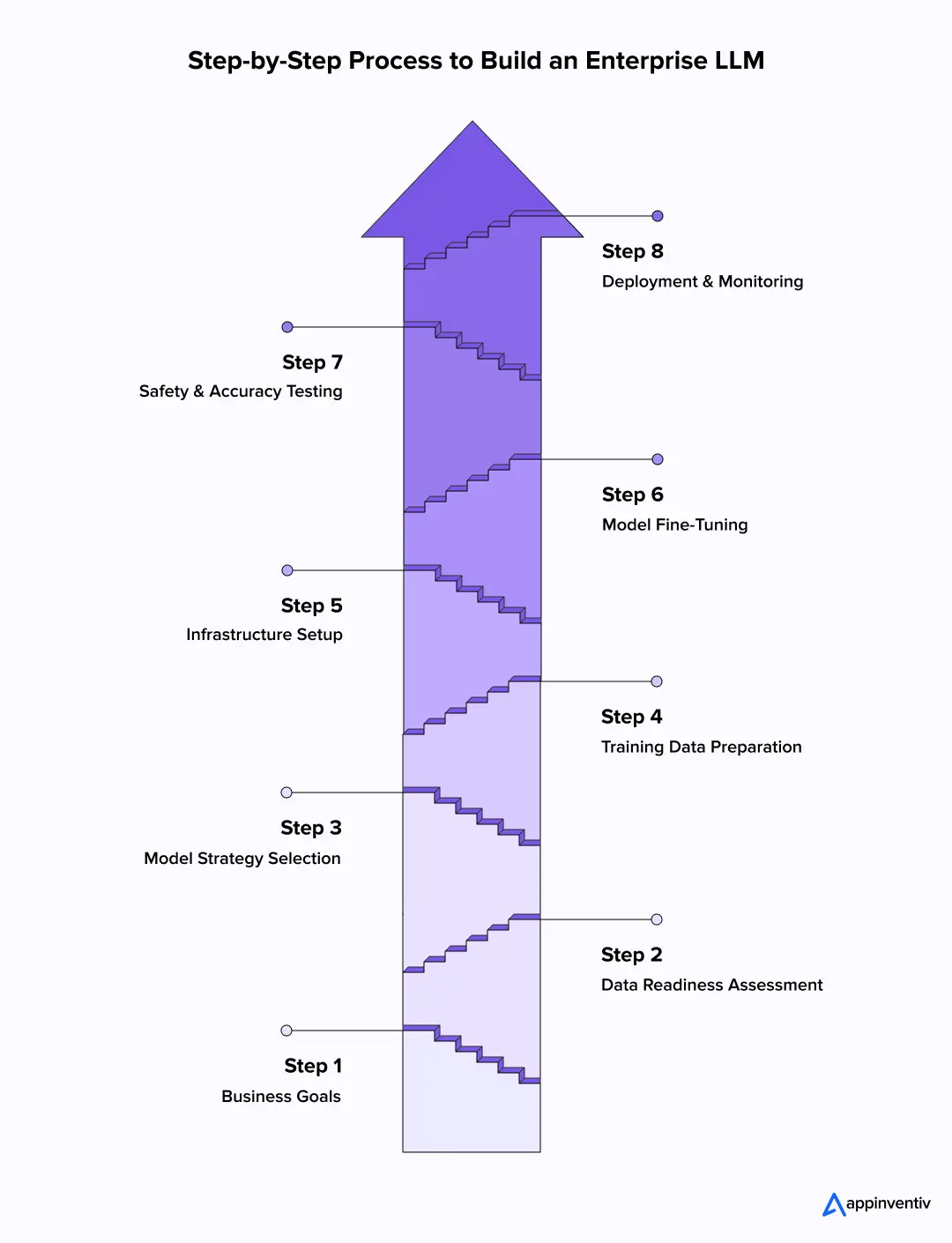
Step-by-Step Process to Build an Enterprise LLM
Most enterprise AI projects fail early, not during model training. Teams find gaps in data quality, security, and hardware planning. Budgets vanish, and schedules slip quickly. Building an enterprise LLM takes more than feeding corporate data to a model. The work requires data engineering, security controls, and long-term operations.
Define Business Objectives and Success Metrics
The first task is to identify the workload the model will support. Generative AI for business spans a wide range of use cases, and a legal contract assistant, an enterprise AI copilot, an engineering knowledge bot, and a customer support agent all require different architectures and datasets. Success metrics should be tied to business outcomes.
Examples include:
- 35% faster case resolution
- 50% reduction in manual document review
- Higher retrieval accuracy
- Lower support handling costs
Clear targets prevent unnecessary model development and infrastructure spending.
Assess Data Readiness
Most enterprises store data across content management systems, data warehouses, SharePoint environments, ticketing platforms, CRMs, and internal databases. The challenge is not data volume. The challenge is data quality.
Teams typically assess:
- Data completeness
- Data lineage
- Access controls
- Retention policies
- Regulatory restrictions
Data profiling and classification exercises often reveal duplicate records, stale content, and inconsistent formats that reduce model performance.
Choose the Right Model Strategy
This stage has the largest impact on project cost. The organization must decide between:
- Training a foundation model
- Continued pretraining of an open-source model
- Fine-tuning an existing model
- Building a RAG-based architecture
For most enterprises, fine-tuning or RAG provides a faster path to value than training a model from scratch. The choice should reflect the business objective, available data, and expected usage volume.
Prepare and Curate Training Data
Raw enterprise data cannot move directly into a training pipeline. Teams clean, normalize, label, and structure datasets before training begins.
Typical preparation tasks include:
- Deduplication
- Data enrichment
- PII removal
- Metadata tagging
- Document chunking
The final dataset often contains policy documents, contracts, support conversations, product manuals, technical documentation, and operational knowledge.
Poor training data produces poor outputs regardless of model size.
Build Training and Inference Infrastructure
Infrastructure requirements vary by model strategy. Training environments often include GPU clusters, distributed storage systems, high-bandwidth networking, and orchestration platforms.
Common technology components include:
- NVIDIA H100 or A100 GPUs
- Kubernetes
- Ray clusters
- Distributed file systems
- Object storage platforms
Inference infrastructure handles production workloads after deployment. This layer serves prompts, manages concurrency, and controls latency.
Fine-Tune and Align the Model
The next stage adapts the model to enterprise requirements. Teams often use supervised fine-tuning, instruction tuning, parameter-efficient fine-tuning (PEFT), or LoRA techniques.
Model alignment focuses on behavior rather than raw capability. The goal is to improve response quality, reduce hallucinations, and keep outputs consistent with business policies.
Evaluate for Accuracy, Safety, and Bias
Testing continues throughout development. Enterprise evaluation frameworks often combine automated benchmarks with human review.
Common evaluation areas include:
- Retrieval accuracy
- Hallucination rates
- Toxic content detection
- Bias measurement
- Data leakage testing
Many organizations create benchmark datasets that reflect real business workflows rather than public evaluation datasets.
Deploy, Monitor, and Continuously Improve
Deployment marks the beginning of long-term operations. Production systems require monitoring across infrastructure, application, and model layers.
Teams typically track:
- Token consumption
- Response latency
- GPU utilization
- User satisfaction
- Model drift
Many organizations establish LLMOps for enterprise practices to manage updates, retraining cycles, observability, and governance reviews.
| Stage | Primary Focus |
|---|---|
| Business Planning | Define goals and measurable outcomes |
| Data Assessment | Validate quality, ownership, and compliance |
| Model Selection | Select the right development path |
| Data Preparation | Build training-ready datasets |
| Infrastructure Setup | Support training and inference workloads |
| Fine-Tuning and Alignment | Improve business-specific performance |
| Evaluation | Measure accuracy, safety, and reliability |
| Deployment and Monitoring | Maintain quality and operational stability |
The technical work involved in enterprise LLM development extends far beyond model training. Data engineering, infrastructure design, security controls, evaluation pipelines, and operational management often consume more effort than the model itself.
That reality explains why Claude-like AI model development remains out of reach for most organizations, pushing them toward fine-tuning or RAG architectures instead.
Enterprise LLM Architecture: Core Components You Need
Enterprise AI systems contain far more than a model. A legal assistant, engineering copilot, claims processing agent, and knowledge search platform often use the same core architecture.
The model sits at the center, but data movement, retrieval, security, and governance determine how the system performs in production.
| Architecture Layer | Purpose |
|---|---|
| Enterprise Data Sources | Documents, emails, databases, tickets, policies, and business records |
| Data Pipeline | Data ingestion, transformation, classification, and indexing |
| Vector Database | Stores embeddings for semantic retrieval |
| Embedding Models | Convert content into searchable vector representations |
| Foundation Model | Generates responses and reasoning outputs |
| Guardrails | Applies security, privacy, and policy controls |
| Agent Layer | Executes tasks and interacts with enterprise systems |
| Monitoring Layer | Tracks cost, latency, usage, and model behavior |
| Governance Layer | Supports compliance, auditability, and access control |
A document rarely travels directly to a model. Most enterprise requests pass through ingestion pipelines, RAG-powered retrieval, security controls, and monitoring tools before a response reaches the user.
That architecture explains a common surprise in enterprise AI projects. The model often receives the most attention, but data engineering, governance, retrieval quality, and AI integration services for connecting enterprise systems often consume more time and budget.
How Much Does It Cost to Build an Enterprise LLM?
Executives often calculate the cost to build an enterprise LLM like Claude. They assume that building a private model saves money compared to paying monthly API fees. The financial math points in the opposite direction.
Total AI development cost spans far beyond the initial code repository. Executives must balance these upfront expenses against real business returns.
Cost of Building a Claude-Like Foundation Model
Few organizations truly need to build a custom AI model like Claude from scratch. Decisions to clone Claude with AI require massive research teams. You must build AI gigafactory-scale GPU environments to train foundation software.
- Typical Investment: $10 million to $100 million
- Data and Infrastructure: $5.5 million to $60 million
- Talent and Testing: $2.5 million to $25 million
This path delivers complete ownership of the technology asset. Buyers face zero vendor lock-in risks. The company controls data privacy completely.
The investment creates a proprietary asset for the business. The model learns unique industry data to power new products.
Does this large spend make financial sense? Yes. You must sell the model as your core product to justify the cost. Standard commercial models must fail at your specific domain tasks to justify this cost.
Cost of Fine-Tuning Open-Source Models
Companies can choose to modify existing models like Llama, Qwen, or Mistral. Teams focus on business data and system deployment. This strategy drops your total AI development cost.
- Typical Investment: $100K to $1 million
- Data Preparation: $25K to $250K
- Tuning and Testing: $50K to $500K
- Operational Setup: $25K to $250K
This path delivers strong returns on specific corporate tasks. Modified models process legal contracts or medical codes accurately.
Hosting smaller models internally reduces your long-term token fees. Businesses process high transaction volumes at a lower cost than public APIs charge. Smaller models also lower response times for automated software agents.
Cost of Building a RAG-Based Enterprise AI System
A retrieval system connects existing models to corporate data sources. Teams work on search tools and data ingestion rather than model training.
- Typical Investment: $50K to $500K
- Data Ingestion: $25K to $150K
- Vector Databases: $10K to $100K
- Application Development: $40K to $250K
This path brings rapid value to the business. Projects go live in two to six months. The system delivers immediate labor savings. Early results show a 50 percent reduction in manual document reviews.
Teams resolve customer support cases 35 percent faster. Corporate data changes constantly, but this system reads live databases directly. You avoid the recurring expenses of retraining a model.
Managing Post-Launch Operating Expenses
Initial builds represent just the starting cost. True operating bills begin on launch day, requiring cash for hosting, security audits, and data updates. A pilot for 100 employees looks cheap. Serving 20,000 users alongside software agents drives expenses up fast.
Winning firms use a mixed model strategy to protect returns. They route basic search requests to cheap retrieval setups. Complex logic goes to premium frontier models. This path keeps computing costs low by matching expenses directly to task value.
How Enterprises Choose the Right LLM Development Path
Companies use the phrase “build an LLM” too loosely. For some, it means connecting an existing model to company files. Others fine-tune models on corporate data, but few train a model from scratch.
Anthropic spent years developing Claude. Frontier training requires thousands of GPUs and specialized research teams. Most corporate projects look nothing like this. A bank building a contract tool does not need to make your app function like Claude.
These organizations simply want to solve a specific business problem.
| Option | Typical Enterprise Objective |
|---|---|
| Foundation Model | Build a new model from scratch |
| Fine-Tuning | Improve performance for specific tasks |
| Domain Model | Support a particular industry workflow |
| RAG System | Use company knowledge without retraining a model |
This distinction matters early. A project that costs $250,000 can easily become a project that costs $25 million when teams confuse customization with model development.
Build vs. Fine-Tune vs. RAG: Which Option Makes Business Sense?
Building a custom AI app sounds simple, but rarely is. Corporate teams quickly discover they are planning entirely different projects. One department often wants a basic employee chatbot.
Another team requires a model trained strictly on internal files. The engineering group assumes the firm will build a frontier model from scratch.
These varying options require very different budgets. This financial breakdown of RAG vs. fine-tuning aligns your business goals with your budget.
| Factor | Build a Foundation Model | Fine-Tune an Existing Model | Deploy a RAG System |
|---|---|---|---|
| Development Cost | $10M-$100M+ | $100K-$1M+ | $50K-$500K+ |
| Time to Market | 2-5 years | 3-9 months | 2-6 months |
| Infrastructure | Large GPU clusters and distributed training systems | GPU resources for training and inference | Vector database, embeddings, retrieval layer |
| Talent Needed | AI researchers, ML engineers, data scientists, MLOps teams | ML engineers, data engineers, MLOps specialists | AI architects, application engineers, data engineers |
| Governance Complexity | Very high | Medium to high | Medium |
| Data Requirements | Billions to trillions of tokens | Curated business data | Enterprise documents and knowledge repositories |
| Best Fit | Proprietary model development | Specialized business workflows | Internal knowledge and search applications |
The table explains why many enterprises pause after the first round of planning discussions. Training a model from scratch sits closer to a research program. Fine-tuning and RAG deployments sit much closer to traditional software projects. The investment profile changes accordingly.
Building Claude Is Rarely the Answer
Many enterprises achieve the same outcome through fine-tuning, RAG, and hybrid architectures.
Real-World Enterprise AI Deployments: What Companies Built Instead of Training Their Own Claude
One detail stands out across many enterprise AI deployments. Most companies are not building foundation models. They are taking existing models and connecting them to proprietary data, internal knowledge, and business workflows. Here are a few use cases.
Morgan Stanley
Morgan Stanley rolled out AI tools for its financial advisors using GPT-4 and the firm’s internal research library. Advisors can search decades of proprietary reports and retrieve answers from approved company knowledge. The company did not build a new foundation model. It built a system around its existing data.
Khan Academy
Khan Academy introduced Khanmigo using GPT-4. The focus was not on model development. The focus was education. The organization added tutoring workflows, classroom controls, and learning experiences on top of an existing model.
What These Examples Show
The pattern is hard to miss.
- The model already existed.
- The business data created value.
- The workflow solved the problem.
- The organization avoided the cost of training a frontier model.
That same pattern appears across banking, healthcare, retail, software, and professional services. Many leadership teams begin by discussing model ownership. Most successful deployments begin with a business problem and then work backward to the technology, which is exactly the approach a structured generative AI implementation guide helps you follow.
Appinventiv followed a similar path, focusing on business outcomes instead of building a foundation model from scratch.
MyExec
Overview
MyExec is an AI-powered business consultant that helps SMBs analyze business data, evaluate opportunities, and make faster strategic decisions through a conversational interface.
Business Challenge
- SMBs often lack access to affordable, on-demand business consulting.
- Critical business knowledge remained scattered across reports, documents, and operational data.
- Users needed actionable recommendations without hiring large consulting teams.
What We Built
- An AI-powered consulting platform that analyzes business documents and responds to strategic business questions.
- A conversational interface capable of delivering context-aware recommendations in real time.
- A system that combines business intelligence, document analysis, and AI-driven decision support.
Technology Used
- Retrieval-Augmented Generation (RAG)
- Multi-agent AI architecture
- Document intelligence pipelines
- Enterprise knowledge retrieval
- Foundation models combined with proprietary business data
Key Learning
- No custom Claude-like model was trained.
- No multi-million-dollar foundation model development program was required.
- Business value came from combining existing AI models with proprietary knowledge and workflow intelligence rather than building a new foundation model.
Hidden Challenges of Building an Enterprise LLM
Operational work determines project success, but technical work gets all the attention. AI programs often slow down before deployment. The model itself is rarely the main problem.
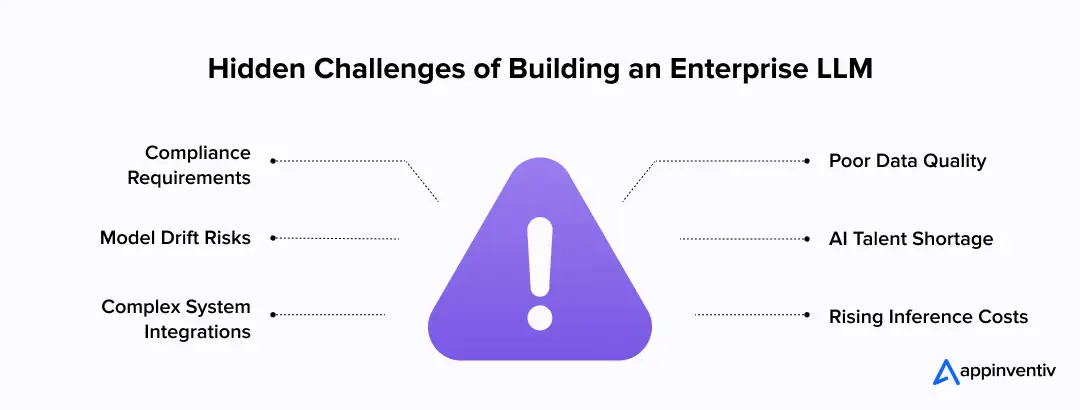
Data Quality Is Usually the Biggest Bottleneck
Data quality blocks most projects. Corporate documents and tickets contain duplicates, outdated policies, and missing metadata.
Ways to reduce the risk:
- Audit your data sources before work begins
- Remove duplicate files and old content
- Standardize all file formats
- Appoint clear owners for business data
AI Talent Is Expensive and Scarce
AI talent is rare and expensive. Software engineers cannot build an enterprise LLM alone. Projects require machine learning engineers, data engineers, and MLOps specialists.
Ways to reduce the risk:
- Limit the initial project scope
- Combine internal employees with external experts
- Build reusable platforms instead of single applications
- Train your current team members
Inference Costs Grow Faster Than Expected
Inference costs grow quickly after launch. Every user prompt and agent action uses expensive compute power. Higher usage can break budgets within months.
Ways to reduce the risk:
- Count token usage from day one
- Assign smaller models to simple tasks
- Use data caching to save compute
- Check usage patterns and apply Claude API cost optimization strategies regularly
Governance and Compliance Requirements
Regulated fields face strict rules because AI handles corporate records. This reality makes AI in data governance a central requirement. Teams deploying AI agents must build an agentic AI governance framework to remain compliant.
Ways to reduce the risk:
- Create audit trails
- Restrict access to sensitive data
- Conduct regular security testing
- Establish retention and deletion policies
Model Drift and Continuous Retraining
Models do not stay current automatically. Corporate policies change and internal databases grow, so model output quality drops over time.
Ways to reduce the risk:
- Monitor output quality continuously
- Refresh datasets on a defined schedule
- Track failure patterns
- Maintain evaluation benchmarks
Enterprise Integration Complexity
Large companies run hundreds of software applications. Connecting an LLM to ERP systems and CRMs takes time. These new connections increase cybersecurity risks in enterprise AI.
Ways to reduce the risk:
- Review existing architecture early
- Prioritize business-critical systems
- Build API-based integrations
- Roll out capabilities in phases
Executives often focus on model selection. Operational teams finish by managing data quality, governance, and hosting bills. These operational variables decide the success of Claude-like AI model development.
Also Read: Confidential AI: How It Secures Enterprise Data
When Should You Build Your Own LLM and When Should You Not?
By the time most enterprises reach this stage, the original question has usually changed. The discussion no longer focuses on Claude, GPT, or subscription costs. The discussion becomes much simpler.
Will building a model create enough business value to justify the investment? For many companies, the answer is no. The technology works, but the economics often does not.
Situations Where Building an LLM Is Usually the Wrong Decision
A custom model often creates more complexity than value if the organization is still experimenting with AI.
| Situation | What Usually Happens |
|---|---|
| Generic chatbot or search use case | Existing models already perform well |
| Small employee or customer base | Infrastructure costs outweigh benefits |
| Limited AI experience | Teams spend months building internal capability |
| No proprietary data advantage | Performance remains similar to public models |
| Short-term ROI expectations | Payback periods become difficult to justify |
In these situations, many enterprises looking to build an app like Claude achieve better results through fine-tuning, RAG deployments, or managed AI platforms.
Situations Where Building or Customizing an LLM Can Be Justified
A different picture emerges in large enterprises that need to build an AI coworker or use AI heavily across daily operations.
These organizations often process large volumes of proprietary information and operate under strict regulatory requirements.
| Situation | Why Organizations Pursue It |
|---|---|
| Large proprietary datasets | Internal knowledge becomes a competitive asset |
| Strict compliance requirements | Greater control over data handling |
| High recurring AI usage | Long-term operating costs become a larger factor |
| Industry-specific workflows | Generic models struggle with domain context |
| AI-driven products and services | Model behavior directly affects revenue |
A useful test is surprisingly simple. Remove the model from the discussion. Then ask whether the business problem still exists. If the answer is yes, start with the business requirement. The technology choice comes later.
Many enterprises enter this process expecting to build a model. They leave with a fine-tuned model, a RAG platform, or a hybrid architecture. In practice, those options often deliver the same business outcome with far less cost and operational overhead.
The Market Has Moved Beyond Single Models
Leading enterprises now deploy hybrid AI ecosystems built around business outcomes and economics.
The Emerging Enterprise AI Strategy: Hybrid AI Instead of Building Claude from Scratch
Two years ago, corporate AI roadmaps looked identical. Companies chose the strongest available model and deployed it everywhere. That strategy is fading.
Clone Claude with AI or Replicate ChatGPT Internally
Early corporate discussions focused on replacing public tools with private alternatives. Leaders wanted to Clone Claude with AI. They tried to build an app like Claude for internal use. They trained separate models for individual departments to own the full technology stack.
What Is Happening Today
Enterprises now take a different route after evaluating costs, timelines, and operations. Teams choose to build apps with Claude Code to deploy tools quickly without training a model.
Companies map specific corporate tasks to different technologies:
- Internal data searches require RAG systems.
- Support tasks run on fine-tuned open-source models.
- Complex reasoning requires frontier models like Claude or GPT.
- Process execution works best through AI agents.
- Large programs deploy multi-model environments.
What Changed?
Market developments drive this new focus. Open-source options perform better, and AI agents are practical. RAG removes the need for training runs. Compute bills remain a major worry.
Different corporate tasks require varying levels of intelligence. A support ticket needs less power than a financial analysis. Organizations use AI PaaS for enterprises to manage models, tools, and hardware. Simple internal searches require less infrastructure than autonomous agents.
This change drives businesses toward hybrid architectures. Companies combine models, retrieval tools, and agents into a single system rather than building a single massive model.
For organizations trying to make their app function like Claude, model selection is simple. The real task is deciding what to build, what to customize, and what to avoid.
How Appinventiv Helps Enterprises Design the Right LLM Strategy
Enterprise leaders review costs, hardware requirements, and ongoing expenses. They realize that building an LLM is not the main challenge.
The true difficulty lies in deciding what to build first. A company often thinks it needs a custom model. Technical reviews change this view. A RAG platform or a fine-tuned open-source model delivers identical results for less money.
This initial review decides project success. Appinventiv provides AI development services to check AI requirements before you spend capital.
Our teams help organizations:
- Choose between a foundation model, a fine-tuned model, or an RAG architecture.
- Lower long-term inference costs by applying Claude API cost-optimization strategies.
- Design AI setups that meet security and compliance requirements.
- Create governance rules for responsible AI deployment.
- Plan hardware setups that accommodate corporate expansion.
- Connect AI tools to current business databases and workflows.
Our record includes:
| Enterprise AI Impact | Scale |
|---|---|
| Manual Process Reduction | 50% |
| Agent Task Accuracy | 90%+ |
| Scalability Increase | 2x |
| AI Prediction Accuracy | 98% |
| Average Reduction in Costs | 40% |
| Faster Time-to-Market | 10x |
Organizations often ask how to build an app like Claude. The real question is simpler. What is the fastest path to your business goal? The answer rarely requires a frontier model. Instead, you need the right mix of data, retrieval tools, governance, and hardware.
Appinventiv helps you calculate the cost to build an enterprise LLM like Claude. We help you invest with confidence. Let’s connect to build your corporate AI stack
FAQs
Q. What is the cost to build an enterprise LLM like Claude from scratch?
A. Most companies should not. The technical challenge is large. The financial commitment is larger. Training a foundation model requires vast amounts of data, specialized AI talent, and substantial compute capacity. That is why most enterprises start with existing models and adapt them to their needs.
Q. How much does it cost to build a custom enterprise LLM like Claude?
A. The answer usually surprises executives. A serious effort can easily move beyond $10 million. Some programs spend much more. Computing, data preparation, model testing, engineering teams, and ongoing operations all contribute to the total investment.
Q. What infrastructure is required to develop and deploy an enterprise-grade LLM?
A. Far more than a model endpoint. Most enterprise deployments involve GPU resources, vector databases, data pipelines, security controls, monitoring systems, and governance tooling. The supporting environment often becomes the larger project.
Q. How long does it take to build a custom AI model like Claude for enterprise use?
A. Longer than most planning teams expect. A frontier model can require years of work. Fine-tuning projects move faster. RAG implementations move faster still. Data readiness and integration work often determine the timeline more than the model itself.
Q. How much does talent contribute to the cost of building an enterprise LLM?
A. Talent is often one of the largest cost drivers in enterprise LLM development. A typical project may require an LLM architect, LLM developers, data engineers, MLOps specialists, and system design experts. Organizations can build an in-house team, hire a dedicated team, or work with a specialist partner using a time-and-material model.
Costs vary based on experience levels, talent acquisition costs, bench utilization, and market demand. In many cases, senior AI talent commands premium compensation, particularly for expertise in model selection, training strategy, and large-scale deployment.
Q. Why do enterprises invest in building AI coworker platforms despite the high development costs?
A. Enterprises invest in AI coworker platforms to improve productivity, automate repetitive work, and create long-term business value. Many organizations in regulated industries prefer platforms built around proprietary data, on-premise deployment, and strong security, compliance, and governance controls.
A typical ROI framework measures labor savings, process efficiency, customer impact, and revenue growth against enterprise AI development costs. Investments often include data pipelines, vector databases, and AI agents, but the goal remains simple: delivering measurable business outcomes while maintaining control over enterprise data.
[ad_2]
Source_link