Scalability in healthcare AI projects is not about how many tasks a system can process, but rather the ability to meet clinical accuracy and compliance standards from annotated data as volume and complexity grow. At Cogito Tech, we offer scalable medical image annotation services in a faster and compliant-ready manner. It also applies to expanding our annotation work from a single modality (e.g., X-rays) to multiple modalities (MRI, CT, and ultrasound).
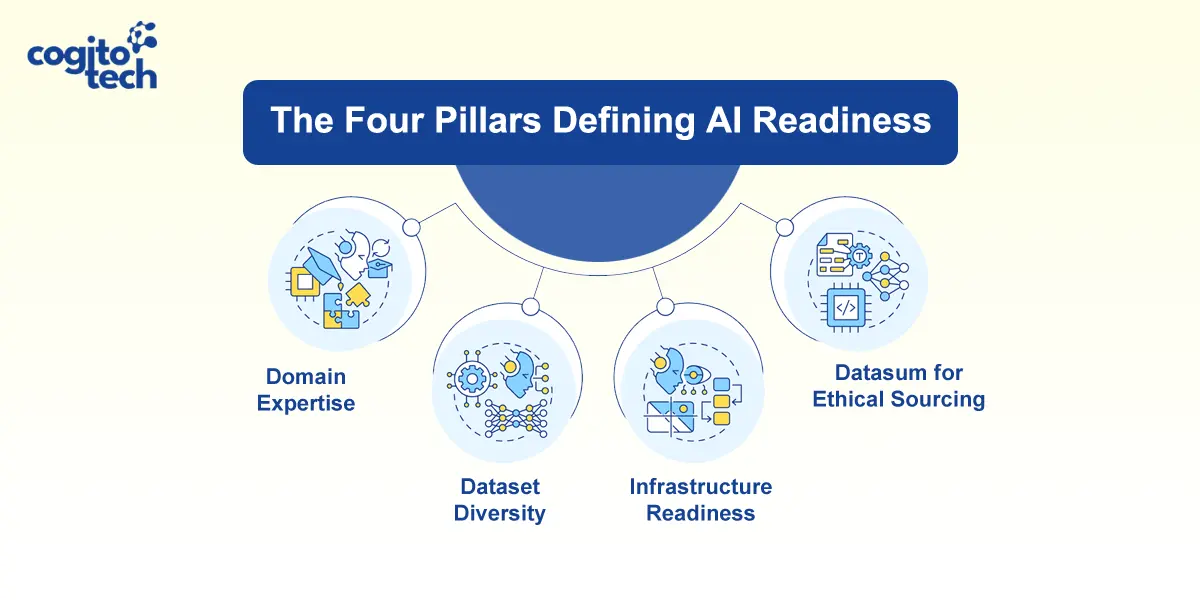
Based on real-world enterprise deployments, four pillars define scalability in our medical image annotation process. Each pillar establishes a foundation for medical AI that scales across multiple use cases. These include a model’s ability to identify fractures on X-rays, predict conditions such as diabetic retinopathy from retinal images, analyze histopathology slides for cancer detection, and identify abnormalities such as pneumonia in chest imaging.
The Four Pillars Defining AI Readiness
For the medical AI system to generate clinically relevant outcomes, raw data must be interpreted, validated, and annotated in machine-readable formats. The following four key pillars shape Cogito Tech’s ability to deliver high-quality datasets optimized for bias-resilient models.
Pillar One: Elastic Workforce with Domain Expertise
Scaling annotation in healthcare begins with people, but it does not mean hiring more data labelers. It requires access to a specialized, elastic workforce with the right clinical expertise available at the right scale.
Unlike generic image labeling, medical annotation demands subject-matter experts, such as:
- Radiologists for imaging interpretation
- Pathologists for histopathology slides
- Dentists for dental imaging interpretation (X-rays, CBCT scans)
- Dermatologists for skin lesion analysis
- Pulmonologists for lung imaging and respiratory condition analysis
- Gastroenterologists for endoscopy and digestive tract evaluation
- Orthopedic specialists for bone and musculoskeletal imaging
- Endocrinologists for hormone-related disorder assessment
- Urologists for urinary tract and prostate evaluation
- And other subject-matter experts for domain-specific labeling tasks
A scalable workforce means that when an AI model moves beyond its initial scope, say, from lung nodule detection to full thoracic analysis, the dataset requirements multiply overnight. New anatomies or edge cases demand fresh annotation at scale, and we meet these demands through rapid onboarding of certified medical professionals, standardized training guidelines aligned with clinical standards, and tiered review methods to maintain consistency.
Pillar Two — Dataset Diversity
Dataset diversity in medical imaging refers to the intentional inclusion of heterogeneous patient groups considering ages, genders, ethnicities, skin tones, body types, and anatomical variations. A lack of diversity limits the generalizability of the model across heterogeneous patient populations.
While patient-level diversity is essential, scaling datasets requires an AI data partner to include the stages of disease (early, progressive, severe); imaging modality (X-rays, CT scans, MRI, ultrasound, and histopathology slides); and geographic diversity (urban vs. rural healthcare systems) to ensure models generalize well across real-world clinical cases.
With cogito tech, our approach to creating datasets also scales by using different annotation methods:
- 2D bounding boxes evolve into pixel-level segmentation
- 2D datasets expand into 3D volumetric annotations
- Static images transition into temporal sequences (e.g., echocardiograms)
A second pillar of Cogito Tech’s image annotation services for healthcare is to offer a sufficient sample size, which is necessary to ensure the model can learn meaningful patterns and avoid the risk of overfitting that arises from insufficient diversity.
Pillar Three — Infrastructure Readiness
An AI data solutions partner provides the data infrastructure layer through the use of annotation tools, improved workflows, and expert-led pipelines, enabling the creation of high-quality training datasets. Many annotation vendors treat compliance as a checkbox; Cogito Tech treats it as infrastructure.
Cogito Tech ensures this by offering a medical imaging dataset that meets clinical-grade quality standards, provides full traceability, supports bias awareness, and ensures regulatory compliance before it enters the client’s AI pipeline. We adhere to HIPAA-compliant data handling, SOC 2 Type II certified operations, de-identification pipelines, and role-based data access controls.
We don’t replace existing infrastructure but make it actually work by complementing their existing compute and deployment environments. All datasets adhere to a proprietary imaging quality standard that includes structured annotations, demographic metadata, compliance documentation, and export compatibility.
Pillar Four — Datasum for Ethical Sourcing
Healthcare medical datasets require strict compliance and governance, but ethics and transparency matter as well. By regulatory compliance, we mean that datasets intended for clinical AI development must meet standards that support systems classified as regulated products, and that ethical sourcing of data includes ensuring the medical AI model serves society fairly and is accountable.
DataSum is a certification framework designed by Cogito Tech to make AI data sourcing more transparent and ethical. Patient data is the most sensitive asset in healthcare. The moment it leaves a hospital’s firewall for annotation, a chain of accountability begins that regulators and patients themselves have every right to scrutinize. Our Datasum framework allows AI developers to confirm that their training data aligns with privacy laws and fair labor practices by creating a detailed audit trail and unbiased dataset composition.
Our secure operating environment enforces end-to-end encryption for the most sensitive datasets, verified de-identification with audit trails, and annotator access scoped strictly to the data required for each task.
The compounding value of all four together
To sum up, each pillar addresses a real problem: building models that are good enough to deploy in clinical settings and well-annotated to meet regulatory standards.
The teams that successfully deploy medical AI models are not the ones with the largest compute budgets or the most sophisticated architectures. They are the ones whose training data is clean, comprehensive, defensible, and continuously refreshable. That is exactly what Cogito Tech is built to deliver, not only as a labeling vendor but more like an extension of your ML team.
If your project is struggling with label quality, wrestling with WSI-scale data, or navigating a compliance requirement you have not solved yet, the conversation starts with the same question:
what does your data need to do?