[ad_1]
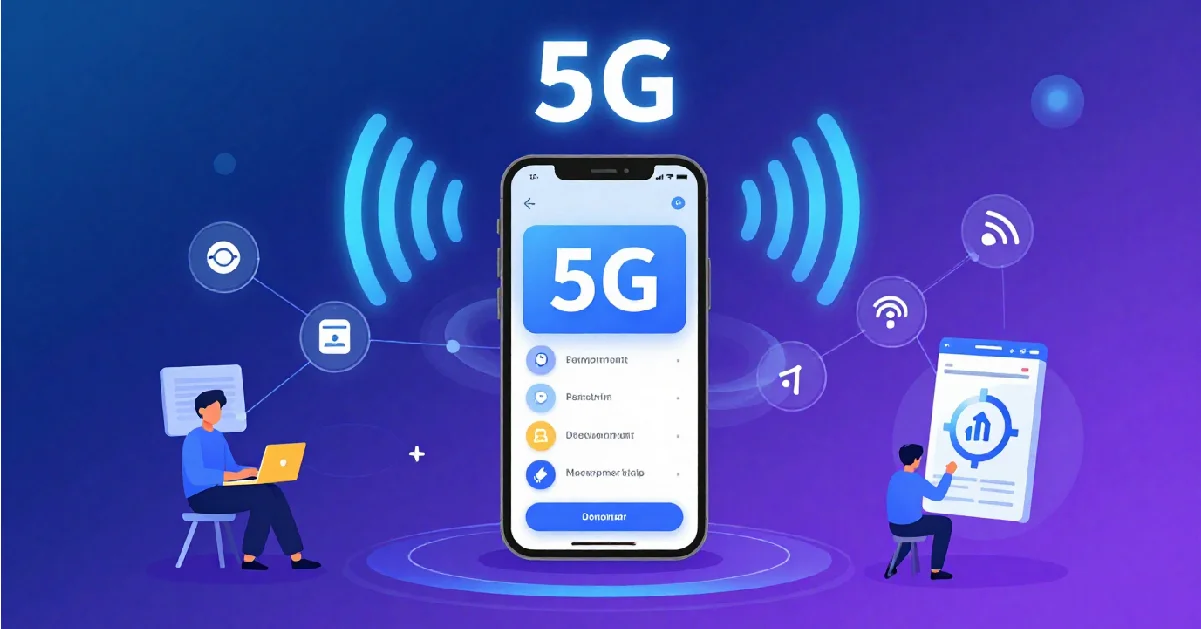
5G technology is the new trend in mobile app development. And the arrival of these technologies is doing magnificently in almost every sector. From tech, food, health, education, and almost everything human beings can imagine.
We will talk about every sector another day, but for now, let’s talk about how 5G technology is changing mobile app development.
What is 5G Technology?
5G is the latest generation of mobile network technology, following on from 4G LTE. It’s designed to meet the ever-increasing demands for faster, more reliable internet connectivity and to support the growth of connected devices. Compared to its predecessors, 5G boasts remarkable improvements in speed, bandwidth, and reliability.
Why is 5G a Game-Changer for Mobile App Development?
5G is coming with some dope changes, so everyone has to adapt to it for their own benefits. It’s offering Ultra-Low Latency, which enables real-time experiences. It reduces latency to nearly 1–10 milliseconds compared to 4G’s 30–50 ms. So that apps can respond almost instantly to user actions.
5G comes with a massive increase in data speed. Download speeds can be up to 10–100x faster than 4G. So that heavy apps can load instantly without long buffering times.
5G also delivers shifts towards cloud-native applications. So apps become lighter because computation happens remotely. So it automatically reduces its dependence on high-end smartphones.
It also enhances user experience expectations. Now users expect zero loading time and seamless navigation. Poor performance becomes less acceptable in a 5G environment.
Key Ways 5G is Transforming Mobile Apps

4.1 Faster App Performance
5G is changing how fast apps actually feel. Loading screens are slowly becoming irrelevant. Apps open almost instantly, even heavy ones. Users don’t wait anymore; they expect speed by default. Faster networks allow developers to build feature-rich apps without worrying too much about delays. Streaming inside apps feels smoother and more stable. Buffering issues are reduced a lot, especially during high traffic hours. Overall performance looks more natural and responsive.
4.2 Enhanced AR & VR Applications
AR and VR apps finally get the environment they needed. Real-time rendering becomes possible because latency is extremely low. Virtual objects respond instantly to user movement. Shopping apps can offer virtual try-ons without lag. Gaming experiences feel more immersive instead of glitchy. Education and training apps also benefit from smoother simulations. Earlier limitations were mostly network-related; now those barriers are slowly fading.
4.3 Growth of IoT-Based Applications
5G supports a massive number of connected devices at once. Mobile apps can now communicate with smart devices more efficiently. Smart homes, wearables, and connected vehicles rely on constant data flow. Real-time data exchange becomes faster and more reliable. Apps can monitor devices continuously without delay. Automation features work better because response time improves. This opens new opportunities for app developers working in smart ecosystems.
4.4 Cloud-Based Mobile Applications
With 5G, apps don’t need to depend fully on phone hardware anymore. Processing shifts toward cloud infrastructure. Edge computing helps data travel shorter distances, improving response speed. Apps become lighter in size but more powerful in function. Devices require less internal storage since data stays on the cloud. Updates and feature rollouts also become easier for developers. Performance stays consistent across different device types.
4.5 Improved Video & Live Streaming Apps
Video consumption grows stronger with 5G networks. High-quality streaming like 4K and even 8K becomes more practical on mobile apps. Live streaming feels stable with minimal interruptions. Buffering has been significantly compared to older networks. Social media platforms benefit from smoother video uploads and playback. Content creators can stream in higher quality without a complex setup. User engagement naturally increases when playback stays uninterrupted.
4.6 Real-Time Gaming & Multiplayer Experiences
Mobile gaming sees one of the biggest upgrades. Low latency enables near lag-free gameplay. Multiplayer games respond instantly to player actions. Competitive gaming on mobile becomes more serious and reliable. Cloud gaming services also perform better due to faster data transfer. Players experience smoother graphics and stable connections. This growth is pushing mobile esports into a more competitive and mainstream space.
Benefits of 5G for Mobile App Developers
- Faster development and testing cycles. Builds upload quicker. Less waiting during debugging.
- Real-time testing becomes easier. Performance issues can be spotted instantly.
- Less need to heavily compress apps. Developers can add richer features freely.
- Better app performance even with complex functionalities. Heavy apps run smoother.
- Improved scalability. Apps handle large user traffic without major slowdowns.
- Cloud integration becomes more practical. Processing shifts from the device to servers.
- Reduced dependency on high-end smartphones. Apps work better across device ranges.
- Real-time data syncing becomes reliable. Live updates feel instant.
- Easier deployment of updates and patches. Continuous delivery workflows improve.
- Supports advanced technologies like AR, VR, and AI integrations. Earlier limitations have been reduced.
- Better backend communication due to low-latency networks. Faster server responses.
- New monetization models emerge. Subscription services and cloud gaming grow.
- Higher user engagement because apps feel faster and smoother. Retention rates improve.
- Developers get more creative freedom. Focus shifts from optimization to innovation.
- Overall development process becomes more efficient but also slightly more demanding in quality expectations.
Conclusion
5G is not just another network upgrade; it is slowly reshaping how mobile applications are planned, built, and experienced. Faster speeds, lower latency, and stronger connectivity are pushing developers to think beyond traditional app limitations. Features that once felt experimental are now becoming standard expectations. Real-time interaction, cloud processing, and immersive experiences are moving into everyday mobile usage.
For businesses and creators, adopting 5G for Mobile App Developers is no longer optional if they want to stay competitive. Users expect instant performance and seamless digital experiences, and apps that fail to deliver speed or responsiveness will struggle to retain attention. Development strategies are shifting toward cloud-first architecture, scalable systems, and smarter integrations powered by high-speed networks.
Cities known for strong tech ecosystems are already adapting quickly. The rise of 5G app development in Bangalore shows how innovation hubs are leveraging advanced connectivity to build next-generation applications across fintech, healthcare, gaming, and e-commerce sectors. Companies investing in modern infrastructure and skilled teams are gaining an early advantage in this transition.
As demand grows, app development in Bangalore continues to evolve with a stronger focus on performance-driven design and future-ready solutions. Developers are not just building apps anymore; they are creating connected digital ecosystems supported by 5G capabilities.
In the coming years, 5G will move from being a competitive advantage to a basic expectation. The developers and businesses who adapt early will define the next phase of mobile innovation, while others may struggle to keep up with rapidly changing user standards and technological possibilities.
[ad_2]
Source_link