As a B2C leader, you’re already trying to balance engaging, high-converting experiences with ROI and brand safety. The push to automate makes this even harder. A 2026 Gartner report shows that 91% of customer service leaders are being pushed to adopt AI, meaning the pressure is real. But moving too fast can backfire. Customers get frustrated with dead-end bots, and the wrong setup can hurt your brand.
Plus, confusion doesn’t help. Many vendors blur the lines between tools. A rule-based chatbot is not the same as conversational AI, and neither can replace the human touch of live chat. To get results, you need to understand how each works and use them together effectively.
This guide breaks down chatbots vs conversational AI vs live chat in a clear, practical way. You’ll learn how each tool works, see a side-by-side comparison, and get a simple decision framework to choose the right one. We’ll also show how Insider’s integrated solution brings them together without adding risk.
What are chatbots, conversational AI, and live chat?
To build a strong customer experience setup, you need to understand what each tool does. Even though vendors often use these terms interchangeably, they work very differently under the hood.
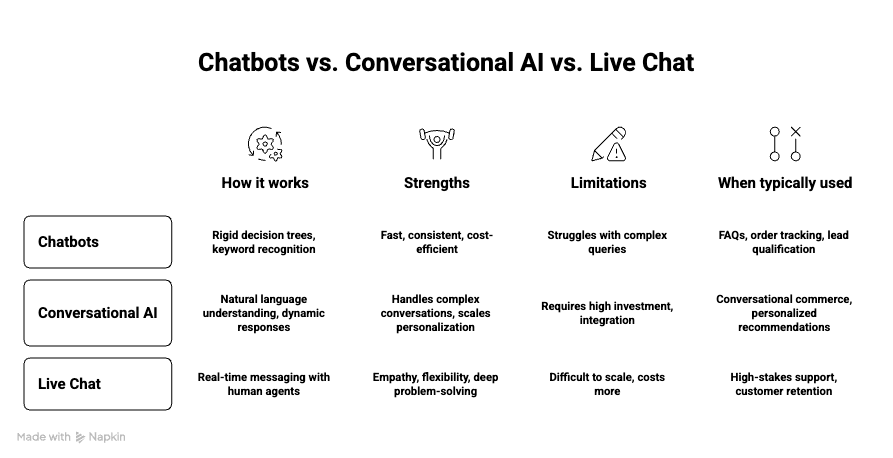
Chatbots
A traditional chatbot is a digital assistant that operates on rigid, predefined decision trees. It is designed to handle structured interactions rather than fully understand intent.
How it works:
Chatbots rely on keyword recognition, menu-based flows, or if/then logic. You script a specific workflow (e.g., if the user clicks “Track Order,” ask for “Order Number”). The user is forced down a narrow path to find their answer. There is no language generation happening here. Every response is pre-written by your team.
Strengths and limitations:
- Chatbots are fast, simple, and cost-effective. They can handle large volumes of queries instantly and work 24/7. They are easy to set up and work well for repetitive tasks like FAQs, order tracking, and basic support.
- Chatbots are limited to predefined flows. If a user asks something outside the script, the experience breaks. They lack context, struggle with complex queries, and can frustrate users if overused.
When typically used:
Chatbots are best for FAQs, order tracking, lead qualification, and repetitive support tasks where speed matters more than depth.

Conversational AI
Conversational AI is an advanced system powered by natural language processing (NLP), machine learning, and large language models (LLMs) that can understand intent, context, and sentiment to hold dynamic, human-like conversations.
How it works:
Unlike a chatbot’s rigid rules, conversational AI uses natural language understanding to decipher what a user means, regardless of typos, slang, or complex phrasing. Modern models generate responses dynamically, remember context across multiple turns (and across channels like web to WhatsApp), and can even pull real-time data from your CRM to hyper-personalize the interaction.
Strengths and limitations:
- Conversational AI can understand intent and handle more complex, multi-step conversations. It supports personalization at scale and can automate large parts of the customer journey. It is also driving major cost and efficiency gains, with some estimates suggesting up to 30% reduction in support costs.
- Conversational AI requires more effort to set up and maintain. You need clean data, strong integrations, and ongoing optimization. Without this, it may not deliver accurate or consistent responses. It also comes with higher upfront costs.
When typically used:
Conversational AI is suitable for conversational commerce, personalized product recommendations, onboarding, proactive engagement, and handling large-scale customer journeys across channels, including WhatsApp or other apps.
Live chat
Live chat offers a real-time messaging interface that connects a customer directly with a human support agent or sales representative.
How it works:
Customers communicate via text on your site or app, but the responses are driven entirely by human intelligence. These live chat agents are typically augmented by AI copilots working in the background. They summarize the customer’s bot interaction, pull up account history, and suggest responses, but the human ultimately steers the conversation.
Strengths and limitations:
- Live chat offers human empathy and flexibility. Agents can handle complex issues, build trust, and adapt to different situations. It works best for high-value conversations, complaints, and conversions.
- It is expensive to scale. You need more agents as volume grows. Availability is limited by staffing, and response times can vary. It also requires training and quality control to maintain consistency.
When typically used:
Best for high-stakes support, customer retention, complaints, complex troubleshooting, and sales conversations where trust and nuance matter.
Chatbots vs conversational AI vs live chat
| Chatbots | Conversational AI | Live Chat | |
| Response speed | Instant (rule-based replies) | Instant (context-aware replies) | Variable (subject to agent availability) |
| Complexity handling | Low (breaks outside rigid scripts) | High (manages multi-turn, unstructured requests) | Very high (humans adapt in real time) |
| Personalization | Basic (basic name or order tags) | Advanced (hyper-personalized via real-time CRM data) | Advanced (human empathy and CRM context) |
| Availability | 24/7 | 24/7 | Limited (business hours or costly 24/7 staffing) |
| Scalability | Very high | High | Low (requires more agents) |
| Cost | Low setup and running cost | High upfront investment and low marginal cost | High ongoing operational cost (salaries, training) |
| Integration | Basic (often siloed or simple API hooks) | Deep (acts as an orchestration layer for CDP or CRM) | Medium (depends on the agent’s helpdesk UI) |
| Analytics | Basic metrics (clicks, flows) | Advanced (sentiment analysis, intent mapping) | Subjective (CSAT scores, manual QA reviews) |
There is no single perfect channel. B2C leaders must balance the friction of cost against the friction of customer experience.
Chatbots and conversational AI are the clear winners if your goal is to handle large volumes. They scale easily and work 24/7. But automation breaks when emotions come into play. If a high-value customer is upset, sending them through a bot can damage trust. That’s where live chat wins by handling the situation with nuance. The downside is cost. You can’t use human agents to answer simple questions all day.
Conversational AI platforms sit in the middle. It combines the scale of chatbots with a better understanding of context. It can handle more complex queries and deliver personalized experiences. But it only works well if it’s properly set up. It needs strong integrations with your CRM and clear guardrails to avoid incorrect or off-brand responses.
How Insider One helps brands with conversational engagement
Most brands don’t struggle with tools. They struggle with combining the capabilities of chatbots, AI, and live agents without breaking the experience. That’s where Insider stands out.
- One platform for chatbots, conversational AI, and live chat: Insider One brings all three into a single stack. You can deploy rule-based bots for simple queries, layer conversational AI for intent-based interactions, and seamlessly hand off to human agents when needed, all within the same flow.
- Omnichannel conversations: Customers can start a conversation on WhatsApp, continue on your website, and complete it via email or app, without losing context. Insider One supports channels like WhatsApp, Instagram, web, and more, enabling true cross-channel journeys.
- Personalization at every step: Insider One uses real-time data, predictive AI, and segmentation to tailor every interaction. This means customized conversations based on behavior, preferences, and past actions.
- Seamless escalation to humans: When automation reaches its limit, Insider One enables smooth handoff to agents with full conversation history and customer data. This avoids the typical customer service mistake which is making customers repeat themselves.
- Built-in analytics and optimization: Every interaction feeds into analytics, helping teams understand intent, optimize journeys, and improve performance over time. Insider One also supports testing and AI-driven optimization to continuously improve outcomes.
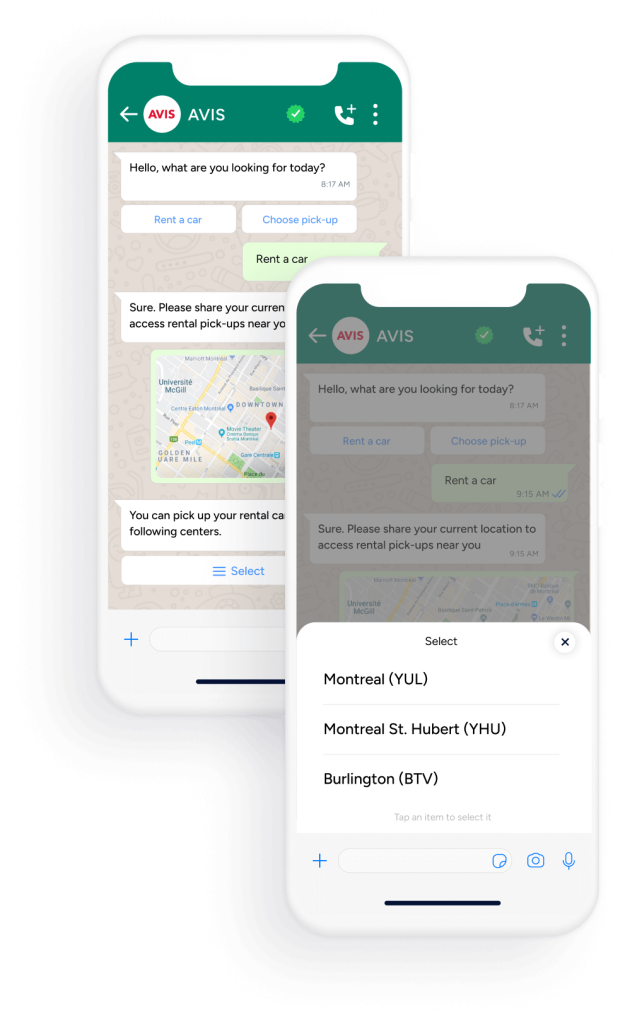
Now, let’s see what this looks like in practice. By using Insider’s advanced NLP with a live-agent fallback, Avis empowered their assistant to handle complex, unstructured conversations. As a result, their digital assistant successfully resolved 70% of all customer queries autonomously, eliminating the need for a live agent in those instances. This seamless blend of AI and human hand-off saved the company 39% in customer support costs within a single year, all while protecting the overall customer experience.
Decision-ready B2C leaders know that conversational engagement is a comprehensive strategy. Insider One’s true differentiator is its hybrid capability. It allows you to deploy highly structured, gamified flows for quick wins, activate Agentic AI for personalized commerce, and maintain a robust human-in-the-loop safety net, all without ever migrating data between disconnected tools. You no longer have to compromise between driving high-converting engagement and protecting your ROI.
Ready to see how a unified conversational stack transforms your customer experience? Book a demo with Insider One to explore the future of AI-native engagement.
Best practices for choosing between chatbots, conversational AI, and live chat
Here is the tactical playbook for B2C leaders to evaluate, select, and implement the right conversational mix.
The Readiness Checklist: What to Evaluate
Before signing a vendor contract, run your current operations through this checklist to determine your true needs:
- Business goals: Are you optimizing for cost-deflection (reducing headcount) or revenue-generation (upselling via gamified interactions)?
- Volume vs. complexity: High volume with low complexity (e.g., where is my order?) demands rigid automation. Low volume with high complexity (e.g., subscription disputes) requires human agents.
- Customer expectations: If you are a premium luxury brand, your tolerance for clunky, rule-based bots should be zero. Your audience expects high-touch service, skewing your needs toward AI-augmented human agents.
- Cost constraints: Look beyond the software license. Can you afford the ongoing training data maintenance required for Conversational AI, or the ballooning headcount needed to scale live chat?
- Staffing capacity: Do you have the human bandwidth to support 24/7 Live Chat? If not, you must bridge the after-hours gap with capable automation.
- Data readiness: Conversational AI is useless without data. Is your CRM unified, or is your customer data sitting in disconnected silos? If your data is messy, start with a basic bot while you clean house.
The evaluation checklist
Do not guess what your customers want. Let your existing data dictate your tech stack.
- Audit current support queries: Pull your contact center data from the last 90 days. Categorize every ticket. Identify the top 20% of repetitive queries that eat up 80% of your agents’ time.
- Map to tool capabilities: Take that list of top queries. Assign rigid, predictable requests (e.g., password resets, store hours) to a rule-based chatbot. Assign unstructured, multi-step tasks (e.g., processing a return) to conversational AI. Leave all high-emotion or high-value retention queries strictly to live chat.
- Pilot hybrid models: Never launch a new tool to 100% of your audience at once. Route a small segment of web traffic through a hybrid flow. Let the AI attempt to resolve the issue first, but ensure a seamless, one-click escalation to a human agent if the user shows friction.
The iterative approach
The fastest way to fail is to attempt a rip and replace of your entire support ecosystem overnight. The most successful B2C brands take an iterative approach.
- Crawl (start simple): Deploy a basic, rule-based chatbot to handle your top three most common FAQs. This provides an immediate, low-risk reduction in agent volume.
- Walk (introduce AI): Once your basic bot is stable, introduce Conversational AI to handle a specific, high-value workflow, like a gamified product recommendation engine. Connect it to your CRM to test personalization.
- Run: Integrate all three layers. The AI handles the bulk of inquiries, triggers personalized up-sells, and acts as a triage system, silently summarizing context and handing off only the most complex, high-stakes conversations to your live chat team.
FAQs
A chatbot follows rigid, pre-scripted decision trees to handle simple, predictable tasks. Conversational AI uses advanced NLP to understand user intent, manage dynamic conversations, and deliver personalized experiences. Live chat connects customers directly with human agents to resolve complex, high-stakes issues with empathy.
Conversational AI excels when user queries are unstructured, complex, or require deep personalization. Unlike rigid chatbots that break when users type outside the script, AI understands intent and can autonomously execute multi-step workflows like processing returns or driving gamified commerce.
Yes, integrating all three into a unified, hybrid stack provides the highest ROI. You can use basic bots for simple triage, AI for personalized self-service and product discovery, and ensure a seamless, context-rich escalation to human agents for high-value retention.
Audit your support volume, query complexity, and overall business goals. Use chatbots for high-volume, low-complexity deflection. Deploy conversational AI for scalable, personalized engagement. And reserve live chat for high-emotion interactions where human nuance is non-negotiable.
Track simple deflection rates and drop-off points for basic chatbots. For conversational AI, monitor intent recognition accuracy, autonomous resolution rates, and revenue generated from personalized flows. For live chat, evaluate Customer Satisfaction (CSAT) scores, Average Handle Time (AHT), and successful retention rates.