When cash flow tightens, most small business owners do the same thing: chase more leads. Hire better salespeople. Invest in ads. Double down on lead generation to increase revenue. But here’s what nobody talks about: you can improve your cash flow without any of that. In fact, for most businesses, the fastest way to increase available cash is something entirely different—and it’s already sitting in your accounting system.
The fastest way to improve cash flow is to get clients to pay invoices faster. Not eventually. Within 14 days. How much faster? According to data from the National Federation of Independent Business, the average small business is holding $47,000 in outstanding invoices at any given time. Payment delays of just 30 days cost small businesses an estimated $130 billion annually in lost productivity and cash flow constraints. Here’s the math: If you’re holding $40,000 in unpaid invoices and you can speed up collection by just two weeks through better follow-up, you’ve freed up $20,000 in working capital without hiring a single salesperson or spending a dollar on ads.
The fastest way to get clients to pay faster is to remove friction from the payment process, establish clear payment terms upfront, and follow up within three days of invoicing. Most payment delays aren’t defiance. They’re administrative chaos. Here’s the system that fixes it.
Payment Speed vs. Lead Generation: Which Affects Your Cash Flow First?
Here’s the comparison most business owners never make. Both lead generation and payment speed improve cash flow. But they work on different timelines, and they target different problems.
Lead generation takes 30–90 days to produce actual cash. You spend money on ads, hire a salesperson, build a pipeline, and then wait for deals to close. It’s effective long-term. It’s how you grow. But if you need cash in the next 30 days, lead generation won’t help.
Payment speed produces cash in 14 days. The money is already committed. It’s in your contracts. Your clients agreed to pay you. The only problem is timing and follow-up. By implementing a 3-day follow-up system, you can recapture $20,000–$50,000 in available cash without touching your sales or marketing strategy.
| Factor | Lead Generation | Payment Speed |
|---|---|---|
| Time to Cash | 30–90+ days | 7–14 days |
| Upfront Cost | $500–$5,000/month | $0–$50/month (tools) |
| Time Investment | High (ongoing) | Low (set once, automate) |
| Amount of Cash | New revenue (additive) | Existing revenue (recapture) |
| Best Use Case | Long-term growth, scaling | Immediate cash flow crisis |
The truth: You don’t have to choose. You run both. But if your cash flow is tight right now, payment speed is the immediate lever. Lead generation is the growth lever.
Why Payment Delays Happen (Spoiler: It’s Not Personal)
Before you can fix a problem, you have to understand why it exists. Most people assume late payment is a sign of cash flow trouble or indifference on the client’s side. Sometimes it is. Usually, it’s not.
Payment delays fall into three buckets. The first is administrative chaos—your invoice arrived, but it landed in the wrong inbox or got buried under 200 other emails. The second is cash flow problems on their end. The third, surprisingly, is that paying your invoice is too easy to defer. When there’s no friction forcing a decision, humans default to delay.
⚠️ REALITY CHECK
Payment delays are not a sign of disrespect. They’re a sign of an admin system that doesn’t prioritize your invoice. That’s fixable. And when you fix it, the conversations become easier because the client isn’t already defensive about being “late.”
Set Your Payment Terms Upfront (The Foundation)
Everything else flows from this one decision. Your payment terms are the contract. They’re not a suggestion. And you need to state them clearly before you send the first invoice.
Setting clear payment terms is the foundation of good small business cash flow management. When you clarify expectations upfront, you eliminate the ambiguity that leads to payment delays.
Here’s what most small business owners get wrong: they either don’t state payment terms at all, or they bury them in the invoice fine print. Then when payment doesn’t arrive in 30 days, they feel awkward bringing it up. The client feels caught off-guard. Both of you are uncomfortable.
Instead, state your terms during the discovery call or proposal. Say it out loud. Put it in writing in your proposal. Repeat it in your first invoice. The goal is that by the time the client receives an invoice, they already know: “We pay on the 15th of the following month” or whatever your terms are.
Common payment terms for service businesses:
- Net 15: Payment due 15 days after invoice date. Good if you have healthy cash flow.
- Net 30: Payment due 30 days after invoice date. Standard for most B2B services.
- Net 45/60: Payment due 45–60 days after invoice date. Common for larger contracts or corporate clients.
- Deposit + Balance: 50% upfront, 50% upon completion. Best for project work.
- Milestone-Based: Payment tied to deliverables (25% at each milestone). Protects both sides on long projects.
Pick one. State it clearly. Then build a follow-up system around it so you’re not manually chasing down every invoice.
The 3-Day Follow-Up System (The Engine)
This is where the speed happens. Most businesses don’t follow up on invoices until day 30 or beyond. By then, the payment has vanished into their accounting system and requires an excavation.
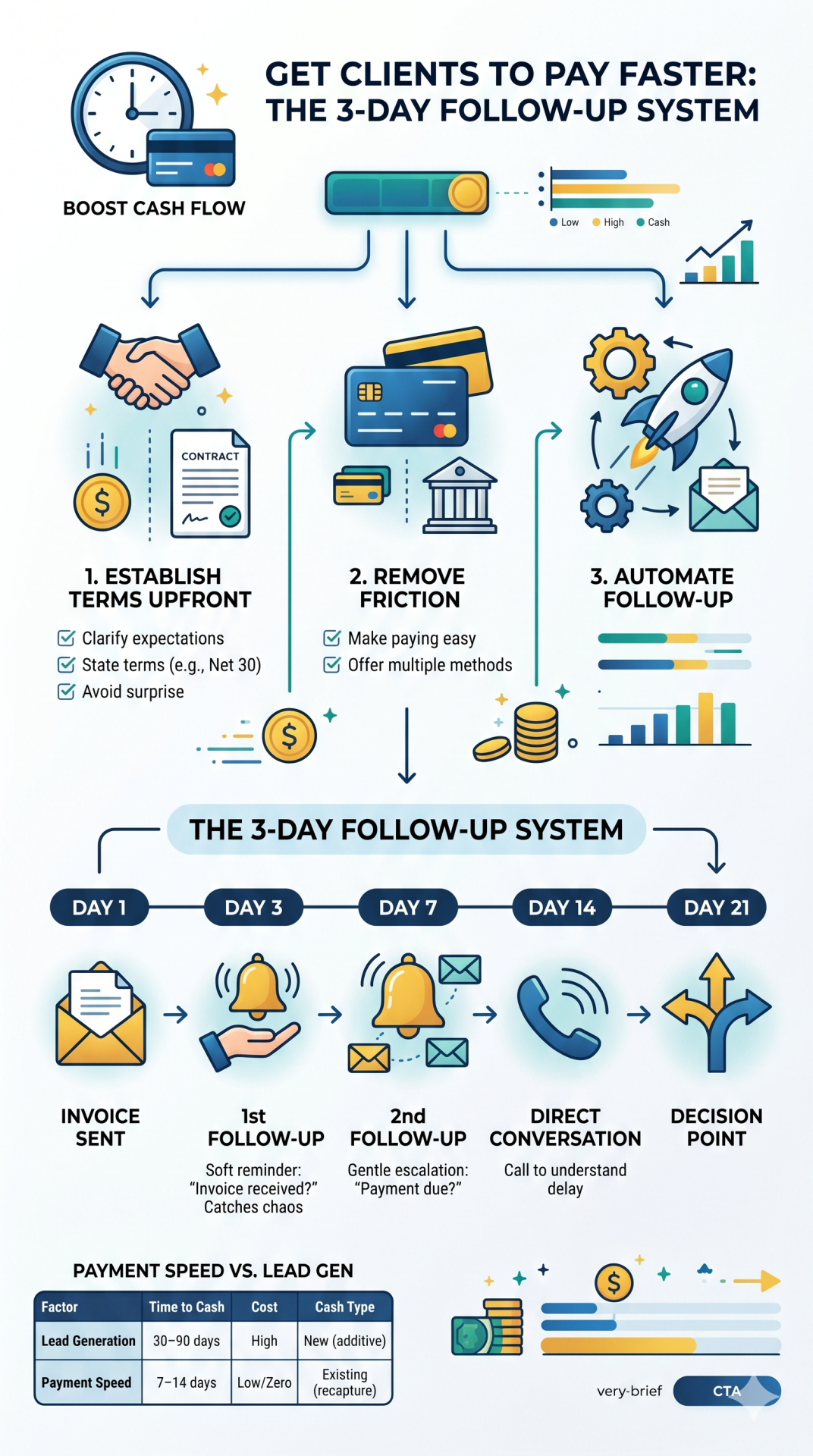
The 3-Day Follow-Up System catches payment early, before it gets lost. Here’s how it works:
Day 1 (Invoice Sent): You send the invoice. Make sure it’s clean, professional, and includes your payment instructions (bank transfer, credit card, PayPal—whatever you accept).
Day 3 (First Follow-Up): Send a friendly reminder. This is not a harsh “where’s my money” email. It’s a soft check-in: “Hey, wanted to make sure you received the invoice for [project/service]. Let me know if you have any questions.”
Why Day 3? Because administrative systems move slowly. By Day 3, the invoice has either landed safely in their accounting queue, or it got lost in email and needs resending. This early catch prevents a 30-day delay.
Day 7 (Second Follow-Up): If you haven’t seen payment, send a second reminder. Slightly more direct: “Just following up on the invoice I sent on [date]. Payment was due [date]. Let me know if there’s anything holding this up on your end.”
Day 14 (Direct Conversation): If payment still hasn’t arrived, pick up the phone. Not to yell. To understand. This is a conversation, not a confrontation. “Hey, I wanted to check in on the invoice we sent two weeks ago. Is there anything I can help clarify, or is there a cash flow issue I should know about?” Most of the time, you’ll learn the real reason for the delay. Sometimes it’s legitimate. Sometimes it’s an easy fix (wrong PO number, wrong email for accounting, etc.).
Day 21 (Decision Point): If payment still hasn’t arrived after three follow-ups and a conversation, you need to make a decision. Do you hold further work? Do you renegotiate terms? Do you part ways? This is where you stop being nice and start protecting your business.
💡 STRATEGY ALERT
Automate Days 1, 3, and 7 with tools like Zoho Invoices, FreshBooks, or Wave. These platforms send automatic reminders on your schedule. You only step in on Day 14 for the conversation. This removes the emotional labor and ensures consistency.
Should You Offer Early Payment Discounts?
This is the question every business owner asks: “Should I offer 2% off if they pay in 10 days instead of 30?”
The math first. A 2% discount for 20 days of early payment equals a 36% annualized interest rate. That’s expensive. You’re literally paying them 36% per year for the privilege of not waiting 30 days.
So when does it make sense? Only when you have a cash flow crisis right now. If you desperately need cash, a 2% discount to accelerate payment by 20 days can be worth it. But if you’re not desperate, you’re just training your clients to expect discounts.
Instead of discounts, consider payment plans. If a client says they can’t pay your full invoice on Net 30, offer them Net 30 + Net 30 (half now, half in 30 days). You get cash in the door, they get breathing room, and you’re not discounting your work.
| Situation | What to Offer | Why It Works |
|---|---|---|
| You need cash now | 2% discount for Net 10 | Speeds payment when you’re desperate. Don’t make it a habit. |
| Client says they can’t pay in full on time | Split invoice (50% now, 50% in 30 days) | You get cash now. They get time. No discount. |
| You have healthy cash flow | Stick to Net 30–45 (no discount) | Teaches clients to pay on time, not early. Protects your margins. |
| Client is chronic late-payer | Move to deposit-based or milestone-based | Money upfront removes the problem entirely. |
The Hidden ROI: Why Payment Speed Unlocks Pricing Power
Here’s the connection most small business owners miss: faster payment directly enables better pricing.
When you’re desperate for cash—when invoices are 60+ days out and you need money now—you accept lower rates. You negotiate payment terms you shouldn’t accept. You discount because you’re afraid. Desperation kills your pricing power.
When you have cash flow, you have options. You can turn down bad clients. You can set higher rates. You can confidently communicate your value without apologizing. Fast payment systems create that financial confidence.
This is why improving your pricing strategy is Step 2 in the cash flow playbook. Step 1 is fixing payment speed. Step 2 is raising your rates. Together, they compound: faster payment + higher rates = 2–3x the cash flow improvement you’d get from either lever alone.
What to Say When Following Up (Scripts That Work)

Here’s what most people struggle with: the language. How do you follow up without sounding demanding? How do you stay professional while protecting your cash flow?
Day 3 Email (Friendly Reminder):
Hi [Name],
Just wanted to check in and make sure you received the invoice I sent on [date] for [project/service]. Sometimes these land in spam, so let me know if you need me to resend.
If you have any questions about the scope or timeline, I’m here to help.
Thanks!
[Your name]
Day 7 Email (Gentle Escalation):
Hi [Name],
Following up on the invoice I sent on [date] (payment due [date]). I haven’t seen payment yet—wanted to check if there’s anything on your end holding this up, or if you need me to clarify anything about the invoice.
Let me know how I can help move this forward.
Thanks,
[Your name]
Day 14 Phone Call (Direct Conversation):
“Hey [Name], I’m calling about the invoice from [date]. I sent two reminders and haven’t heard back, so I wanted to touch base directly. Is there something on your end that’s holding up payment, or did the invoice get lost?” [Listen. Ask clarifying questions. Solve the real problem, not the payment problem.]
Notice what these scripts have in common: they assume the best about the client, they offer help, and they don’t sound desperate. That’s the tone that works.
The Payment Relationship Is the Relationship
Here’s the final piece most people miss: how a client pays tells you everything about how they’ll treat you going forward.
Clients who respect payment terms also respect deadlines, deliverables, and your expertise. Clients who chronically pay late also tend to move goalposts, expand scope, and undervalue your work. It’s not always true, but it’s true often enough that payment patterns are a leading indicator.
The 3-Day Follow-Up System isn’t just about getting paid faster. It’s about filtering for clients who respect your business systems. And those are the clients worth keeping.
Common Questions about how to get clients to pay faster
Is improving payment speed faster than chasing new leads for cash flow?
Yes, dramatically. Lead generation takes 30–90 days to produce cash. Payment speed produces cash in 7–14 days. If you need immediate cash flow relief, improving payment speed should be your first move before investing in lead generation.
How much cash am I losing by not following up on invoices?
The average small business leaves 15–25% of invoiced revenue uncollected or delayed by 30+ days. If you invoice $100,000/month, you’re holding $15,000–$25,000 that should be available now. A 3-day follow-up system recovers half of that—$7,500–$12,500—in available working capital within two weeks.
Why do most small businesses ignore payment speed?
Because it’s invisible. Lead generation feels like “doing something”—running ads, making calls, building a pipeline. Payment speed feels like admin work. But the ROI is higher. A $50 investment in invoicing tools returns $7,500–$12,500 in recovered cash. Lead generation typically needs $2,000–$5,000 to produce the same result.
What’s the best way to ask for payment without sounding pushy?
Don’t ask. State. Your payment terms are not a request. They’re a contract. If you frame them as a question (“Is it okay if I invoice you on Net 30?”), you’ve already lost. State it clearly upfront: “We invoice on Net 30” and treat it like any other business term.
Should I give discounts for early payment?
Only if you’re desperate for cash right now. A 2% early-pay discount equals 36% annualized interest. Use it sparingly. Prefer payment plans (split invoices) over discounts. You get cash in the door, they get time, and your rate stays intact.
How do I handle clients who ignore payment requests?
After 21 days and three follow-ups, you have options: hold further work, renegotiate terms to deposits/milestones, or part ways. Don’t continue working for someone who doesn’t respect your payment terms. It teaches them your boundaries don’t matter.
Does this system work for retainer clients?
Yes, with one adjustment. Invoice on the same day each month, and set up automatic follow-ups. Retainer clients should be your easiest to collect from because the payment is predictable. If a retainer client suddenly starts late-paying, that’s a signal the relationship is changing.
Which payment platform should I use?
Zoho Invoices (integrates with Zoho CRM), FreshBooks, or Wave all have automatic reminders built in. Pick one that integrates with your CRM so you have a complete record of each client’s payment history. That data matters more than the platform.