
You’re considering mobile app business transformation in Qatar — and you’re right to. Few markets in the region offer this combination: 100% internet penetration, the world’s fastest mobile speeds, a cash-light economy compounding monthly through Fawran and QMP, and a government actively underwriting digital through Vision 2030 and the Digital Agenda 2030.
The opportunity is real. The execution is where most programmes stall — because Qatar rewards local context (Arabic-first UX, QCB and CRA compliance, Hukoomi and TASMU integration) in ways offshore-only vendors routinely miss.
For businesses looking to hire app developers in Qatar, this gap between global capability and local execution becomes the defining factor.
We cover this in detail below.
Let’s skip the theory and dive right into the numbers!
Write to us, and we will share three relevant case studies for your project.

The numbers that justify the conversation
Before we talk about who builds, let’s anchor why now. Qatar’s digital economy is not a slow-burn opportunity — it is already compounding.
| Metric | Figure | Source |
|---|---|---|
| Qatar digital transformation market (2025) | USD 9.19 billion → USD 22.59bn by 2031 (CAGR 16.16%) | Mordor Intelligence, Jan 2026 |
| Internet penetration (early 2025) | 100% | Zawya |
| Median mobile download speed | 517.44 Mbps | The Peninsula Qatar |
| Digital payments, July 2025 alone | QR 16.133bn across 51.7m transactions | Qatar Central Bank via SAMENA |
| AI & analytics share of 2025 tech spend | 28.12% | Mordor Intelligence |
Put simply: a near-universal connected audience, the world’s fastest mobile pipes, a cash-light economy in motion, and a government actively funnelling capital into AI and cloud. That is the backdrop against which the benefits of mobile apps for businesses in Qatar move from “nice-to-have” to “commercial oxygen”.
Why are Qatar-based developers significant to your app’s growth
Global outsourcing made geography feel irrelevant for a while. In Qatar, it isn’t. Here’s the blunt reasoning.
1. Qatar Vision 2030 and Digital Agenda 2030 alignment
The Third National Development Strategy frames IT and digital as a core enabling sector for Qatar National Vision 2030, and the government’s Digital Agenda 2030 rests on six pillars — hyperconnectivity, hypercomputing, hyper-automation, digital innovation, the digital economy, and digital infrastructure.
A mobile app development company in Qatar that has actually read these policy documents, worked with TASMU Smart Qatar frameworks, or delivered under Hukoomi’s e-government standards is operating with a context that an offshore-only vendor simply does not have.
Government and public sector procurement alone made up 24.55% of the Qatar digital transformation market in 2025. If your roadmap touches public-sector integration, e-government rails, or citizen-facing services, Qatar’s digital transformation without local grounding is a non-starter.
2. Compliance and data sovereignty — the bit everyone underestimates
Qatar’s National Data Classification Policy (2023) and the Communications Regulatory Authority’s evolving remit mean enterprise data handling isn’t a box-tick. Payment integrations with QPay, Noqoody and the Fawran instant payments rail each carry their own regulatory envelopes.
Healthcare apps touching Hamad Medical Corporation ecosystems, fintech apps connected to QCB-licensed banks, and logistics apps brushing up against customs — all of these sit inside industry-specific mobile applications territory where compliance failure means shelved product, not a fine.
A partner already shipping into Qatar knows, for instance, that the 3G shutdown was mandated by the end of 2025, meaning any app still assuming fallback to legacy networks is already broken. These are the compounding small facts that separate on-time launches from write-offs.
3. Bilingual, RTL-first design is not a patch job
Proper Arabic UI/UX is not Google Translate plus dir=”rtl”. It is typography systems (Kufi vs Naskh), number formatting (Hindi-Arabic vs Eastern Arabic digits), date systems (Hijri support), and seasonal UX adjustments for Ramadan traffic spikes.
We have watched perfectly good English apps collapse in Qatar because no one briefed the team on bidirectional text in mixed-script fields.
How mobile apps are actually driving growth here — six concrete lenses
Enough context. Here’s where the benefits of mobile apps for businesses show up on the P&L. At this stage, teams also start evaluating the cost to build community platforms, especially for sectors like real estate, fintech, and e-government, where engagement layers drive retention.
These are the patterns we see across our own portfolio and across the market.
a) Customer experience as a direct revenue lever
Mobile commerce already accounts for roughly 51% of Qatar’s digital transactions. When a retail or F&B brand ships a well-built app with personalisation, loyalty hooks and embedded payments, the uplift is measurable.
When we rebuilt KFC’s delivery ecosystem across seven Middle East markets, including Qatar, conversion rose by 22% and store-rating settled at 4.5 on both app stores — numbers we break down in detail in our analysis of mobile app development in the Middle East.
Customer experience mobile apps win in Qatar because the audience is high-spending, mobile-native, and allergic to friction.
4. Business process automation and ERP-linked mobility
This is where most B2B value actually accrues. Enterprise mobile app solutions that plug into SAP, Oracle NetSuite, or bespoke ERP software solutions convert meetings into dashboards and paper trails into real-time workflows.
Field sales teams, logistics dispatchers, facility managers, and retail operations leads all benefit from business process automation apps that surface the one number they need in the one moment they need it.
This is the real impact of enterprise mobile app development, getting the architecture right with microservices, API-first design, and offline-capable caching that can actually hold up under Qatari enterprise load.
5. AI-first product experiences
Qatar released secure-AI guidelines, and AI/analytics already claim 28.12% of tech spend. In practice, this means you are not selling your board on “maybe AI someday” — you are building apps where AI is the product surface.
Think in-app co-pilots for customer support, anomaly detection inside fintech apps, predictive maintenance alerts inside industrial field apps, and Arabic-capable conversational interfaces as the default entry point.
A reasonable business app development strategy in Qatar today assumes AI is table stakes, not a feature flag. This shift is also accelerating the adoption of AI agents for digital transformation in ME, where automation is becoming a core layer rather than an add-on feature.
6. Real-time insights and a mobile-first business strategy
Ooredoo’s Nvidia partnership, the Microsoft and Google Cloud regions launched in Doha — the data infrastructure is finally local enough to support real-time insights without the latency tax. That unlocks dashboards, IoT telemetry, live pricing engines, and telehealth — all inside a phone.
7. Scalability without re-platforming
A proper custom mobile app development partner builds for the scale you haven’t hit yet. Cloud-native, containerised, event-driven — so when your app hits the Fawran-style hockey-stick moment, the architecture holds. (Fawran, QCB’s instant payments platform, processed USD 896.5m across 1.87m transfers in July 2025 alone — it got there fast.)
8. Operational efficiency and workforce mobility
Enterprise mobility solutions — the internal-employee apps — are where the quiet wins live. HR self-service, field maintenance, warehouse picking, compliance attestations. None of it is glamorous; all of it pays back.
This is where mobile apps and enterprise digital transformation intersect in a very practical sense—streamlining everyday operations without the noise of customer-facing innovation.
Industries feeling the impact hardest in Qatar
Not every sector moves at the same pace, but a handful are visibly pulling ahead — and the gap between leaders and laggards within each industry is widening month by month. The table below maps where mobile is no longer optional, alongside the typical app footprint we see in production engagements.
| Sector | Why apps are non-negotiable here | Typical app footprint |
|---|---|---|
| Fintech & Banking | 94% digital banking usage; Fawran + QMP expanding | Digital wallets, SME banking and invoice finance |
| Healthcare | National telemedicine push; market ~USD 150m | Appointment, teleconsult, chronic-care monitoring |
| Retail & E-commerce | 65% mobile share of digital transactions | Loyalty-driven storefronts, AR try-on, Q-commerce |
| Logistics & Supply Chain | Smart-ports and the digitised customs agenda | Fleet, last-mile, cold-chain tracking |
| E-government | Hukoomi + Tawtheeq + TASMU | Citizen services, residency, utilities |
| Hospitality & Tourism | Post-World-Cup, Web Summit-era inbound | Booking, loyalty, event-led experiences |
| Real Estate | Qatar Vision 2030 smart-city build-out | Listings, virtual tours and tenant management |
This is also where future-ready real estate platforms for Qatar Vision 2030 are emerging as a strategic priority, combining mobile, IoT, and data-driven tenant experiences.
If your business sits in any of these, the question is not whether to invest in digital transformation through mobile apps — it is whether you can afford to let a competitor beat you to it.
How to identify a credible Qatar app development partner
Here’s how you recognize who is actually familiar with how Qatar works.
- Proven delivery in the region, not just a localised landing page. Ask for Qatar- or GCC-specific case studies with named outcomes.
- Native Arabic UI/UX capability with RTL seniority on the team. Not freelance-contracted. In-house.
- Compliance literacy — QCB, Ministry of Public Health, CRA, National Data Classification Policy. If they don’t recognise the acronyms, move on.
- Integration fluency with local rails — QPay, Noqoody, Fawran, QMP, Hukoomi SSO, Tawtheeq.
- Bilingual client-facing teams — because translation lag is where projects die.
- AI-native engineering — not an AI practice stapled on the side.
- Transparent commercial terms — fixed-scope, time-and-materials, or product-studio retainer, clearly structured.
- Post-launch maintenance services — a 12-month SLA at minimum, with incident-response in your timezone.
- Proven enterprise mobility track record — ask how many apps they have shipped with SSO, MDM and zero-trust postures.
This list filters out roughly 80% of the market. That is deliberate.
The service models you’ll actually be choosing between
Qatar has experts for every requirement if you have a plan. Here are some examples:
| Model | Best for | Trade-off |
|---|---|---|
| Native (Swift / Kotlin) | High-performance, hardware-heavy, fintech, AR | Double the build, highest fidelity |
| Cross-platform (Flutter / React Native) | Faster go-to-market, consistent UX across iOS + Android | Slightly constrained on deep OS features |
| Custom enterprise mobile apps | Internal ops, field workforce, ERP-linked | Longer discovery; bigger integration surface |
| Super-app builds | Consumer platforms bundling wallets, bookings and messaging | Regulatory and architectural complexity |
| On-demand app solutions | Q-commerce, logistics, home services | Real-time engine and ops playbook matter more than UI |
| App UI/UX design + audits | Existing apps that leak conversion | Pair with analytics instrumentation from day one |
| App maintenance and modernisation | Legacy builds on deprecated stacks | Often cheaper than full rebuilds — but only if scoped properly |
A decent mobile-first business strategy often means picking two of these, not one. Consumer-facing in Flutter, internal ops native, both plugged into the same microservices backbone.
ROI: what the numbers typically look like
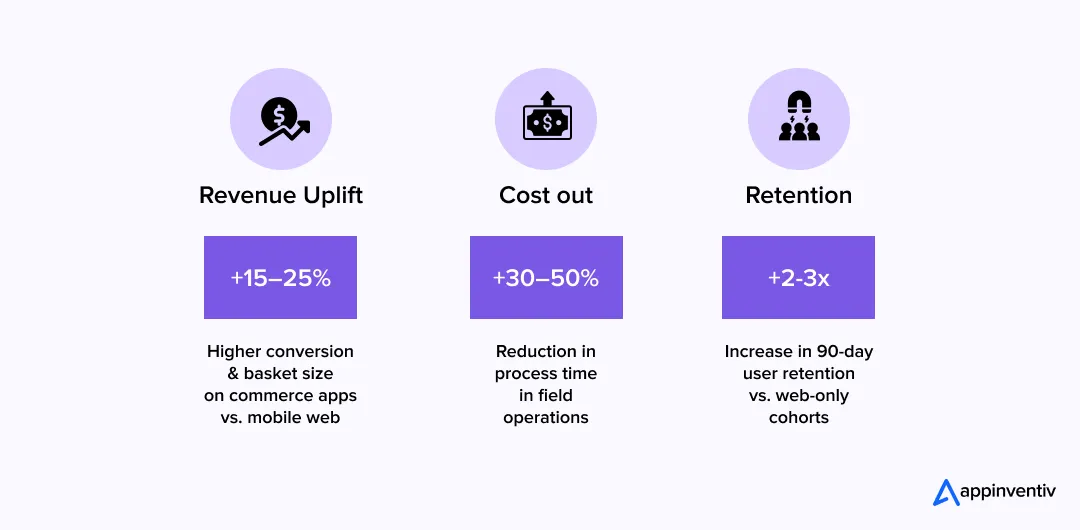
Across our deployments, a well-governed app programme will surface returns along three axes:
- Revenue uplift — conversion and basket size on commerce apps typically +15–25% versus mobile web.
- Cost out — enterprise mobility apps collapse process time by 30–50% in field ops (our own internal baselines, consistent with SAP/Oxford Economics research showing 80% of digitally transformed businesses report profit increases).
- Retention — push-notification and personalisation loops routinely add 2–3x to 90-day retention versus web-only cohorts.
The honest caveat: mobile app ROI for companies depends entirely on whether the product is instrumented for measurement from launch. If analytics are an afterthought, the ROI conversation a year in will be guesswork.
From Vision 2030 alignment to a live app — in one engagement.
See the exact capabilities, case studies and delivery model our Qatar practice brings to the table.

How long does it take for Qatar-based firms to build apps
Timelines in Qatar depend on complexity, compliance, and integration depth—here’s what typical delivery looks like.
| Scope | Typical duration |
|---|---|
| MVP (1 platform, ~8–10 core screens) | 12–16 weeks |
| Full consumer app (iOS + Android, payments, auth, backend) | 5–8 months |
| Enterprise app with ERP integration | 6–9 months |
| Super-app or platform play | 12–18 months |
Anything quoted dramatically below these ranges for Qatar-complex work deserves scepticism.
How Appinventiv Supports Your Qatar App Strategy
KFC

Edfundo

6th Street

Hukoomi

IKEA


This is the bit where most blogs get sales-y. We’ll keep it short, because the work speaks louder.
We have spent more than ten years building mobile apps across the Middle East, with deep delivery muscle in Qatar specifically — including government-facing platforms, KFC’s rollout that touched Qatar and enterprise-grade products across fintech, healthcare, logistics and retail.
Our teams operate with bilingual PMs, native Arabic designers, and AI engineers who are shipping AI-native features into production apps every quarter — not experimenting with them in decks.
If the right next step is a discovery workshop, a product audit, a rebuild, or a from-scratch enterprise platform, our mobile app development services in Qatar are structured to slot in at whichever stage you are at. We are equally comfortable consulting your internal team as building the full product alongside you.
The simplest way forward is a 30-minute scoping conversation — no deck, no boilerplate. Bring the problem; we will bring the shape of a solution.
FAQs
Q. Why are businesses in Qatar investing in mobile apps?
A. Because the audience is there (99% internet penetration, 156% mobile connections), the payment rails support it (Fawran, QMP, QPay), and the Vision 2030 policy is actively funding digital transformation. Apps are the cheapest, fastest way to meet customers where they already are.
Q. What industries benefit most from mobile apps in Qatar?
A. Fintech, healthcare, retail and e-commerce, logistics, hospitality, real estate, and e-government are the top seven in our experience. Industrial and oil-and-gas are catching up quickly via predictive maintenance and field inspection apps.
Q. How long does it take to build a business mobile app in Qatar?
A. An MVP: 12–16 weeks. A full consumer app: 5–8 months. An integrated enterprise platform: 6–9 months. Super-apps: 12–18 months.
Q. What trends are shaping mobile app adoption in Qatar?
A. AI-native UX, Arabic-first voice interfaces, super-apps, embedded finance, IoT-connected logistics, and a steady climb of mobile-first healthcare.
Q. How do mobile apps support Qatar Vision 2030 initiatives?
A. By operationalising the Digital Agenda 2030 pillars — hyperconnectivity, hyper-automation, digital economy — at the citizen and employee touchpoint. E-government apps, fintech inclusion, telehealth and smart-city services are all mobile-led by design.