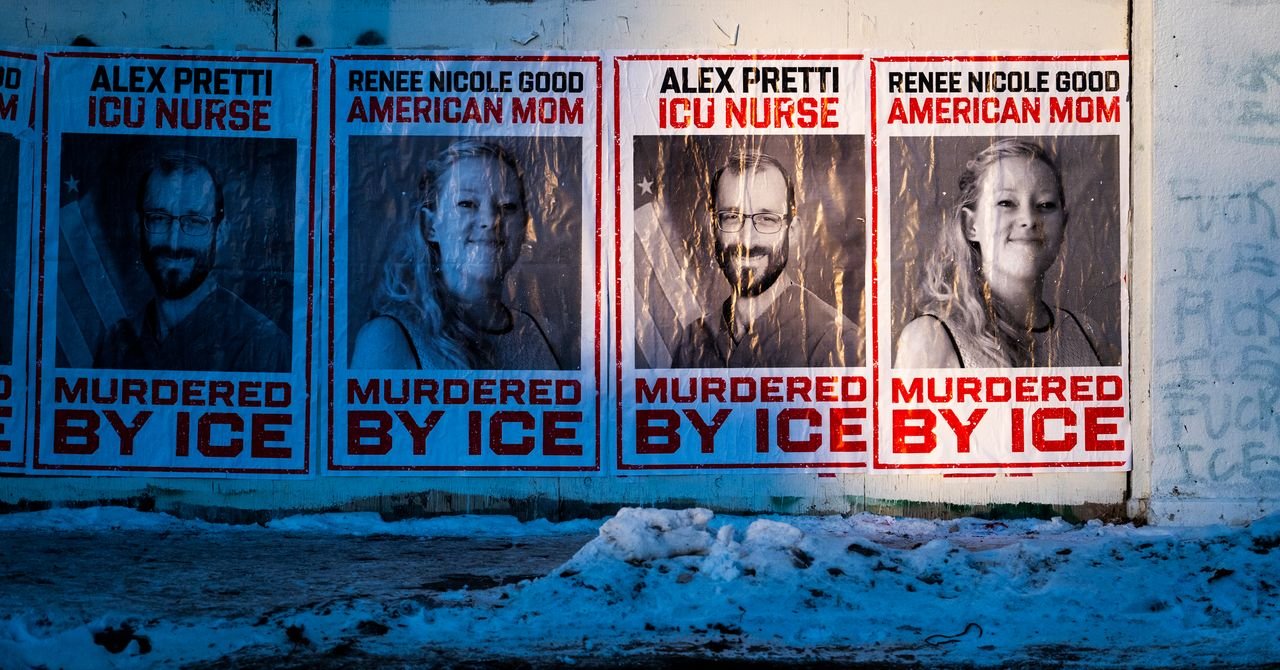
On Wednesday, January 7, federal immigration enforcement and deportation officer Jonathan Ross shot and killed Renee Good at approximately 9:37 am local time. That same day, an official from the Minnesota Bureau of Criminal Apprehension (BCA) texted a Federal Bureau of Investigation counterpart, repeatedly requesting access to the crime scene evidence.
But according to records WIRED obtained through a public records request, the FBI did not respond for at least two days.
The texts appear to have been sent shortly before the FBI, according to the BCA, told the agency that the investigation into Good’s death would “be led solely by the FBI” and that the BCA “would no longer have access to the case materials, scene evidence or investigative interviews necessary to complete a thorough and independent investigation.”
The texts provide new insight on a breakdown in communication between the two agencies that eventually contributed to the BCA, Hennepin County Attorney, and the state of Minnesota filing a lawsuit against the Department of Homeland Security and the Department of Justice, which includes the FBI. The lawsuit, filed on March 24, demands that federal authorities give state and local law enforcement access to investigative material relevant to the shootings of Good; Alex Pretti, a nurse shot and killed by Border Patrol agents on January 24; and Julio Sosa-Celis, a Venezuelan Minneapolis resident shot and injured by a federal immigration agent on January 14.
“The longstanding practice of cooperation and evidence-sharing between federal and Minnesota law enforcement authorities broke down during DHS’s Operation Metro Surge,” the lawsuit claims, adding that this partnership “abruptly ended once federal leadership became involved.”
In response to WIRED’s request for all emails, text messages, and digital communications the agency exchanged with the FBI on January 7 and January 8, the day the public record request was filed, the agency provided an image showing texts exchanged between a top BCA official and the FBI. (The agency added that “no emails were discovered.”)
The image obtained by WIRED, which was seemingly captured between January 9 and 13, shows text messages that appear to have been sent from an iOS device. The BCA says that the texts were sent on January 7 by Drew Evans, the agency’s superintendent to an individual whose name is redacted but is identified in Evans’ device as an “FBI ASAC,” or assistant special agent in charge. The FBI’s Minneapolis branch currently has three people with that title, according to its website.
The only text the FBI agent sent was delivered at 11:17 am local time. The message was mostly redacted by the BCA, but it begins with “ERO”—an apparent reference to Enforcement and Removal Operations, the ICE branch that oversees arrests, detainments, and deportations.
At 12:56 pm, Evans sent three messages to the FBI agent in quick succession.
“Can you be sure with your folks to include us on interviews,” Evans began. “It sounds like they have tried to do some and keep us out of them. I know this is a little challenging, but it really helps us to just have one set of interviews/interactions so we have a common understanding of the facts and information.”
“We are going to cancel crime scene – sounds like a lot of federal agents showed up to confront the crow[d] and it’s getting very contentious now,” Evans wrote in the second text. “We are in a lot of these in that city and our [special agent in charge] is working with your folks to clear – really unfortunate we did not get this done.”
The beginning of Evans’ next message was redacted, but likely includes the name of the FBI agent. “Do you think once they get [things] a little under control today our management teams and team leaders should connect today yet?” Evans wrote in the third text. “We could do it at your office at a time that makes sense once they can breathe a bit?”
Protesters began gathering near the site of Good’s killing shortly after news of her death began circulating. The lawsuit eventually co-filed by BCA claims that on January 7, its investigators had “trusted that important evidence gathered by federal investigators”—including Good’s car, the ICE agent’s gun, and the shell casings at the scene—would be available to them.