Reading Time: 6 minutes
The Moment That Gets Lost
Alex opens a retailer’s app on her phone. She’s not logged in, but spends 15 minutes browsing running shoes, filters by size 7, and adds two pairs to her cart. Then she gets distracted and closes the app.
Later that evening, she opens the same app and logs in to check an old order. The app has no idea this is the same person who was browsing running shoes an hour ago on this device. That browsing happened before she was identified, and the session was never stitched to her account. She sees a generic homepage. No cart reminder. No nudge.
15 minutes of clear purchase intent. Same device. Same session. Gone the moment she logged in, because the anonymous session and the known profile were never connected.
This happens across every industry. The version in BFSI looks different but the root cause is the same.
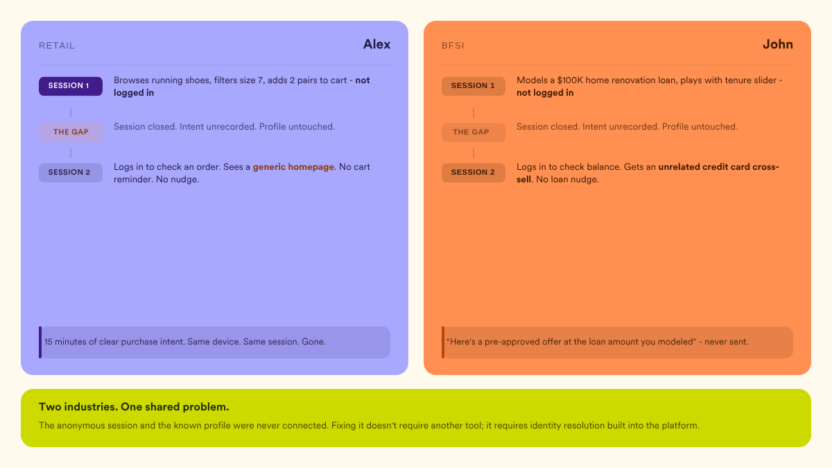
John opens his bank’s app on his phone to check his balance. He’s not logged in yet, just browsing what’s publicly viewable. He taps into the personal loan calculator, models a $100K loan for a home renovation, plays with the tenure slider for a few minutes, then gets distracted. He comes back later on the same device and logs in to check his account balance.
The bank has no idea the person who just logged in is the same person who spent those minutes seriously evaluating a loan minutes earlier on the same device. The anonymous calculator session never gets attached to his now-known profile. So instead of a relevant nudge like “here’s a pre-approved offer at the loan amount you modeled,” he gets nothing. Or worse, an unrelated cross-sell for a credit card. The intent was right there, on one device, in one continuous visit. It just never crossed the line from anonymous to known.
That gap has a name: the anonymous-to-known problem. And fixing it doesn’t require adding another tool to your stack.
Anonymous Users Aren’t Strangers, They’re Your Most Misread Segment
The instinct is to treat anonymous traffic as acquisition territory. Basically, unknown consumers at the top of the funnel, and how to bring them in.
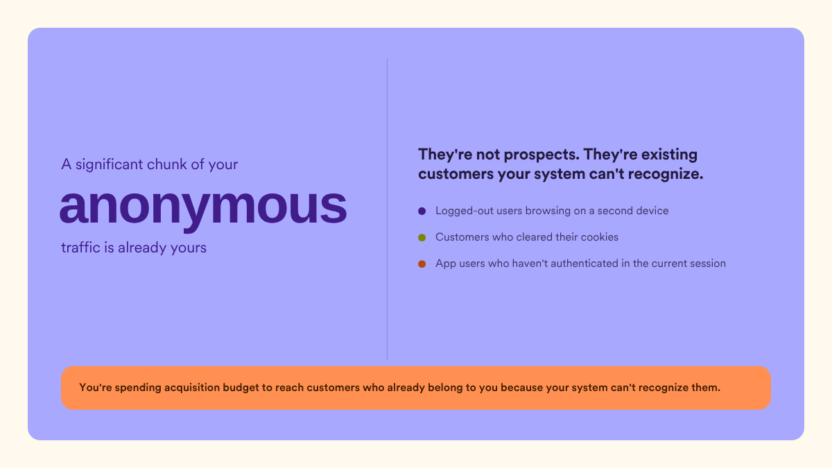
Take Alex again. She’s not logged in when she opens the retailer’s app on her phone. She browses, filters by size, adds two pairs of running shoes to her cart, then closes the app. An hour later, she logs in to the same device, in the same app, to check an old order. The brand has no record of the cart. No trigger. No timely nudge. The recovery campaign that should have fired never does. Not because the data wasn’t there, but because it was never connected.
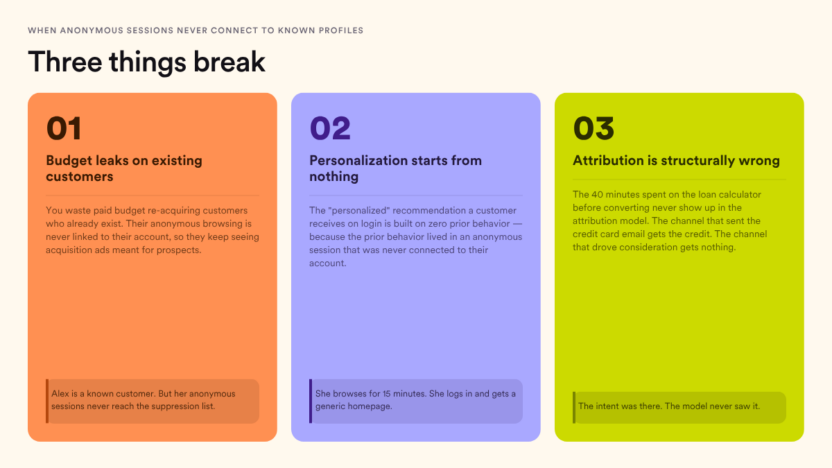
Three things break when a platform can’t connect anonymous sessions to known profiles:
3 Moments Where Stitching Must Happen and How Long You Have
Not all stitching moments are equal. Some have a window measured in seconds; if you miss it the context is gone.
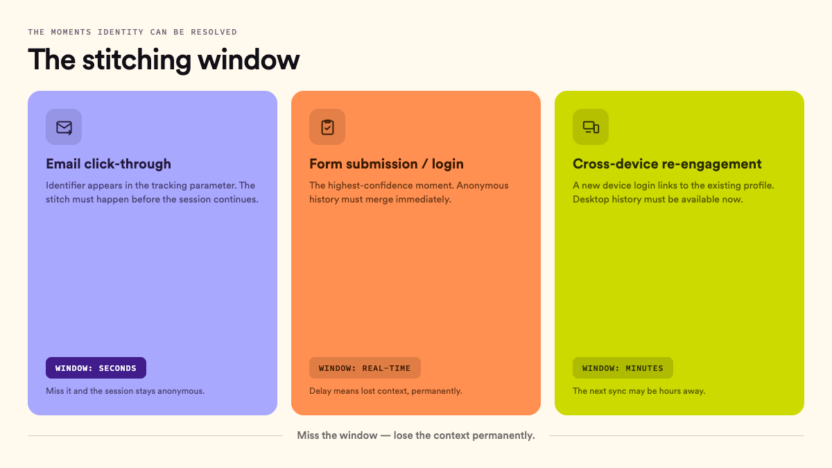
Email click-through: Alex’s email address is in the analyzing parameter the moment she clicks. If stitching doesn’t happen in real time, the session continues as anonymous, and any campaign trigger built on “customer re-engaged after three days of inactivity” fires incorrectly or not at all.
Form submission or login: The highest-confidence stitching moment if the identifier is directly provided. Any delay is context the platform loses.
Cross-device re-engagement: Alex’s mobile device ID links to her known profile via the login event. Her desktop browsing history should be available for mobile personalization immediately, not after the next scheduled sync.
A stitching event that resolves in hours misses every real-time trigger that would fire within minutes of identification. For brands where the anonymous-to-known journey is a primary revenue lever, that lag has a measurable impact on conversion.
Deterministic vs. Probabilistic: Which One Should Your Platform Adopt
There are two ways platforms approach identity stitching. Understanding the difference matters when evaluating whether your stack is actually solving the problem.
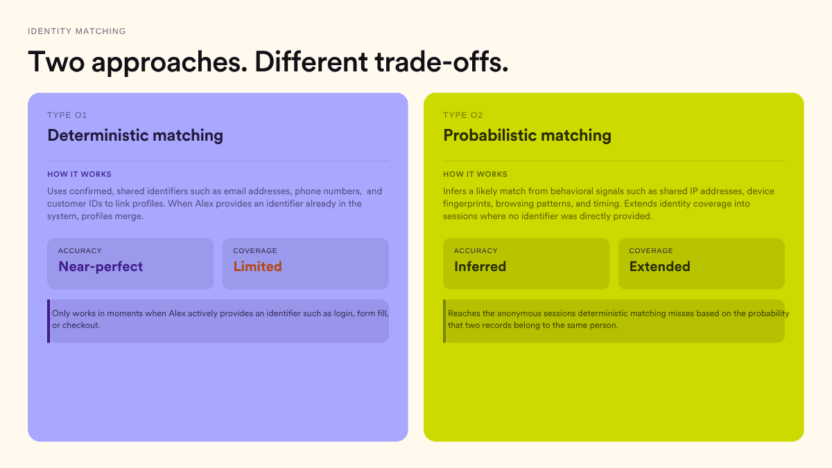
The distinction matters more than most content on this topic acknowledges. Probabilistic matching is useful for analytics use cases where directional accuracy is enough, such as attribution modeling, audience sizing, and reach estimation. But for 1:1 personalization, it introduces a risk that’s hard to justify: false mapping.
If the platform guesses it’s Alex based on behavioral signals and gets it wrong, the “personalized” experience it delivers is actively worse than no personalization at all. Alex receives a message built on someone else’s behavior. The brand has made a confident mistake.
For real-time engagement decisions, deterministic matching should be the foundation for personalization, suppression, and journey triggers. The identifier must be confirmed before the platform acts on it.
What Native Stitching Actually Enables
When identity stitching and campaign execution live on the same platform, the architecture failure disappears. Here’s what becomes possible:
Triggers can fire on the stitch itself. The moment Alex’s anonymous session merges with her known profile, that merge event can trigger a campaign. “User just identified from a new device, has three prior purchases and 40 minutes of home loan browsing – send a home loan consultation offer.” This trigger doesn’t exist in a two-system architecture because the engagement platform never knows the stitch happened.
Personalization reflects the full history from the first authenticated moment. Alex’s purchase history, browsing behavior, product affinities, and engagement patterns are available immediately and not after the next sync. The first message she receives after logging in can reflect everything she did before.
Suppressions apply in real time. The moment Alex is recognized as an existing customer, acquisition campaigns are suppressed correctly. No more spending paid media budget to acquire someone who already converted last month.
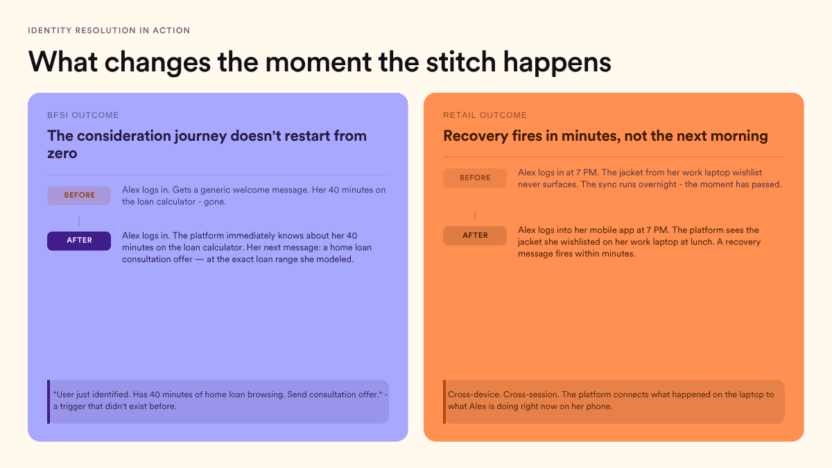
Attribution captures pre-identification behavior. The sessions that happened before login, such as the product pages, calculator time, and content consumed, are now part of Alex’s record. Attribution models that have access to pre-identification behavior are structurally more accurate than those that start counting from the first authenticated event.
How MoEngage Handles This Natively
Anonymous-to-known merging is technically distinct from identity resolution. Identity resolution merges two known profiles. Anonymous-to-known merges an unidentified session into a known account when the identifier first appears. MoEngage handles both, but this section focuses specifically on how anonymous sessions get stitched to a known profile the moment identification happens.
The design principle is straightforward: pre-identification behavior should never be lost. When Alex adds two pairs of running shoes to her cart while anonymous, and then logs in an hour later, the merge should preserve everything she did before the login. The cart. The size filter. The 15 minutes of intent. All of it available to the recovery campaign at the moment she becomes a known customer.
Here’s how MoEngage delivers on that:
Real-time merging via SDK and API: New incoming users are merged in real time, whether the identifier arrives through the SDK or the API. There’s no batch delay between the login event and the profile stitch. The merge happens the moment identification occurs, so the known profile has full context of the pre-identification session immediately.
Trigger-on-stitch campaigns: MoEngage lets a campaign fire at the exact moment of profile merge, using the merge event itself as the trigger. This is what makes the “15-minute window of intent” recoverable. The moment Alex logs in, her known profile is enriched with the anonymous session data, and a personalized message can go out before she leaves the app. Not five minutes later. Not tomorrow morning in an email batch. The moment the merge fires.
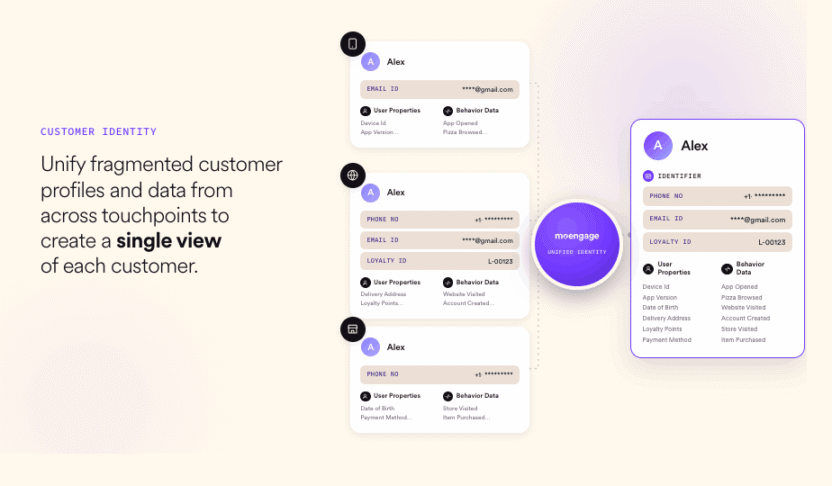
Full pre-identification history preserved: All events that happened before identification, plus all events after, are attributed to the now-known user. Not just attributes like device or location, but the full behavioral history. What Alex browsed, filtered, added, and considered. That history becomes part of her merged profile immediately, and any downstream segmentation, journey, or personalization can act on it.
Profile Retention Rules for conflict resolution: When the same data field exists in both the anonymous session and the registered profile, MoEngage’s default is to prioritize the registered profile. Existing values win on conflict. But the rules are nuanced where it matters:
- First Seen stays anchored to the registered profile
- LTV, conversion counts, and session counts are summed across both sources
- Attributes exclusive to the anonymous profile get copied over when the registered profile lacks them
- Push reachability recalculates across all associated devices
- Email suppression flags travel with the copied email attribute
For brands where recent pre-login behavior is more relevant than older profile data, say, a BFSI use case where a customer’s loan calculator session should override a stale attribute, there’s an opt-in override that flips the default. Enabled through your CSM, this lets the anonymous session’s latest value take precedence on selected custom attributes.
Talk to our team to see how MoEngage handles user profile stitching or identity management natively and what that means for your brand.
The post Anonymous to Known: How to Stitch User Profiles Without Adding Another Tool to Your Stack appeared first on MoEngage.