[ad_1]
Key takeaways:
- Define your RAG architecture scope to avoid misaligned hiring decisions
- Identify end-to-end architectural ownership across retrieval, governance, and scaling
- Evaluate deep technical capabilities beyond prompt engineering and tools
- Validate governance and compliance readiness at the retrieval layer
- Test system-level thinking through real-world failure scenarios
- Choose the right hiring model based on scale, risk, and long-term ownership
Frequently Asked Questions
How do you differentiate RAG architects for enterprise AI and vendors?
Focus on architectural depth, not demos. Strong candidates explain retrieval design, governance enforcement, and scaling trade-offs with real examples. Vendors should demonstrate production deployments, measurable outcomes, and system ownership. If discussions stay at tools or prompts without covering latency, cost, and access control, the capability is likely superficial.
How long does it take to build a high-performance enterprise RAG architecture?
Timelines depend on scope and complexity. A limited internal deployment typically takes 6 to 8 weeks. Enterprise-grade systems with governance, scaling, and compliance require 12 to 20 weeks. Advanced implementations with multi-region infrastructure or agentic RAG architecture can extend beyond 16 to 24 weeks due to added architectural depth.
How to build an enterprise RAG system?
Building an enterprise RAG system involves implementing ingestion pipelines, generating embeddings, configuring vector indices, and integrating retrieval with LLM orchestration. Beyond functionality, production readiness requires audit logging, role-based access control, performance benchmarking, and cost modeling. Deployment typically progresses from controlled internal rollout to full-scale enterprise integration after stability and compliance validation.
How does Appinventiv build enterprise-grade RAG architecture?
Appinventiv designs RAG systems end-to-end with a focus on retrieval, governance, and scalability. This includes building hybrid retrieval pipelines, enforcing permission-aware access, optimizing embedding workflows, and deploying distributed infrastructure. Every system is engineered for production with auditability, performance stability, and cost control built into the architecture from the start.
Most RAG systems don’t fail during development; they fail in production. Latency spikes begin to break response SLAs. Retrieval leakage exposes sensitive documents across roles.
Embedding pipelines quietly inflate costs as data scales. Meanwhile, prompt injection risks and permission-aware retrieval gaps introduce security vulnerabilities that are difficult to detect until damage is already done.
Other failure patterns emerge over time, retrieval drift reduces answer accuracy, vector database scaling issues impact performance under load, and governance gaps surface during compliance audits.
At that stage, the issue is no longer fixable with incremental improvements. It becomes a structural problem.
This is where the difference lies. Organizations that rely on generic AI teams often react to these failures. Organizations that invest in AI RAG architecture from the start design systems that prevent them
This blog outlines a clear, step-by-step approach to hiring RAG architects who can build systems that remain stable, secure, and scalable under real-world pressure.
Most RAG Systems Fail Early
Only 16% of enterprise AI systems reach true production maturity. Skip costly mistakes by validating your RAG architecture early.
Step 1: Define Your RAG Architecture Scope
Before you evaluate candidates, you need absolute clarity on what your enterprise RAG architecture is expected to handle in production.
Most hiring mistakes happen here. Teams move forward with vague requirements like “build a knowledge assistant” or “improve LLM accuracy.” That ambiguity leads to hiring profiles that optimize locally but fail system-wide.
Start by defining the operational boundaries of your RAG architecture:
1. Use Case Criticality
- Internal productivity assistant vs customer-facing AI
- Decision-support system vs informational retrieval
- Low-risk queries vs high-impact, regulated workflows
A system supporting executive decisions or financial/clinical outputs requires a completely different architectural approach.
2. Data Sensitivity and Compliance Scope
- Does the system access PII, PHI, or financial data?
- Are you operating under GDPR, HIPAA, SOC2, or regional data laws?
- Do you require audit logs and traceability for every response?
If compliance is in scope, governance must be embedded at the retrieval layer—not added later.
3. Scale and Deployment Environment
- Single-region vs multi-region deployment, and alignment with top platforms supporting agentic RAG architecture
- Expected query volume and concurrency
- Data size and growth rate
This directly impacts:
- Vector database design
- Indexing strategy
- Latency expectations
These factors also shape the overall RAG integration process and cost as systems scale.
4. Retrieval Complexity
- Structured + unstructured data integration
- Need for hybrid retrieval (semantic + keyword)
- Multi-hop or contextual retrieval requirements
Simple retrieval needs engineers. Complex retrieval needs architects.
5. System Evolution Requirements
- Static knowledge base vs continuously updating data
- Frequency of embedding refresh cycles
- Need for versioning, rollback strategies, and readiness for agentic RAG architecture as capabilities evolve
Without planning for evolution, systems degrade silently over time due to retrieval drift.
Also Read: RAG in AI Development
Step 2: Identify Required Architectural Ownership
Once your scope is defined, the next step is to identify what the RAG architects for enterprise AI must own end-to-end.
As RAG in generative AI expands from isolated use cases into enterprise-wide systems, this ownership becomes critical to avoid fragmented architectures.
This is where most hiring decisions fail. Enterprises often distribute RAG architecture components across multiple teams — data engineering, ML, platform — assuming collaboration will solve complexity. In reality, this leads to fragmented systems where no one owns performance, governance, or cost under production pressure.
A RAG architect must own the entire system behavior, not just parts of it.
1. End-to-End RAG Pipeline Ownership
Look for candidates who have designed and operated full RAG LLM architecture pipelines in production, including:
- Data ingestion (batch and streaming pipelines)
- Chunking strategies (semantic, hierarchical, or adaptive)
- Embedding generation, versioning, and refresh cycles
- Indexing, retrieval, and re-ranking layers
- RAG architecture, LLM orchestration, and response assembly
A strong candidate should be able to clearly explain:
- How chunking impacts retrieval precision and token cost
- How embedding choices affect recall across different data types
- How latency accumulates across pipeline stages
If they only discuss prompt engineering or isolated components, they are not operating at an architectural level.
2. Retrieval System Architecture Ownership
The retrieval layer defines the quality of your enterprise RAG architecture. Weak ownership here leads to poor relevance, high latency, and unstable outputs.
Look for candidates who have implemented:
- Hybrid retrieval pipelines (dense + lexical + re-ranking)
- Multi-stage retrieval (coarse-to-fine search)
- Multi-hop retrieval across distributed data sources
- Index design strategies (e.g., HNSW, IVF) with clear trade-offs
They should be able to answer:
- How do you balance recall vs precision under latency constraints?
- How do you design retrieval for large, evolving datasets?
If they cannot explain retrieval trade-offs under real-world constraints, they are not ready for enterprise-scale architecture.
3. Governance Ownership at the Retrieval Layer
Governance must be enforced before data reaches the model.
Look for candidates who have built:
- Role-based or attribute-based access control at query time
- Metadata filtering and document-level permission enforcement
- Query logging and traceability frameworks
- Citation enforcement and source validation mechanisms
They should demonstrate:
- How do they prevent retrieval leakage across user roles
- How do they segment sensitive data within vector indices
- How governance is embedded into the retrieval pipeline—not added later
If governance is treated as an afterthought, the system will fail under compliance review.
4. Distributed Infrastructure and Scaling Ownership
Enterprise RAG systems must handle scale without degrading performance.
Look for candidates with experience in:
- Vector database sharding and replication
- Horizontal scaling of retrieval services
- Load balancing across the retrieval and generation layers
- Failover and multi-region deployment strategies
They should be able to explain:
- How do they scale indices without full reprocessing
- How do they maintain latency SLAs under high concurrency
- How do they design for fault tolerance
If their experience is limited to single-node or low-scale systems, they will struggle in enterprise environments.
5. Cost and Performance Ownership
RAG systems can become expensive quickly if not architected properly.
Look for candidates who actively model and optimize:
- Token usage across retrieval and generation
- Embedding pipeline costs and refresh frequency
- Infrastructure costs (storage, compute, query load)
They should be able to explain:
- Trade-offs between retrieval depth and token cost
- How do they prevent the embedding pipeline cost explosion
- How does cost scale with data growth and query volume
If cost is not part of their architectural thinking, long-term sustainability will be at risk.
Step 3: Evaluate Core Technical Capabilities
At this stage, you are no longer assessing ownership—you are validating whether the candidate can actually execute at architectural depth under real-world constraints.
Many candidates can conceptually describe RAG pipelines. Very few can defend technical decisions under scale, latency, and governance pressure.
This step is about separating surface-level implementers from production-grade architects.
1. Vector Database and Index Design
Look for candidates with hands-on experience designing and operating vector indices at scale.
They should demonstrate:
- Deep understanding of index types:
- HNSW (graph-based, high recall, memory-heavy)
- IVF (cluster-based, faster search, recall trade-offs)
- Product Quantization (memory optimization vs accuracy loss)
- Practical implementation experience with:
- Index sharding across nodes
- Replication for fault tolerance
- Online re-indexing without downtime
Ask:
- How do you choose between HNSW vs IVF under memory constraints?
- How do you rebalance indices when data distribution shifts?
- How do you handle index degradation over time?
If they cannot explain index-level trade-offs, they are not ready for enterprise RAG systems.
2. Hybrid Retrieval and Ranking Pipelines
Enterprise retrieval is never purely semantic. These architectural choices often extend to decisions like RAG vs fine-tuning depending on data dynamics and system goals.
Look for candidates who have built:
- Hybrid pipelines combining:
- Dense embeddings (semantic search)
- Sparse retrieval (BM25 or TF-IDF)
- Re-ranking layers (cross-encoders or LLM-based ranking)
- Multi-stage retrieval systems:
- First-stage recall (fast, broad retrieval)
- Second-stage precision (re-ranking for relevance)
They should explain:
- How do they tune recall vs precision
- When to introduce re-ranking layers
- How re-ranking impacts latency and token cost
Ask:
- How do you design retrieval for ambiguous or multi-intent queries?
- How do you evaluate retrieval quality beyond accuracy (e.g., nDCG, MRR)?
If they rely only on embeddings without hybrid strategies, retrieval quality will degrade at scale.
3. Embedding Lifecycle and Drift Management
Embedding strategy determines long-term system stability.
Look for candidates who understand:
- Embedding model selection:
- Domain-specific vs general-purpose models
- Versioning strategies:
- Backward compatibility across embedding updates
- Refresh pipelines:
- Incremental vs full re-embedding
They must address:
- Embedding drift and its impact on retrieval relevance
- Index compatibility during model upgrades
- Cost implications of frequent reprocessing
Ask:
- How do you update embeddings without breaking existing indices?
- How do you detect and correct retrieval drift over time?
If they cannot manage the embedding lifecycle, the system will silently degrade.
4. Distributed Systems and Latency Engineering
RAG systems are distributed systems first, AI systems second.
Look for candidates with experience in:
- Service decomposition:
- Retrieval service
- ranking service
- LLM inference service
- Latency optimization techniques:
- Query batching
- caching (semantic + result-level caching)
- async retrieval pipelines
- Reliability patterns:
- Circuit breakers
- fallback retrieval strategies
- timeout handling
They should explain:
- Latency budgets across pipeline stages
- How to maintain SLA under high concurrency
- Trade-offs between speed and retrieval depth
Ask:
- How do you design for <300ms retrieval latency at scale?
- Where do you introduce caching without harming relevance?
If they cannot quantify latency, they are not designing for production.
5. LLM Orchestration and Context Engineering
Retrieval alone is not sufficient, and in agentic RAG implementation in an enterprise, context assembly and multi-step orchestration determine output quality.
Look for candidates who understand:
- Prompt orchestration pipelines:
- context injection
- instruction layering
- guardrails
- Context window optimization:
- chunk selection strategies
- redundancy reduction
- token budgeting
- Response validation:
- citation grounding
- hallucination detection mechanisms
They should explain:
- How retrieval outputs are transformed into model-ready context
- How to balance context richness vs token limits
- How to enforce grounded responses
Ask:
- How do you ensure the model does not hallucinate beyond the retrieved context?
- How do you design prompts that scale across use cases?
If they rely purely on prompt tuning without structured context assembly, outputs will be inconsistent.
6. Observability, Evaluation, and Monitoring
You cannot scale RAG pipeline architecture without the ability to measure it.
Look for candidates who implement:
- Retrieval metrics:
- Recall@K
- Precision@K
- nDCG, MRR
- System-level monitoring:
- Latency tracking
- Query success/failure rates
- Token usage metrics
- Quality evaluation:
- Groundedness checks
- hallucination rate tracking
- human-in-the-loop validation
They should explain:
- How they define SLAs for retrieval and generation
- How do they detect degradation early
- How monitoring feeds back into system improvements
Ask:
- How do you measure whether retrieval is actually improving output quality?
- What signals indicate your system is degrading?
If observability is missing, issues will only surface after user complaints or audits.
Step 4: Validate Governance and Compliance Readiness
At enterprise scale, governance is not a policy layer; it is a core constraint of the RAG system architecture
Most RAG systems fail compliance not because policies are missing, but because governance is not enforced at the retrieval and data access layer. By the time data reaches the LLM, it is already too late.
This step ensures the architect can design audit-ready, permission-aware, and regulation-aligned systems from day one.
1. Permission-Aware Retrieval Design (Core Requirement)
Look for candidates who have implemented access control inside the retrieval pipeline, not just at the API level.
They should demonstrate:
- Role-Based Access Control (RBAC) and Attribute-Based Access Control (ABAC)
- Query-time filtering using metadata (user role, region, clearance level)
- Namespace or index-level segmentation for sensitive datasets
- Pre-retrieval filtering before context assembly
Ask:
- How do you prevent retrieval leakage across roles sharing the same index?
- How do you enforce document-level permissions during retrieval?
If access control is applied after retrieval, sensitive data exposure becomes inevitable.
2. Data Classification and Metadata Architecture
Governance depends on how well data is structured and tagged.
Look for candidates who design:
- Metadata schemas for:
- sensitivity level
- document ownership
- regulatory classification
- Automated tagging pipelines during ingestion
- Policy-driven filtering rules based on metadata
They should explain:
- How metadata drives retrieval filtering
- How classification evolves as data grows
Ask:
- How do you handle unstructured data that lacks classification?
- How do you ensure metadata consistency across pipelines?
Without a strong metadata architecture, governance becomes inconsistent and unreliable.
3. Audit Logging and Traceability
Enterprise systems must be able to reconstruct every response.
Look for candidates who implement:
- Query-level logging (who queried what, when, and why)
- Retrieved document tracking (which sources were used)
- Response traceability (input → retrieval → output mapping)
- Immutable audit logs for compliance review
They should be able to explain:
- How logs are stored and queried
- How audit trails are generated for regulators
Ask:
- Can you reconstruct a response end-to-end for an audit?
- How do you handle audit requests across distributed systems?
If traceability is weak, compliance audits will fail.
4. Security Architecture Across the Pipeline
Enterprise RAG architecture private data security must be enforced across every layer, from ingestion to retrieval to generation.
Look for candidates with experience in:
- Encryption:
- Data at rest (vector stores, storage layers)
- Data in transit (TLS across services)
- Key management systems (KMS, rotation policies)
- Secure API gateways and authentication layers
- Isolation of sensitive indices (multi-tenant environments)
They should explain:
- How they secure embeddings and vector indices
- How do they prevent unauthorized access across services
Ask:
- How do you secure vector databases containing sensitive embeddings?
- How do you isolate tenants in shared infrastructure?
If security is treated as an infrastructure add-on, vulnerabilities will persist.
5. Regulatory Compliance Mapping
Governance must align with real regulatory frameworks.
Look for candidates who have mapped architecture to:
- GDPR (data access, deletion, residency)
- HIPAA (health data protection)
- SOC2 (audit and control requirements)
- Region-specific data laws
They should demonstrate:
- How regulatory requirements translate into system design
- How compliance controls are enforced technically
Ask:
- How do you handle “right to be forgotten” in vector databases?
- How do you manage cross-border data access restrictions?
If candidates cannot connect architecture to regulations, they are not enterprise-ready.
6. Protection Against RAG-Specific Threats
RAG introduces new attack surfaces beyond traditional ML systems.
Look for candidates who understand and mitigate:
- Prompt injection attacks
- Data poisoning during ingestion
- Retrieval leakage across contexts
- Model inversion risks
They should explain:
- How they validate and sanitize retrieved content
- How they isolate untrusted data sources
Ask:
- How do you defend against prompt injection at the retrieval level?
- How do you prevent malicious documents from influencing outputs?
If these risks are ignored, your system becomes vulnerable by design.
Avoid Hidden Compliance Failures
Governance gaps stay invisible until audits or data leaks occur. Fix them early before they turn into serious enterprise risks.

Step 5: Test System-Level Thinking Under Failure Scenarios
At this stage, assume every candidate can explain architecture. The real question is:
Can they defend that architecture when things start breaking?
Advanced RAG architecture does not fail in ideal conditions.
It fails under:
- Scale
- Data volatility
- Adversarial inputs
- Cost pressure
This step is about testing whether the candidate thinks in failure modes, trade-offs, and recovery strategies.
1. Retrieval Drift and Data Evolution
Over time, retrieval quality degrades as:
- New data is added
- Embeddings become outdated
- Index distributions shift
Look for candidates who can handle:
- Incremental vs full re-embedding strategies
- Index versioning and backward compatibility
- Drift detection signals (drop in recall, relevance mismatch)
Ask:
- How do you detect retrieval drift before users notice it?
- How do you update embeddings without breaking existing results?
If they don’t proactively monitor drift, system quality will silently decline.
2. Vector Database Scaling Failures
As data and queries grow, vector systems hit limits:
- Memory pressure
- Query latency spikes
- Index imbalance
Look for candidates who understand:
- Dynamic sharding and rebalancing
- Tiered storage strategies (hot vs cold data)
- Query routing across distributed indices
Ask:
- What if the index no longer fits in memory?
- How do you maintain latency as data grows 10x?
If scaling is reactive, performance degradation becomes inevitable.
3. Prompt Injection and Adversarial Inputs
RAG systems are vulnerable to malicious inputs that manipulate outputs.
Look for candidates who design:
- Input sanitization pipelines
- Retrieval filtering for untrusted sources
- Context validation before LLM invocation
They should understand:
- How injected instructions can override system prompts
- Why retrieval-layer filtering is critical
Ask:
- How do you prevent a malicious document from altering model behavior?
- Where do you enforce trust boundaries in the pipeline?
If they rely only on prompt-level defenses, the system remains exposed.
4. Retrieval Leakage and Access Violations
One of the most critical enterprise risks, especially in user-facing systems like AI chatbot RAG integration, is where incorrect retrieval directly impacts user trust.
Look for candidates who can prevent:
- Cross-role data exposure
- Improper document retrieval from shared indices
- Context mixing across tenants or departments
They should explain:
- Permission-aware query execution
- Index segmentation strategies
- Access enforcement before retrieval
Ask:
- How do you guarantee a user never retrieves unauthorized data?
- How do you validate access across multi-tenant systems?
If they cannot enforce strict boundaries, compliance risk is immediate.
5. Latency Spikes and SLA Failures
Under production load, latency becomes unpredictable.
Look for candidates who can manage:
- Latency budgets per pipeline stage
- Query prioritization and throttling
- Caching strategies without degrading relevance
They should explain:
- Trade-offs between retrieval depth vs speed
- How do they maintain SLA under peak traffic
Ask:
- What happens when latency exceeds SLA thresholds?
- Where do you optimize first—retrieval, ranking, or generation?
If latency is not actively managed, user experience degrades quickly.
6. Cost Explosion in Embedding and Retrieval Pipelines
Costs often grow unnoticed until they become unsustainable.
Look for candidates who actively control:
- Embedding refresh frequency
- Token usage during context assembly
- Infrastructure scaling costs
They should explain:
- How does cost scale with data and query volume
- How to reduce unnecessary reprocessing
Ask:
- How do you prevent embedding pipelines from becoming cost bottlenecks?
- What trade-offs do you make between cost and accuracy?
If cost is not modeled upfront, budgets will spiral.
Step 6: Choose the Right Hiring Model
By this stage, you know what the role requires and how to evaluate it. The final decision is whether to hire RAG architects in-house or bring that capability through a partner.
This is not just a hiring choice—it directly impacts:
- Speed of deployment
- Architectural quality
- Long-term system stability
Different models introduce different constraints. The goal is to choose one that aligns with your system complexity, risk exposure, and scaling roadmap.
| Hiring Model | Best Suited For | What to Look For | Technical Capability | Risks |
|---|---|---|---|---|
| In-House Architect | Large enterprises with a long-term AI roadmap and mature teams | Proven production RAG experience, cross-functional leadership, and strong decision-making | Can design full systems from scratch, including retrieval pipelines, index architecture, governance layers and integrate with existing systems | Long hiring cycles, limited talent pool, dependency on one individual |
| Freelancers / Consultants | Short-term projects or limited-scope use cases | Strong execution in specific areas, quick onboarding | Works at the component level, such as retrieval or embeddings, with limited exposure to scaling, governance, and cost modeling | Fragmented architecture, lack of ownership, and governance gaps |
| Enterprise AI Partner (Recommended) | Regulated, large-scale, multi-region deployments | Proven enterprise RAG systems, cross-functional teams, and end-to-end delivery capability | Expertise in hybrid retrieval, distributed scaling, governance-first design, cost optimization with proven frameworks and benchmarks | Vendor lock-in, risk of over-engineering if not aligned with business goals |
How to Make the Right Choice
Your decision should depend on three factors:
- System Complexity
- Simple internal tools → freelancer or small team
- Enterprise-scale systems → architect or partner
- Risk Exposure
- Low-risk data → flexible hiring options
- Regulated data → governance-first expertise required
- Speed vs Control
- Need speed → partner
- Need long-term internal capability → in-house
Also Read: How to Develop a RAG-Powered Application
Red Flags to Avoid When Hiring RAG Architects
Not every candidate who understands RAG can design systems that hold under production pressure. Knowing what to avoid is just as important as knowing how to hire RAG architects effectively. These signals help you identify weak architectural depth early.
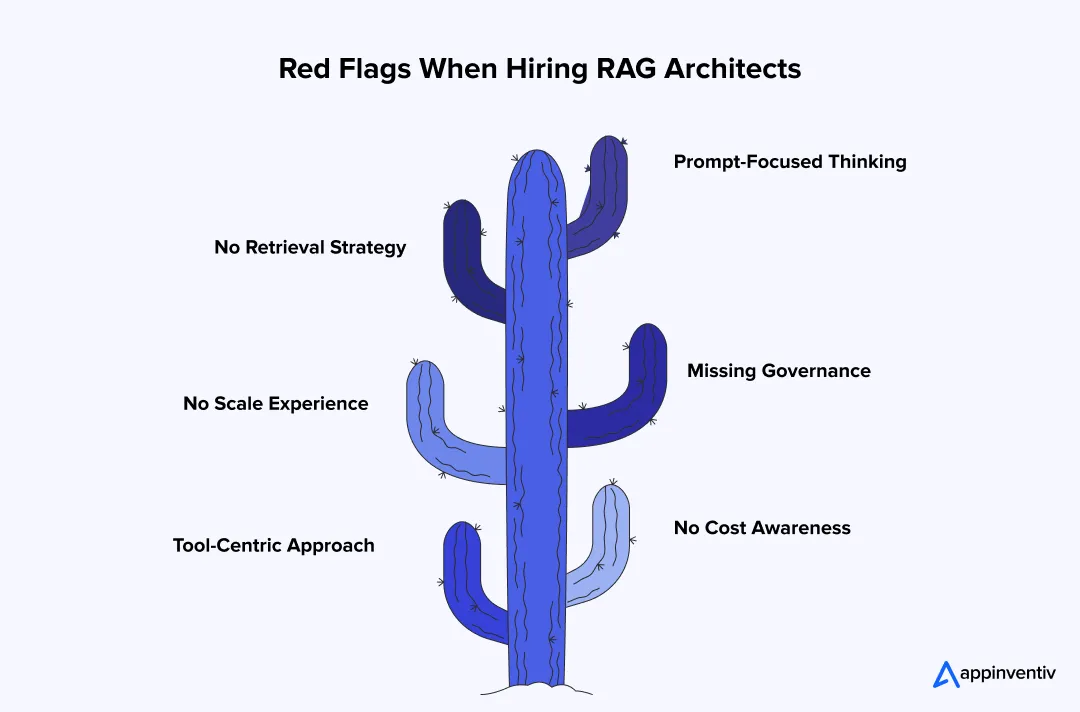
1. Overfocus on Prompt Engineering
If the discussion revolves around prompt tuning and output formatting, with little focus on retrieval design, it indicates shallow system understanding.
What this leads to:
- Poor retrieval relevance
- Unstable outputs under scale
A strong architect prioritizes retrieval and system design before prompts.
2. No Clear Retrieval Strategy
Candidates should be able to explain how they design retrieval pipelines, not just use vector search tools.
Watch for:
- No mention of hybrid retrieval
- No understanding of recall vs precision trade-offs
- No re-ranking strategy
This results in low-quality responses and inconsistent system behavior.
3. Lack of Governance Thinking
If governance is treated as an afterthought or delegated to another team, it is a major risk.
Watch for:
- No approach to permission-aware retrieval
- No audit logging or traceability design
- No compliance alignment
This leads to data exposure and audit failures.
4. No Production-Scale Experience
Many candidates have built demos but not enterprise systems.
Watch for:
- No experience with high-concurrency systems
- No understanding of scaling vector databases
- No latency or SLA discussions
These systems fail when exposed to real user load.
5. No Cost Awareness
Architectural decisions directly impact cost, especially in RAG systems.
Watch for:
- No discussion of embedding pipeline costs
- No token usage optimization strategy
- No infrastructure cost modeling
This leads to uncontrolled cost growth over time.
6. Tool-Centric Thinking Instead of System Design
Candidates who focus heavily on specific tools rather than architecture often lack depth.
Watch for:
- Listing frameworks without explaining design decisions
- Inability to justify architectural trade-offs
Strong architects explain systems, not tools.
How Appinventiv Supports Enterprise RAG Architecture
When you hire RAG architects, building a system that works in production requires more than assembling components. It requires architectural ownership across retrieval, governance, and scaling from day one.
Appinventiv approaches RAG as enterprise infrastructure, not as an experimental layer.
What We Deliver
- End-to-end RAG architecture design across ingestion, indexing, retrieval, and generation
- Permission-aware retrieval systems with built-in access control and auditability
- Hybrid retrieval pipelines combining semantic search, keyword matching, and re-ranking
- Distributed vector database architecture supporting agentic RAG architecture for high-scale environments
- Cost-optimized embedding and retrieval pipelines designed for long-term sustainability
How We Operate
- Governance is embedded at the retrieval layer, not added after deployment
- Systems are designed around latency, throughput, and SLA targets from the start
- Every architecture decision is tied to measurable outcomes across performance and cost
- Security and compliance are mapped directly into system design
Proven Enterprise Scale
- 3000+ digital solutions delivered
- 500+ enterprise workflows modernized
- 95% client satisfaction rate
- 1000+ global clients served
Real-World Execution: MyExec AI Business Consultant
A strong example of enterprise-grade RAG architecture in action is MyExec, an AI-powered business consultant platform.
The Challenge
Small and mid-sized businesses lacked access to real-time, data-driven consulting due to high costs and operational complexity.
The Solution
Appinventiv built a multi-agent RAG-based system that:
- Processes business documents and structured data
- Extracts insights using retrieval pipelines
- Delivers decision-ready recommendations through a conversational interface
The Impact
- Faster, data-backed decision-making for business leaders
- Reduced reliance on expensive consultants
- Scalable AI-driven advisory system that evolves with business data
This implementation demonstrates how RAG architecture, when designed correctly, becomes a decision intelligence layer, not just a chatbot.
Stop Delaying Your RAG Build
Every delay increases risk and cost. Move forward with a team that builds production-ready RAG systems without rework.
Real-World Examples of Enterprise RAG Deployments
When enterprise RAG architecture moves into regulated or high-value workflows, it stops being a feature and becomes infrastructure.
Below are three real-world deployments from globally recognized organizations where retrieval architecture, governance, and scalability were central to success.
Morgan Stanley: Wealth Management Knowledge Assistant
Morgan Stanley deployed a GPT-4 powered assistant for its financial advisors to navigate tens of thousands of internal research documents, reports, and policy materials.
This was not a simple chatbot rollout. The system required:
- Strict document-level access control across advisory teams
- Retrieval grounded exclusively in approved internal content
- Citation-backed responses for regulatory defensibility
- High reliability under advisor query load
In financial services, an incorrect answer can carry regulatory consequences. This implementation required disciplined RAG system architecture, not prompt engineering.
Mayo Clinic: Clinical Knowledge Integration
Healthcare environments demand privacy controls and precision. Mayo Clinic has leveraged retrieval-based AI systems to surface validated medical knowledge to clinicians.
Architectural complexity included:
- Segmented data environments for protected health information
- Controlled retrieval across clinical research and internal guidelines
- Strict governance alignment with HIPAA requirements
- Continuous knowledge updates as medical protocols evolved
Here, RAG architecture had to balance speed, privacy, and medical accuracy simultaneously.
Also Read: RAG in Healthcare
Thomson Reuters: AI Legal Research with CoCounsel
Thomson Reuters introduced AI-powered legal assistance grounded in authoritative legal databases.
This deployment required:
- Retrieval restricted to validated legal sources
- Citation traceability for courtroom defensibility
- Version control of statutes and case laws
- High-precision re-ranking for complex legal queries
Legal AI cannot tolerate hallucinated precedent. The architecture had to enforce retrieval integrity at every layer.
In each of these examples, enterprise RAG architecture was not treated as an experimental enhancement. It was engineered as enterprise-grade infrastructure, with governance, performance, and scalability built into the core.
What Should You Do Next to Build a Scalable RAG System
At this stage, you likely have clarity on what to look for, how to evaluate, and what risks to avoid. The next step is execution.
Hiring the right RAG architects for enterprise AI demands precision across retrieval, governance, and scaling. Delays or fragmented decisions at this stage often lead to costly rework later.
This is where working with an experienced partner makes the difference.
Appinventiv, a top RAG development services company, helps enterprises move from planning to production with systems designed for performance, compliance, and long-term stability.
If you are planning to build or scale a RAG system, now is the right time to validate your architecture and approach.
Turn your RAG strategy into a production-ready system. Share your requirements with Appinventiv.
[ad_2]
Source_link