In a business environment saturated with strategy decks and transformation roadmaps, one truth is becoming unmistakable: sustainable growth is not built through strategy alone. It is built through leadership behaviour — especially under pressure.
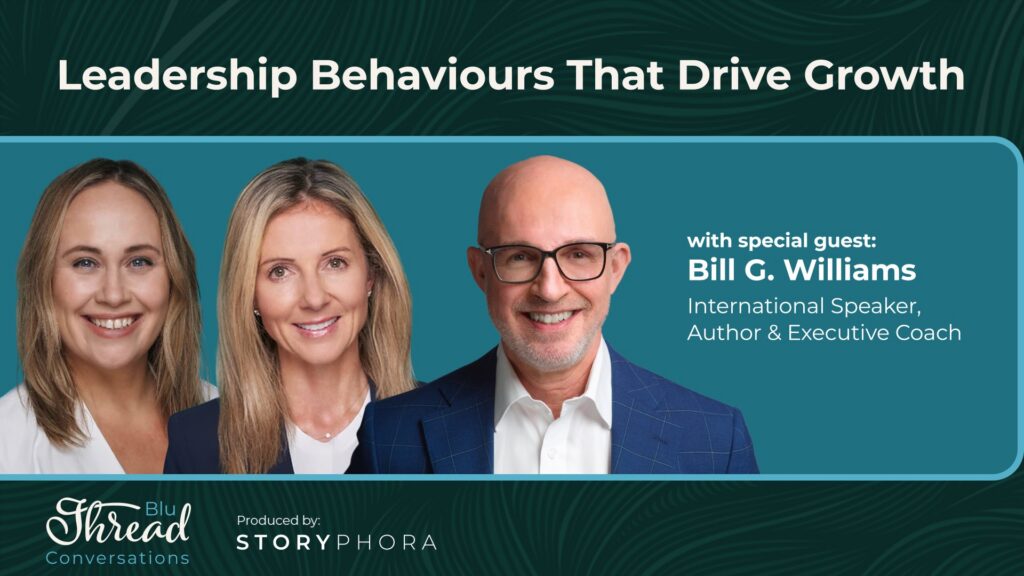
In Episode 21 of Blu Thread Conversations, we sat down with Bill Williams — award-winning leadership expert, executive coach, and bestselling author of Electric Life — who has spent decades advising senior leaders on how behaviour shapes performance — to explore what drives growth inside modern organizations.
His message was clear: leaders do not simply influence culture — they conduct it. The energy they carry, the trust they build, and the behaviours they model determine whether organizations accelerate or fragment.
That conversation reinforced what we see globally in our employer brand and culture advisory work: culture does not scale through messaging. It scales through behaviour.
For CEOs, CHROs, and boards navigating performance pressure, workforce evolution, and heightened reputation scrutiny, the implications are significant.
Culture Is Not Meant to Be Universal
One of Bill’s most provocative insights reframed how leaders should think about culture positioning:
“Your culture story should unapologetically repel those who don’t fit and powerfully attract the talent whose behaviours and values align with how you actually operate.”
The strongest employer brands are not broad. They are intentional and behaviourally specific.
Organizations that attempt to appeal to everyone often dilute alignment. Sustainable performance comes from clarity — about how decisions are made, how accountability is practiced, and how pressure is handled.
At Blu Ivy Group, this principle anchors our EVP and employer brand strategy work — not only because of attraction and retention outcomes, but because clarity creates alignment.
When organizations articulate how they truly operate, the right talent self-selects. Shared expectations reduce friction. Momentum accelerates.
Employer brand, when done well, is the infrastructure that aligns behaviour, strengthens reputation, and sustains growth.
Authenticity Is the Starting Point of Trust
When asked what leadership characteristic matters most today, Bill did not hesitate: authenticity.
Coming from someone who has spent decades coaching senior executives across industries and continents, that answer carries weight.
Authenticity is rarely comfortable.
Leaders often feel pressure to appear decisive, confident, and composed at all times. Over time, that pressure can create distance between who they are and who they believe they must be.
In Bill’s coaching work, this tension surfaces most at senior levels. Leaders may privately acknowledge uncertainty or fatigue yet feel compelled to mask those emotions publicly. Teams sense the disconnect immediately.
Authentic leadership is not oversharing. It is alignment between belief, emotion, and behaviour. When that alignment exists, trust strengthens. When it does not, culture erodes quietly.
Employer brand is shaped far more by lived leadership experience than by external storytelling. Authenticity is not soft. It is consistency — and consistency builds credibility.
Emotional Intelligence Is the Competency Required for This Era
This was the moment when Bill’s conviction sharpened. Emotional intelligence was not described as one skill among many — he defined it as the leadership competence required for this era.
The context explains why.
Leaders are operating in sustained pressure environments. Research from the American Psychological Association shows that most employees report ongoing work-related stress, with emotional exhaustion and disengagement rising. Managers report some of the steepest declines.
The strain is cumulative.
In that environment, emotional intelligence becomes stabilizing.
Bill outlines four core capacities:
- Self-awareness – knowing what you are feeling.
- Self-regulation – managing how you respond.
- Social awareness – reading what others are experiencing.
- Social regulation – acting with awareness of your impact.
His most resonant point was simple: “Fine” is not a feeling.
If leaders enter a room carrying frustration or anxiety and do not acknowledge it, the team still feels it. When emotional state is unnamed, people fill in the gaps.
Naming your starting point reduces misinterpretation and models maturity. Emotional intelligence is not softness. It is disciplined leadership.
Leadership Is Energy And Leaders Conduct It
Where emotional intelligence creates awareness, leadership determines expression.
Bill was unequivocal: leaders conduct energy.
They shape the emotional climate of an organization whether they intend to or not.
Before entering a room, leaders can ask: What am I carrying? How intense is it? What will it amplify?
Leaders set emotional temperature.
As Stacy Parker reflects, “Leadership brand is defined in moments of pressure — not by what we say in stability, but by how we regulate ourselves and conduct energy when it matters most.”
In strained moments — missed targets, restructures, uncertainty — teams absorb tone before they absorb strategy.
Conducting energy does not mean suppressing emotion. It means calibrating it. Choosing what to amplify. Taking responsibility for the current you create.
People hold onto feelings longer than they hold onto words. Unmanaged energy lingers. Managed energy stabilizes.
Emotional intelligence creates awareness of state. Leadership determines how that state is transmitted. Culture absorbs the result.
Trust: What Sustains Culture Under Pressure
If emotional intelligence creates awareness and leadership energy shapes the moment, trust determines whether culture holds.
Trust sustains performance when conditions are strained.
Drawing on Patrick Lencioni’s work, author of The Five Dysfunctions of a Team, Bill emphasized that high-performing teams are built on vulnerability-based trust.
Leandra Harris shares, “Trust is the operating system of a high-performance culture — without it, we consistently see execution slow, accountability weaken, and growth become more fragile.”
Trust is not abstract. It is performance infrastructure.
When credibility and transparency are consistent, teams move faster. Conflict becomes productive. Accountability strengthens. When trust weakens, instability spreads quietly.
Trust is built through repeated, observable behaviour.
Middle Management: Where Leadership Culture Either Scales or Splinters
Trust, energy, and emotional intelligence are not confined to the executive suite. They are tested — and amplified — in middle management.
If senior leaders set tone, middle managers translate it.
When volatility exists at the top — unclear direction, unmanaged energy, reactive communication — middle managers do not simply absorb it.
They amplify it.
Because they operate closest to daily execution, whatever they carry travels faster and farther. Tension becomes tone. Ambiguity becomes assumption. Fatigue becomes friction.
Momentum rarely stalls because strategy is flawed. It slows because energy becomes fragmented.
Middle managers are not just executors of strategy; they are conductors of culture at scale.
Employer Brand Is an Expression of Leadership Conduct
Employer brand is not separate from leadership behaviour. It is the expression of it.
When leadership conduct is consistent, employer brand strengthens. When behaviour and narrative diverge, credibility erodes.
Employer brand should echo the ideal expression of leadership conduct — how decisions are made, how pressure is handled, and how accountability is lived.
Talent is not choosing messaging. They are choosing experience. They evaluate how leadership behaves under strain.
Your employer brand is not what you say about yourself. It is how leadership is experienced.
A Message for CEOs in 2026
Strategy will always matter.
But in this era, leadership is not just about vision and direction. It is about the energy conducted across your organization, the trust sustained through its leaders, and whether that behaviour earns the followership your strategy depends on.
Culture and reputation are not soft variables. They are enterprise risk indicators and performance accelerators shaped directly by how leaders show up.
You can watch the full episode of Blu Thread Conversations here: https://www.youtube.com/watch?v=mR3xAfYFPuI
About Bill Williams
Bill Williams is an award-winning leadership expert, executive coach, keynote speaker, and bestselling author of Electric Life. Known globally as “Electric Bill,” he has spent more than three decades advising senior leaders and executive teams on how behaviour shapes performance, culture, and growth.
About Blu Ivy Group
Blu Ivy Group is a globally recognized employer brand, culture, and reputation consultancy partnering with organizations, boards, and private equity firms across Canada, the United States, and internationally.
For more than a decade, Blu Ivy has helped organizations align leadership behaviour, culture narrative, employer brand, and reputation to drive measurable business value.
In today’s environment, culture and employer brand reputation are not Human Resource initiatives. They are enterprise growth drivers — and risk indicators — shaped directly by leadership conduct.
If you are questioning whether leadership conduct, culture, and employer brand are accelerating your growth, or quietly slowing execution, now is the time to assess it.
Learn How: https://bluivygroup.com
For Inquiries Contact: Stacy Parker sparker@bluivygroup.com
The post Leadership Shapes Culture. Culture Amplifies Employer Brand. appeared first on Blu Ivy Group.