Reading Time: 17 minutes
SMS has become one of the highest-ROI channels for Shopify brands. That’s because, according to Statista, consumers increasingly prefer authentic engagement with brands. The best SMS platforms for Shopify do more than send text messages; they let you reach customers at the right moment in their customer journey, from an abandoned cart to a post-purchase follow-up to a loyalty reward.
In this article, we evaluate the best SMS marketing apps for Shopify in 2026. We also consider the key features to look for when choosing an SMS app or platform, and answer some frequently asked questions about SMS marketing apps. Let’s dive in!
TL;DR: Best SMS Marketing Apps for Shopify, Compared
We’ve ranked the best Shopify SMS marketing apps based on what each does well, how it connects to Shopify data, and the type of team or growth stage it best suits.
| Tool | Best For | SMS Strength | Other Channels | Quick Take |
| MoEngage | Enterprise & mid-market Shopify stores wanting a full retention stack | Strong; behavior-triggered, predictive, personalized | Email, mobile & web push, in-app, onsite, WhatsApp, MMS, RCS | Best choice if SMS is a part of a broader omnichannel marketing strategy |
| Klaviyo | Brands already using Klaviyo for email | Good; solid flows and Shopify-native triggers | Convenient if you want email and SMS in one place; SMS depth is secondary | |
| Postscript | Shopify brands wanting SMS-only done well | Excellent; built exclusively for SMS | None | Best dedicated SMS tool for Shopify; limited if cross-channel is the goal |
| Attentive | Brands with high SMS volume | Excellent; deliverability and scale | Strong at volume; contract-based, less accessible for smaller brands | |
| Omnisend | Small to mid-sized stores on a budget | Good; functional automations | Email, push | Affordable bundled option; less sophisticated at advanced use cases |
| OneText | Brands prioritizing in-text purchasing | Focused; commerce-first, one-tap buying | None | Strong for reducing purchase friction; revenue-share pricing |
| Privy | Early-stage Shopify stores and beginners | Basic | Good entry point; most brands outgrow it quickly | |
| Shopify Messaging | Shopify merchants testing SMS for the first time | Basic; transactional and simple campaigns | Free and frictionless; ceiling is low, not a long-term retention tool |

7 Key Features to Look for in the Best SMS Platforms for Shopify
As we’ve already said before, SMS is one of the highest-performing marketing channels available to Ecommerce brands. Forbes notes that SMS open rates are 98%, and messages are typically read within 3 minutes of delivery, a level of immediacy that email and social channels simply can’t match.
But strong open rates alone don’t guarantee strong results; the platform behind those messages determines whether that attention translates into actual revenue.
Before committing to any platform, it’s worth understanding which features really move the needle for Shopify merchants.
The following are the key capabilities to evaluate when choosing SMS marketing apps for your Shopify store.
1. Shopify-native automation and event triggers
The best Shopify SMS marketing app should integrate directly with Shopify events and customer data.
When choosing, look for a platform that integrates automated workflows for abandoned carts, shipping updates, purchases, and more.
With native Shopify integrations, you can trigger hyper-personalized messages using real-time Shopify data, for example, purchase history, customer segments, etc., all without relying on third-party connectors or manual syncs.
These native integrations also help your marketing team reduce setup friction and ensure automations fire accurately, keeping customers engaged at every stage of their journey with minimal effort from you and your team.
2. SMS compliance, opt-in capture, and deliverability
Compliance is critical if you want to avoid legal trouble, costly lawsuits, and reputational damage. Before choosing a Shopify SMS marketing app, ensure the platform fully complies with key regulations such as the new Telephone Consumer Protection Act (TCPA) rules, the General Data Protection Regulation (GDPR), and CAN-SPAM.
It should include robust tools such as customizable opt-in forms, consent management, double-opt-in support, and automated keyword processing for commands like STOP, HELP, and UNSUBSCRIBE.
Beyond legal compliance, deliverability deserves equal attention since a compliant message that never reaches the inbox is worthless.
Therefore, look for Shopify SMS marketing apps with strong carrier relationships, dedicated short codes or toll-free numbers, sender reputation monitoring, and built-in deletion list management.
Transparent deliverability reporting will also help you identify and resolve issues before they impact your campaign performance.
3. Email + SMS support vs. SMS-only tools
Although many brands start with SMS-only marketing, they eventually outgrow single-channel platforms as their customer base and campaign complexity grow.
That’s why it’s prudent to invest in a unified omnichannel marketing platform that supports engagement across SMS, WhatsApp, in-app messaging, push notifications, and email. Managing separate tools for email, SMS, and push notifications creates data silos, inconsistent experiences instead of personalized ones, and unnecessary operational overhead.
Rather than piecing together disconnected workflows, your team can coordinate messaging sequences that respond intelligently to how customers interact across every channel— improving personalization, reducing redundancy, and ultimately driving stronger customer retention and revenue outcomes as your brand scales.
4. Revenue attribution, segmentation, and reporting
Your Shopify SMS marketing platform should clearly connect campaigns to revenue outcomes, not just open rates.
Look for features like multi-touch conversion tracking, customer lifetime value (CLV) analysis, cohort reporting, and real-time dashboards that surface actionable insights fast.
Equally important are advanced customer segmentation capabilities. The ability to build dynamic audiences based on engagement frequency, predicted churn risk, loyalty tier, RFM (Recency, Frequency, and Monetary value) scores, and granular purchase history allows you to move well beyond basic list blasting.
Precise segmentation ensures the right message consistently reaches the right customer at the right moment, directly improving conversion rates while reducing unsubscribe rates caused by irrelevant or poorly-timed messaging.
Combined, robust attribution and smart segmentation give your team the intelligence needed to continuously improve campaign performance and justify SMS marketing investment.
5. Ease of use for marketers and support quality
Even the most feature-rich SMS marketing automation software platform delivers little real value if your marketing team struggles to navigate it effectively.
Ease of use should be a non-negotiable evaluation criterion, particularly for lean teams without dedicated technical resources. So you should prioritize Shopify SMS automation platforms with clean, intuitive dashboards, a low-code or no-code journey builder, drag-and-drop campaign editors, and a comprehensive library of pre-built automation templates tailored to common Shopify use cases, such as welcome series, post-purchase flows, and win-back campaigns.
As your brand grows and things become more complex, fast and knowledgeable customer support becomes essential.
Your Shopify SMS platform should offer dedicated onboarding assistance, live chat, detailed documentation, and proactive account management for higher-tier plans.
Checking user reviews on G2 or other review websites specifically for support responsiveness and ease-of-use ratings can help you avoid platforms that look impressive in demos but frustrate marketing teams in daily use.
6. Abandoned Cart Recovery
Abandoned cart recovery is one of the highest-performing use cases for Shopify SMS marketing. Unlike email, automated text messages are opened within minutes, which makes them uniquely effective for re-engaging shoppers while purchase intent is still fresh.
The best SMS platforms for Shopify automatically trigger personalized recovery sequences the moment a cart is abandoned, incorporating dynamic product images, direct cart restoration links, and time-sensitive incentives such as limited discount codes or low-stock alerts.
It’s recommended that you look for platforms that support multi-step recovery flows with adjustable send delays, so you can test whether a reminder or a sequence of three performs better for your audience.
Built-in A/B testing, conversion tracking, and revenue attribution specific to cart recovery flows are also essential. Smart exit conditions ensure customers who complete a purchase mid-sequence aren’t messaged unnecessarily, protecting the customer experience and your sender reputation simultaneously.
7. Two-Way Conversational Support
Modern SMS engagement is increasingly conversational, and customers now expect to respond, not just receive. One-way broadcast messaging no longer meets those expectations, especially as brands compete on personalized customer experiences.
Two-way messaging enables customers to reply directly to texts for real-time support, order status inquiries, return requests, appointment confirmations, and product recommendations. The best SMS marketing apps for Shopify pair this capability with AI-powered auto-responses and intelligent keyword routing to handle common queries at scale, seamlessly escalating to a live agent when a conversation requires human judgment.
Hence, this transforms SMS from a one-directional marketing channel into a genuine, high-value customer service touchpoint. The result is measurably higher satisfaction scores, stronger brand trust, and increased likelihood of repeat purchases.
What are the Best SMS Marketing Apps for Shopify in 2026?
Whether you’re a lean B2C brand just getting started or a Shopify Plus merchant running complex omnichannel marketing campaigns, the Shopify SMS app you choose will directly shape how effectively you can acquire, retain, and convert customers through text.
As such, you must choose platforms that’ll make SMS one of the most direct and high-performing channels for your brand.
1. MoEngage
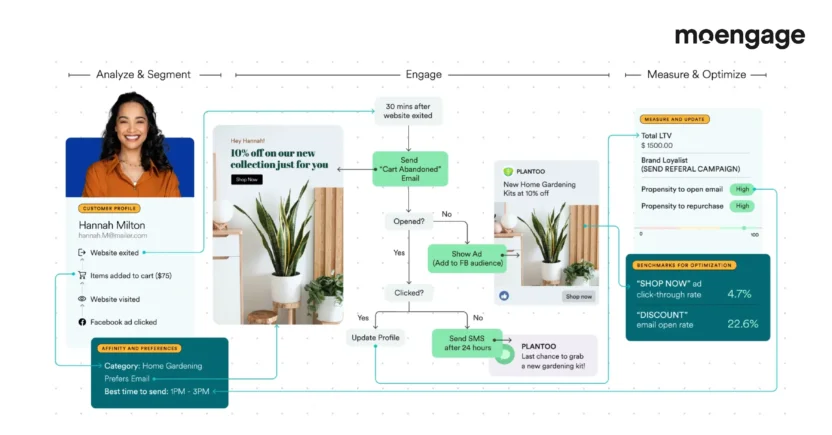
MoEngage is an agentic customer engagement platform built for Shopify brands that want more than a point SMS solution. While other platforms might stop at offering SMS features, MoEngage goes further, extending engagement across Shopify Email and SMS, push notifications, on-site and in-app messaging, WhatsApp, and web personalization.
If your Shopify brand is serious about retention and customer lifecycle marketing, then MoEngage’s SMS marketing automation platform is a great option to consider.
Key SMS and cross-channel capabilities
The MoEngage Shopify integration connects your store’s data directly to MoEngage’s engagement engine. Hence, cart abandonment, browsing behavior, and purchase history events feed right into segments and journeys in real-time.
Furthermore, MoEngage allows you to build channel-spanning campaigns seamlessly and intelligently. So instead of sending messages via different channels in a disconnected mess, MoEngage lets you define rules about the best channel for each customer based on behavior and preferences.
In addition, MoEngage’s customer journey orchestration sets it apart from SMS-only tools. Segmentation also goes beyond surface-level targeting. Instead, you can build audiences based on RFM attributes, product category affinity, and real-time behavioral signals.
What MoEngage is best for: MoEngage is an excellent option for mid-market and enterprise Shopify brands that have outgrown single-channel tools and need a platform that scales with them. Specifically, it’s great for:
- Retention and lifecycle marketing teams that want a single tool for email, push, on-site messaging, and SMS.
- Growth-stage B2C brands that want to move to personalized engagement driven by real customer behavior.
- Brands with a meaningful existing customer base where the retention ROI justifies investing in a full engagement platform.
Pricing: MoEngage uses a contact-based pricing model that scales with the size of your engaged audience. Pricing is customized based on monthly active users, the channels you activate, and the features required. Pricing plans are tailored to each brand’s scale and use case.
2. Klaviyo
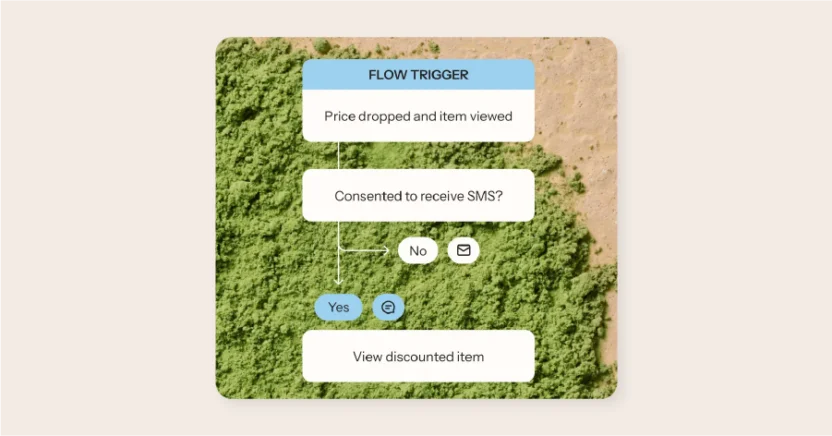
Klaviyo is one of the most popular retention marketing platforms for Shopify brands. It combines email and SMS in a tightly integrated suite and supports deep native Shopify data connectivity. Users also love its automation and segmentation features.
Best suited for: Small Shopify brands that already use Klaviyo for email and want to manage SMS within the same platform.
Pricing model: Klaviyo charges separately for email (contact-based) and SMS (per message sent). The free plan includes up to 250 email contacts, while SMS pricing varies by country and volume.
Key considerations: Klaviyo pricing scales with your contact list, which adds up quickly for high-growth brands. Some users also find the reporting less flexible than they’d like, and navigation between sections isn’t always intuitive.
If you want tighter cross-channel orchestration, real-time segmentation, and unified analytics, you can explore some useful Klaviyo alternatives.
You can also compare MoEngage vs. Klaviyo to see which of these two excellent platforms might be best for you.
3. Postscript
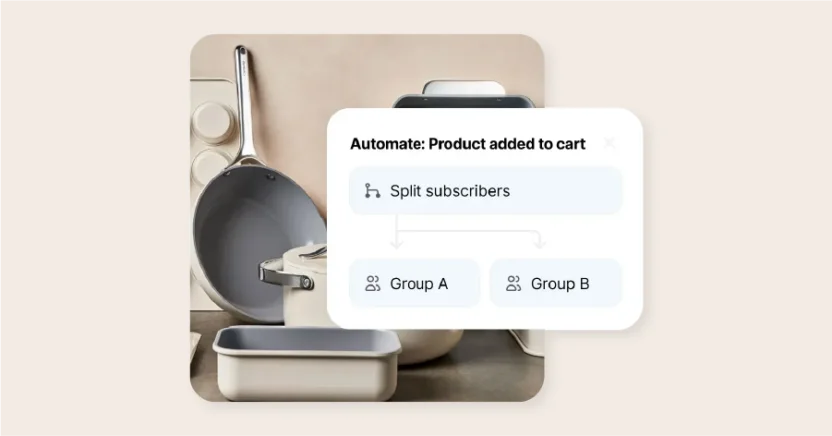
Postscript is a dedicated SMS tool with robust compliance, segmentation, and workflow capabilities for Shopify stores. It delineates itself by focusing completely on SMS.
Best suited for: Brands that need a focused, SMS-only solution that jettisons the complexity of a broader platform. If SMS is your primary retention channel, then this is a great choice.
Pricing model: Postscript’s pricing is usage-based. Plans include a base fee plus per-message costs for SMS and MMS. It scales with message volume rather than contact count.
Key considerations: Some users find Postscript’s feature development hasn’t kept pace with more complex operational needs, and workarounds are occasionally required to fill the gaps. Also, as we’ve highlighted before, this platform is SMS-only. Hence, it doesn’t offer email, push, or omnichannel marketing automation features.
Brands that later want omnichannel capabilities will have to migrate to a new platform or integrate additional tools. Additionally, the analytics features could use some refinement.
4. Attentive
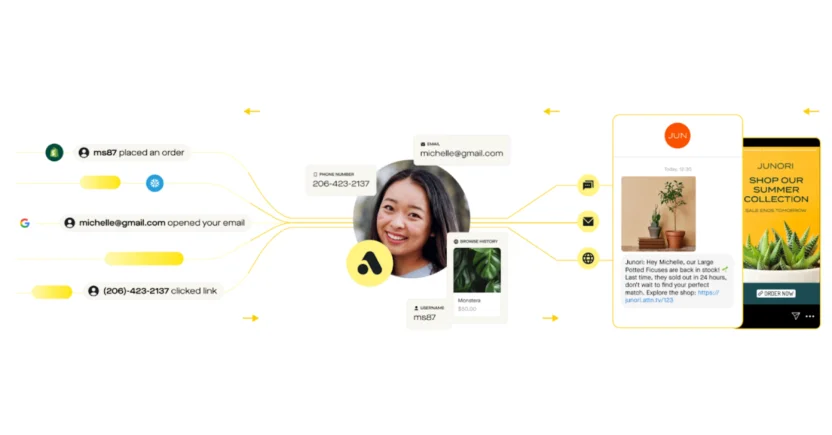
Attentive is an SMS and email platform, known for its two-tap sign-up technology and strong overall deliverability.
Best suited for: Large Shopify and Shopify Plus brands with relatively high subscriber volumes and a need for enterprise-grade deliverability, compliance, and dedicated account support.
Pricing model: Custom, contract-based pricing structured around message volume and subscriber count.
Key considerations: Email customization has real limits. Order confirmation templates can’t pull order tags, which creates friction for brands managing pre-orders, oversized items, or split shipping timelines. Some Attentive users also run into character constraints that limit how much can fit in a single SMS, particularly when using emojis or MMS. And a few have flagged inconsistent account support, including losing dedicated customer success managers without notice.
5. Omnisend
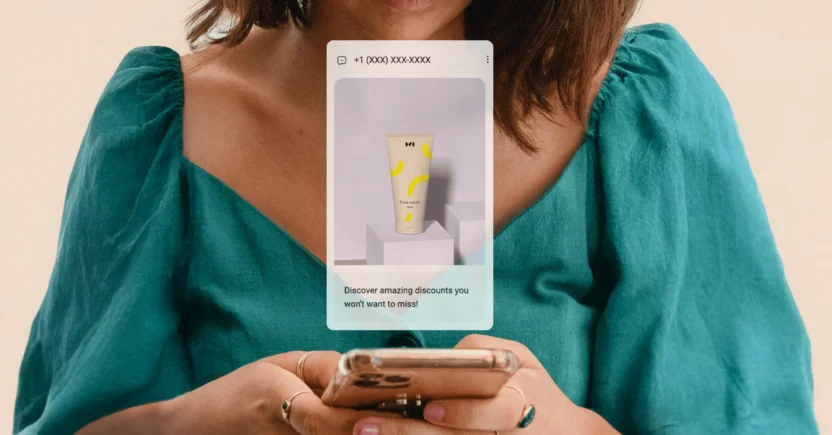
Omnisend is one of the top SMS marketing platforms for Shopify in 2026, offering email, SMS, and push notifications in one interface.
Best suited for: Omnisend is popular with Shopify store owners who want email and SMS bundled together at a relatively affordable price. It’s best suited for small to mid-sized Shopify stores that want a combined marketing platform without the complexity of an enterprise platform.
Pricing model: Tiered plans based on contact count and feature access. Your SMS credits are purchased separately on top of the base plan. The free plan includes a limited number of sends.
Key considerations: Permission levels are inconsistently scoped; audit access doesn’t include flow designs, which is a friction point for agencies reviewing client accounts. The pop-up builder is limited to two steps, and image sizing within it is more cumbersome than it should be.
Analytics and deliverability visibility are functional, but leave room for improvement. Initial setup can also be a lift for users newer to email marketing, and the onboarding experience skews heavily toward standard Ecommerce use cases, leaving merchants with less conventional business models to figure out more on their own.
6. Privy
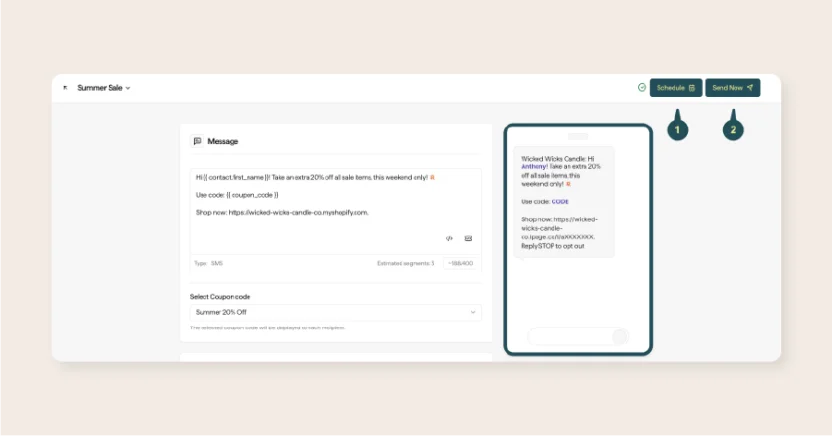
Source: https://help.privy.com/docs/learn/sms-campaigns/send-a-text-campaign
As one of the top SMS marketing apps for Shopify in 2026, Privy works as a conversion, email, and SMS marketing platform focused on on-site capture and foundational retention. In 2025, Privy acquired Emotive to build a unified email and SMS platform built for “personalized, authentic marketing.”
Privy now stands out as a conversational SMS marketing platform that combines automation with human-assisted messaging. While it uses AI-powered automation, it is supplemented by human agents.
Best suited for: Privy is a good choice for smaller Shopify stores that want a beginner-friendly, all-in-one solution. If you’re looking for a simple, affordable tool to grow your subscriber list and run basic campaigns, this might be a good fit.
It also works for DTC Shopify brands that desire conversational SMS experiences and for brands that focus on retention and customer service integration rather than just broadcast messaging.
Pricing model: Starts at $30/month with 250 free SMS credits included.
Key considerations: As this is a beginner-friendly option, its capabilities are more limited than those of mature platforms like MoEngage or Klaviyo. Brands that grow quickly will quickly outstrip Privy’s capabilities and will need something more comprehensive.
Although its hybrid model creates very personalized two-way text conversations, this model might not be cost-efficient for brands that just want automated broadcast campaigns. Furthermore, pricing becomes unclear as your business scales.
7. OneText
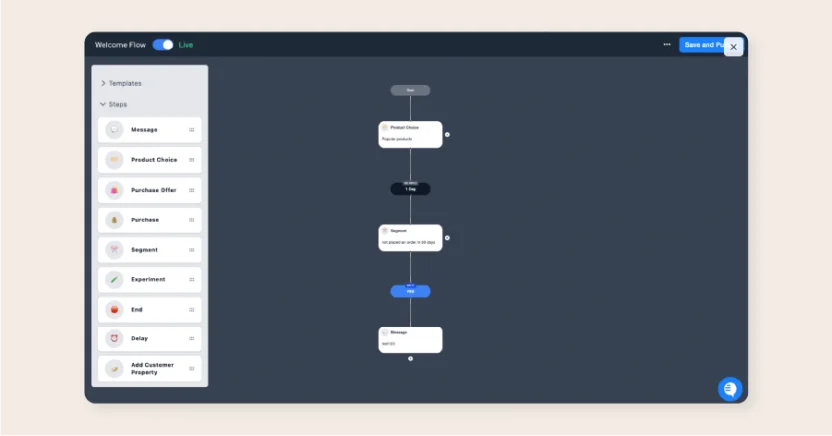
Source: https://docs.onetext.com/articles/7068216908-welcome-message
OneText is a Shopify SMS platform focused on one-tap purchasing via text message. With this option, customers can buy your products without leaving the SMS thread.
Best suited for: The frictionless SMS purchasing makes this a good option for Shopify brands that want to shorten the path to purchase.
Pricing model: Performance-based pricing model. OneText charges a percentage of revenue generated through the platform rather than a flat fee or per-message cost.
Key considerations: With its commerce-first focus, OneText is less suited for brands that desire broad lifecycle marketing or omnichannel marketing. You should also consider that the platform’s revenue-sharing model can become expensive for high-volume brands.
8. Shopify Messaging / Native Shopify options
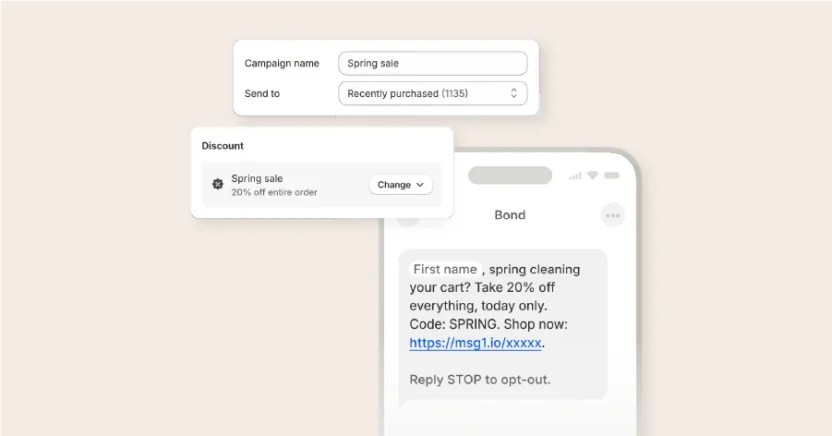
Source: https://www.shopify.com/email-marketing
Shopify also offers built-in SMS support with Shopify Messaging. This is in the Shopify admin and lets you send text notifications such as order confirmations, local pickup notifications, gift card issuance, and POS receipts. Everything else beyond these will require a third-party app.
Best suited for: Early-stage Shopify store owners who want to test native SMS and email marketing capabilities with additional tooling or extra vendor relationships. It serves as an excellent option for testing before your brand has the volume or complexity to invest in a third-party solution.
Pricing model: It comes with the Shopify store plan. You get 10,000 free emails per month. Pricing starts at $1/1000 emails per month.
Key considerations: Shopify Messaging has a low ceiling: it handles transactional notifications and basic campaign sending. However, for more advanced features such as behavioral segmentation, multi-step automation flows, or event triggering, you’ll need to look to platforms like MoEngage or Klaviyo.
How We Evaluated These Shopify SMS Marketing Apps: 7 Criteria
There are dozens of SMS marketing apps for Shopify, but not all of them perform equally well in real Ecommerce environments. To build this list, we evaluated each platform across 7 criteria that consistently influence merchant reviews, competitive comparisons, and purchasing decisions.
- Shopify integration depth: The first thing we did was to find SMS platforms with deep Shopify integration. The evaluation focused on whether the platform can pull real-time events such as product views, cart abandonment, browsing behavior, and purchase history. Stronger integrations typically enable better personalization and reduce the manual data management your team must handle.
- Automation workflows: We evaluated the flexibility of each platform’s automation workflow builder. The review covered support for multi-step workflows, conditional logic, branching customer journey maps, and dynamic automation paths.
- SMS compliance: Compliance capabilities played a major role in the evaluation process. We reviewed whether each platform supports GDPR and TCPA consent management, subscriber preference controls, audit trails, and opt-out handling. Weak compliance systems can create legal risks and negatively affect SMS deliverability.
- Segmentation quality: We examined how precisely each Shopify SMS app can segment audiences. The customer segmentation analysis included behavioral targeting options such as browsing activity, purchase frequency, and cart abandonment, as well as predictive attributes such as churn likelihood and purchase intent. We also considered whether audience segments update automatically as customer behavior changes.
- Reporting and attribution: We assessed the depth and usefulness of each platform’s analytics. The evaluation focused on revenue attribution, campaign performance reporting, customer engagement metrics, and visibility into how SMS campaigns contribute to conversions and retention.
- Merchant review signals: We analyzed merchant feedback from the Shopify App Store, G2, and Gartner to identify recurring strengths and weaknesses. The review process considered customer onboarding quality, ease of use, customer support responsiveness, deliverability reliability, and whether the product experience matched marketing expectations.
- Cross-channel breadth: Because SMS marketing rarely operates in isolation, we also evaluated whether each platform supports coordinated engagement across channels such as email, web push notifications, in-app messaging, and web personalization. Strong cross-channel support allows brands to create more consistent customer experiences.
4 Common Shopify SMS Marketing Use Cases
SMS marketing isn’t a one-size-fits-all broadcast tool. The Shopify stores seeing the strongest returns from SMS aren’t simply sending more messages, but are sending smarter ones, triggered by real customer behavior and tailored to where each shopper is in their relationship with the brand.
From recovering abandoned carts to rewarding loyal VIPs, the following four use cases represent the highest-impact opportunities available to Shopify merchants today.
1. Welcome Series and Subscriber Growth
The first message a new subscriber receives sets the tone for the entire customer relationship.
A short multi-step welcome series that introduces the brand, promotes bestsellers, and invites engagement in the first week can improve long-term subscriber retention and first-purchase conversion rates.
For example, a Shopify food subscription brand offers 10% off a first box in exchange for an SMS opt-in. The first message delivers the code instantly.
Two days later, a follow-up introduces their sourcing story and links to their most popular boxes.
On day five, a final message highlights their subscription option with a “Never run out” angle. Subscribers who move through all three messages are more likely to convert.
2. Abandoned Cart Recovery
Cart abandonment is the highest-intent trigger in Ecommerce. Shopify store owners can use SMS instead of email to quickly reach customers who don’t complete a purchase.
For example, say a Shopify skincare brand notices that a customer abandoned a product. Within 35 minutes, they send: “Still thinking it over? Your glow-up is one step away: your cart is saved.”
Twenty hours later, non-converters receive a follow-up message saying, “Last chance: get 10% off your order for the next 3 hours.”
The two-message sequence can recover a meaningful portion of otherwise-lost income without blanket discounting.
3. Post-Purchase Updates and Repeat Purchase Campaigns
SMS is well-suited to the post-purchase window, where transactional messages have high open rates.
Sending communications like order confirmations, shipping updates, and delivery notifications can build trust. Beyond the transaction, a well-timed reminder message, triggered by product type and the number of days since purchase, may turn a one-time buyer into a repeat customer.
For instance, a Shopify pet supplies store sends an order confirmation SMS the moment a customer purchases a 30-day supply of dog food, followed by a shipping update and delivery notification.
On day 25, an automated message fires: “Heads up— Jake’s food is probably running low. Reorder in 30 minutes before you run out.”
The message uses the customer’s pet name from a post-purchase survey.
Repurchase rates for consumable products will likely increase significantly compared with stores that rely solely on email for reorder reminders.
4. Promotions, Launches, and VIP Campaigns
SMS remains one of the most effective channels for time-sensitive campaigns.
Product launches, flash sales, and seasonal promotions benefit from the immediacy of text. VIP segments, defined by purchase frequency or lifetime value, respond well to early-access messaging and exclusive offers, reinforcing loyalty while driving revenue from customers most likely to convert.
For example, say a Shopify streetwear brand is dropping a limited-edition capsule collection. Rather than announcing to their entire SMS list at once, they send VIP subscribers an exclusive 24-hour early-access link the night before the public launch.
The message might read something like: “You’re in. Early access to our new drop is live — 24 hours before everyone else.”
Such treatment can improve customer loyalty among high-value customers while creating organic urgency for the broader launch.
How to Choose the Right Shopify SMS App for Your Store
With dozens of SMS marketing apps available in the Shopify App Store, the decision can feel overwhelming, especially when most platforms make similar promises around Ecommerce marketing automation, personalization, and ROI.
The right Shopify SMS automation platform depends on several factors, such as your current size and channel needs, compliance & deliverability, and cost.
1. Choose based on your channel needs, not SMS alone
A common mistake brands make when evaluating SMS platforms for Shopify online stores is scoping the decision too narrowly. True, if you have no plans to coordinate SMS with email, push, or on-site messaging, then a focused point solution might be okay. But most growing Shopify brands don’t work that way.
Retention improves when SMS is part of a coordinated omnichannel marketing strategy, where the same customer information informs what gets sent, which channel it’s sent through, and when.
If omnichannel engagement is part of your current or planned strategy, then build that requirement into your app evaluation strategy from the start. Migrating from a single-SMS tool to another platform after building a large subscriber list, establishing automations, and integrating compliance workflows is often expensive and disruptive. Hence, choose a platform that can grow with you.
2. Check compliance, deliverability, and consent tooling
SMS marketing has legal obligations that email doesn’t replicate. For example, in the USA, the TCPA requires that customers opt in to marketing messages and provides clear opt-out mechanisms. GDPR applies in the UK and Europe.
So, before committing to any Shopify SMS app, ensure it handles opt-in consent collection at the point of subscription, supports real-time opt-outs, and maintains auditable records of when and how consent was given.
Additionally, you should consider the platform’s SMS deliverability. The sender’s reputation, its carrier relationships, and message format standards affect whether your message reaches the customer at all.
3. Compare pricing model vs. lifecycle value
SMS platform pricing is rarely what it appears to be at first glance. Low headline rates, often marketed as cost-per-message or a flat monthly fee, can compound quickly once you account for the full picture: per-send charges that scale with list size, separate fees for MMS vs. SMS, feature tiers that gate automations or analytics behind higher plans, and in some cases, distinct contact charges for email and SMS subscribers even within the same platform.
For brands running high-frequency campaigns — think flash sales, cart recovery, back-in-stock alerts, post-purchase sequences — the unit economics shift significantly at scale. A platform that looks affordable at 10,000 contacts may price you out of your own retention strategy at 100,000.
The more important framing, though, is the total cost of ownership (TCO) across your martech stack. Many brands end up paying for SMS through one platform, email through another, and push or in-app notifications through a third. Each of those contracts comes with its own seat fees, integration costs, and data sync overhead. When you add it up, the fragmented approach is often more expensive than a consolidated platform — and that’s before you factor in the operational drag of managing three vendor relationships, three contract renewal cycles, and three sets of compliance obligations.
The right question to ask when evaluating any SMS tool is, “What does this decision cost me over the next 18-24 months, including the platforms I’d need alongside it?”

Final Thoughts: Choose From the Best SMS Platforms for Shopify in 2026
So, out of all the Shopify SMS marketing apps, which is the best for your Shopify store?
If you have SMS-only needs, Postscript and Attentive are strong options. If you want bundled email and SMS, Klaviyo and Omnisend will deliver good results.
But if you want SMS, email, push, on-site, segmentation, and personalization to work together as one system, MoEngage is a better choice in 2026. Shopify personalization with MoEngage supports dynamic content driven by real-time behavioral context, such as the last product viewed, their most-purchased category, offers they’ve previously responded to, and so on, so every message feels timely rather than broadcast. If that kind of coordinated engagement is where you’re headed, see it in action with a MoEngage demo.
The post 8 Best SMS Platforms for Shopify in 2026 appeared first on MoEngage.