Curiosity-driven research has long sparked technological transformations. A century ago, curiosity about atoms led to quantum mechanics, and eventually the transistor at the heart of modern computing. Conversely, the steam engine was a practical breakthrough, but it took fundamental research in thermodynamics to fully harness its power.
Today, artificial intelligence and science find themselves at a similar inflection point. The current AI revolution has been fueled by decades of research in the mathematical and physical sciences (MPS), which provided the challenging problems, datasets, and insights that made modern AI possible. The 2024 Nobel Prizes in physics and chemistry, recognizing foundational AI methods rooted in physics and AI applications for protein design, made this connection impossible to miss.
In 2025, MIT hosted a Workshop on the Future of AI+MPS, funded by the National Science Foundation with support from the MIT School of Science and the MIT departments of Physics, Chemistry, and Mathematics. The workshop brought together leading AI and science researchers to chart how the MPS domains can best capitalize on — and contribute to — the future of AI. Now a white paper, with recommendations for funding agencies, institutions, and researchers, has been published in Machine Learning: Science and Technology. In this interview, Jesse Thaler, MIT professor of physics and chair of the workshop, describes key themes and how MIT is positioning itself to lead in AI and science.
Q: What are the report’s key themes regarding last year’s gathering of leaders across the mathematical and physical sciences?
A: Gathering so many researchers at the forefront of AI and science in one room was illuminating. Though the workshop participants came from five distinct scientific communities — astronomy, chemistry, materials science, mathematics, and physics — we found many similarities in how we are each engaging with AI. A real consensus emerged from our animated discussions: Coordinated investment in computing and data infrastructures, cross-disciplinary research techniques, and rigorous training can meaningfully advance both AI and science.
One of the central insights was that this has to be a two-way street. It’s not just about using AI to do better science; science can also make AI better. Scientists excel at distilling insights from complex systems, including neural networks, by uncovering underlying principles and emergent behaviors. We call this the “science of AI,” and it comes in three flavors: science driving AI, where scientific reasoning informs foundational AI approaches; science inspiring AI, where scientific challenges push the development of new algorithms; and science explaining AI, where scientific tools help illuminate how machine intelligence actually works.
In my own field of particle physics, for instance, researchers are developing real-time AI algorithms to handle the data deluge from collider experiments. This work has direct implications for discovering new physics, but the algorithms themselves turn out to be valuable well beyond our field. The workshop made clear that the science of AI should be a community priority — it has the potential to transform how we understand, develop, and control AI systems.
Of course, bridging science and AI requires people who can work across both worlds. Attendees consistently emphasized the need for “centaur scientists” — researchers with genuine interdisciplinary expertise. Supporting these polymaths at every career stage, from integrated undergraduate courses to interdisciplinary PhD programs to joint faculty hires, emerged as essential.
Q: How do MIT’s AI and science efforts align with the workshop recommendations?
A: The workshop framed its recommendations around three pillars: research, talent, and community. As director of the NSF Institute for Artificial Intelligence and Fundamental Interactions (IAIFI) — a collaborative AI and physics effort among MIT and Harvard, Northeastern, and Tufts universities — I’ve seen firsthand how effective this framework can be. Scaling this up to MIT, we can see where progress is being made and where opportunities lie.
On the research front, MIT is already enabling AI-and-science work in both directions. Even a quick scroll through MIT News shows how individual researchers across the School of Science are pursuing AI-driven projects, building a pipeline of knowledge and surfacing new opportunities. At the same time, collaborative efforts like IAIFI and the Accelerated AI Algorithms for Data-Driven Discovery (A3D3) Institute concentrate interdisciplinary energy for greater impact. The MIT Generative AI Impact Consortium is also supporting application-driven AI work at the university scale.
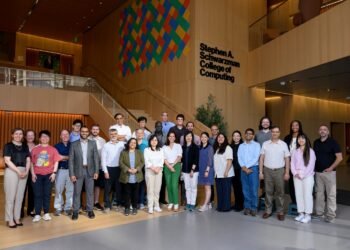
To foster early-career AI-and-science talent, several initiatives are training the next generation of centaur scientists. The MIT Schwarzman College of Computing’s Common Ground for Computing Education program helps students become “bilingual” in computing and their home discipline. Interdisciplinary PhD pathways are also gaining traction; IAIFI worked with the MIT Institute for Data, Systems, and Society to create one in physics, statistics, and data science, and about 10 percent of physics PhD students now opt for it — a number that’s likely to grow. Dedicated postdoctoral roles like the IAIFI Fellowship and Tayebati Fellowship give early-career researchers the freedom to pursue interdisciplinary work. Funding centaur scientists and giving them space to build connections across domains, universities, and career stages has been transformative.
Finally, community-building ties it all together. From focused workshops to large symposia, organizing interdisciplinary events signals that AI and science isn’t siloed work — it’s an emerging field. MIT has the talent and resources to make a significant impact, and hosting these gatherings at multiple scales helps establish that leadership.
Q: What lessons can MIT draw about further advancing its AI-and-science efforts?
A: The workshop crystallized something important: The institutions that lead in AI and science will be the ones that think systematically, not piecemeal. Resources are finite, so priorities matter. Workshop attendees were clear about what becomes possible when an institution coordinates hires, research, and training around a cohesive strategy.
MIT is well positioned to build on what’s already underway with more structural initiatives — joint faculty lines across computing and scientific domains, expanded interdisciplinary degree pathways, and deliberate “science of AI” funding. We’re already seeing moves in this direction; this year, the MIT Schwarzman College of Computing and the Department of Physics are conducting their first-ever joint faculty search, which is exciting to see.
The virtuous cycle of AI-and-science has the potential to be truly transformative — offering deeper insight into AI, accelerating scientific discovery, and producing robust tools for both. By developing an intentional strategy, MIT will be well positioned to lead in, and benefit from, the coming waves of AI.