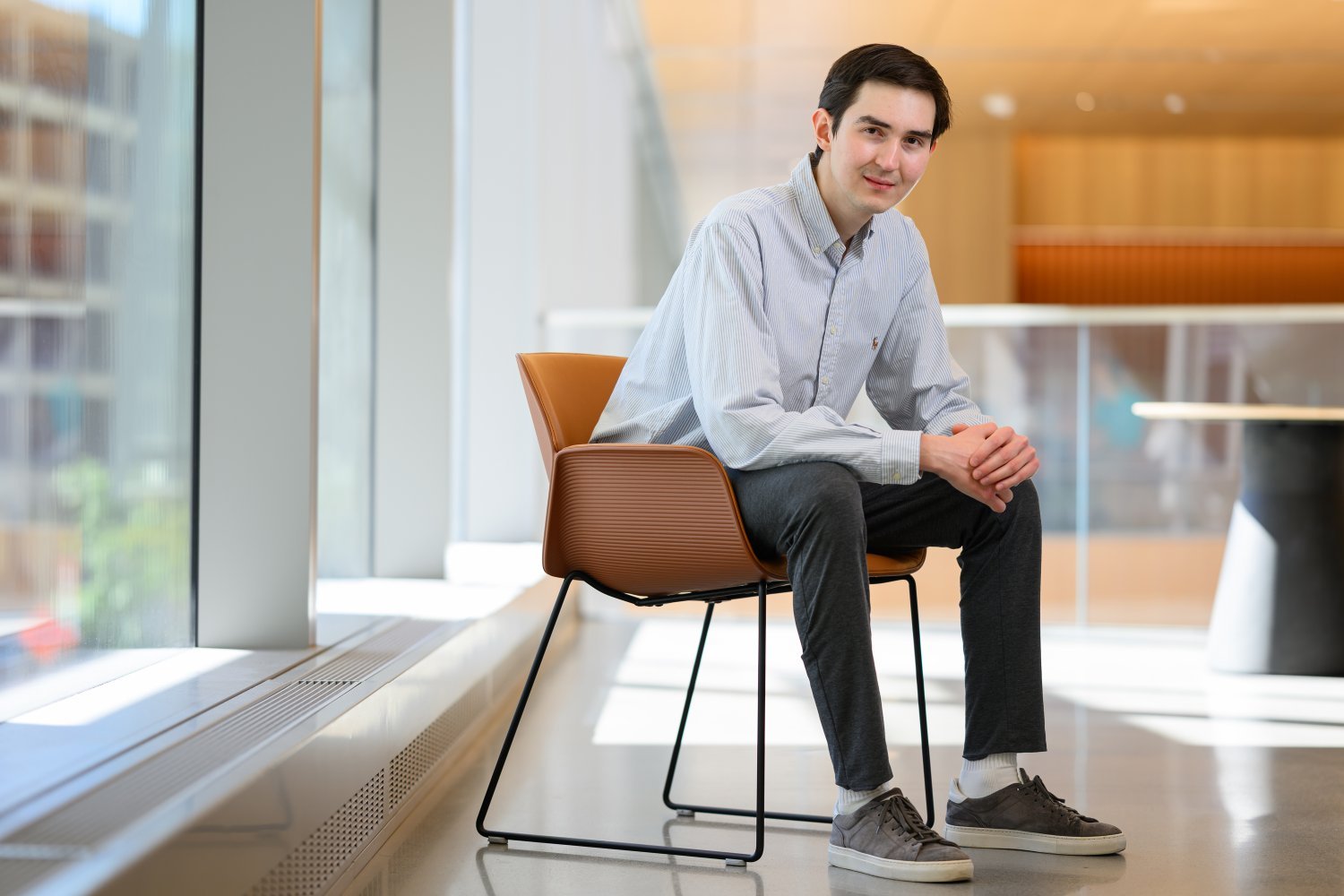
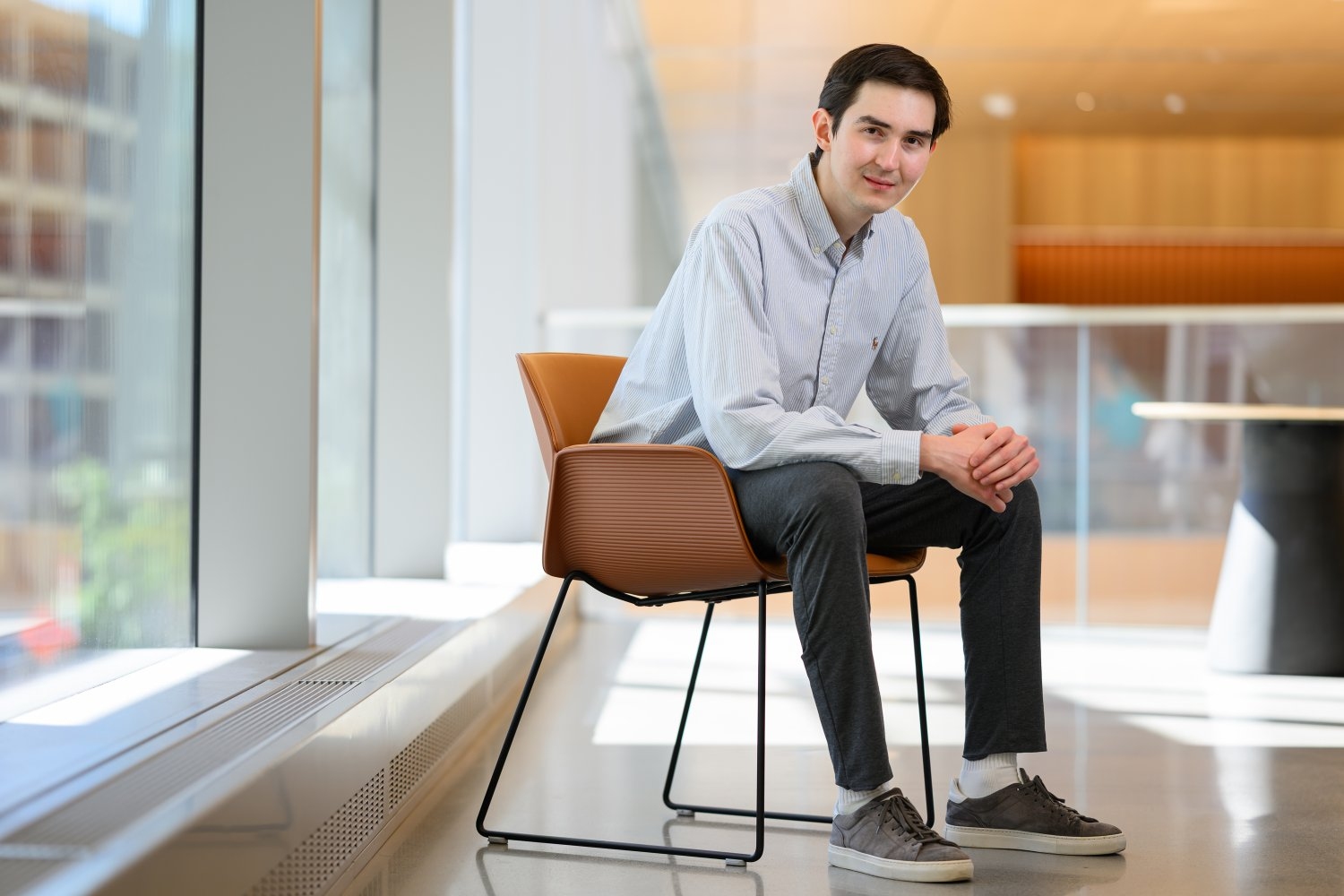
What if there were a way to solve one of the most significant obstacles to the use of nuclear energy — the disposal of high-level nuclear waste (HLW)? Dauren Sarsenbayev, a third-year doctoral student at the MIT Department of Nuclear Science and Engineering (NSE), is addressing the challenge as part of his research.
Sarsenbayev focuses on one of the primary problems related to HLW: decay heat released by radioactive waste. The basic premise of his solution is to extract the heat from spent fuel, which simultaneously takes care of two objectives: gaining more energy from an existing carbon-free resource while decreasing the challenges associated with storage and handling of HLW. “The value of carbon-free energy continues to rise each year, and we want to extract as much of it as possible,” Sarsenbayev explains.
While the safe management and disposal of HLW has seen significant progress, there can be more creative ways to manage or take advantage of the waste. Such a move would be especially important for the public’s acceptance of nuclear energy. “We’re reframing the problem of nuclear waste, transforming it from a liability to an energy source,” Sarsenbayev says.
The nuances of nuclear
Sarsenbayev had to do a bit of reframing himself in how he perceived nuclear energy. Growing up in Almaty, the largest city in Kazakhstan, the collective trauma of Soviet nuclear testing loomed large over the public consciousness. Not only does the country, once a part of the Soviet Union, carry the scars of nuclear weapon testing, Kazakhstan is the world’s largest producer of uranium. It’s hard to escape the collective psyche of such a legacy.
At the same time, Sarsenbayev saw his native Almaty choking under heavy smog every winter, due to the burning of fossil fuels for heat. Determined to do his part to accelerate the process of decarbonization, Sarsenbayev gravitated to undergraduate studies in environmental engineering at Kazakh-German University. It was during this time that Sarsenbayev realized practically every energy source, even the promising renewable ones, came with challenges, and decided nuclear was the way to go for its reliable, low-carbon power. “I was exposed to air pollution from childhood; the horizon would be just black. The biggest incentive for me with nuclear power was that as long as we did it properly, people could breathe cleaner air,” Sarsenbayev says.
Studying transport of radionuclides
Part of “doing nuclear properly” involves studying — and reliably predicting — the long-term behavior of radionuclides in geological repositories.
Sarsenbayev discovered an interest in studying nuclear waste management during an internship at Lawrence Berkeley National Laboratory as a junior undergraduate student.
While at Berkeley, Sarsenbayev focused on modeling the transport of radionuclides from the nuclear waste repository’s barrier system to the surrounding host rock. He discovered how to use the tools of the trade to predict long-term behavior. “As an undergrad, I was really fascinated by how far in the future something could be predicted. It’s kind of like foreseeing what future generations will encounter,” Sarsenbayev says.
The timing of the Berkeley internship was fortuitous. It was at the laboratory that he worked with Haruko Murakami Wainwright, who was herself getting started at MIT NSE. (Wainwright is the Mitsui Career Development Professor in Contemporary Technology, and an assistant professor of NSE and of civil and environmental engineering).
Looking to pursue graduate studies in the field of nuclear waste management, Sarsenbayev followed Wainwright to MIT, where he has further researched the modeling of radionuclide transport. He is the first author on a paper that details mechanisms to increase the robustness of models describing the transport of radionuclides. The work captures the complexity of interactions between engineered barrier components, including cement-based materials and clay barriers, the typical medium proposed for the storage and disposal of spent nuclear fuel.
Sarsenbayev is pleased with the results of the model’s prediction, which closely mirrors experiments conducted at the Mont Terri research site in Switzerland, famous for studies in the interactions between cement and clay. “I was fortunate to work with Doctor Carl Steefel and Professor Christophe Tournassat, leading experts in computational geochemistry,” he says.
Real-life transport mechanisms involve many physical and chemical processes, the complexities of which increase the size of the computational model dramatically. Reactive transport modeling — which combines the simulation of fluid flow, chemical reactions, and the transport of substances through subsurface media — has evolved significantly over the past few decades. However, running accurate simulations comes with trade-offs: The software can require days to weeks of computing time on high-performance clusters running in parallel.
To arrive at results faster by saving on computing time, Sarsenbayev is developing a framework that integrates AI-based “surrogate models,” which train on simulated data and approximate the physical systems. The AI algorithms make predictions of radionuclide behavior faster and less computationally intensive than the traditional equivalent.
Doctoral research focus
Sarsenbayev is using his modeling expertise in his primary doctoral work as well — in evaluating the potential of spent nuclear fuel as an anthropogenic geothermal energy source. “In fact, geothermal heat is largely due to the natural decay of radioisotopes in Earth’s crust, so using decay heat from spent fuel is conceptually similar,” he says. A canister of nuclear waste can generate, under conservative assumptions, the energy equivalent of 1,000 square meters (a little under a quarter of an acre) of solar panels.
Because the potential for heat from a canister is significant — a typical one (depending on how long it was cooled in the spent fuel pool) has a temperature of around 150 degrees Celsius — but not enormous, extracting heat from this source makes use of a process called a binary cycle system. In such a system, heat is extracted indirectly: the canister warms a closed water loop, which in turn transfers that heat to a secondary low-boiling-point fluid that powers the turbine.
Sarsenbayev’s work develops a conceptual model of a binary-cycle geothermal system powered by heat from high-level radioactive waste. Early modeling results have been published and look promising. While the potential for such energy extraction is at the proof-of-concept stage in modeling, Sarsenbayev is hopeful that it will find success when translated to practice. “Converting a liability into an energy source is what we want, and this solution delivers,” he says.
Despite work being all-consuming — “I’m almost obsessed with and love my work” — Sarsenbayev finds time to write reflective poetry in both Kazakh, his native language, and Russian, which he learned growing up. He’s also enamored by astrophotography, taking pictures of celestial bodies. Finding the right night sky can be a challenge, but the canyons near his home in Almaty are an especially good fit. He goes on photography sessions whenever he visits home for the holidays, and his love for Almaty shines through. “Almaty means ‘the place where apples originated.’ This part of Central Asia is very beautiful; although we have environmental pollution, this is a place with a rich history,” Sarsenbayev says.
Sarsenbayev is especially keen on finding ways to communicate both the arts and sciences to future generations. “Obviously, you have to be technically rigorous and get the modeling right, but you also have to understand and convey the broader picture of why you’re doing the work, what the end goal is,” he says. Through that lens, the impact of Sarsenbayev’s doctoral work is significant. The end goal? Removing the bottleneck for nuclear energy adoption by producing carbon-free power and ensuring the safe disposal of radioactive waste.