If your marketing team is generating plenty of marketing qualified leads (MQLs) but pipeline still isn’t progressing as expected, the problem may not be lead quality but how you’re defining qualification.
As B2B buying groups have grown larger and more complex, relying on a single MQL to represent purchase intent has become increasingly unreliable. Today’s buying decisions are shaped by multiple stakeholders across departments, each bringing different priorities, timelines, and influence over whether a deal moves forward.
That doesn’t mean MQLs are obsolete. They remain valuable indicators of individual engagement and buying interest. But one highly engaged contact no longer tells the full story of an opportunity.
To better reflect how modern organizations actually buy, leading B2B marketers are expanding beyond lead-centric qualification and adopting marketing qualified accounts (MQAs)—also known as opportunity-centric qualification. Rather than measuring the engagement of a single individual, MQAs evaluate buying readiness across the entire buying group, giving marketing and sales a more accurate picture of which accounts are building consensus and moving toward a purchase decision.
Instead of treating an MQL as the finish line, modern revenue teams use it as one signal within a broader buying journey. By combining individual engagement with buying group intelligence, they can improve targeting, personalize engagement for every stakeholder, and measure marketing’s contribution based on opportunity progression—not just lead generation.
Here’s how to make the transition from MQLs to MQAs without disrupting the revenue engine you’ve already built.
Step 1: Stop Treating MQLs as the Destination
As buying group strategies gain momentum, some marketers have been quick to declare the MQL obsolete.
That’s a mistake. MQLs remain one of the most valuable indicators of buyer interest. They help marketing teams identify engaged prospects, measure campaign performance, and surface individuals who may be driving purchase discussions within an account. The challenge isn’t the metric itself but expecting a single person’s engagement to represent the buying readiness of an entire organization.
For years, B2B organizations have followed a relatively simple qualification model:
MQL → Opportunity
That approach made sense when buying decisions could reasonably be attributed to one primary decision-maker, but today’s purchase journeys are far more collaborative. Forrester research reveals that most enterprise deals now involve champions, executive sponsors, technical evaluators, procurement, finance, end users, and other stakeholders who all influence whether an opportunity ultimately moves forward.
As a result, one highly engaged lead no longer provides enough context to determine whether an account is truly sales-ready.
Instead of treating an MQL as the finish line, leading revenue teams are beginning to view it as the first indication that buying activity may be emerging within an account. The qualification journey becomes:
MQL → Buying Group Signal → Marketing Qualified Account (MQA) → Opportunity
This subtle shift changes how marketers interpret engagement. Rather than asking whether a single contact has accumulated enough points to be handed to sales, teams begin asking a much more meaningful question: What does this engagement tell us about the buying group?
That distinction is critical because individual interest and organizational buying readiness are not the same thing. A champion may be enthusiastically researching solutions while finance hasn’t approved budget. An executive sponsor may support the initiative while security is still evaluating risk. Procurement may ultimately delay the purchase entirely. Looking at one person’s activity alone hides those dynamics.
During our webinar, The Buying Group Paradox: Why More Stakeholders Means Fewer Deals—and What to Do About It, Maidson Logic Growth Strategist Jon Tilden described MQLs as “signals of interest” and “snapshots of intent” rather than complete representations of buying behavior. That’s an important mindset shift. MQLs continue to provide valuable insight into who is engaging with your brand, but they should be viewed as one signal within a much broader buying journey and not definitive proof that an account is ready for sales engagement.
This is precisely where opportunity-centric qualification adds value.
Instead of evaluating one person’s engagement in isolation, marketers begin looking for evidence that multiple stakeholders are independently demonstrating buying intent. As those signals accumulate across roles and departments, they provide a far more reliable indication that an account is progressing toward consensus and ultimately toward a purchase decision.
For marketing teams, success is no longer defined by generating the highest number of MQLs. It’s defined by understanding whether individual engagement is translating into meaningful buying momentum across the entire account.
Key Takeaway: Don’t replace MQLs—redefine their purpose. They’re no longer the destination of the qualification process; they’re the earliest signal that a buying group may be beginning its journey toward becoming a qualified opportunity.
Step 2: Define Your Buying Group
Once marketers begin viewing MQLs as signals rather than endpoints, the next question becomes obvious: Who else needs to be engaged before this account is truly ready to buy? The answer is the buying group.
One of the biggest misconceptions about buying group marketing is that it simply means marketing to more people. In reality, it’s about understanding that every stakeholder plays a different role in the buying process, enters the conversation at a different point in the journey, and needs different information to confidently move a purchase forward.
As guest speaker Nora Conklin, Principal Analyst Forrester explained during the Buying Group Paradox webinar, buying groups are not homogeneous. They’re made up of stakeholders with distinct responsibilities, priorities, and definitions of success. Treating them as if they all consume the same content or respond to the same messaging creates friction throughout the buying journey.
Understanding those differences is foundational to opportunity-centric qualification because it helps marketers determine not only who is engaging, but whether the right people are engaging.
Every Buying Role Serves a Different Purpose
While every organization structures purchasing decisions differently, most B2B buying groups include five core stakeholder roles:
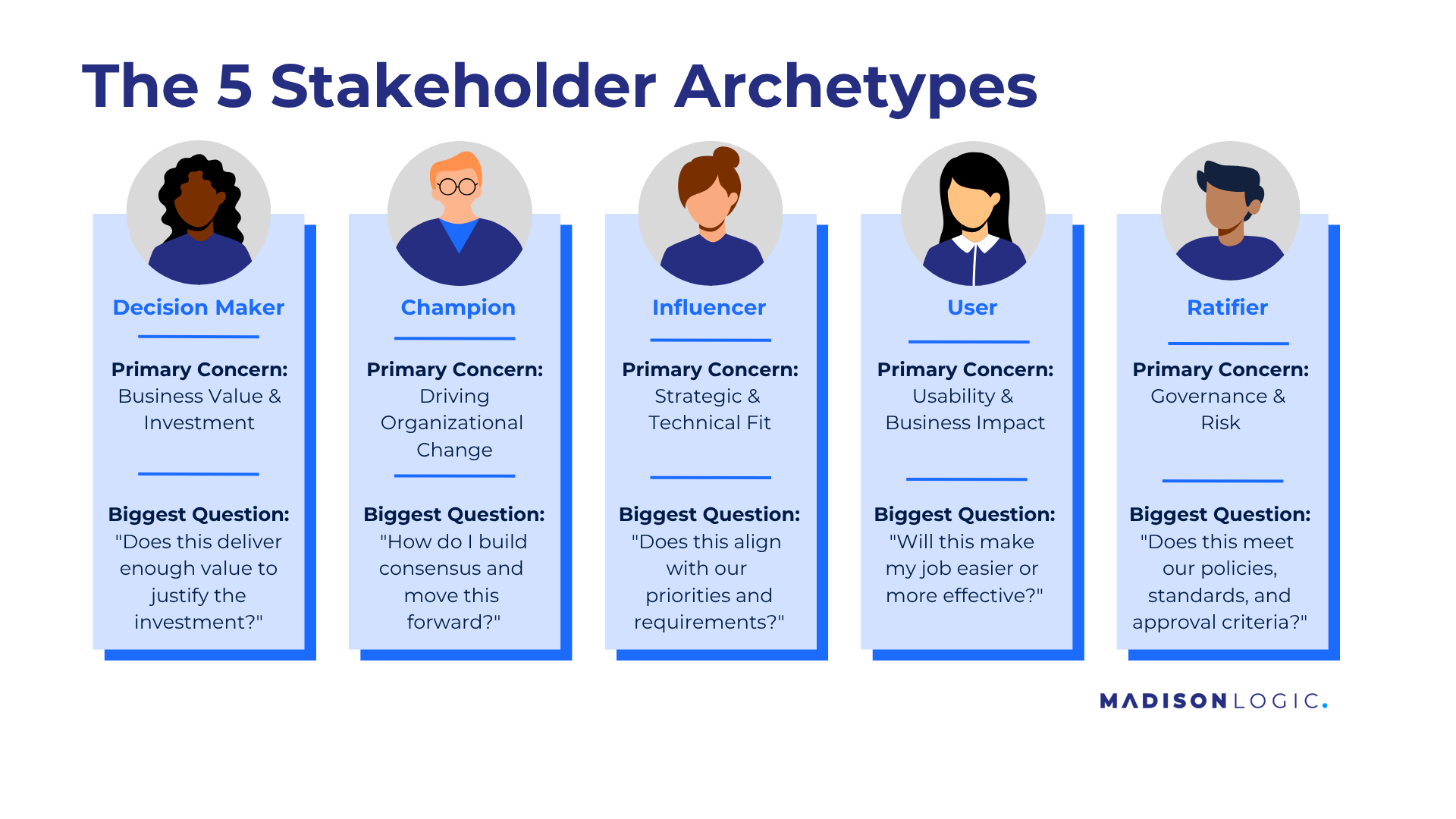
Champions are often the first people to recognize a problem and begin researching potential solutions. They’re your early advocates and stakeholders most likely to download thought leadership content, attend webinars, or request product information. Their engagement frequently generates the first MQL, making them an important signal that buying activity may be starting within an account.
Decision-Makers (sometimes called economic buyers) determine whether an initiative deserves investment. Rather than evaluating features, they’re focused on business outcomes, financial impact, strategic priorities, and organizational risk. They need evidence that a solution will deliver measurable value and not simply solve an operational challenge.
Influencers help shape the purchasing decision without necessarily owning it. They may evaluate vendors, recommend technologies, or provide subject matter expertise that influences the final outcome. Although they often operate behind the scenes, their recommendations frequently determine which solutions advance to serious consideration.
Users evaluate whether a solution will actually improve their day-to-day work. They’re concerned with usability, implementation, workflows, and adoption. If they don’t believe a solution will make their jobs easier, enthusiasm from executives alone rarely translates into long-term success.
Finally, Ratifiers—including procurement, legal, security, finance, and compliance teams—often determine whether a deal can move forward at all. They may never download an ebook or attend a webinar, but they play an essential role in removing risk and approving the purchase. Ignoring these stakeholders until the end of the sales cycle is one of the most common reasons otherwise healthy opportunities lose momentum.
Different Roles Require Different Engagement
Identifying buying group roles changes more than qualification—it changes how marketing engages each account. Rather than delivering the same campaign to every contact, marketers can tailor messaging to each stakeholder’s priorities, making engagement more relevant while revealing whether buying participation is spreading across the account.
This role-based approach creates more relevant buyer experiences while also giving marketing richer insight into account progression. Rather than measuring engagement volume alone, teams can begin evaluating engagement quality by asking whether participation is expanding across the buying group.
Defining your buying group changes what qualification means. Instead of asking whether one person is qualified, marketers begin asking whether the buying group is taking shape. The next step is connecting those individual signals into a single view of account readiness.
Key Takeaway: Buying readiness isn’t determined by one engaged contact—it’s revealed by the strength and diversity of engagement across the buying group. Identifying who plays each role allows marketers to move beyond activity tracking and understand whether true purchase momentum is building.
Step 3: Connect Your MQL Islands
The first actionable step toward opportunity-centric qualification is connecting your MQL islands. Rather than evaluating each lead independently, marketers need to understand how engagement comes together across the buying group to reveal account-level buying momentum.
As Jon puts it, “Begin by connecting those MQL islands.” The metaphor works because most organizations still track marketing activity at the contact level. Every webinar registration, content download, pricing page visit, or product demo is tied to an individual lead record and evaluated independently. In effect, every contact becomes its own island.
The problem, of course, is that buying decisions don’t happen on islands. They happen when those individual interactions begin connecting across an account.
Imagine you’re selling into a Fortune 1000 company. Over the course of several weeks:
- A demand generation manager downloads your latest research report.
- A marketing executive attends an executive roundtable.
- A marketing operations leader explores your integration documentation.
- Someone from procurement reviews your security resources.
- An end user watches an on-demand product demonstration.
Viewed individually, none of these people may appear ready for a sales conversation. In fact, several of them may never become traditional MQLs.
Viewed together, though, they tell a very different story. They’re evidence that buying activity is spreading across the organization. And that’s the signal marketers should be looking for.
Shift From Lead Activity to Account Momentum
Traditional lead scoring measures the engagement of one person, and opportunity-centric qualification measures the momentum of an entire buying group.
This is a subtle but important distinction.
Instead of asking whether one contact has accumulated enough points to qualify, marketers begin evaluating whether engagement is expanding across the people most likely to influence a purchase.
That means looking beyond individual contacts and aggregating engagement across:
- Buying roles
- Departments
- Job functions
- Levels of seniority
- Marketing and sales touchpoints
As those interactions begin to overlap, they create a much richer picture of buying intent than any single lead score ever could. Jon describes this as moving beyond isolated engagement to understanding the collective activity happening within an account—a foundational step toward opportunity-centric qualification.
Look For Patterns—Not Just Points
This shift also changes what marketers should pay attention to. The goal isn’t simply to accumulate more engagement, but to identify meaningful engagement patterns.
For example, an account where five end users consume content tells a different story than an account where a champion, an executive sponsor, a technical evaluator, and procurement all engage within the same month.
The overall engagement volume may be similar, but buying readiness is not.
One reflects interest within a single team, while the other reflects consensus beginning to form across the buying group.
Those patterns help marketing and sales distinguish between accounts that are merely active and accounts that are genuinely progressing toward a purchase decision.
Create a Shared View of Buying Readiness
Connecting MQL islands does more than improve marketing measurement—it creates a common language for marketing and sales.
Instead of handing sales a list of individual leads and expecting them to determine whether an account is viable, marketing can provide a far more complete picture of buying activity. Sales gains visibility into who is engaged, what roles they play, how their interests complement one another, and whether engagement is expanding across the organization.
That additional context allows sales teams to prioritize outreach more effectively, tailor conversations to each stakeholder, and engage accounts at the right moment when buying momentum is building rather than when a single lead happens to cross an arbitrary scoring threshold.
Ultimately, this is the bridge between traditional lead scoring and marketing qualified accounts. Once marketers stop evaluating contacts in isolation and start connecting engagement across the buying group, they’re no longer measuring lead activity. They’re measuring opportunity readiness, and that’s the foundation of opportunity-centric qualification.
Key Takeaway: Individual MQLs rarely tell the full story. By connecting engagement across contacts, roles, and departments, marketers can uncover the account-level patterns that reveal whether real buying momentum is building.
Our webinar on the ever-expanding buying group will help you shift toward better opportunities with your target accounts.