Key takeaways:
- The development of white-label enterprise procurement software typically costs between $50,000 and $500,000, depending on complexity and features.
- Key features include vendor management, budget tracking, purchase approvals, and invoice automation.
- Flexible monetization models – from modular licensing to integration fees- can future-proof revenue streams.
- Building a custom white-label solution gives you long-term control over branding, user experience, and profitability.
From global retailers to fast-scaling SaaS platforms, white-label enterprise procurement software has become a reliable solution for streamlining complex purchasing workflows that businesses across several sectors encounter. These platforms are designed to enable businesses to manage vendors, approve purchases, track budgets, and optimize procurement – all under their own brand name. Their growing popularity lies in the ease of adaptability: companies can deploy powerful procurement systems without building one from scratch.
But with high demand comes curiosity. More and more enterprises, especially in sectors like manufacturing, healthcare, and e-commerce, are now asking: What’s the real cost to build procurement management systems? Or better yet, what determines the final bill when you opt for custom-built, white-label enterprise procurement software?
Well, long answer short, on average, the white-label enterprise procurement software development cost can range between $50,000 and $500,000, based on your needs, level of integrations, custom modules, and security architecture.
In this article, we break down everything you need to know – from the enterprise procurement software development cost to the factors affecting the cost of white-label enterprise procurement software, plus features, use cases, and how to optimize the costs.
Let’s start by understanding what makes these platforms such a strategic investment.
Planning to launch your own white-label procurement platform?
A Comprehensive View of the Costs Involved in Developing an App
How much does it cost to build enterprise procurement software? The answer to this question is based on what you are developing, from where, and how complex the system will be. Below, we have given the enterprise procurement software cost breakdown based on complexity, development stages, and geographic location so you can get a realistic picture before investing.
Cost by Software Complexity
The more complex your platform is, the more resources and time it will require to get built. Thus, the higher it will cost. Here’s a general breakdown:
| Complexity Level | Features Included | Estimated Cost |
|---|---|---|
| Basic | Core workflows, vendor onboarding and order processing | $50,000 – $100,000 |
| Mid-Level | Analytics, custom approval chains, and integrations (ERP, payment) | $100,000 – $200,000 |
| Advanced / Enterprise | AI/ML forecasting, multi-org support, advanced dashboards, layered security | $200,000-$500,000+ |
TL;DR: Features like automation, AI, and scalability shoot up costs – but they also drive long-term value.
Cost by Development Stage
Each phase in the development lifecycle comes with its own cost. Even stages like planning and testing that feel secondary, can cost substantial initially but save thousands down the road.
| Stage | What It Covers | Estimated Cost |
|---|---|---|
| Planning & Discovery | Market research, roadmap, requirement mapping | $5,000 – $20,000 |
| UI/UX Design | Wireframes, mockups, user flow, and responsiveness | $5,000 – $40,000 |
| Development | Frontend + backend, APIs, cloud setup, database | $20,000 – $350,000 |
| Testing & Launch | QA, bug fixing, deployment pipelines, and user acceptance testing | $10,000 – $40,000 |
| Maintenance | Regular updates, minor enhancements, server & DB support | $10,000 – $50,000/year |
Note: A solid planning and QA process often reduces technical debt and post-launch patching costs.
Cost by Development Region
Where your development team is located will have a massive impact on your overall cost. Here’s what you can expect to pay hourly across key geographies.
| Region | Hourly Rate (USD) |
|---|---|
| US / Canada | $120 – $250 |
| Western Europe | $100 – $180 |
| Middle East | $60 – $150 |
| Eastern Europe | $40 – $80 |
| India / SE Asia | $25 – $50 |
| Latin America | $40 – $75 |
Estimating the Total Cost
If you’re looking for a formula to estimate your procurement software budget for reference, here it is.
Estimated Cost = Total Development Hours × Hourly Rate of Developers × Complexity Multiplier
Imagine your project needs 2,000 hours, with an hourly rate of $60, and a complexity multiplier of 1.2. Your ballpark estimate will be:
2,000 x $60 x 1.2 = $144,000
Time and Team Estimates
Building enterprise procurement software is not a solo act – it requires a cross-functional team and several months of focused effort.
Expect 5 to 8 core team members (project manager, business analyst, UI/UX designer, 2 to 3 developers, QA engineer)
| Build Type | Time to Build | Team Size |
|---|---|---|
| MVP / Pilot | 3–5 months | 4–6 (PM, BA, 1-2 devs, QA, UX) |
| Full-scale software | 6–12 months | 6–8 (Add DevOps, backend lead) |
Pro tip: Time to market depends heavily on the scope, tech stack, and decision-making cycles.
Curious what your enterprise procurement app might actually cost?
Let’s get on a scope call and build you a custom estimate

Factors Affecting the Cost of White-label Enterprise Procurement Software
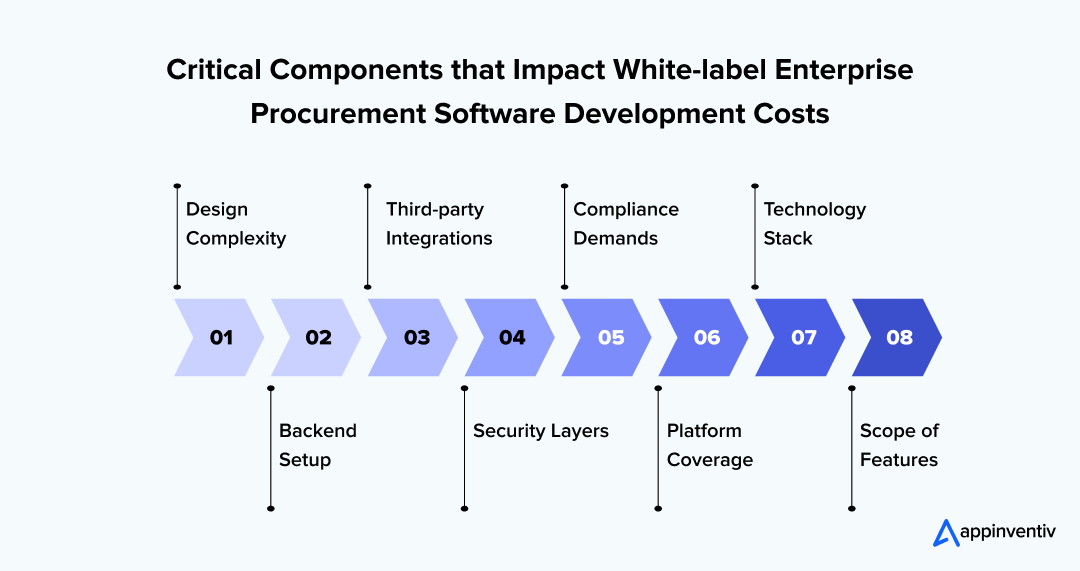
No two procurement systems cost the same to build – especially when you’re working with a white-label model designed for enterprise use. The final price can swing significantly based on a number of practical choices made early in the planning and development stages.
Design Complexity
Clean, intuitive interfaces take time, especially when tailored for large teams and multiple permission levels. A system with branded dashboards, animated workflows, and user-specific views demands more effort than a basic layout – pushing design hours and costs up.
Backend Setup
The backend is where enterprise-grade software development gets complex. When you are dealing with approval chains, dynamic supplier onboarding, or order lifecycle tracking, the infrastructure has to be rock-solid and scalable. However, the deeper you go into workflows, the higher the cost would get.
Third-party Integrations
Whether it’s plugging in a payment gateway, syncing with ERP software, or tying into tax tools, each integration adds hours, costs, QA cycles, and added security checkpoints. These features aren’t optional for modern procurement systems.
Security Layers
Enterprise-grade software requires security to be baked in, not bolted on. This layered approach demands highly specialized engineering hours, which significantly impacts the cost. Beyond standard SSL/TLS, the platform must support the following security measures:
- Data encryption
- Multi-factor authentication
- Role-based access control
- Audit logging and forensics
- Vulnerability management
Compliance Demands
Aside from technical security, your software has to pass legal and audit compliance across sectors like healthcare, public sector, or finance. A process that will involve extra documentation, testing, and certification, often adding several weeks to your timeline. Some non-negotiable compliance requirements are:
| Compliance Standard | Industry Focus | Cost Driver (Development & Audit) |
|---|---|---|
| SOC 2 Type II | Technology & SaaS, Finance | Requires months of audit preparation, specialized documentation for data security controls, and proof of continuous monitoring procedures (e.g., change management, access reviews). |
| GDPR/CCPA | Global Data Privacy | Mandates explicit data subject rights (right to be forgotten, access to data), which requires complex engineering for data mapping and deletion workflows. |
| HIPAA | Healthcare, Medical Supply | Requires specific security and privacy rules for Protected Health Information (PHI), often involving mandatory, secure data segregation and stricter encryption standards. |
| ISO 27001 | General Information Security | Involves adhering to a comprehensive Information Security Management System (ISMS), requiring extensive documentation and procedural rigor across the development lifecycle. |
Platform Coverage
Web-only platforms are generally affordable, but when you make the software for desktop, mobile, Android, and iOS, the budget will definitely rise, especially if you are going native instead of using cost-effective frameworks like React Native or Flutter.
Technology Stack
Features like AI-led demand forecasting, automated reorder suggestions, or blockchain-backed audit trails offer a competitive edge – but they’re resource-heavy to build. Advanced tech can double development time and cost, depending on depth.
An ideal tech stack for procurement software development is:
| Component | Description |
|---|---|
| Frontend | React.js, Angular, or Vue.js for building responsive and dynamic user interfaces |
| Backend | Node.js, Python (Django or Flask), Ruby on Rails for efficient server-side processing |
| Database | PostgreSQL or MySQL for relational data, MongoDB for NoSQL, or Microsoft SQL Server |
| Cloud Infrastructure | AWS, Google Cloud, or Microsoft Azure for scalable cloud computing and storage |
| AI/ML Frameworks | TensorFlow, PyTorch, or Scikit-learn for AI-driven demand forecasting and automation |
| Blockchain | Ethereum or Hyperledger for blockchain-backed audit trails and decentralized record-keeping |
| Authentication | OAuth 2.0, JWT (JSON Web Tokens) for secure user authentication and authorization |
| APIs | RESTful APIs for integrating with third-party systems (ERP, suppliers, etc.) |
| Payment Processing | Stripe, PayPal, or Razorpay for payment gateway integration if handling transactions |
| DevOps & CI/CD | Docker for containerization, Jenkins or GitLab for continuous integration and deployment |
| Analytics | Google Analytics, Power BI, or Tableau for reporting and analytics dashboards |
| Testing Frameworks | Jest, Mocha, or Selenium for frontend and backend testing automation |
| Container Orchestration | Kubernetes for container management and scaling applications efficiently |
Scope of Features
Some teams want simple RFQ management; others ask for deep procurement analytics, user access controls, and budget enforcement layers. As features pile up, so do dev hours, testing cycles, and cost. Here is a brief list of “must have” and “advanced” features that can impact your white-label enterprise procurement software development cost significantly:
| Feature | Must-Have Features | Advanced Features |
|---|---|---|
| RFQ Management | Basic Request for Quotation (RFQ) functionality | Multi-tier RFQ with advanced comparison and supplier negotiation tools |
| Procurement Analytics | Basic spend tracking and reporting | Deep procurement analytics with AI-driven insights, forecasting, and decision support |
| User Access Controls | Simple user roles and permissions | Customizable access levels and compliance-driven roles |
| Budget Enforcement | Basic budget tracking for purchases | Real-time budget enforcement with alerts and budget optimization based on trends |
| Integration with ERP Systems | Basic ERP system integration for financial tracking | Advanced, multi-ERP integration with real-time sync and financial forecasting |
Hidden Elements That Shoot Up White-Label Enterprise Procurement Software Development Costs
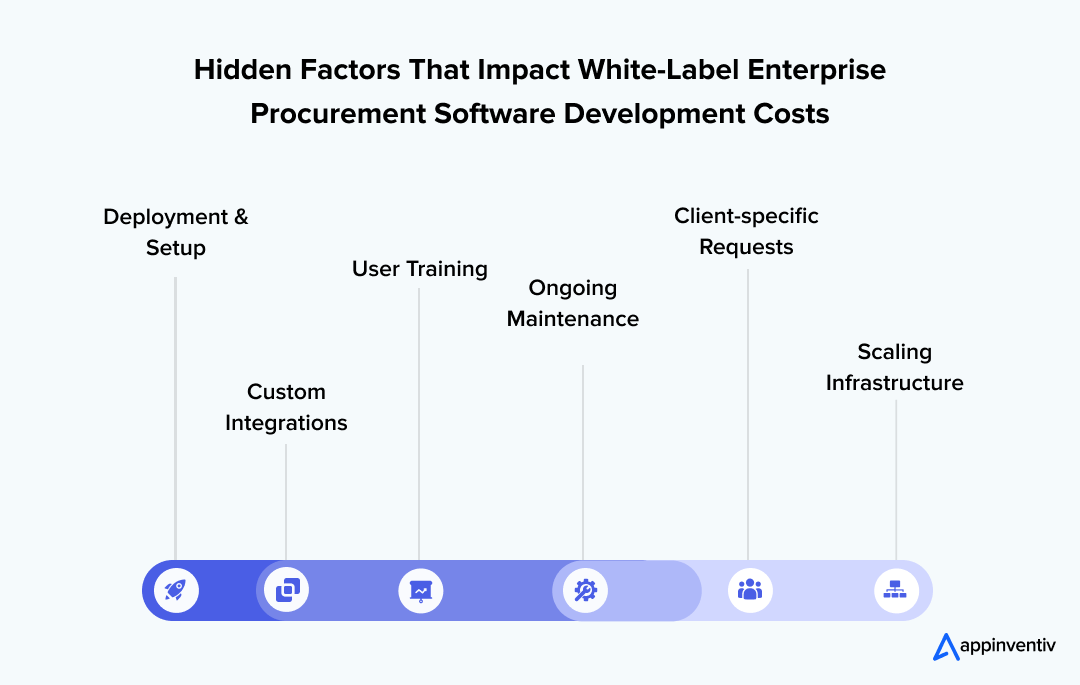
The upfront elements (mentioned above) affecting development cost only tell part of the story. With enterprise-grade white-label procurement software, unexpected costs often surface once real users start working with the system or when your client starts scaling it across teams.
Deployment & Setup
Installation isn’t always a one-click affair. Depending on the hosting method, configuring servers, setting up internal environments, and preparing for first use can take time – especially in multi-tenant environments.
Custom Integrations
The time it takes to integrate software with tools like NetSuite, SAP, or other business-critical systems cannot be planned in advance. Even if the APIs exist, the logic would need adjusting to align with workflows, adding to the cost.
User Training
You may not account for it upfront, but training sales teams, finance departments, or procurement heads adds to the overall spend, especially if your client expects an in-person session or multilingual documentation.
Ongoing Maintenance
Handling post-launch bugs, version upgrades, or tweaks based on user feedback is inevitable. To manage these, companies often rely on support contracts, in-house resources, or retained vendor hours, which can often tend to add recurring costs.
Client-specific Requests
After the launch, some clients (who buy your white-label software) will want things rebranded again. Others might ask for minor features that sound simple but require rework. These “just one thing” asks can quietly stack up in cost and time.
Scaling Infrastructure
As the user count grows, so does the load. You may need to increase cloud capacity, adjust the database structure, or move toward a more distributed architecture. None of that is free.
How to Optimize Software Development Costs: Some Proven Practices
While there are several upfront and hidden elements that can drive up the white-label enterprise procurement software development cost, there are some smart ways too that can help you control the cost without compromising on functionality:
- Start with MVP: Build the MVP with core functionalities first to test user feedback and validate the product concept before scaling your product.
- Prioritize Features: Focus on critical features that deliver immediate value, like automated purchase order management, to ensure key business needs are addressed early in the development process.
- Use Cross-platform Frameworks: React Native or Flutter can lower the codebase and cut frontend costs significantly. It would be a good move to use them
- Outsource Development: Partnering with enterprise procurement software developers from regions like Eastern Europe, India, or Asia can further lead to 30–50% savings when compared to working with US-based teams.
Enterprise Procurement Software Development Process: A Quick Look
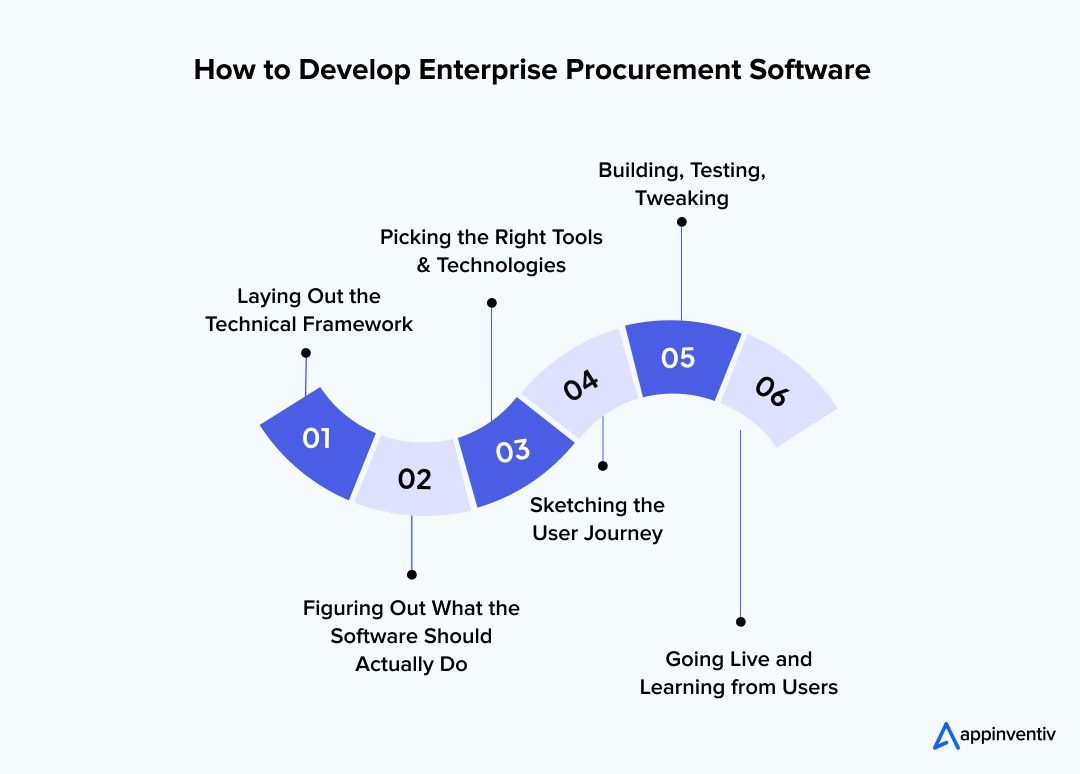
Creating enterprise procurement software isn’t just about building screens or ticking off features. It’s about solving very real bottlenecks in how teams buy, approve, track, and manage spend. Here’s how most modern procurement systems take shape:
Figuring Out What the Software Should Actually Do
Before a single line of code is written, the team digs into what kind of procurement problems the tool needs to solve. Is it just about speeding up internal approvals or does it need to handle multi-region vendor onboarding and complex budget workflows? Getting this part right saves a lot of trouble later.
Laying Out the Technical Framework
Once there’s clarity on scope, developers map out the platform’s structure. This includes thinking about how modules like vendor management, invoice tracking, spend analytics, and PO generation will connect and scale together.
Picking the Right Tools and Technologies
The development team, here, select a tech stack that can handle scalability, automation, and integrations. Whether it’s a cloud-native backend or a secure way to manage vendor data – these decisions shape performance and future flexibility.
Sketching the User Journey
Before the actual development begins, designers tend to create prototypes to show how users will move through the system. The goal? Fewer steps, less confusion, and minimal user training sessions.
Building, Testing, Tweaking
This is where the real development kicks off. Depending on the features planned – from approval flows to contract repositories – timelines and costs can vary for procurement software development. A good QA cycle helps avoid bugs and ensures smooth rollouts.
Going Live and Learning from Users
Once the software is live, it’s far from done. Real users give real feedback – often pointing out things that weren’t obvious during development. These insights can power updates and even decide how features like AI recommendations or dashboard customizations evolve.
Working with seasoned white label development services providers often makes this complete process much faster and cost-efficient, especially if you’re looking to build something ready to scale from day one.
How to Make Your Procurement Software Stand Out in the Market
Most enterprise procurement platforms are either bloated or stuck in legacy thinking. If you want your use cases of white-label enterprise procurement software to genuinely outperform others, look beyond the conventional.
Invisible UX: Make It Feel Like It’s Not Even Software
Instead of designing “a tool,” aim for process invisibility. This would mean lowering the number of clicks, automating decision paths, and integrating the tool so tightly with the existing workflows (like Slack, Teams, or ERP dashboards) that users barely notice they are using new software. It’s how you turn enterprise procurement software development into true process enablement.
Modular Licensing to Reduce Procurement Fatigue
Not every enterprise needs every module. Introduce a pay-as-you-scale licensing structure where teams only activate and pay for what they use. It helps justify the cost of enterprise procurement software at the CFO level and keeps adoption friction low in multi-department setups.
Built-In Supplier Scoring Powered by Live Data
Go beyond static vendor profiles. Use a plugin model to bring in third-party datasets, like ESG scores, financial health reports, and social proof – directly into vendor dashboards. This makes the features of white-label enterprise procurement software feel intelligent, not just functional.
Onboarding-as-a-Service
Instead of just offering a tool, bundle in an optional Onboarding-as-a-Service program, especially for companies that deal with hundreds of suppliers. Automate policy education, data syncing, and compliance mapping. It’s an easy upsell, and also a hidden value add that gives your enterprise procurement software developers a revenue edge.
Procurement Gamification
It sounds odd but gamifying compliance (e.g., “fastest approver of the month”) or budget usage (e.g. “least last-minute purchases”) can radically change user behavior. For companies where procurement is seen as red tape, this could reduce friction without changing policy.
Zero-Code Custom Workflows
Hardcoded approval trees are out. Let end-users build their own mini workflows – think “If budget exceeds 50K, alert CFO via email and pause request for 2 hours.” With the right UI, you shift the balance from dev dependency to business control. And yes, it does impact the white-label enterprise procurement software development cost, but it’s a worthwhile edge.
AI That Flags What You Didn’t Ask For
Predictive suggestions are common but consider reverse-AI. The system flags missing steps in your process based on historical patterns. For example: “You haven’t updated this supplier’s compliance record in 12 months.” It’s these overlooked nudges that shape the future of white-label enterprise procurement software.
Have a game-changing procurement idea? Let’s build it, white-label and ready to scale.

From Licensing to Subscriptions: Real Ways to Monetize Your Platform
Your revenue model should evolve with how procurement is used, not just sold. While SaaS is a common route, the specifics of how you charge matter deeply in enterprise environments where procurement isn’t just a back-office task, but a strategic function.
Here are a few models that work in the real world and could secure the future of white-label enterprise procurement software
Modular SaaS Licensing: Instead of offering everything in a package, allow clients to select the modules they would need – procurement planning, contract management, invoicing, etc. This would not just lower the friction during onboarding but also give you space to upsell later.
Tiered Usage-Based Pricing: Base your software price on the number of users, purchase orders processed, vendors onboarded, or invoice volumes. This would align the costs with value and work great with high-growth businesses.
Perpetual Licenses for Large Enterprises: Some large enterprises prefer full control. Offering a white-label license with optional annual maintenance/support can open doors in markets where SaaS adoption is still maturing.
White-Label Deployment Fees: Since you’re selling to enterprises that are looking to rebrand and resell, charge a one-time setup fee plus ongoing hosting or support charges.
Integration as a Service: Charging for integrations with SAP, Oracle, QuickBooks, etc., turns technical customization into a revenue line.
The takeaway? Enterprise procurement software isn’t a one-size-fits-all product and neither should its pricing model be.
Beyond SaaS: 4 Smart Ways to Monetize a Procurement System
Beyond your core offering, there are underutilized channels that can boost revenue, especially once you’ve got adoption at scale.
In-Platform Vendor Marketplace (Commission Model)
Let buyers connect with verified vendors within your system – think pre-vetted suppliers for office equipment, software, logistics, etc. You can take a commission on successful transactions or charge vendors to be listed. This also makes your platform stickier for users.
Data Intelligence Subscriptions
With the right permissions and anonymization, you can offer powerful industry trend reports – e.g., procurement cycles by sector, average lead times, and common vendors by region. This can be valuable to investors, analysts, and industry leaders. Use strict compliance to stay privacy-safe.
Custom AI Workflows as Paid Add-ons
Charge separately for AI-driven procurement forecasting, auto-recommendations (vendors or pricing), or spend analysis tools. These features deliver strategic ROI and justify premium pricing tiers.
Enterprise Enablement Services
Go beyond software. Offer change management services, onboarding toolkits, stakeholder training, and implementation consulting, especially for clients rolling the platform out to hundreds or thousands of employees.
A well-built procurement system has multiple revenue layers. The goal is not to overcharge but to meet every need that emerges as clients grow more reliant on your solution.
How Appinventiv Helps with Enterprise Procurement Software Development
Building procurement software isn’t just about ticking off technical checkboxes. It’s about understanding tangled approval flows, stakeholder politics, vendor onboarding pains, and real-world inefficiencies that generic development teams often miss.
Here’s what an experienced enterprise software development services provider like Appinventiv brings to the table:
- Domain-Aware UX Thinking: Procurement software has multiple user personas – finance leads, sourcing officers, department heads, and external vendors. A generic UI won’t cut it. You need interfaces that reflect real workflows and access hierarchies.
- Deep API Fluency: Enterprises rarely work in silos. You will need a plug-and-play compatibility with ERP systems (SAP, Oracle), accounting tools (NetSuite, QuickBooks), and even security systems (SSO, LDAP, RBAC). It’s not optional.
- Compliance-First Engineering: From audit trails to data residency and role-based access – procurement software must check legal, financial, and operational boxes, especially in regulated industries like healthcare, finance, and the public sector.
- Rapid Iteration Backed by Real Feedback: With the right partner, you don’t just ship features. You test hypotheses fast, measure adoption, and continuously refine workflows. That’s how truly enterprise-ready products evolve.
In our 10+ years of industry experience, we have helped numerous enterprises streamline, re-platform, or launch procurement systems from the ground up. The business impact?
- 95% SLA Compliance Rate
- 10x Data Throughput Increase
- 30% Operational Cost Savings
So, if you’re looking to build a white-label platform that wins across multiple verticals, experience isn’t nice-to-have, it’s non-negotiable.
Partner with us today and bring your vision to life.
Final Thoughts – Now Is the Time to Build, Not Wait
Procurement software has quietly become one of the most valuable enterprise tools today – not just for automating tasks, but for driving smarter, faster decisions across the supply chain.
If you are going to launch a white-label enterprise procurement solution, the time is now – the market is evolving quickly and businesses are actively looking for solutions that are flexible, affordable, and built to scale.
Yes, there’s complexity but that’s where the real edge lies. If you can address what traditional tools miss, speed, usability, real-time insights – you’re not just building software, you’re solving real-world procurement bottlenecks.
Whether you are still estimating the white-label enterprise procurement software development cost or you’re already speaking with developers, one thing is clear: delay can cost more than development ever will.
Build it right, build it fast and make it matter.
FAQs.
Q. How much does enterprise procurement software cost?
A. There’s no one-size-fits-all formula to quote the exact white-label enterprise procurement software development cost, to be honest. It could start around $50,000 if you’re building something lean with basic features. But once you start layering in custom workflows, multiple user roles, integrations with ERP systems, you’re probably looking at $100,000 to $500,000 or even more. The final figure really depends on how deep and tailored you want the platform to be.
Q. What features impact the cost of procurement software development?
A. The biggest cost drivers are the features like:
- Multi-level approval flows
- Real-time inventory or vendor dashboards
- Role-based permissions
- Integrations with finance tools like NetSuite or SAP
- Mobile support
Also, if you need the UI to match your internal tools or follow strict compliance protocols, that adds up too. Every new layer of complexity means more development hours.
Q. What’s the difference between custom and white-label procurement software?
A. Custom is fully yours, built from scratch, designed around how your team actually works. White-label, on the other hand, is a pre-built foundation that gets rebranded and lightly modified to fit your use case.
The upside with white-label? Speed and cost. The downside? Less flexibility. If your process is unique or you’re scaling fast, custom might make more sense long term.
Q. How long does it take to build enterprise procurement software?
A. Timelines vary a lot. For something basic and white-label-based, you could be looking at 6 to 6 months. A full-scale custom platform with multiple modules, dashboards, and integrations? That’s more in the 6 to 12 months range.
A big factor is how clear your specs are at the start. Scope creep is real, and it’s usually what stretches the timeline more than anything else.