AI started in massive data centers. Far from users. Far from devices. That model worked. For a while. But it was slow. Expensive. Dependent on constant internet. Now the shift is clear. AI is moving to the edge. Onto the device itself.
This is called Edge AI. Or On-Device AI. The logic runs locally. Data stays closer. Decisions happen in real time. No round-trip to the cloud every second. For product teams and mobile app developers in Bangalore, this changes the core architecture. Apps feel faster. Battery usage becomes predictable. Privacy risks reduce. Even offline features start behaving intelligently.
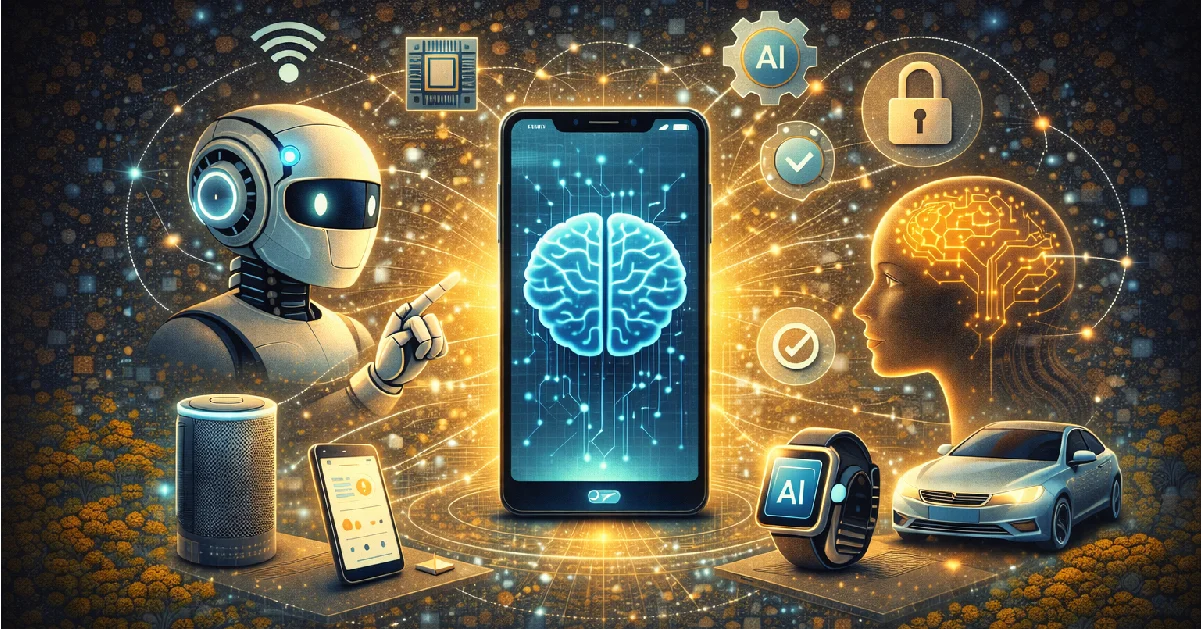
Yet this movement is not limited to mobile app development in Bangalore or any single city. It’s global. Smartphones. Smart cameras. Wearables. Cars. Even medical devices. Intelligence is being pushed closer to where data is created.
Edge AI also forces better engineering discipline. Models must be smaller. Optimized. Efficient. There is no luxury of unlimited computing. This is where real skill shows. Cloud AI is not dying. That assumption is lazy. But it is no longer enough on its own. Let’s understand it in detail in this blog.
What is Edge AI?
Edge AI means running artificial intelligence directly on the device where data is created. Not in a remote cloud. Not after data travels back and forth across servers. The computation happens at the edge. Close to the user. Close to the hardware.
The “edge” can be a smartphone. A smartwatch. A security camera. A car system. Even industrial sensors. Any endpoint that generates data and can process it locally qualifies. Edge AI turns these endpoints from passive collectors into active decision makers.
In traditional AI systems, data is captured on the device, but intelligence lives elsewhere. Data is uploaded. Processed in centralized servers. Results are sent back. This model introduces latency, network dependency, and privacy risks. Edge AI removes much of this friction by keeping inference on-device.
To make this possible, AI models must be optimized. Smaller size. Lower memory footprint. Efficient power usage. This constraint is not a weakness. It forces better engineering. For teams and mobile app developers in Bangalore, Edge AI changes product thinking. Features are no longer cloud-first by default. Apps can respond instantly. Work offline. Protect sensitive user data. This matters for user trust and performance. The impact is not limited to mobile app development in Bangalore or any single tech hub. It’s a global shift.
How do edge computing and on-device AI work?

Data generation at the edge
Edge computing begins where data is created. User taps. Camera frames. Sensor signals. Location updates. All of this originates on the device itself. Instead of pushing raw data to distant servers, the system keeps it local. This is the first technical shift. Less data movement. Less dependency on network quality.
On-device preprocessing
Before AI models even run, data is cleaned and prepared on the device. Images are resized. Noise is filtered. Inputs are normalized. This step reduces the compute load. It also improves prediction quality. Many people ignore this layer. That’s a mistake. For mobile app developers in Bangalore, this is where performance gains are quietly won or lost.
Local model inference
The trained AI model is already stored on the device. When input arrives, inference happens instantly. No API call. No waiting for cloud response. The model processes data using the device CPU, GPU, or dedicated AI chips. This is the core of on-device AI. Decisions are made in milliseconds. Even without the internet.
Edge-level decision execution
Once inference is done, the result is applied immediately. Unlocking a phone. Triggering an alert. Adjusting UI behavior. Blocking a threat. Edge computing handles this execution layer. It ensures actions happen close to the user, not after server approval.
Optional cloud sync and learning
Edge AI does not work in isolation. Selective data, summaries, or updates are sent to the cloud later. Not continuously. The cloud trains models. Improves accuracy. Sends optimized versions back to devices. This loop supports large-scale mobile app development in Bangalore systems without killing speed or privacy.
On-Device AI Explained in Simple Terms

What “On-Device” actually means
On-Device does not mean smaller cloud. It means no cloud at the moment of action. The AI model sits inside the device storage or app bundle. It loads into memory when needed. The device thinks on its own. Earlier, devices were data collectors. Now they are decision makers. That change is architectural, not cosmetic. It affects latency, security, and cost structure.
For mobile app developers in Bangalore, this also means fewer backend calls and more responsibility on the app side. If the model is wrong, the app is wrong. There is no server to hide behind.
How decisions happen on the device
Models are trained elsewhere. Usually in the cloud. That part is heavy and slow. But inference is lightweight.
Before deployment, models are trimmed. Quantized. Sometimes converted to platform-specific formats. This step matters more than people admit.
When data arrives, the model processes it instantly. The output is used immediately. No request. No response, wait. This is why On-Device AI feels fast even on mid-range phones.
Why the internet is no longer critical
Cloud-based AI assumes stable connectivity. Real life does not. On-Device AI keeps working when networks drop. Trains. Basements. Rural areas. Even airplanes.
This reliability improves user trust. Features don’t randomly fail. Apps feel consistent. That consistency is a competitive advantage in mobile app development in markets, both in Bangalore and beyond.
What changes for privacy and data safety
Data staying on the device reduces exposure. Fewer transmissions mean fewer leaks. Biometric data is the best example. Faces and voices should not travel unless required. On-Device AI respects that by design, not policy. However, this also shifts responsibility. Security is now a device-level problem. Weak implementations create new risks.
The role of the cloud is still important
On-Device AI is not isolated. That idea is naive. The cloud trains models, monitors performance, and sends updates. Edge devices execute decisions. This loop keeps systems improving without sacrificing speed in simple terms. The cloud teaches. The device acts. That balance defines modern AI systems.
Conclusion
Edge AI is not a buzzword anymore. It is a response to real problems. Latency. Privacy. Reliability. Cost. Cloud-first systems struggle with all four. On-Device AI addresses them by shifting intelligence closer to users, where data is actually created.
This does not mean the cloud is obsolete. That assumption is lazy and wrong. The future is hybrid by default. Training and scale stay centralized. Execution and decisions move to the edge. For teams and mobile app developers in Bangalore, Edge AI forces better engineering choices. Smaller models. Smarter optimization. Clear trade-offs. There is no room for careless design when computing and battery are limited.
More importantly, Edge AI changes user expectations. Apps are expected to be fast. Always available. Respectful of data. Products that fail here will lose relevance, quietly but quickly. On-Device AI is not about making systems look advanced. It is about making them work in real conditions. Ignoring this shift is not neutral. It is a strategic delay. And in technology, delay usually means decline.